
I. INTRODUCTION AND REVIEW OF PAST STUDIES
The extent and impact of macroeconomic factors on real estate cycles have been established in the literatures, particularly in consideration of the significant role of real estate market to economic growth and the resultant implication to monetary policy making (Alkali et al, 2018). Demir (2009) highlight that certain macroeconomic factors such as increasing real interest rates, lack of credit availability and increasing product market competition as a result of higher rate of returns in the financial markets tend to deter real investments while favouring short term investors. Fifield et al (2002) assert that the effect of macroeconomic factors on asset prices are well developed both theoretically and empirically, especially with fluctuations in macroeconomic variables. Mnyande (2008) highlights the potential positive and negative benefits of macroeconomic variables on the overall economic performance, interest rates which are low relative to inflation can be used to stimulate the economy, while the long-term consequences of high interest rates are quite destructive, and however, it is a requirement for economy to effectively offset any increasing inflation spiral.
McCue and Kling (1994) examined macroeconomic variables and real estate returns from data obtained from equity REIT between 1972 and 1991 and the outcome is that macroeconomic variables such as nominal interest rates explain almost 60% of the variation in real estate prices. Also, Brooks and Tsolacos (1999) uncovered the obtainable influence of interest rate term structure and unexpected inflation on property returns, similar to Brooks and Tsolacos, Ling and Naranjo (1997) estimated the impact of macroeconomic factors on the behaviour of real estate asset returns and investigated whether factors which have persistent influence on asset returns are priced based on forecast rather than on actual result-ex ante. The result from empirical evidence suggest that state variables such as the slope of the term structure, expected and unexpected inflation, industrial production, and the spread between high-grade and low-grade bonds act as a proxy for economic risk factors that are rewarded, ex ante, in the stock market.
According to Wilson and Okunev (1999) the proper understanding of cyclical movement is a significant factor for efficient portfolio management. The presentations of property appraisal that do not clearly take into account cyclical variations may produce unrealistic and impractical valuation estimates resulting in property assets being incorrectly/over-valued, especially at peak period or undervalued at low period. As a result, the decision to add or remove such asset from the general investment portfolio is likely to be influenced. The author used conventional spectral analysis techniques to examine property and financial assets for evidence of cycles and co-cycles. The outcome explicitly reveal that the very pronounced cyclical patterns that appear in direct real estate markets and the economy as a whole are very much less obvious once they have filtered through to securitised property markets and financial assets markets. The extent and impact of cyclical variations on investment returns and risk tend to cut across all forms of asset classes ranging from real estate to infrastructure investments, for instance Pyhrr et al (1999) highlights that investment across the various asset classes need to incorporate cycles and indeed their impact on returns and risks need substantial development to be useful to decision makers. Models should include linkages between macroeconomic factors and investment cash flow variables, and explicitly provide for sensitivities and lead/lag relationships.
A comprehensive report on property and economic cycles prepared by investment property databank and the University of Aberdeen on behalf of the Royal Institution of Chartered Surveyors defines property cycles as recurrent but irregular fluctuations in the rate of all-property total return, which are also apparent in many other indicators of property activity, but with varying leads and lags against the all-property cycle. This is a result of the compounded cyclical influences from the wider economy, which are coupled with cyclical tendencies that are inherent to property markets. Economic cycles are the result of lags- things happening now that are the results of past decisions- and unfulfilled expectations- which mean that at least some of those current actions are inappropriate to current circumstances RICS (1994).
A twofold view of cycles was taken by Rottke and Wernecke (2002), one from the macroeconomic and the other from the microeconomic perspective, the macroeconomic real estate cycles are regarded as part of the business cycle and focus on overall development activity and sector unemployment rates and the linkages between cyclical behavior of real estate and other aggregate markets. Four markets were identified as part of the real estate market from the microeconomic point of view and include: the space market, the investment market, the market for new construction and the land market. A focus is put on elements like rent levels, vacancy and absorption rates and the role of different forms of expectations formation.
Similarly, Pyhrr et al (1999) explicitly differentiate macroeconomic cyclical variations from those of the microeconomic cyclical variations. Macroeconomic cyclical variations are primarily focused on the national, international or regional levels, also the general business cycle, inflation cycles, currency cycles, population and employment cycles, and technology cycles are examples of cycles that are generally classified under the macroeconomic category, including demand cycles, supply (construction) cycles, occupancy cycles, long cycles and short cycles, when viewed from the regional or national levels, are also considered macroeconomic. The microeconomic cyclical movements are basically focused on the urban area market, submarket or property location (Pyhrr et al, 1999).
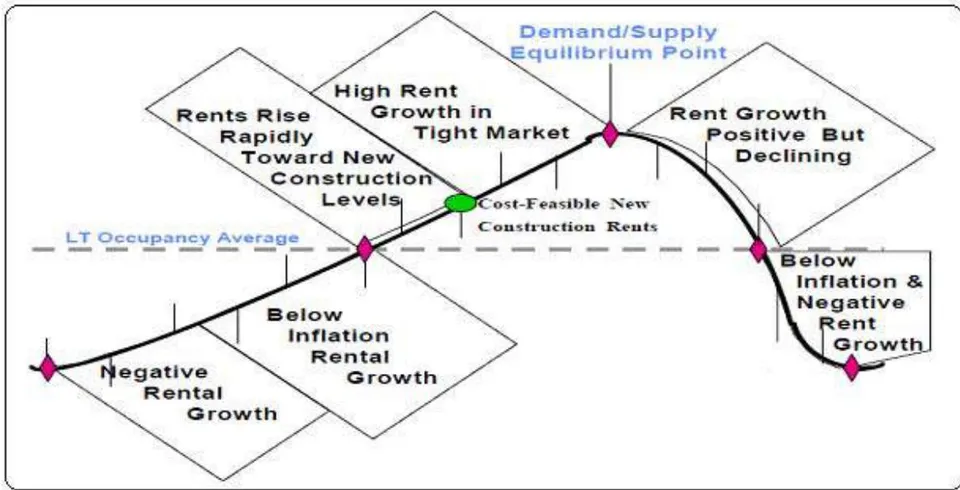
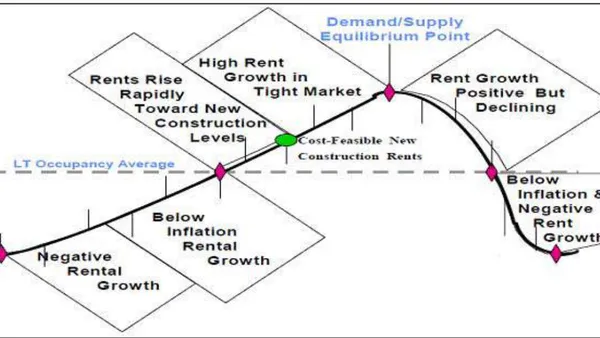
A further classification of real estate cycle was made by Mueller (1995), a physical cycle that described only the demand, supply, and occupancy of physical space in a local market that affects rental growth and a financial cycle that scrutinizes the capital flows into real estate for both existing properties and new construction which affects property prices(Figure 1) Incorporating a more user friendly and wider range of cycle classification, Phyrr et al (2003) categorized cycle movements (Figure 2) into three; (1) The macro focus groups; the financial/capital market and the behavioural/non-financial, (2) A mix of macro and micro groups; property type cycles and the space market cycles and (3) the micro groups; the investment variable cycles group consisting of the project and portfolio decision variables.
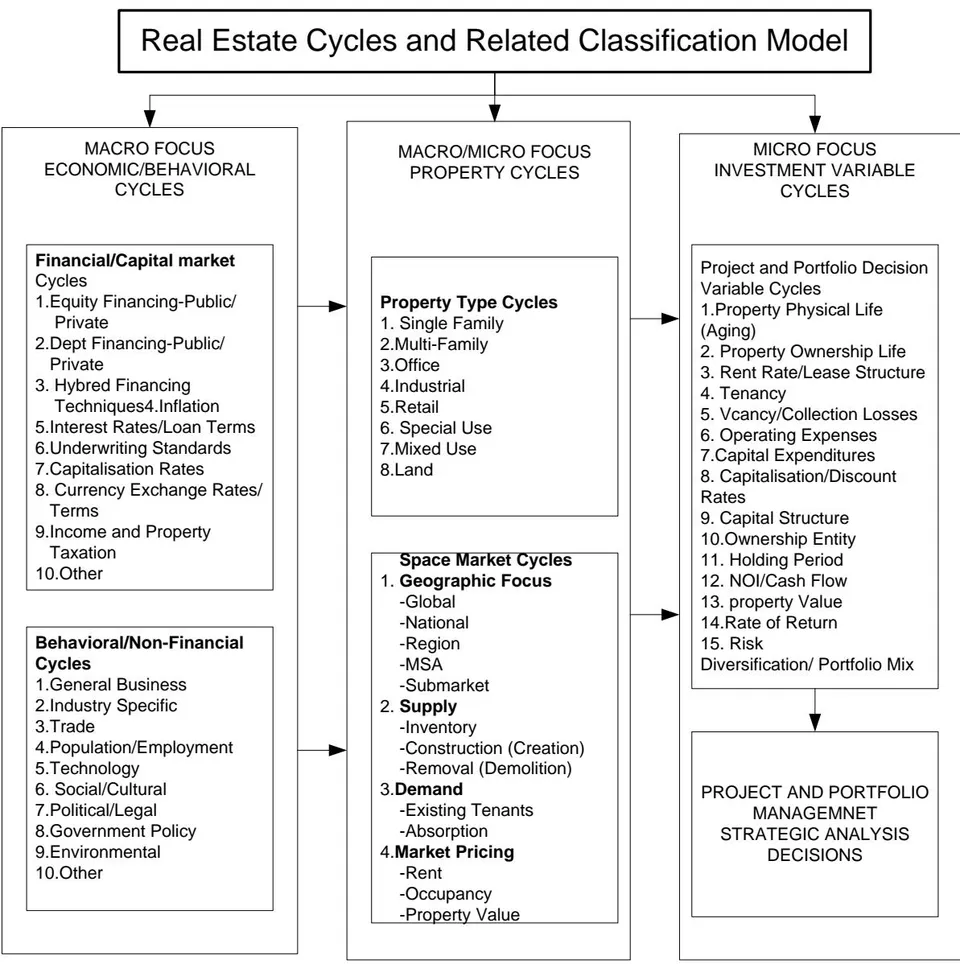
Figure 2: Real Estate Cycles and Related Classification Model
This classification and distribution of the cycle framework into macro, macro/micro and micro cycles helps to explain the extent in which cycle variations tend to cut across the various sectors of the economy particularly the capital market into the macroeconomic cycles. It therefore suggest that policies and regulations that affect issues such as equity financing, debt financing (public and private), inflation and interest rates will tend to influence capital flows and the general investment climate. This view is also encapsulated by Mueller (2006) stating that capital flows are the major factor affecting prices in real estate as well as all other investments.
According to Mueller (2006) commercial real estate cycles has been viewed by various economists as a significant replica of the economy. As one of the three major factors of production (land, labor and capital) demand for commercial real estate is a necessary and important part of economic growth.
Figure 3: Dominant Economic and Property market parameters
| Economic Parameters | Lead Time | Property Market Parameters |
| Employment growth | Building rents | |
| Inflation | Regional/central building vacancies | |
| National and regional economic activity (GDP) | Property income and capital returns | |
| Interest rates | Property values | |
| Share market activity | Construction activity and development approvals | |
| Alternative investment returns | Construction costs | |
| Capital availability | Building space absorption | |
| Foreign investment | Property capitalization rates |
The identification of real estate asset class as a financial vehicle has always been an important issue in the study of the wider economic, therefore understanding real estate cycles and the turning points of business cycles are, in particular, a significant reference for the public and private sectors in their economic and investment decisions (Chun-Chang et al, 2009). In establishing and evaluating the relationship between the real estate market and the economy, Cowley (2007) provide a range of dominant economic factors and their linkages with the property parameters (Figure 3) as an estimate of the lead and lag times existing between the turning points of numerous property market variables and economic indicators. These features are imperative in the development of forecasting models, which by implication affect key investment decisions and issues such as; acquisition, and disposition strategies, and the optimal holding period of each investment; different optimal strategies for leverage, lease structures, capital expenditure plans and operating policies will depend on the cycle projection made; and the nature and scope of market research, the types of data collected and analyzed and the structure of cash flow variations which need to be redesigned to accommodate cycle analysis (Pyhrr et al, 1999).
Tracing the causes of cyclical movements to external and domestic causes, Renaud (1997) proposed an investigative survey of the global real estate cycle of 1985 to 1994 and identifies globalisation of financial markets as a major international factor affecting real estate market. The major financial deregulation and regulatory influence of capital flows that took place during the 1980s was accounted to have made the global real estate cycle possible. From a survey of German real estate practitioners undertaken by Wernecke et al (2004) globalisation was also identified as a factor that causes cyclical variations although the survey reveals that the general business climate/cycles is perceived as the most important influence on the real estate cycle (Figure 4).
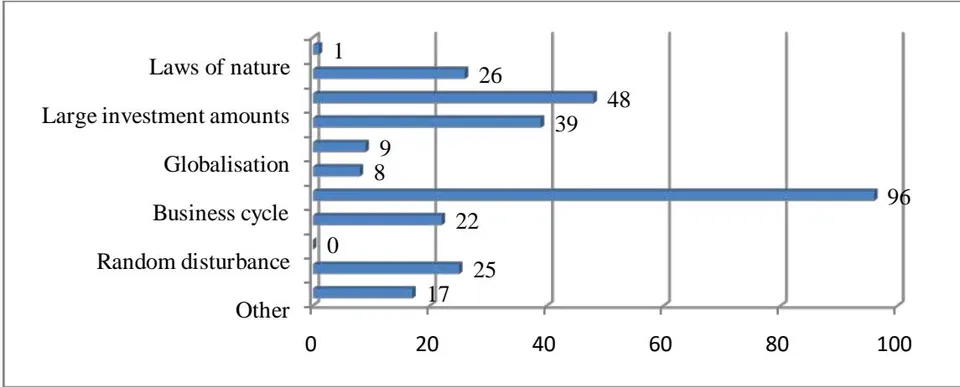
Figure 4: Causes of Real Estate Cycles
Baum (1999) highlights that smoother and a less pronounced cycle is achievable especially when cyclicality is articulated over time and capital flows become more efficient through globalisation and the opening up of capital into the market. Articulating the effect and magnitude of cyclical variations on the economy becomes imperative for real estate investors, institutional investors and policy makers; this will not only influence investment decisions but also significantly develop a formative investment climate.
II. SOURCES OF FINANCE AND THE ASSET CLASSES
According to Adair et al (1994), investment involves the present commitment of a capital sum for benefits to be enjoyed in the future which could be in the form of an income flow or capital gain or a combination of both thereby utilizing capital for maximum possible return, for instance most institutional investors maintain a conservative investment style, trying to combine the highest return with the lowest risk level in the investment portfolio McGreal (1994). Investors have a number of options in terms of financial objectives, expectations and selections with respect to risk tolerance and return, these options between investments are usually referred to as asset classes. The ultimate about asset classes therefore is to provide a model structure to the numerous collections of financial instruments available for investment decision and selection to take place. Asset classes are important to investors, as each different asset class has a different risk profile and effect on portfolio performance (Finweek, 2006).
The pioneering studies on the significance of asset allocation by Brinson et (1986) has attracted so much support and criticism, the study show that asset allocation decision commands 94% as the key determinant of portfolio returns, other factors are market timing 2% and security selection 4%. Jahnke (1997) observe an anomaly with this analysis, stating that the focus was on explaining portfolio volatility rather than portfolio returns, instead, investors should be more concerned with the range of likely outcomes over their investment planning horizon than the volatility of returns. A study by Ibbotson and Kaplan (2000), also support that asset allocation explains about 90% of the variability of returns over time. Ho et al (2006) highlight asset allocation as an important component in balancing asset weights in a portfolio within the constraints of an investor's capital resources and investment time horizon, in order to attain the most favourable risk-return trade-off for the investor. Similarly, the Vanguard Group (2006) also identifies that strategic asset allocation, or policy allocation, is the most important determinant of total return and risk for a broadly diversified portfolio, Adair et al (1994) also assert that the optimal allocation of asset classes forms an integral part of the investment decision-making process.
This is particularly significant in determining investment performance which varies over time for different asset classes.
The above table shows percentage returns for various asset classes performance measured over each calendar year ranging from overseas equity to cash. In 1994, the UK property exhibits a superior quality among the asset classes and rated best performing. However, in 2008 after the onset of the credit crunch which tend to have a global effect on the international investment climate, the performance of the UK property was adversely affected and the worst hit was on the UK equities which was rated best performing in 1995. Investing in several asset classes which tend to have different performance characteristics therefore increases the diversification benefits which protect the investor from losses associated with just one asset class thereby reducing volatility by offsetting the falls of one asset class with the gains of another within the investment portfolio (Scottish Widows, 2009). Efficient diversification becomes a model structure for investors to sufficiently benefit from the quality performance of other asset classes.
Adair et al (1994) highlight the significance of efficient diversification to an investment portfolio; the optimal allocation of asset involves combining investment with less than perfect positive correlation between the returns of the assets involved in order to reduce risk without sacrificing the portfolio's returns. McGreal et al (2006) conjectures that the rationale of diversifying an investment portfolio is to reduce non-systematic risk, this arises from a number of sources including lease terms, operating and financial leverage, tenant mix and location. These factors are influenced by business cycles (local, regional, national and international); socio-economic trends (demographic, employment and income); and the macroeconomic factors such as levels of inflation and interest rates.
From the academic and professional perspectives Adair et al (2007) and the Australia and New Zealand (ANZ) Banking Group (2007) identify various asset classes in relation to their central characteristics as affects class (defensive or growth), return, risk, liquidity, transparency and holding period (Table 1).
| Asset class/type of fund | Return | Risk | Liquidity | Transparency | Holding period | Class |
| Cash | Low | Low | High | High | Short/medium | Defensive |
| Gilts | Low | Low | High | High | Long | Defensive |
| Corporate bonds | Medium | Medium | High | High | Long | Defensive |
| Property | Medium | Medium | Low | Low | Medium/long | Growth |
| Equities | High | High | High | High | Short/medium | Growth |
| Private equity | High | High | Low | Low | Short/long | Growth |
| Hedge funds | High | High | Low | Low | Medium/long | Growth |
Source: Adair et al (2007) and ANZ (2007)
Defensive assets such as cash and fixed interest assets are assets intended to provide a shield for investors who are risk adverse and prefer a safe and more secure investment and a steady returns. While growth assets such as property and shares are more volatile and higher risks assets designed for investors who are willing to maximise the cyclical peaks and troughs of the investment climate (ANZ, 2007).
It is arguably believed that real estate investment is a good diversifier of risk, considering the correlation between direct real estate and alternative asset classes, Lee (2004) examined the risk reducing benefits of adding property to increase diversification and identify in which periods real estate helps to reduce portfolio risk. The results suggest that for 70% of the time direct real estate would have contributed little to the return performance of alternative assets. In others words, returns from direct real estate only offset the losses in the alternative asset about 30% of the time. However, this increase in performance occurs when the alternative asset showed negative returns.
A similar study by Adair, McGreal and Webb (2006) propose that real estate tend to be a good portfolio diversifier for low- and medium-risk portfolios only for non-securitized real estate returns as well as real estate returns from pooled property funds and real estate common stocks (securitized real estate) but have virtually no impact on the allocations for common stocks, government bonds (gilts) or inflation. However, placing this assertion in the context of a different investment climate such as the current credit crunch tends to depict a different investment performance. In the light of this, Liow and Zhu (2007) highlight that the optimal performance of real estate portfolio during a bear market (market characterized by falling prices for securities) regime show a different outcome from those of the bull market (market characterized by rising prices for securities) system, with higher correlations between various real estate security markets' returns in the bear market regime than in the bull market regime. Therefore taking into consideration the effect of market variations due to regime shifts might result in sub-optimal asset allocation and inaccurate portfolio performance measurement.
Closely related to the real estate asset class is the infrastructure investment which is already emerging as a separate asset class. According to Newell et al (2009) the last ten years have witnessed an unprecedented growth and performance of investment in listed infrastructure and the global infrastructure sub-sectors, basically outperforming other asset classes such as global stocks and the real estate (Table 2) revealing the average annual returns for one-, three-, five and ten-year holding periods for global infrastructure and the various global asset classes at the fourth quarter of 2006.
| Asset class | 1Y | Average annual returns (%) | ||
| 3Y | 5Y | 10Y | ||
| Infrastructure | 44.3 | 31.0 | 27.7 | 12.8 |
| Toll roads | 33.8 | 28.7 | 32.0 | NA |
| Airports | 63.0 | 33.9 | 26.0 | NA |
| Communication | 32.3 | 46.9 | 21.7 | NA |
| Ports | 76.4 | 38.0 | 33.2 | NA |
| Diversified | 73.7 | -5.7 | -10.8 | NA |
| USA | 31.6 | 51.1 | 24.2 | NA |
| Europe | 56.0 | 32.2 | 29.4 | 15.0 |
| Asia Pacific | 29.3 | 24.6 | 25.5 | 7.5 |
| Utilities | 35.7 | 26.4 | 17.4 | 11.5 |
| Property companies | 42.8 | 31.3 | 28.5 | 16.5 |
| Stocks | 20.6 | 16.4 | 11.9 | 9.2 |
| Bonds | 6.1 | 2.9 | 8.4 | 5.2 |
As a result of the foregoing, it is not unexpected to see property companies both at the international and domestic levels, including infrastructure in their investment portfolio cutting across a wide range of infrastructure investment subsectors (Table 3). Economic infrastructure consists of services for which the user is prepared to pay; investments may be sourced through government privatization processes, sales of businesses already in private hands, or by constructing and subsequently operating the asset, although subject to varying scales of regulatory supervision and market risk.
| Economic Infrastructures | Social infrastructure |
| Transport- Toll roads, bridges, tunnels- Air ports- Sea ports- Rail networks | Education facilities- Schools- Universities |
| Utilities- Distribution of gas, electricity and other energy sources- Treatment and distribution of water- Renewable energies- Communication infrastructure | Health care facilities- Hospitals- Aged care- Child care |
| Specialty sector- CAR PARKS- Storage facilities –- Forest | Correctional facilities- Courts- Jails and prisons |
Social infrastructure investments typically consist of partnerships between the public and private sectors under which the government continues to provide the core service while the private sector builds, owns, operates and maintains the physical assets and facilities. These arrangements are usually described as public/private partnerships (PPPs) and are generally employed in sectors such as affordable housing, schools, public transport and hospitals. RREEF (2005).
Evidence of the Private Finance Initiative (PFI) introduced in the UK in 1992 is a clear indication of a Public Private Partnership model used to procure projects involving the construction of assets needed to deliver public services cutting across intricate and major public sector infrastructure projects such as in transportation, schools, defense, leisure, culture, housing and public health infrastructure. As of March 2008, over 625 PFI projects had been signed with a total capital value of ^{1}$.
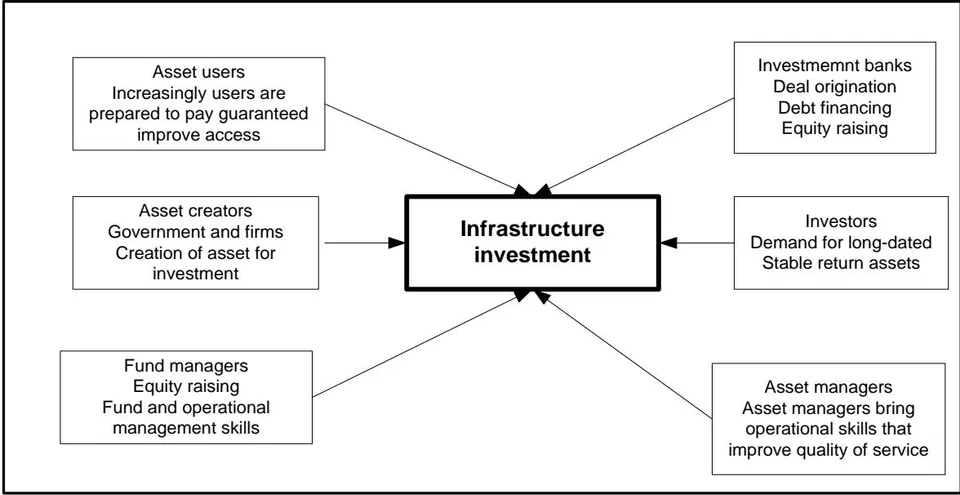
There tend to be a consensus among the key players (Figure 5) in infrastructure financing and provision that infrastructure as an asset class has reached a new phase in its growth and expansion, this relates to the benefits of increasing investment returns derived from the maintenance and upgrading of existing assets and the broad range of opportunities included in the construction of new assets (PEI, 2009) Despite the current global financial crises, institutional investors tend to remain attracted to the infrastructure asset class for its quality as a valuable diversifier capable of delivering meaningful risk-adjusted returns over the long term.
| GDP Growth | Inflation | |
| Rising | EquitiesResourcesReal estateInfrastructure | ResourcesInfrastructure |
| Falling | BondsReal estateInfrastructure | BondsEquitiesReal estate |
Reinforcing the above claim, Lindeiner and Eckermann (2009) highlight that the attraction of infrastructure in an environment of an intense global recession and extended volatility on financial markets lies in the resilient characteristics and the portfolio benefits that it offers across the business cycle. In periods of accelerating inflation (Table 4), infrastructure assets tend to have structures in place such as the road tariff that allow for an annual adjustment to the consumer or retail price index.
III. CONCLUSION
The paper demonstrates the significance of macroeconomic theories to real estate cycles. Appropriate understanding of cyclical movement is a significant factor for efficient portfolio management. The presentations of property appraisal that do not clearly take into account cyclical variations may produce unrealistic and impractical valuation estimates resulting in property assets being incorrectly valued, either overvalued, especially at peak period or undervalued at low period. As a result, the decision to add or remove such asset from the general investment portfolio is likely to be influenced. The resultant implication on real estate investment could be far-reaching particularly on risk and return. The degree and effect of cyclical variations on investment returns and risk tend to influence virtually all forms of asset classes including real estate and infrastructure investments. Hence, investment across the various asset classes need to incorporate cycles and indeed their impact on returns and risks need substantial development to be useful to decision makers. Conclusively, the study of macroeconomic theory and its impact on cyclical variations has been recognized to generally influence the wider economy and particularly the influence of globalisation and business cycles on financial markets and capital flows.