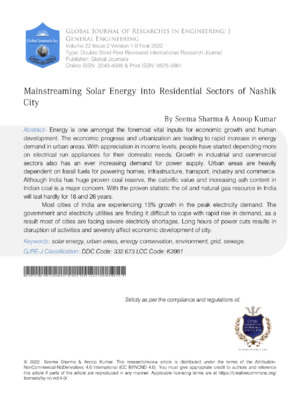
Mainstreaming Solar Energy into Residential Sectors of Nashik City

Article ID

P4Y19

High-quality research on solar energy and renewable power sectors in Nashik city.

Mainstreaming Solar Energy into Residential Sectors of Nashik City

Ar. Seema Sharma
Ar. Seema Sharma
Er. Anoop Kumar
Er. Anoop Kumar
DOI

Abstract

Energy is one amongst the foremost vital inputs for economic growth and human development. The economic progress and urbanization are leading to rapid increase in energy demand in urban areas. With appreciation in income levels, people have started depending more on electrical run appliances for their domestic needs. Growth in industrial and commercial sectors also has an ever increasing demand for power supply. Urban areas are heavily dependent on fossil fuels for powering homes, infrastructure, transport, industry and commerce. Although India has huge proven coal reserve, the calorific value and increasing ash content in Indian coal is a major concern. With the proven statistic the oil and natural gas resource in India will last hardly for 18 and 26 years. Most cities of India are experiencing 15% growth in the peak electricity demand. The government and electricity utilities are finding it difficult to cope with rapid rise in demand, as a result most of cities are facing severe electricity shortages. Long hours of power cuts results in disruption of activities and severely affect economic development of city. With increased dependency on fossil fuels, urban areas have emerged as one of the major sources of Green House Gas (GHG) emissions, with buildings alone contributing to around 40% of total GHG emissions. CO2 emissions are creating serious global warming issues. SOx, NOx and SPM are contributing to local environmental impacts and flattering a challenge for human well being. In this context there is need to develop a framework that will encourage and assist cities in assessing their present energy consumption status, setting clear targets for and preparing action plans for generating energy through renewable energy sources and in conserving energy utilized in conducting urban services. This paper provides a framework to harness solar energy potential to reduce the burden of peak energy demands of urban areas.

Mainstreaming Solar Energy into Residential Sectors of Nashik City

Energy is one amongst the foremost vital inputs for economic growth and human development. The economic progress and urbanization are leading to rapid increase in energy demand in urban areas. With appreciation in income levels, people have started depending more on electrical run appliances for their domestic needs. Growth in industrial and commercial sectors also has an ever increasing demand for power supply. Urban areas are heavily dependent on fossil fuels for powering homes, infrastructure, transport, industry and commerce. Although India has huge proven coal reserve, the calorific value and increasing ash content in Indian coal is a major concern. With the proven statistic the oil and natural gas resource in India will last hardly for 18 and 26 years. Most cities of India are experiencing 15% growth in the peak electricity demand. The government and electricity utilities are finding it difficult to cope with rapid rise in demand, as a result most of cities are facing severe electricity shortages. Long hours of power cuts results in disruption of activities and severely affect economic development of city. With increased dependency on fossil fuels, urban areas have emerged as one of the major sources of Green House Gas (GHG) emissions, with buildings alone contributing to around 40% of total GHG emissions. CO2 emissions are creating serious global warming issues. SOx, NOx and SPM are contributing to local environmental impacts and flattering a challenge for human well being. In this context there is need to develop a framework that will encourage and assist cities in assessing their present energy consumption status, setting clear targets for and preparing action plans for generating energy through renewable energy sources and in conserving energy utilized in conducting urban services. This paper provides a framework to harness solar energy potential to reduce the burden of peak energy demands of urban areas.

Ar. Seema Sharma
Ar. Seema Sharma
Er. Anoop Kumar
Er. Anoop Kumar

No Figures found in article.

Ar. Seema Sharma. 2026. “. Global Journal of Research in Engineering – J: General Engineering GJRE-J Volume 22 (GJRE Volume 22 Issue J2): .

Download Citation

Journal Specifications

Crossref Journal DOI 10.17406/gjre

Print ISSN 0975-5861

e-ISSN 2249-4596

Classification
GJRE-J Classification: DDC Code: 332.673 LCC Code: K3981
Keywords
Article Matrices
Total Views: 1622
Total Downloads: 23
2026 Trends
Research Identity (RIN)
Related Research
Our website is actively being updated, and changes may occur frequently. Please clear your browser cache if needed. For feedback or error reporting, please email [email protected]

Request Access

Please fill out the form below to request access to this research paper. Your request will be reviewed by the editorial or author team.
X

Quote and Order Details

Contact Person

Invoice Address

Notes or Comments

This is the heading

Lorem ipsum dolor sit amet, consectetur adipiscing elit. Ut elit tellus, luctus nec ullamcorper mattis, pulvinar dapibus leo.

High-quality academic research articles on global topics and journals.

Mainstreaming Solar Energy into Residential Sectors of Nashik City

Ar. Seema Sharma
Ar. Seema Sharma
Er. Anoop Kumar
Er. Anoop Kumar

Research Journals