
Jayathilake H.M.T.M.
I. INTRODUCTION
a) Background of the Study
Many studies are associated with the basic question of why firms diversify. The reason for diversification is mainly for firm performance. It also provides theoretical support for empirical studies at the same time. Therefore, this study bases itself can examine on a different and broader conceptual framework and efforts to identify the factors that contribute to the diversification decision and the give values to results (Tonidandel et al, 2012). There are limited studies on the managers' intention for the diversification strategies for firm performance. The research interested in diversification strategies in the healthcare industry of Sri Lanka. But there are many types of research have done with diversification strategies and the firm performance (Rumelt et al., 1996). When study about managers' Tonidandel examine that individual tasked with developing, selecting, or placing them should take all four skill dimensions of technical, administrative, human and citizenship behavior into account. Also special attention should give to administration skills, and this emphasis increases managers higher up in the firm power structure (Tonidandel et al, 2012). As Gentry explains in a firm, managerial skills are important at different levels and across different functions of an organization in today's work environment. How changes in the workplace may have coincided with shifts in the importance of managerial skills over the past 15 years and to identify the managerial skills needed at different levels and functions in today's work context. The results have implications for training and development, selection and succession planning (Gentry, et al 2008). Therefore the managers' intention for diversification is based on their skills for a successful performance.
The research is selected to do in the healthcare industry of Sri Lanka, because of a highly diversifying industry. Mainly with the pharmaceutical and the medical devices firms which are always with innovations of product lines. Health care industry drivers to create a strong demand for private healthcare services in Sri Lanka. Accordingly, the projection of private health expenditure is 11% average annual growth. Therefore, Private Service providers to benefit with strong financial performance within the next few years. But there are industry challenges of imposing minimum price regulation, new tax increases and VAT charge of 15% will back the growth prospects of the healthcare industry in the short run. But the healthcare industry is a defensive industry. The private healthcare sector will see a top side in the long run. The per capita healthcarespending is significantly below the average per capita for other high and middle-income countries (It is above the South Asian), highlighting the growth potential in the mid to long term. The number of private-sector beds has been increasing at a higher rate, because of the increasing demand for private healthcare services. There is a positive sign on an industry that demand will not be affected because of the price increases. Also the levels of health insurance have been positively affecting by making private health services more affordable to the public. Other factors of this industry attention of growth are increasing of the aging population. Also there are increasing of non-communicable diseases, demand for inpatient and outpatient care services and also the laboratory and other support services with technologies. According to the statistics, there is a strong relationship between levels of income and the health outlays of the country. This demand for health rising due to high income and improve their quality of lifestyles. Sri Lanka is expected income is reaching the gross domestic product (GDP) per capita of US $ 4000. Projection of ‘per capita health spending’ to be increased at an average annual growth of 11% in next years. This will provide a strong impetus to the Sri Lankan healthcare industry. Sri Lankan government health industry is with 76,781 beds and the number of beds of the private sector is increasing. Due to increases in affordability of patients and the government failing to meet the growing demand. Therefore the demand for private healthcare is based on the industry growth expectations (Daily mirror, 2017). The pharmaceutical industry offers a very valuable opportunity for Sri Lanka to diversify its manufacturing and export base and thereby reach the goal of the upper-middle-income country by 2020 and a rich country by 2035 (Research and Markets, 2015).
b) Research Problem
This research is important because of the current industry growth of Sri Lanka. Country economy growth and industrial diversification is one direction for the business growths of many industries. This area is worth to investigate because the outcome of the research will benefit the current and future organizations to drive their directions. Firms will gain new penetrations into the high nature of relationships between product diversification and firm performance. Also firms can move to search the roles the home country environment and time can play in this relationship (Osorio, et al 2012). Also diversification can use frequently as a risk management strategy. Therefore, has the added advantage of price risk options (Clark, 2004). In a firm always corporate boards are the important decision-makers in firm strategies such as joint ventures, diversification, and acquisitions (Finkelstein and Hambrick, 1996). Therefore, investigating about diversification is more useful for the firm's future.
This study outcome will be a real direction for a product diversification of a healthcare industry firm in Sri Lanka. Also, this study outcome can be applied to the other industries of Sri Lanka when a firm wants to drive for product diversification. Corporate level of many industries can use this study results when they are going for mergers and acquisitions or choice of this strategy (Kwangmin & Jang, 2012). The effects of managerial skills for the success of product diversification will be presenting as the other outcome of the study by Li and Lo, in 2017. Therefore, for the future of product diversification strategies of a firm can have a clear direction of the manager's skills to succeed and implement it. Those skills are in managerial experience, their educational background, capable financial skills, and productivity. Managers need to pay more attention to the effects of the diversity of managerial resources on diversification strategies (Li & Lo, 2017). Sahin found that many boards of organizations can have an outcome of this study because there are moderating effect on diversification and financial performance by them (Sahin, et al 2015). As per the Musteen investigated, when companies are entering into new investments as a corporate strategy director should have a clear direction for them. This study may direct outside directors to choose strengthen managers, who are affecting diversification in the restructuring of the corporate or strategic investments and selecting of entries (Musteen et al, 2009).
II. LITERATURE REVIEW
Diversifications strategies will give successes in the performance of a firm when there are capable managers in the various divisions of the company. As porter said “competition occurs at the business unit level. Diversified companies do not compete; only their businesses do” (Porter, 1987). This statement is a valid one for every diversification strategies success. As per the Kenny illustrates in 2012 every business managers need to be performed with their capable skills and diversification success will remain there. If not diversification will have to face many difficult tasks and corporate level needs to take responsibility for it. Therefore the managers should be capable enough to implement diversification strategies to avoid all problems (Kenny, 2012). Chang and Wang found that there is a positive influence on related product diversification for firm performance. But unrelated product diversification negatively moderates firm performance. Therefore it is important in making out different mixed product diversification strategies on firm performance (Chang & Wang, 2007).
a) Managerial Skills
The skillful managers are the main powerful employees who have to bring successful diversification to the company. As Kenny explains, selecting these managers as good managers to the firm diversification should have a good system to select. If not, they will identify as bad managers. So measuring these good manager's performance is a key decision of the company and it should have a proper system. Then the perform managers will work more actively and will drive for the performance by developing as well as diversifies (Kenny, 2012). When examining managers' skills, it is more important to identify seven major factors of management tasks. These are can identify as managing individual performance, instructing to their subordinates, planning and allocating the resources, coordinating of mutually beneficial groups, managing of their group performance, continually monitor the business environment and represent in one's staff. Also, this is important to examine the findings has given clear -cut differences in the importance of the role of the level of the manager (Kraut et al. 1989). Finally as per Madhoun and Analoui, this research is more important to carry out because a cluster of managerial skills needs to be analyzed as a system of interrelated skills (Madhoun, and Analoui, 2002).
b) Managers intention on diversification strategies for firm performance
Managerial experience investigates the role of in small and medium enterprise growth using the Managerial Capacity Index (MCI). As Asah and Fatoki explain the MCI is a good measure of managerial experience and their activity. Asah and Fatoki found that a high score in the MCI has a positive relationship to both strategic planning and firm performance and growth (Asah & Fatoki, et al 2015). Martin and Staines (2008) investigated that lacking managerial experience, managerial skills and personal qualities of them are the main effects to failed new firms. Also, other reasons to fail new firms are such as contrary economic situations, weekly implement business plans and resource starving. The differentiating feature of high and low-growth small firms are the levels of education of senior managers and training and experience of senior managers. Other empirical studies such as Shariff and Peou (2008) and Parida et al, (2010), investigated that managerial competencies can measure by managerial education, managerial experience, managerial experience and knowledge of the industry. This factors positively impact the performance of small firms and medium firms. The lacking of managerial education and training has reduced management capacity in firms. This is one of the reasons for the low level of entrepreneurial creation and the high failure rate of new ventures (Herrington & Wood, 2006). However, finds that the managerial skills of entrepreneurs are not the unique determinants of performance. Bosma and the team did not find a significant relationship between the managerial skills of managers and firm performance (Bosma et al. (2004). Some studies did not find a significant relationship between the managerial skills of managers and firm performance (DuBrin, 2012). But many kinds of literature have found an insignificant relationship between managerial skills and firm performance. The argument of this study is that firms with owners-managers that are educated and have industry or managerial experience should outperform firms (Appuhami, 2007) & (Chan, 2009). Some studies have found that top management teams have a negative impact on international diversification. But managers' experience maintains a positive impact on international diversification. Also the educational background of managers' diversification and international experience will have reduced the negative effects of firms' performance in international diversification (Li & Lo, 2017). Also the manager's educational background knowledge and their experience drives to reduce the negative effect of diversification (Li and Lo, 2017).
c) Managerial experience, Productivity, Knowledge and the Educational background for diversification strategies
There are both positive and negative impacts on Diversification strategies with top management and their experience capacity. This management negative impact can minimize by the educational background and experience of them for diversification strategies (Li & Lo, 2017). Kor explains that when there is experience in mix ways managers are well-argued and applying effective growth strategies. Also, this mixed managerial experience will work to grow the firm through diversification strategies. This is the best time to practice with top management teams who are with well-mixed experience and capable skills to drive diversification strategies in this environment (Kor, 2003).
Finkelstein & Hambrick examined that the top management teams with well-diversified education knowledge are a heterogeneous resource to the organization. This educational background of the top management team will execute good thinking and innovative ideas to implement diversification strategies. This managerial knowledge will contribute to well-diversified experience and skills to think innovatively. Also top managementis linked toa high range of networks, strategically thinking and wide range of skills with their diversity background (Finkelstein & Hambrick, 1996).In many studies explain that diversity of educational experience for the top management teams are well contributing positively to implement diversification strategies. These skills have taken firms to position in many markets and also to capture the new markets geographically. This has driven with top-level managerial new ideas and innovative strategies contribution (Carpenter & Fredrickson, 2001). Also, the top management educational background will contribute to professional and very value-creating a situation in the access of diversification (Hambrick and Mason, 1984). More ever managerial thinking pattern and the managerial knowledge can improve by giving training in education (Wiersema & Bantel, 1992).Always managers should be an open mind when going for diversification strategies to alert the issues. The managerial level and the corporate level should be in a good alert to prevent from different facts that can unsuccessful the diversification. Therefore always they need to come up with new ideas and good opportunities to grow the business by diversification. (Kenny, 2012).
When a firm diversified with corporate diversification, decisions of financing and management
in earnings should be considerable. The firm's expenditure will arise high for research and development costs. Therefore, Keating and Zimmerman explain that the division cost is going to be high due to the information that is found in research and development. The managers need to decide their own of this expenditure in diversification and controlled the earnings. Diversified firms are used to change their policies in depreciation. That is because it can affect the financial policies of the firm and the taxes on assets (Keating & Zimmerman, 2000). Managers are empowered to control the expenses to manage the earnings of the diversified firm. These are the main expenses of research and development, sales and administration costs, expenditure on advertising. Roychowdhury explained that this managerial actions will drive to good cash flow of the firm in the future and control the earning management (Roychowdhury, 2006). Therefore, corporate-level managers are offered with high incentives to control the research and development costs. This action implement by the firm investors who drive toward to achieve short-term goals in earning (Bushee, 1998). Diversification strategies are given motivation to managers in changing the accounts numbers of the firm and also to continue with favorable systems in earning processes. The reasons for these conditions is when a firm implement diversification strategies it is less in transpiring. Therefore, it is not possible to detect earnings as a focused firm. As Mehdi & Seboui found, the management in earning in a diversified firm is positively related to the debt ratio (Mehdi & Seboui, 2011). But there can be an effect on the firm's long-term growth when managers work to reduce the expenses. Initially it may result in higher earnings but in the long run it is not good for the firm. Main costs of research and development and the advertising are based on implementing projects of the diversification strategy. These cost reductions can develop high earnings for the firm (Oswald & Zarowin, 2004). When implementing a level of diversification strategies in a firm with over involvements and practicing to increase costs, it can affect the firm. These effects can drive for benefiting the firm by adding firm value or dropping up the firm value (Palich et al., 2000). When firms diversifying, budgets are more important and itseffects to slow down the activities. Corporate diversification is an important factor and strategy of the business unit is another factor. The administration systems that diversify firms go through can affect the budgets such as controlling budgets and also the current incentive systems. Budgets that are allocated to business units have a positive effect on corporate diversification. Effective control of budgets and the powerful incentive systems will pick up the business (Van der Stede, 2000). As Pitts and Hopkins explain when the firms diversify budgets slack is a big issue and firms stimulate in distinct business. This is a time that firms are active in clear-cut businesses (Pitts and Hopkins, 1982). Corporate managers in the diversified firm are not close to different activities that are run by the business units (Campbell et al., 1995). Most of the time corporate managers are attending with the controlled budgets, financial result measures and administrative operations. But they are not much involved actively in business operations (Ghoshal & Moran, 1996).
Firms can gain high market power by implementing the strategy of diversification. It also creates luxury benefits with the surplus of productivity factors. Also, diversification strategies can create an efficient internal capital market by allocating resources efficiently (Chakrabarti et al., 2007). Diversification is depending on the productivity of the organization to be successful as a business strategy itself. Giroud & Mueller have investigated these productivities of the firm to success diversification are the efficiency of the management structures and also recourses of the firm. Therefore, firms functioning in productivity has defined as a moderator variable in the diversification and the organization's performance. This moderating variable of firm productivity has impacts on the performance and diversification strategies of the firm. There are factors that the firm should able to utilize their resources productively to give benefits to the firm. So this business strategy of diversification will give return benefits to the firm by productivity (Giroud & Mueller, 2015). A process that can add value to the core activities of a firm business is by producing the products from the given inputs or resources (Tangen, 2002). There should be a viable environment when a firm wants to innovate to grow their business. When the firm financial systems are not in the maturity stage productivity is lesser (Gatti and Love, 2008). But still managers follow up on greater diversification strategies for the gain in power and prestige of their firms (Jensen, 1986). Firm trust to implement greater diversification strategies in a large size because the firm's size is linking positively to manager's compensation. Therefore, managerial behavior on diversification level is effecting for the delivery of firm performance (Jensen & Murphy, 1990). As Kenny illustrates diversification is a good focus for a company and sometimes it can be bad due to the diversifying business. But still firms fail even their focus is so good. There are many boards of the companies and the managers are still fearful of diversification because of how to make it a success. Companies' best opportunities are that they can go to a potential business which will benefit them and overcome the barriers. Writing the failure of diversification is very easy. One reason for the bad reputation of diversification is this sloppy analysis of diversifying businesses (Kenny, 2012). Managers need to clarify the objectives that they are going to implement with the firm recourses. Managers should careful when they use firm recourses processing with business structure and the product diversification. (Lee, 2017).
d) Firm Performance with diversification strategies
There are potential effects of diversification strategies related to the performance of the organization. Widely diversification strategies deliver better results. Osorio found that successful firms have achieved their value with product diversification and depending on country environment and time period. So in the institutional base widely diversification strategies effects with the above two factors of the time period and the environment of the operating country. (Osorio at el, 2012). Diversification strategies result in both positive and negative impacts on firm performance. Also diversification benefits for firms' to cross-sell their products, for cost savings, enter into new markets and market hybrid products to increase brand image (Jayathilake, 2018). There are many studies on the relationship between diversification and company performance. But they are not shown a clear relationship between these two factors of the performance and diversification (Palich et al., 2000). But many studies have gone through to find out which are the factors that affect the relationships between performance and the diversification strategies. As Chakrabarti and team say there is no clear relationship between these two factors. But there should be some dependable reasons for it (Chakrabarti et al., 2007). Ajay & Madhumathi investigated that firms with product diversifications and international diversification are not powered to act as a strong player, as the firms with focused strategy in the capital structure. But the firms implementing product and market diversification are having a positive earning on the asset base (Ajay & Madhumathi, 2015). Diversification strategies directing firms to reach strategic assets, new technology, natural resources and skills (Lewellen, 1971). In this growth with diversification strategies firms are ready with markets and products to compete for worldwide standards (Teece, 1982). As Williamson examines there will be fewer chances of bankruptcy because diversification is improving the debt capacity. So diversification will improve the firm's profitability and the assets by reaching to new markets and new products (Williamson, 1988). Firms' diversification is a strategy that connected with its performance and also effects the earning management in the firm practices. So the managers are facing challenges with financial support for their decisions. Those are to maximize the values and minimize the cost of the firm (Mehdi and Seboui, 2011). Diversification strategies are creating conditions for earnings. It can be in favorable or unfavorable conditions. Chung and the team found that to perform firm earnings with the corporate strategies, need to create with the performance of the operational level (Chung et al., 2005). Also, diversification strategies direct into related or unrelated diversifications. There are many modes of diversification strategies. Those are by firm internal expansion, mergers, and acquisitions or choice of this strategy (Kwangmin & Jang, 2012). Diversification strategies and performance links do not exist in many economies. It runs in well-developed economies and emerging economies (Berger & Ofek, 1995). Divarication strategies carried forward in rising economies to make values to firms. (Guillen, 2000). Firms with implementing higher diversification strategies result for high performance in emerging economies (Chang & Hong, 2002). Sometimes in the emerging economies diversification strategies will perform negative result within the firms (Tevfik, 2008). But in other ways diversification strategies deliver value to firms in the emerging economies (Olu, 2009). Firms' performance exists when there is a relationship to keep positive. Yaghoubi explains that diversification delivers mix results with the condition of the economy, and types of a diversification strategy. That is related and unrelated diversification and also when the time periods are different diversification strategies drive for a mixed performance (Yaghoubi et al, 2011).
Diversification strategies drive for high firm performance in developed economic settings. Khanna and Palepu explain that this is as a result of high costs adopting the financial markets and weak entries from the financial markets. Also resulting inefficient capital markets increases the firm performance in developing economies (Khanna & Palepu, 1997). Donaldson findings present that greater diversification strategies activate in complication in managing, structural and organizational factors of firms (Donaldson, 2000). Firms are creating segments with new business and also different product categories to bring under control and put to use as diversification strategies. Tevfik found that expansion of a firm with their control is a basic description for the diversification (Tevfik, 2008). When firms over diversified there are many ways of failing the ongoing businesses. As Kenny investigated there are points that a successful company who implement diversification strategies should not have and also points that a focused company for diversification should not have. Those are keeping in effective managers at many levels, regulatory and cultural differences when expanding to other countries. Also the acquisitions are happening with many requirements to integrate. Some make big payments to acquisition even when the expenses are high. Also there are more points companies should not do when implementing diversification strategies. If failing to understand all the liabilities and the where the market is correctly focused on, this is not the time to diversify. In this case diversifying firm should practice the good discipline of the total management and also total staff increase to the current operations. As per the Kenny investigated,
when a firm implements diversification strategies the highest performance will give with the moderate unrelated diversification. Rather than going for a high related diversification or high unrelated diversification moderate diversification will give good performance to the firm. Always firm's businesses focused to achieve corporate performance and when there is a moderately diversified business, it gives the best performance (Kenny, 2012). When considering insurance firms, there is a negative relationship between product diversification strategies. Lee examined that these results are logical according to the theory of diversification discount. Diversification strategies resulted there is an impact of the firm's business lines on the performance of the firm. The size of the firm and the product diversification involves that there are increasing results of product diversification in large size firms. There are high-value points that the diversification effects and business structure for the firm performances in countries that are under developing (Lee, 2017). In many countries a product diversification strategy is used to increase the financial performance of firms. As Elango describes they highly implement this strategy and leads to expanding the market shares while the liberalization of financial markets globally (Elango et al., 2008).
III. CONCEPTUALIZATION AND HYPOTHESIS
The researcher has proposed a complete model for measuring influencing factors for diversification strategies by the managers' intention for diversification strategies. The researcher has found and collected related research to create this framework. This was based on past research, hypotheses to support the concept.
Mediating Variable
Dependent Variable
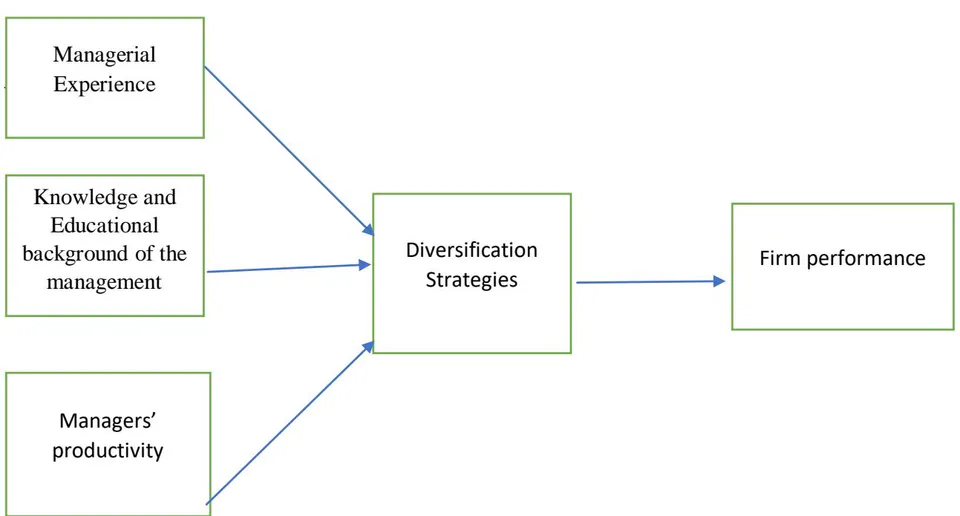
The hypotheses formulated with the combination of the research question. Also, previous research findings and research limitations supported in formulating the hypotheses. Diversification of firms is reaching too high performance with their high attention to the activities. Firms will get increased performance by reinvesting in related business by engaging new business (Chiao et al, 2008). Therefore in the healthcare industry of Sri Lanka, there can be a relationship between diversification and the firm performance.
H1: There is no relationship between diversification and the firm performance of the healthcare industry in Sri Lanka.
Prior experience of managers will drive to innovation with financial expectations. Also this fast experience will act against negative effects on the business. Managers' experience will give the ability to increase innovation actions and improve new businesses to compete for the market (BarNir, 2014). So there can be a relationship between managerial experience and the diversification strategies of the healthcare industry.
H2: “There is no relationship between managerial experience and the diversification in firms of the healthcare industry in Sri Lanka.
Managers' knowledge and the educational background drives through to a diversification strategy. When managers knowledge of their environment, firms directions will change to the correct path. This knowledge will change the context in growing the businesses and readjust the job roles and responsibilities (Woldesenbet, et al 2007)
H3: There is no relationship between the educational background of the management and the diversification in firms of the healthcare industry in Sri Lanka.
A productive manager always will be a performing worker with happiness and wellbeing. When a manager is a productive worker their performance and job satisfaction drive high. So the productivity of a manager brings success to a firm in growing the business and increase the performance (Hosie & Sevastos, 2009).
H4: There is no relationship between managerial productivity and the diversification in firms of the healthcare industry in Sri Lanka.
The research has considered above four hypotheses to investigate the research problem by analyzing data with SPSS. The hypothesis is built on considering correlation with the dependent, independent and other variables of the research. The researcher has investigated the skills of managers who are having more intention on diversification strategies for firm performance.
IV. METHODOLOGY
In the study healthcare managers of both pharmaceutical and surgical used as the population. These managers are the people who have the intention to grow their current business through diversification strategies. The researcher has considered the most potential managers of the healthcare industry who drives leading businesses in the Sri Lankan market. For the data collection self-administrated questionnaires were used (Wanninayake and Chovancova, 2012). As the samples 31 numbers of Pharmaceutical managers were used to distribute the data. This category was done with 2 junior managers, 21 middle managers, and 8 senior managers. IBM SPSS was used to analyze the data. Data were analyzed with descriptive statistics. Also, reliability test is done through SPSS for variables and described the Cronbach's Alpha value. Relationships of variables analyzed with parsons correlation to find out the relationships among dependent and independent variables.
The study has followed the deductive approach which works from more general to the more specific. Also, the deductive approach informally called a "top-down" approach (Worster, 2013). The study has used questioner to collect the data and manually delivered to each respondent to answer. Therefore this study is a quantitative one. The sampling method used in the study was the snowball sampling method. This method works like a chain of business referrals for the study. In the initial stage of the snowball sampling method smallest of the groups are studied. In the next stage looking for their help study another group with a similar type of qualities. This is a kind of Non-probability sampling and also the size of the sample can increase by forwarding with research process (Karunanayake & Wanninayake, 2015). When using Non-probability sampling clear rationale is needed for the inclusion of some cases or individuals rather than others(Yin, 2003).
V. FINDINGS AND DISCUSSIONS
The IBM SPSS was used to analyze the data of the study. The outcome of the data analysis is given in the below tables. Fist the reliability test was done to measure internal consistencies of the total scores for each scale. That is by measuring the Cronbach's Alpha Coefficients. The calculation of reliability measurements is presented below with the Cronbach's Alpha value. The findings of reliabilities for two scales were found to be adequate since Cronbach's Alpha values are higher than 0.7 (George & Mallery, 2003). That is in the measurements of managerial experience and managers' productivity. But managers' knowledge measurement was below 0.7 which was found in the reliability test. In this Cronbach's Alpha value was.659 which is near to 0.7.
| Reliability Statistics- Managers experience | ||
| Cronbach's Alpha | Cronbach's Alpha Based on Standardized Items | No. of Items |
| .800 | .774 | 4 |
| Reliability Statistics- Managers knowledge | ||
| Cronbach's Alpha | Cronbach's Alpha Based on Standardized Items | No. of Items |
| .651 | .656 | 4 |
| Reliability Statistics- Managers productivity | ||
| Cronbach's Alpha | Cronbach's Alpha Based on Standardized Items | No. of Items |
| .761 | .758 | 4 |
The below item statistics table -2 gives the means and the standard deviations for each question items. These scores should be in a similar range to match the same concept. The questionnaire can make more reliable by removing the very high or very low scores items from it. In the below table the few items are not in the similar range. But overall below results of means and standard deviations are in a similar range. For more reliability few items of which gives a different range of results can remove from the questionnaire.
| Item Statistics – Managers Experience | |||
| Mean | Std. Deviation | N | |
| Your total experience | 3.19 | .402 | 31 |
| Managerial experience | 3.19 | .402 | 31 |
| You experience in the relevant industry | 3.10 | .301 | 31 |
| Your experience in the current job role | 3.06 | .250 | 31 |
| Item Statistics – Managers Knowledge | |||
| Mean | Std. Deviation | N | |
| Your Education background level | 4.10 | .539 | 31 |
| Current knowledge of the Industry | 4.55 | .568 | 31 |
| Your Current marketing knowledge | 4.42 | .620 | 31 |
| Current knowledge of the job role | 4.61 | .558 | 31 |
| Item Statistics – Managers Productivity | |||
| Mean | Std. Deviation | N | |
| Your overall productivity | 4.29 | .783 | 31 |
| Your finance management | 4.29 | .693 | 31 |
| Your resource management | 4.16 | .583 | 31 |
| Your people management | 4.13 | .499 | 31 |
Below Table - 3 presents a correlation matrix of managers experience, knowledge and productivity. This displays how each item correlates to all other items. The analysis given every two questions is being compared. From top left to bottom right, there is a list of 1.000 across the diagonal, which represents instances that the items are correlated with itself. Here the scores are identical because of the correlation is perfect . If items in the questionnaire are measured the same concept, items should correlate well together. To keep the reliability any items can remove from the questionnaire, which has consistently low correlations across the board. But in the below table 3, there are only a few results that give low scores. Also by removing those few items questionnaire can make more reliable.
| Inter-Item Correlation Matrix - Experience | ||||
| Your total experience | Managerial experience | You experience in the relevant industry | Your experience in the current job role | |
| Your total experience | 1.000 | 1.000 | .392 | .536 |
| Managerial experience | 1.000 | 1.000 | .392 | .536 |
| You experience in the relevant industry | .392 | .392 | 1.000 | -.086 |
| Your experience in the current job role | .536 | .536 | -.086 | 1.000 |
| Inter-Item Correlation Matrix - Knowledge | ||||
| Your Education background level | Current knowledge of the Industry | Your Current marketing knowledge | Current knowledge of the job role | |
| Your Education background level | 1.000 | .256 | .273 | .572 |
| Current knowledge of the Industry | .256 | 1.000 | .366 | .271 |
| Your Current marketing knowledge | .273 | .366 | 1.000 | .196 |
| Current knowledge of the job role | .572 | .271 | .196 | 1.000 |
Inter-Item Correlation Matrix - Productivity
| Your overall productivity | Your finance management | Your resource management | Your people management | |
| Your overall productivity | 1.000 | .639 | .478 | .327 |
| Your finance management | .639 | 1.000 | .458 | .466 |
| Your resource management | .478 | .458 | 1.000 | .270 |
| Your people management | .327 | .466 | .270 | 1.000 |
Correlations figure out the strength of the linear relationship between two variables. Correlation coefficients range from -1.0 to positive 1.0 which counts a perfectly negative correlation and a perfect positive correlation. The correlation coefficients within -1.0 to 1.0 will figure out the weaker to stronger correlation. When the correlation coefficient gets closer to zero, the result shows a week correlation is between the two variables (Ratner, 2009). Below table - 4 gives the Correlation coefficients of managers intention for diversification and three independent variables. The Correlation coefficient of managers' intention for diversification and managers experience is 0.380 which indicates a moderate positive relationship between two variables. Also with managers' knowledge, it is -.173 which indicates a week negative relationship between two variables. The Correlation coefficient of managers' intention for diversification and managers productivity is 0.371 indicates a moderate positive relationship.
| Correlations | |||||
| What is your intention to grow the business diversification strategies | EXPERIENCE | KNOWLEDGE | PRODUCT | ||
| What is your intention to grow the business | Pearson Correlation | 1 | .380* | -.173 | .371* |
| Sig. (2-tailed) | .035 | .352 | .040 | ||
| N | 31 | 31 | 31 | 31 | |
| EXPERIENCE | Pearson Correlation | .380* | 1 | -.258 | .173 |
| Sig. (2-tailed) | .035 | .161 | .352 | ||
| N | 31 | 31 | 31 | 31 | |
| KNOWLEDGE | Pearson Correlation | -.173 | -.258 | 1 | .092 |
| Sig. (2-tailed) | .352 | .161 | .624 | ||
| N | 31 | 31 | 31 | 31 | |
| PRODUCT | Pearson Correlation | .371* | .173 | .092 | 1 |
| Sig. (2-tailed) | .040 | .352 | .624 | ||
| N | 31 | 31 | 31 | 31 | |
| *. Correlation is significant at the 0.05 level (2-tailed). | |||||
As per the below null hypothesis, H2 - There is no relationship between managerial experience and the diversification in firms of the healthcare industry in Sri Lanka. In the hypothesis test, P-value is 0.035. Therefore P < 0.05, statistically significant and reject the null hypothesis. There is a relationship between managerial experience and the managers' intention on diversification strategies.
In the next hypothesis H3 -There is no relationship between the educational background of the management and the diversification in firms of the healthcare industry in Sri Lanka. In this hypothesis test, P-value is 0.352 which is greater than 0.05.0. Result is statistically not significant. Here accept the null hypothesis and explains that there is no relationship between knowledge and educational background of the management and their intention for diversification.
Next hypothesis is H4 -There is no relationship between managerial productivity and the diversification in firms of the healthcare industry in Sri Lanka. In the hypothesis test, P-value is 0.040. Therefore P < 0.05, statistically significant and reject the null hypothesis. There is a relationship between managerial productivity and the managers' intention of diversification strategies.
| Correlations | |||
| What is your intention to grow the business diversification strategies | What is your contribution to increase firm performance | ||
| What is your intention to grow the business by diversification strategies | Pearson Correlation | 1 | -.370 |
| Sig. (2-tailed) | .041 | ||
| N | 31 | 31 | |
| What is your contribution to increase firm performance | Pearson Correlation | -.370* | 1 |
| Sig. (2-tailed) | .041 | ||
| N | 31 | 31 | |
| *. Correlation is significant at the 0.05 level (2-tailed). | |||
As the first null hypothesis H1 – There is no relationship between diversification and the firm performance of the healthcare industry in Sri Lanka. But according to Table 5, the P-value is 0.041 which is P > 0.041. Therefore 0.041 is less than 0.05. It is significant. Can reject the null hypothesis. Therefore alternative hypothesis is there is a relationship between diversification and the firm performance of the
Below given the manager's categories who are taken as the sample population.
healthcare industry in Sri Lanka. This study proves that there is a relationship between diversification and the firm performance of the healthcare industry in Sri Lanka. The correlation coefficient of managers' intention in diversification and the firm performanceis-0.370, which indicates a strong negative relationship between two variables.
| Your current position category | |||||
| Frequency | Percent | Valid Percent | Cumulative Percent | ||
| Valid | Junior | 2 | 6.1 | 6.5 | 6.5 |
| Middle | 21 | 63.6 | 67.7 | 74.2 | |
| Senior | 8 | 24.2 | 25.8 | 100.0 | |
| Total | 31 | 93.9 | 100.0 | ||
| Missing | System | 2 | 6.1 | ||
| Total | 33 | 100.0 | |||
As per the above table three type of category managers are taken as the samples for the research. The sample has represented more middle category managers which can find more good results. Senior and junior managers are less number as the research data analyzed.
VI. CONCLUSION AND RECOMMENDATION
This study has investigated which skillful managers are having an intention for diversification strategies to drive for firm performance. The study evaluated the experience of managers and their educational background, knowledge and the productivity of them. According to the findings experience of managers and the productivity of them drives for the intention of diversification strategies. According to the data there is a relationship between managers intention for diversification, with the managers who have more experience and high productivity. But there is no relationship between the managers' intention for diversification, with their knowledge and the educational background. Also Study found out that, there is a relationship between the managers' intention for diversification and firm performance. When the managers are having high experience and the productivity they are intention is more for diversification strategies to grow their business. This strategy has gained the organizations to achieve their performance by-products or turnover. In the Sri Lankan healthcare industry managers intention for diversification strategies will direct them to firm performance. Firms can select managers with high experience and productivity to implement diversification strategies to grow their businesses. Educational background or the knowledge of managers will not the main factor to implement diversification strategies. The productivity of managers and using the experience as a manager will direct to success in implementing diversification for firm performance for this healthcare industry. Also, the same concept can use in other industries as well as increase the firm performance of the organization.
This study outcome is more important to the firms who drives to the diversification strategies in the future. The Sri Lankan healthcare industry both in government and private will be more benefited of this study outcomes to grow their business. Especially pharmaceutical and the medical devices firms will take more attention to use this study results in diversification strategies. According to the findings managerial experience and the managerial productivity direct impact on the diversification strategies for firm performance. This study is important for the managers who are planning to implement diversification strategies in the future to use the correct managers with more experience and high productivity. For the future investigations can examine the specific factors of managers' intention for diversification strategies and the firm performance.