Piezoresistive pressure sensors are manufactured frequently by the researcher around the world currently. The most of the sensors are passive in nature. The yarns may be intrinsically conductive, i.e. stainless steel yarn or it may be made conductive by coating, i.e. graphene oxide coated polyester yarn. The stainless steel yarn is embroidered in the fabric. When installed inside a garment, the sensors can track both muscle activity and vital signs in people. The polyester fabric that dip-coated with graphene oxide (GO) has a wide detection range and good sensitivity, making it suitable for use as a pressure sensor in plantar measurement and gait-analysis applications.
## I. INTRODUCTION
A textile fiber is a long, incredibly thin piece of material.
- Synthetic fibers typically have a very low conductivity of less than $10^{-07} \mathrm{~S} / \mathrm{cm}$, while the conductivity of conductive fibers ranges from $10^{-6}$ to $10^{6} \mathrm{~S} / \mathrm{cm}$.
- The fiber must also meet standards for use in textile applications and for the various stages of textile manufacturing.
- The conductive fiber must be washable if the final product must be washable.
- The conductive fiber must not affect the environment, which is another crucial factor.
- Conductive fibers have a variety of known applications, including antistatic, ESD shielding, heating, and power transfer. Other application areas for conductive fibers might be as sensors or to propagate signals.
- The test was performed in the ESD lab where the relative humidity was $(12 \pm 3) \%$ and the temperature was $(23 \pm 2)^{\circ} \mathrm{C}$. (4)
Textronics is not just "textiles plus electronics" but textile itself as a sensor that can sense and react to the world around them; this qualifies it to be called "textile-based."
### a) Objectives
- To produce conductive yarns and fabrics with conductive coating.
- To check the properties of the conductive yarns and fabrics.
- To produce the piezoresistive pressure sensors from the conductive fabric.
### b) Research Questions
- Is it possible to use cotton yarn as core material instead of polyester?
- Is it possible to wash the conductive fabric?
- Is it possible to get consistent piezoresistive effect with the graphene oxide coated fabric?
- Is it possible to achieve sufficient elasticity of conductive yarns to produce fabric in loom?
- How do we protect the conductive materials of conductive textiles during production of fabric in knitting machine and loom (yarns friction with parts)?
- How do we measure the pulse rate and elbow movement with pressure sensors?
- How do we manufacture the different Piezoresistive pressure sensors?
- Is it possible to make the pressure sensors cost-effective?
### c) Types of Wearable Texronics
When integrated into textiles, electronics can keep track of our body and communicate with other devices to make everyday tasks more manageable. The types of wearable Texronics that are mentioned below:
- Textile-based sensors: pressure sensors, strain sensors, temperature sensors and electrochemical sensors.
- Textile based electrodes
- Heating textiles
- Energy harvesting textiles
- Textile-based energy storage
- Textile based communication (2)
### d) Textile-Based Sensors
In the modern digital age, wearable technology is a hot trend, and sensors are its essential components. The sensors are meant to perceive changes in the environment, whether they be physical, chemical, or in any other way. Actuators, in contrast, provide data to the wearer or an external device regarding the change that the sensor has noticed. It is difficult to embed electronic sensors and actuators in textiles because they are constructed of solid inorganic materials or metals that are either solid or enclosed in solid housings. They are also uncomfortable to wear and lack flexibility, wash ability, fatigue resistance, and wear ability. Due to these restrictions and other related technical problems, it is now necessary to produce new materials and engineering methods in order to combine electronics and textiles.
Active and passive sensors come in two varieties. While the latter need an external power source to operate, active sensors can transform input energy into quantifiable output signals without it. The majority of textile-based sensors are non-active. Electromechanical and electrochemical wearable textile sensors are two categories that are the subject of intensive research. While chemical changes trigger a response in chemical sensors, mechanical forces cause electromechanical sensors to produce an electric signal. For instance, strain sensors and pressure sensors are used to monitor a wearer's breathing rate, heart rate, muscular activity, and gestures that are brought on by a mechanical force or stretching of the body. In contrast, sweat changes can be detected using a pH sensor, and changes in glucose or lactate can be detected using a bio molecular sensor. Additionally, scientists are developing intelligent clothing that has textile-based sensors built in to measure body temperature, vital signs, and other chemical changes. (1)
### e) Applications in Sports
One of the first industries to start utilizing the advancing Textronics technology is the sportswear
### b) Conducting Polymer Coated Textiles
sector. The way athletes are coached and physically monitored during competition has the potential to alter dramatically thanks to smart gear. Major sporting brands have released a number of e-textile products on the market, and demand for most of them is rising quickly. A smart sock having built-in textile-based sensors that can track an athlete's speed, distance traveled, and number of steps taken. By monitoring the foot landing patterns, the Sensoria smart sock can also assist in identifying running techniques that are prone to damage. The information is wirelessly transmitted to a mobile application running on a smartphone through a removable Bluetooth component. One of the key methods for a runner to monitor their performance is gait analysis through pressure profiling. Sports bras and smart shirts can also be produced.
## II. MATERIALS AND METHODS
### a) Materials and Machines Required
- Cotton, Polyester and Stainless steel yarn.
- Embroidery machine
- Plain stitch machine
- For weaving/Knitting: Rib Circular Knitting Machine, Single Jersey Circular Knitting Machine, Rapier Loom, Socks machine, suitable environment
- Chemicals: Graphene oxide, sulphonate dopant, oxidizing agent.
- Testing instruments: Scanning Electron Microscope; The Voltmeter, The Multi meter, Crocodile clips, The fixer, Vapor Phase Polymerization chamber, Incubator or Dryer, Pico ammeter, FTIR, Tensile Testing m/c, Extensometers, Co-efficient of Friction Tester, Martindale abrasion tester, Washing machine.
 Figure 1: General Procedure of Coating a Conducting Polymer on Textiles (2)
### c) Testing of Conductive Coatings
Conductivity, Coating thickness, Coating fastness evaluation, electrical conductivity and antistatic performance, frictional properties, durability, tensile properties.
## III. RESULTS AND DISCUSSION
Resistive, capacitive, and piezoelectric components make up textile-based pressure sensors. When a compressive mechanical force is applied, they generate an electrical signal. These sensors are often woven with conductive yarns or fabrics coated with conductive polymers. In response to the mechanical stress, they alter their resistance, capacitance, or produce an electric charge. These sensors are essential for getting the highest functional and sensing performance in a wearable, depending on their use. Over the past ten years, there has been a significant advancement in the development of textile-based pressure sensors because to their many benefits,
including their high flexibility, low cost, and simplicity of integration into wearable's.
When squeezed, piezoresistive sensors change their shape, which changes the contact area between the conducting material and affects resistance. Due to their straightforward construction and straightforward production method, piezoresistive-based pressure sensors are explored in greater detail than other wearable pressure sensors. These sensors also use less electricity and have numerous uses in both sports and medicine.
In recent years, research has been done to create textile-based piezoresistive sensors using several types of conductive materials (yarns/fabrics). Generally speaking, they fall into two categories: naturally conductive and carefully processed conductive yarns and textiles. Stainless steel (SS), nickel, copper, aluminum, and other metals are frequently used to make intrinsically conductive yarns, which are based on metal yarns or filaments. Similar to this, fabrics made of metal threads are referred to as inherently conductive fabrics. Examples include knitted fabrics made of stainless steel or copper mesh. Conductivity is added to specially prepared conductive yarns or fabrics by additional processing processes like printing, coating, etc. Among the most common are conductive coatings made of carbon. Figure 2 a, b shows an intrinsic conductive yarn and fabric, whereas Figure 2 c, d shows an example of a specially treated conductive yarn and fabric.
Piezoresistive sensors that are stitched-based have been created utilizing SS yarns and a sewing machine. When installed inside a garment, the sensors can track both muscle activity and vital signs in people. The article described a novel fabrication method to build force sensing resistor (FSR) concept-based wearable textile sensors. Similar to this, metallic yarns were coated with a carbon-based conductive polymer solution to improve the pressure sensitivity in a yarn-based force sensor created by Parzer et al. Additionally, a resistive pressure sensor made of graphene was reported and utilized to track elbow movements and human heart rate. The polyester fabric that Lou et al. dip-coated with graphene oxide (GO) has a wide detection range and good sensitivity, making it suitable for use as a pressure sensor in plantar measurement and gait-analysis applications. Piezoresistive sensors are a strong choice for the next generation of wearable sensing due to their simple construction, great responsiveness, and repeatability. Examples of textile-based pressure sensors are shown in Figure 3.
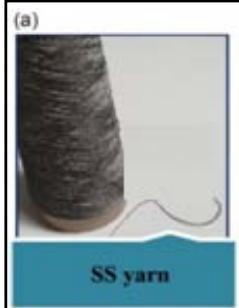
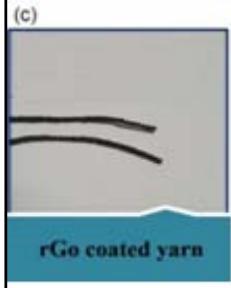
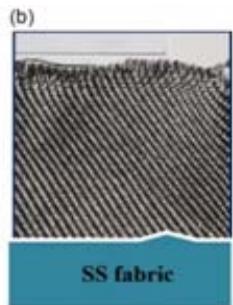
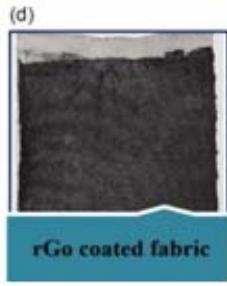
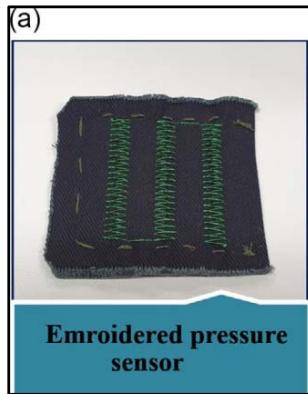 Figure 2: a) SS yarn.
b) SS fabric.
c) Reduced Graphene Oxide (rGO)- Coated yarn. d) rGO-Coated Fabric.[1]
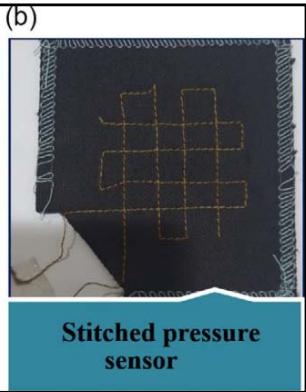 Figure 3: a) Conductive thread-based Embroidered Pressure Sensor.
b) Stitched Pressure Sensor. [1]
## IV. CONCLUSION
The conductive yarns and fabrics are essential for the production of piezoresistive pressure sensors. The fiber material is coated with monomer, oxidant and Dopant. Moreover, the fiber may be intrinsically conductive like SS yarn. The conducting threads are attached with the fabric by stitching or embroidered machine. When the sensors are attached in the garments, it can detect the plantar measurement and gait analysis etc. The researchers are working continuously to find different products from the piezoresistive pressure sensors.
Generating HTML Viewer...
References
5 Cites in Article
Nauman Choudhry,Lyndon Arnold,* Abher Rasheed,A Khan,Lijing Wang (2021). Textronics-A Review of Textile-Based Wearable Electronics.
Lijing Wang,Xungai Wang,Tong Lin (2010). Chapter 6: Conductive Coatings for Textiles. Smart textile coatings and laminates.
Ali Maziz,Alessandro Concas,Alexandre Khaldi,Jonas Stålhand,Nils-Krister Persson,Edwin Jager (2017). Knitting and weaving artificial muscles.
Lefayet Sultan,Lipol (2011). Characterization of the conducting threads.
G Nazmul Islam,Mohammad Stewart Collie,M Qasim,Ali (2020). Highly Stretchable and Flexible Melt Spun Thermoplastic Conductive Yarns for Smart Textiles.
No ethics committee approval was required for this article type.
Data Availability
Not applicable for this article.
How to Cite This Article
Lefayet Sultan Lipol. 2026. \u201cManufacturing of Conductive Yarns and Fabrics to Produce Piezoresistive Pressure Sensors A Review\u201d. Global Journal of Research in Engineering - J: General Engineering GJRE-J Volume 23 (GJRE Volume 23 Issue J3): .
Explore published articles in an immersive Augmented Reality environment. Our platform converts research papers into interactive 3D books, allowing readers to view and interact with content using AR and VR compatible devices.
Your published article is automatically converted into a realistic 3D book. Flip through pages and read research papers in a more engaging and interactive format.
Piezoresistive pressure sensors are manufactured frequently by the researcher around the world currently. The most of the sensors are passive in nature. The yarns may be intrinsically conductive, i.e. stainless steel yarn or it may be made conductive by coating, i.e. graphene oxide coated polyester yarn. The stainless steel yarn is embroidered in the fabric. When installed inside a garment, the sensors can track both muscle activity and vital signs in people. The polyester fabric that dip-coated with graphene oxide (GO) has a wide detection range and good sensitivity, making it suitable for use as a pressure sensor in plantar measurement and gait-analysis applications.
Our website is actively being updated, and changes may occur frequently. Please clear your browser cache if needed. For feedback or error reporting, please email [email protected]
Thank you for connecting with us. We will respond to you shortly.