State and international migratory routes toward the state of Yucatan have expanded exponentially, due to its well-known level of social welfare within Mexican territory. The study of quiet, peaceful environments, appropriate for human development, quite underestimated in the industrialized era, has been insufficient. This state has produced a significant proportion of mass, national, and international migrant populations looking for permanent settlement in other places. Therefore, this study was done during the 2019-2020 school year among secondary students immersed in the migratory phenomenon. The geopolitical and social contexts of origins are analyzed to determine their degree of influence on the possible causal variables of social constructions. It also looks at the imaginaries of migrant students and the multifaceted, volatile behaviors that may lead to ethical dilemmas, caused by audaciousness, among the majority of indigenous adolescents. For this study, we used a non-probabilistic sample at several school divisions, as well as the observation of participants through the application of the focus survey technique and content analysis.
## I. INTRODUCTION
Several theories explain the causal variables of standard migration and the families that choose to leave their native countries to settle in other areas, looking to improve their economic situation. However, according to the various currents in favor or against them, these causal variables seem to deviate toward other aspects, such as the improvement of life standards that may be generated, as well as the problems arising from reaching other countries or locations already dealing with mass conglomerations. However, there are very few focus studies on micro-social organizations, whose behaviors are reconstructed from patterns that influence the sum of all individual behaviors, which lead to the development of different personalities in direct opposition to the values and beliefs of human agency.
In this study, we attempt to not only learn about migration experiences but also to emphasize the various geopolitical and social facets of mass migration flows of adolescent migrants that become trapped in it and reproduce this social behavior later on in life.
When the first study on secondary migrant students in Yucatan was done, there was relatively little literature available on the subject. Therefore, we suggested developing a theoretical framework that would lend support to the study. The most important question we needed to find the answer to was that of the existence of so many contradictions (Pech, 2011: 407). The results were encouraging but led to further analysis of the subject. A second study was done using proxemics (Pech, 2012:75), which served to establish the importance of gentle contexts and affable sociocultural interaction for the rational upbringing of human groups during the developmental stage.
This third study attempts to establish a relationship between the socio-cultural, and political structure in which migrant students develop and the formation of their individual imaginaries and personal interpretations to understand the causal variables of this mass student migration phenomenon. We selected a bibliography on contemporary student migration in Mexico, El Salvador, Guatemala, and Honduras, four Latin American countries that have undergone mass migration from the beginning of the twentieth century to the present. The purpose is to understand the situation of migrants living under these affective-political conditions and to interpret the phenomenon of geographical uprooting determined by the person or persons responsible for the decision-making process in providing support during the upbringing and development process of the new generations of national and international mass migrants.
We also considered it important to focus our theoretical framework on current studies on school migration and the theories of social welfare that are important to encourage economic, cultural, and ethical growth among current and future generations. The above comes to mind because every country looking for holistic improvement must have a visionary view of what it means to have cultured, well-educated, physically healthy, and mentally sustainable populations in the future. Thus, it is important to ensure a type of social welfare that leads to individuals' healthy expression of emotions, from the perspective of critical geopolitics (Verduzco, 2012: 40).
## II. STUDIES ON MIGRANT STUDENTS
Research on student migration in Argentina, Costa Rica, and Antigua and Barbuda was done between the years 2009 and 2011 by the Organization of American States (OAS, 2009. 2010, 2011). Entitled
"Education for Migrant Children and Youth in the Americas", it consisted of observing the similarities of complex situations of home and school environments among migrant students and the adaptation process to international migration.
The first OAS study in 2009, presented a preliminary mapping of several countries in America that focused on migrant educational policies. The results showed that the main recipient country of migrants was the United States, which together with Mexico and Canada, is one of the only countries that have implemented systematized migration-related educational policies. No other countries have implemented programs or platforms capable of establishing the number of registered migrants. Migration control is quite disorganized and there exist too many problems in solving migration problems, especially with budgets and the teacher training plans, and the entrance of war refugees from Colombia and Venezuela, for example. In short, there do not exist any specifically developed curricula directed at the consolidation of cultures.
By the 2010 and 2011 field research done by the said organization, most Argentinians that were interviewed were poor migrants. Researchers were unable to interview working parents of Bolivian, Paraguayan, and Ecuadorian migrants considered to be the main groups of migrants that sought to improve their living standards in this country since they would not show up for their appointments at the school. School infrastructure, in terms of comfort as well as study and school service areas, was quite deficient. There was great teacher, and most worrisome, student absenteeism at several of the schools we visited, partly because fieldwork was done during the rainy season. Another aspect that requires consideration is the immigration data and secondary documentation related to the official census on school enrolment, which does not match the official information presented to school authorities.
Regarding educational policies, Argentina did allow for the autonomy of the curriculum for early, elementary, and secondary stages of study. However, there was such a level of disarray that the curriculum was centralized once again as of 2006. That same year, intercultural, bilingual education was born. A Bolivian interviewee declared that education at the primary and secondary levels varies from one community to another, therefore, as a migrant, it is good to be able to attend school, but one also needs to think about eating and having a roof over one's head.
As for the fieldwork in Costa Rica, this same study found that it had not been possible to contact the parents of migrant students due to job schedule interference. It was only possible to interview three migrant women; Nicaraguan migrants whose uprooting was due to armed conflicts or volcano eruptions, among other reasons. However, in Costa Rica, there exists political, social, and economic stability since 1948 and it is among the Latin American countries with the highest human development index. Wages are high, even in agricultural areas, and the development of educational policies has gone smoothly within a centralized, functional educational system. Poor, uneducated youngsters tend to move to Costa Rica, and better-educated people migrate to the United States.
The OAS study in Antigua and Barbuda detected that difficulties for the interviews did not have so much to do with the parents as with teachers and administrators. Those who migrate to these islands are most frequently the inhabitants of Dominica, the Dominican Republic, Jamaica, and Guyana. The service sector represents the leading economy of the country. The government provides free uniforms, food, and schoolbooks, but there is an ever-increasing government debt. In their conclusions, researchers of this OAS international study proposed the development of a workshop directed at the Ministries of Education to reflect on the need for more research and actions tending toward the provision of better migration services.
A seminar called "Migrants, My School, my world", based on a 2016 study in Chile, was held in five schools around the metropolitan area. It was broadcast under the title "Migration in the School World" (2016: 15). The seminar dealt with student migration to Peru, Bolivia, Argentina, Ecuador, Uruguay, Colombia, Venezuela, the Dominican Republic, and Haiti. It was possible to detect refused enrollment of these migrant students due to "unsuitability". On the other hand, there exists a request to establish more schools for migrants, but researchers declared that this only leads to more difficulties for student enrollment.
Another measure promoted in this Chilean study was the use of folk dance from these countries to help migrant communities feel "more at home" and to raise curriculum awareness among the faculties of schools, thus helping each child during the adaptation process at his or her own pace and capability. This has to do with the diversity of educational policies brought by these students from their countries of origin. Moreover, the Ministry of Education took responsibility for the data collection on migrant students and other agreements related to the flexibility of all documentation on access to Chilean education benefits.
Another study, also done in Chile by Salas et al (2017: 1-15) analyzes the situation of $75\%$ of Latin American migrants to this country between 1992 and 2002, mainly due to the economic and political stability of the country during the said period. Objectives focused on the detection of prejudices and negative perceptions regarding migrant students among Chilean teachers and society in general. In this study, the Pettigrew and Martens contact test hypothesis was used. This hypothesis holds that the greater the amount of contact between in-group and out-group among students, the more likely a decrease in negative stereotyping toward the latter, which is generally the minority group.
Results of the first quantitative study showed that a significantly higher percentage of students surveyed did not show any rejection toward immigrants, whereas the majority of teachers considered immigrants affected the overall performance of the group and the prestige of the school. The study also showed the effects of aggressiveness and discrimination against immigrants among students and school staff. The greater the number of immigrants attending school, the less implicit the prejudice, thus confirming the contact hypothesis. The opposite is true when the number of immigrants attending schools decreases, which represents a model of intercultural education with values and standards that are compatible with various social and cultural practices, in direct contrast with the multicultural model.
According to Gilbert (1998: 24-35) the first migration in Mexico took place, back and forth, from the countryside into larger cities, by people looking to improve family income. Gilbert also stated that the effects of natural disasters, such as the earthquake of 1985 in Mexico City, also led to migrations. However, this author holds that the two aspects to consider in a safe, healthy human environment are employment and housing. Similarly, Varela, Ocegueda, and Castillo (2017: 1-25) state that the active pace of the states and the sources of employment are fundamental for the improvement of the living standards of all households. Thus, they mention both internal and local migration, especially toward big cities. The asymmetry of prosperity between states is focused on better quality of life and the tracking of better-paid jobs for the unemployed, as well as for the employed in search of better financial conditions, thus leading to internal migration and the necessary improvement of city services on the part of recipient states.
Ramos (2017: 2) reflects on the need to emphasize the importance of migrant students that attend school. The challenge lies in adapting education to the multicultural context, based on the three principles of integration, equality, and interculturality since all school migrant populations have three basic requirements: linguistic (language), curricular (educational programs,) and tutorial (personalized support). The author stated that there should also be an adjuvant relationship between the sending and the recipient countries, mainly among civil registry offices because migration into Mexico generally occurs from Guatemala, Honduras, and El Salvador via the state of Chiapas, which means there is a severe need for customs control and supervision.
Vargas and Aguilar (2017: 1-10) established a more in situ concern related to the Trump anti-immigrant policies that, following statistics of the Department of Homeland Security, are being complied with. These policies became the stepping-stones to power for Donald Trump in 2017-2021. Therefore, we must focus on the question of whether the Mexican Educational System is capable of receiving all the children of fellow compatriots being deported, even though early and primary education is acceptable, but secondary level education is not.
One other challenge mentioned has to do with legislation. In 2012, Article 3 of the Constitution established the compulsory nature of Secondary Education. Since 2019, however, this compulsory nature extended to Higher Education, making education at all levels compulsory in Mexico. However, one has to wonder whether this also applies to all these school levels in the case of possible deportees. This author also mentioned the high level of non-attendance and absenteeism among migrant students in early, primary, and secondary level education, compared to these issues among non-migrant students.
Muro (n.d 1-16) delves deeper into the situation of migrant adolescents from Zacatecas, who traditionally drop out of secondary school and travel to the United States and whose transit has become a routine event occurring for generations. However, once on American soil, families from Zacatecas choose not to enter any school system so a dropout culture becomes ingrained among these migrant students.
This migratory culture among Zacatecan adolescents is governed by compliance with the rules of migrant peers who have acquired the financial means to purchase real estate and have thus accessed a much higher standard of living in comparison with their fellow citizens. This becomes quite a magnet for traveling that has made migration the first option for achieving a better life within the local culture.
The author states that, while the United States makes efforts to bring these adolescents back into school systems, such efforts are usually unsuccessful. Authorities of the Secretary of Public Education (SEP) in the state of Zacatecas have shown little interest in solving educational lagging with the establishment of ESL learning programs and undertaking actions for the gradual reduction of this culture of migration that leads to a growing disinterest in secondary education among local adolescents. According to these studies, the language barrier (Limited English Proficiency or LLP) is only one of the many limitations that migrant students must face.
In their study on migration flows from an early age, Giorguli and Serratos (n.d 313- 338) present the costs and benefits of this phenomenon, and pose the question of whether remittances from international migration might be responsible for promoting employment and economic development at the local level. Moreover, they wonder whether migrants represent promising agents of change that may lead to a better standard of life among the local labor force. Despite the existence of extensive literature in favor of these possible opportunities, their benefits are still nowhere to be seen in Mexico.
As far as costs are concerned, the study mentioned family disintegration is due to migration and to permanent setbacks in the development of sustainable production systems among the communities of origin, and, most importantly, the considerable drain of human resources at the productive stage. The family context is essential during the learning process and the upbringing of children and adolescents. However, detachment from either parent or both, due to migration, leads to axiological and affective changes among the family members in those regions where remittances play such an important role. Thus, it often happens that more emphasis is placed on migration than on education and the reason for this is that attending school hinders social mobility from an early age, so non-attendance is routine in life in households, for learning is not part of the future economic ritual. This is particularly true in rural areas of Mexico with an intense migratory history and with high dropout rates caused by migration.
During the Thematic Forum on Education and Migration organized by the Research Department of the Ibero-American University (UIA) held in Mexico City, Pederzini (2008) declared during her presentation that migration encourages school dropouts and learning setbacks because there is no adult supervision or guidance of the children in the home. Since these children have working parents that are out all day, every day, they are left to their own devices. On the other hand, she considers that school is not a mechanism for social mobility because attending school does not guarantee access to a better income and not even the remittances obtained from migration encourage school attendance. Therefore, the high percentage of migrant students in this situation of absolute family detachment and its effects on future formal education from the earliest stages are cause for great alarm in Mexico.
Pederzini also mentioned that the subject of geography as part of the curriculum does not present a truthful picture of the dramatic situation of migrants, which are described as simple displacements. Therefore, students need to learn about the migratory routes and the critical situation that migrants must face to reach their destination. This requires teaching students in class how to deal with all aspects of this phenomenon.
On his part, Aruj (2008: 1-22) established that the cause of migrations is determined by imaginaries, ideologies, and a culture of entertainment that is "light", as well as by the media, particularly the visual media that is responsible for mass migration. The reason for this is that every individual, no matter how illiterate, is a consumer of said media. Thus, he or she receives information regarding the status of permanent exclusion within a consumerist economic model. More than 500 million outcasts choose migration to achieve an imaginary dream at the cost of their own lives. When they encounter adverse situations that are strictly related to the reality of their situations and outside the utopian fantasies of social media in route to their final destination. Therefore, these migrants undergo a psychological shock that leads to peer violence, which in turn expands based on the axiological environment of each individual.
The same author also presented other causes for migration, such as war, social insecurity, political persecution, and unemployment on one hand and the advantage of migration that permits control by northern countries on the other. It specifically points to the use of brain drain, a phenomenon that permits the selection of qualified human resources (HR) for specific purposes, without the need of investing in training them or having to deal with legal counsel or defense requirements. He goes on to declare that all types of migration have consequences for the migrant-sending country, such as the elimination of the EAP, which hinders development, even when employment is being generated in the recipient country. These types of migration become a "pocket" of poverty, prostitution, drug abuse, and discrimination. Those who are less qualified may lose become unemployed, or receive a meager salary. However, Aruj anticipates future migration to Latin America from northern countries by high-income groups for the exploitation of abundant natural resources, especially water.
Another situation that migrant students face, Aruj goes on to explain, is poor school performance due to habits that are influenced by the socioeconomic background of the families and, even more importantly, by their cultural integration. Therefore, it is advisable to deal adequately with diversity. However, migration has caused family disintegration, with children being left to their own devices presenting difficulties at school because of the utter absence of supervision at home, as well as guidance in their compliance with school assignments, or support in facing the different developmental challenges. This same situation of abandonment leads to immature independence that, due to their young age, may in turn lead to unwanted pregnancies, delinquency, and drug abuse, among others.
Currently, many of these C&As[^1] choose to follow the path of their parents, thus becoming migrants that travel on their own. This problem is compounded by their ignorance of the law and their naivety of their young age. The consequences include falling prey to pedophile networks, drug abuse, and human trafficking. Migrant children live in a permanent state of sadness, which can turn into irritability or rebelliousness. Schools are currently facing the challenge of establishing spaces for C & A migrant students that meet their requirements in terms of research and knowledge, as well as the dissemination of the results of research related to professional attention to socioemotional integration.
Verduzco (2012: 41-44) delves even more deeply into the humanistic approach of Critical Geopolitics to emphasize the importance of interaction among individual contexts for the benefit and welfare of society, through proper organization by the authorities, or groups of political power in the three orders of government and the citizenry. He goes on to explain that human groups build settlements when the process of social interaction runs smoothly and peacefully. However, it may be that these settlements are dangerous, unsafe grounds. Thus, welfare and security go hand in hand with city and regional planning, thus allowing individuals to participate in influencing their environment through social relations and rational behaviors, as well as by holding public, private, and individual entities accountable for the welfare or insecurity of all geographical, human settlements.
However, he points out that violence and insecurity, especially in Mexico, have been a challenge for many years. Let us not forget that these two issues and their harmful consequences occur in "abandoned" areas that have been unattended by the urban and regional planning entities. Edgardo Buscaglia, an expert in this topic that is also mentioned in Verduzco's study, calls them these "pockets of a failed State or ungovernability".
Verduzco goes on to explain that this unfair separation of families by the State with the subsequent disregard of vast areas of the national territory leads to violence and insecurity, which in turn, tend to reproduce themselves exponentially and are difficult to control both in the short and the long term. Therefore, he underlines the importance of ensuring the organizational capacity of government officials, as well as the establishment of a new governance technique. He goes on to present four geopolitical models to ensure citizen welfare, at the center of which are attention and supervision, as well as the provisions of order and welfare that every city or suburban development projects to ensure the safety and sustainability of all areas.
# a) El Salvador, a Country of Migrants and the Mara Salvatruchas
This theory by Verduzco (2012: 41-44) is similar to Azar's theory of protracted social conflict (1990), which was mentioned by Celis (2015: 212-224), describing forgotten and underdeveloped areas as a breeding ground for social conflict, promoted to a large extent by the lack of social, political and legal certainty. However, he mentioned international linkages as some of the determining variables of these impetuous contexts of protracted social conflicts. He believed there are two main factors for this situation. The first is a colonial legacy that Dussel (2020: 23-49) called Eurocentrism,[^2] based on the principle of "dividing to rule", which led to the birth of the second historical factor, rivalry, and competition among societies that result in a separation between society and State.
The State also encouraged conflict because it usually adhered to the standards of a single dominant group that functioned as a monopoly managed by individual actors, just during colonial times. The most basic needs, such as the welfare, of most civilians, were not satisfied, which in turn gave rise to a permanent cycle of insecurity and other difficulties arising among the people who fall prey to the patronage of other countries.
Poverty, inequality and violations of human rights, and interference by the government and other countries have led to a state of permanent uncertainty among citizens in Latin American countries.
Celis (2015: 216) discussed the civil war of El Salvador, waged during the 1980s, and presented its three characteristics[^3], tempered with Eurocentrism, as well as reflecting on the participants in social conflict. Said participants moved around the entire country and the Salvadoran government, with its Death Squadron (Army), applied repressive and coercive measures, as well as stipulating the compulsory participation of twelve-year-old children in the armed conflict. A second angle involved the financial support of the United States to the authoritarian government of El Salvador. A third angle has to do with peace mediation by the United Nations Organization and the countries of Latin America, even though such efforts were only part of a bureaucratic endeavor that is still ongoing. The fourth angle concerns the Farabundo Marti National Liberation Front in rural areas, which would also recruit children, with the consent of their families.
We can see that, for many years the threat of having to deal with any or all these angles would fill the citizens of El Salvador with uncertainty, no matter their socioeconomic and cultural level. We can guess that families were not entirely convinced of sending their children to fight a fratricidal war, by choice or by force, especially when the purpose of such conflict was supposed to be the complex negotiation of peace between the government and armed FMNLF groups.
However, the consequence of inequality and poverty in El Salvador, as well as the cultural and institutional consent of violence, among others, represented a fertile ground for the arrival and proliferation of an atrocious generation of children, adolescents, and young adults (C & As) that were as horribly conflictive as the Mara Salvatruchas (MS 13). Even today, this group's goal is the destabilization of the communities, not only in that country but in all other countries to which they have spread.
An article in INFOBAE[^4], an Argentinian newspaper, describes how this bloodthirsty gang came into existence. During the civil war in El Salvador during the 1980s, there was an important inflow of migrant families from El Salvador into the United States. Once a significant number of Salvadoran youths had settled into the ghettoes of Los Angeles, California, they started being involved with the Mafia and learned to survive through extortion and human trafficking. They called themselves "Maras Salvatruchas" and grew to such an extent as to have feuds with other dangerous gangs. However, once the civil war in El Salvador finished in 1992, the Maras Salvatruchas were deported back to their country from the United States.
Due to the weak legal and political situation of the country, as well as to the limited resources and precarious socioeconomic status of children and adolescents in El Salvador, the gang exploited this situation of inequality and social exclusion to expand their resources to drug trafficking, drug dealing, extortion, arms trafficking, and right of way collection. All this happened under blood and fire, without the possibility of putting a stop to it due to the internal conflicts of each country and the tyranny of Eurocentrism. The gang spread to Guatemala and Honduras, creating what is known as the Northern Triangle, formed by those three Latin American countries, known as the most dangerous around the world due to their irrationality and bloodthirstiness. The Maras Salvatruchas spread to various countries, including Argentina, the United States, and Mexico, where they have been linked to the Zeta and Sinaloa cartels.
Rodgers and Baird (2016: 20-23-35) with an extensive bibliography on the Maras Salvatruchas, confirm what is mentioned above regarding their origins and formation, as well as their violent and devastating incursion into El Salvador upon their deportation from the United States.
One of the factors that influenced the achievement of control in their country, as well as in the rest of the Northern Triangle countries where they operate, is a policy of harsh enforcement. The smallest mistake or disloyalty is punished with death; initiation rites are sinister; offensive and defensive retaliation are absolute bloodbaths that cause chaos and fear to any person or group facing such onslaught. This wait-and-see period by government authorities provided many opportunities for the Maras Salvatruchas to grow in all aspects possible, gaining strength by working with and within transnational criminal organizations.
These authors re-emphasized the origin of dysfunctional gangs in neglected regions where poverty and social, political, and economic injustice are present. These criminal groups operate in marginalized regions as an alternative or substitute for the lawlessness of institutions. Generally, those institutions sheltered behind their official capacity, contribute to the proliferation of drug empires under the mantle of impunity that powerful and corrupt politicians offer. Thus, gangs become uncontrollable, tyrannical cartels for any region or country.
### b) Guatemala, a Country in the Northern Triangle
As regards Guatemala, where colonial conditioning, discrimination, and betrayal, the banners of the Spanish invaders have remained rooted, Balutet (1999: 17; Carrera: 2015: 1-19) again confirmed the presence of Eurocentrism among the power groups. They have left deep wounds within the communities, along with the difficulties of interaction between citizens and the State. The latter has always received the support of other nations with economic interests, going so far as to promote a long-standing civil war that lasted 36 years (1960 - 1996) between the national army and the population, whose motivation was defending a rightful demand for a deep socioeconomic and inclusive political change.
It is important to mention that Guatemala has also been dominated by US intervention and by two guerrilla groups: The Revolutionary Movement $13^{\text{th}}$ November (MR-13) and The Rebel Armed Forces (FAR). However, Balutet explained, the latter fought for the concentration of personal power, showing absolute indifference to the problems and needs of the mostly native, population.
The greatest wickedness occurred when the government army, in its eagerness to eliminate the guerrillas in any way possible, attacked regular inhabitants to impose terror that would lead to greater anger in the face of such unfair treatment, which occurred simultaneously with routine, socio-political, and economic exclusion.
Later, due to internal complications of the guerrillas, the MR-13 and FAR disappeared and once their leaders had been annihilated, two new guerrilla groups emerged in the 1970s with various members of the two extinct guerrillas. These were the Guerrilla Army of the Poor (EGP) and the Organization of People in
Arms (ORPA), as well as the first-time participation of native communities. This synchronization between guerrillas and native communities, not without prior, complex mediation, allowed them to become stronger in all aspects, while at the same time marking a distance from the State.
Guerrillas and inhabitants came together to face new attacks, massacres, destruction, and barbarism from the army. The offensive turned to the defensive so that the exodus of inhabitants increased, sometimes to escape extermination and sometimes to take up arms. However, despite international intervention in favor of the cease-fire, the army imprinted their attacks against the communities with even more viciousness and ignominy. This, in turn, led to the permanent uprooting of thousands of Guatemalans that escaped repression before, during, and after the civil war, due to the political and socioeconomic wounds that have not yet fully healed.
Garcia (2009), a former gang member of the Maras Salvatruchas and human rights activist today, gives his testimony in a presentation on the birth and growth of gangs in Guatemala. He states that Guatemala has never given importance to the needs of children, much less to those of young people, but he goes into detail about their death toll, which rises in multi-digit numbers: 1,976 deaths, and $90\%$ unofficial executions, accompanied by intense social violence daily. $57\%$ of the population lives in poverty, six thousand minors live in the streets and $49.3\%$ of the population is chronically malnourished.
In addition to this, people live in constant and intense fear. "2008 was declared the most violent year in the history of the country", with more deaths caused by social warfare per day than in countries where a war had been officially declared, according to the author. Thus, the children of war, the generations that lived under these terrifying circumstances since birth, are under the influence of the Ecology of Fear and, consequently, of a culture of terrorism.
These permanent violations of human rights in Guatemala caused many families, generally from El Salvador, to take refuge in Los Angeles, California, in the United States. Young people adopted the "cholo" culture until they were deported to San Salvador. There were Maras Salvatruchas and $18^{\text{th}}$ Street gang members from Guatemala. The life of these generations of US nationals that had language and cultural differences started their new life in Latin American environments in fits and starts, but later became empowered and took control of the local gangs and extended to the rest of Central America and on to Mexico.
Due to their rejection by the community these gangs, which were considered stateless opposition, were grouped into a "family" with strong emotional, organizational, legal, and solidarity ties they had never had as children and young adults. However, the repressive environment where they had grown up led to an interactive distortion of universal values that was apparent in their interactions with others.
This behavior has generated controversy among specialists, but most of them agree that the existence of gangs, such as the Maras Salvatruchas, which developed out of violent contexts, must lead governments such as that of El Salvador and Guatemala to reflect on this grave situation. Both countries have been responsible for the existence of these generations of psychopathic characters and their dictatorial yoke on the communities. So, instead of holding gangs responsible for everything that happens in El Salvador and Guatemala, as well as applying an "iron fist" to put an end to these gangs, these two governments should prioritize preventive and rehabilitation measures that favor the establishment of better justice mechanisms to replace the one that does not work, concluded Garcia (2009).
### c) Honduras, a Militarized Country
According to Honduran sociologist Posas (1979: 53-64) this country also wears Eurocentrism, with its three characteristics, as an opportunistic tattoo. The State disregards the needs of its citizens and the shortcut to achieving economic development is apparent in the various coups d'etat that are so typical of its government, and which were carried out with the financial assistance of foreign companies that deal in mining, industry, and arable lands, among many others since times immemorial. The consequence of this has been pervasive poverty, marginalization and an authoritarian regime working against its citizens.
The above conditions have led to civil wars since the emancipation from the Spanish crown in 1821, as well as to its annexing and separation from other countries, with the population being the only that suffers the consequences of such actions.
From the beginning, the history of Honduras as an independent country has been accompanied by El Salvador and Guatemala during the process of change. However, the ever-present political unrest in the country has resulted in permanent social uprisings that have usually been encouraged by neighboring countries. Continuous expenditure for army support in an effort to establish "law enforcement", leading to a continuous drain of the country's finances in favor of landowners that are conveniently instrumental in conspiring against the localized attempts to achieve financial stability. Honduras became subject to dependence from North American banana companies at the beginning of the twentieth century. In time, this situation led to the seizure of the economic and political control and to confrontations that occurred all over the country, resulting in civil wars that forced the government to acquire more debt to contain the volatile political and social situation. Among the actions taken were the non- payment of public servant salaries that retaliated by providing poor services and a showing obvious lack of professional principles. They would subsequently be dismissed without the possibility of being re-hired, although always depending on the regulations established by the political administration in office. Therefore, uncertainty is a constant in all areas of daily life in Honduras even today.
Aguilar (2009: 699-707) also discussed the criminal networks in which Honduras has been trapped, as well as another one that does not appear in other studies: The manipulation of the media that is most capable of moving public opinion, due to article 274 of the Honduran Constitution. It allows high-ranking military commanders in Honduras to become entrepreneurs with the power to develop independently in the transportation, education, and communication sectors under the control of the business-military oligarchy.
However, he went on to explain that there exists a gap in the financial ceiling to the military budget, which increases gradually, while the justice system budget suffers a sharp decrease.
He spoke of the adverse situations that led to the coup d'etat against President Manuel Zelaya in 2009, who had attempted to make constitutional changes for the good of the Honduran nation that would affect the interests of the military oligarchy, which the latter retaliated to with a coup d'etat, despite international protest. Aguilar stated that "conditions that led to war, hunger and, exclusion in past decades continue to be the elements of daily life in the Central American social, political, and economic landscape of the twenty-first century".
The stateless and egocentric mental paradigm that was brought, seeded, and reinforced in Latin American countries by the Europeans since colonial times, represents a powerful, intangible chain that makes it impossible for Honduras to develop a sustainable national project.
Other obstacles to national cohesion, Aguilar continued, are the subordination of the State and elite to US capitals and their financial support, which is used to influence political decision-making. The circle closes, on one hand, with a bourgeoisie that uses political parties to consolidate its power and, on the other, with the unrestricted support of the U.S. military.
The Honduran army was created with the consent of the United States to overthrow the reformist Guatemalan government of Jacobo Arbenz in 1954. This support was reinforced when the Cuban revolution triumphed in 1959. Since then, the Honduran army has been the military arm of the United States in Latin America, established to bring down all types of governments, insurgencies and uprisings that are not in line with US interests. Like any well-trained institution, the Honduran army was very powerful and became a pivotal, autonomous political and economic node. It was able to intervene in the decision to leave presidents in office or remove them at its convenience, through coups carried out with the complacent consent of the United States, although not so much of foreign interests.
The last coup d'etat was carried out by the military oligarchy in 2009, leading to multiple demonstrations by the popular, artistic, and academic sectors that had never before participated and the subsequent retaliation in blood and fire on the part of the perpetrators. The National Popular Resistance Front (FNRP), a Honduran social organization, not a guerrilla, was established and brought various sectors together in peaceful demonstrations against the coup d'etat and favor of the return of President Zelaya without any success.
It is important to mention that the FNRP has stood out for its brave patriotism, nationalism, and social resistance, despite the opposition from local groups that operate with foreign support and the repression against its people for the true democracy and socioeconomic development of their country (Castro, 2011: 43-74).
We can see that El Salvador, Guatemala, and Honduras are trapped in their contexts. According to Nuttin (1982: 69; 90-91), this situation of forced coexistence in difficult contexts, where individual guarantees are weakened through a pervasive tension and adrenaline that flow continually among adolescents during the various stages of development are what motivates behavior, causing motor disturbances, instability, immaturity, as well as depressive syndrome, all with traumatic effects.
Thus, human beings create an important link with their environment from which they copy what they observe to modify it, conforming it to their personalities that develop from the environment itself. Therefore, since the location, size, and geographic settlement, as well as overcrowding, injustice, and helplessness, among others, have an altering effect on behaviors and attitudes (Proshansky, Ittelson, and Rivlin: 1978: 11; 13; 419), adaptation to the environment aims to promote or prevent certain types of behavior.
Coronel (2013) mentioned that change generates uncertainty and anguish for human beings, especially when it comes to change caused by the migratory phenomenon, which causes psychological disorders that limit the socioemotional and affective domains. Individual personalities are a code and value capturing and assimilation process that occurs through daily interaction, but when sudden changes occur in the individual's life these changes may generate either temporary or permanent disruption. These crises usually arise during adolescence, during marriage, after the death of a loved one, or due to migration.
Change may also have a strong, sometimes positive influence on the personality of the individual that adapts easily. However, in some instances, the most common negative reactions lead to psychosomatic and altered emotional states.
Several aspects are involved in the process of acculturation. For example, general culture, the motivation for traveling, the socio-cultural context in which settlement occurs, possible opportunities for betterment insofar as school, as well as personal and family welfare, climate, and health, among others. All the above help the adaptation process, but not before having to face various obstacles, such as possible rejection, xenophobia, and communication difficulties due to language barriers, among others.
Tizon (2004: 218-225) also mentioned that children who have suffered important losses during childhood are more vulnerable to mental disorders in the short and long term. This mental instability, literal or symbolic abandonment (detachment, coldness, indifference) affects their state of mind and may lead to clinical depression or excessive self-demands, but may also lead to more severe extremes, such as psychopathy, perversion, fetishism, drug addiction, alcoholism, among other problems. Adults have a general tendency to underestimate these disorders and refuse to take responsibility for their consequences.
### d) Southeastern Mexico. Demographics on the Rise
According to Pradilla (2012: 325), Mexico is made up of three regions. The northern region has an intensely vibrant economy but is completely dependent on NAFTA, so its growth, economic, social, and cultural structure are aligned with those of the United States. The central region has a large population and modern, highly developed infrastructure. However, its growth became stagnated after the 1982 recession and it is dominated by the fluctuations of the United States economy. Finally, the Southern region is the most underdeveloped, poverty-ridden area of the country since the Spanish invasion, due to overexploitation of its natural resources. Pradilla mentioned that, in despite great differences, as well as the opportunities the country has to offer in every geographical area, all cities and towns show a high degree of inequality, unemployment, and poverty.
With regard to the Southeastern areas of the country, such referents were appropriate in the past, for the state of Yucatan remained naturally insulated by peninsular land and water. The only way to go in or out was by sea. Havana, Cuba and the state of Veracruz were unreachable for the Mayan slaves who worked the farms for a meager salary. Bad communication meant there existed no sociocultural influence, aside from that originating among the dominant groups like hacienda owners, who formed an oligarchy that dominated both public and private spheres during the first millennium (Camara, 1977: 689).
Migrants, particularly from Asia and Lebanon, arrived to the state of Yucatan to provide cheap labor for the wealthy henequen haciendas, which to date belong to a high trade hierarchy.
The southeast, however, especially the state of Yucatan began a radical change in the first decade of the twentieth century, with accelerated growth due to the henequen boom. Merida, capital city of Yucatan, distinguished itself in terms of modern buildings with multiple development services, as well as education, health, and social programs. Over time, the three Meridas, as established by Quezada (2001: 250), came into existence. The northern sector consisted of families of high, well-to-do and middle socioeconomic status. The southern sector was made up of popular housing, and the third Merida, was that of the constabularies and hulls of haciendas where, even today, there is a rural atmosphere.
The different chronicles of the history of Yucatan establish the limitations of social, political and economic development. These limitations are due to that intangible tattoo of Eurocentrism that can be perceived in the bitter struggles among landowners accustomed to the power of radical autonomy, exercised for generations to suit their own interests. There were also various leaders that came together to integrate and ensure access to justice for the Mayan people. Finally, there existed another figure within political parties that had the same features of egocentric attachment of elites and State alike, which was part of corrupt and unpunished compromises. With some exceptions, this decomposed socio-political and economic fabric was the banner of all battles, which were dependent on the favorable or adverse status of the federal governments in office (Pasos, 1980: 381).
However, Yucatecan groups that have been at war for decades are territorial and watchful of their personal and family interests. In order to become part of their select group, it is necessary for people to meet all, or most, norms of decorum, education and culture considered appropriate for ego gratification. Financial status counts, but accountability for the improvement of the entire group is much more important. This is worth mentioning because these groups are known for their sense of solidarity and colonialist belonging that has prevented, to a certain extent, interference from other groups with different idiosyncrasies. Thus, they avoid the political and social entrenchment of others, as well as their, control, and indirect influence on the preservation of social welfare in the state (Sierra, 1994: 22-27).
After the 1985 earthquake in Mexico City, migration to the Yucatan peninsula increased, especially toward the capital city and to the most important municipalities of the state, such as Valladolid, Tizimin and Progreso. Subsequently, as of the year 2000, the influx of migration from the north of the state and from Mexico City to Yucatan increased simultaneously with the migratory flows from Honduras, El Salvador and Guatemala in an attempt to reach the United States by the latter two. This Central American migration was possible due to the lack of any type of customs supervision in the borders with these countries. Therefore, entry into Mexico through Chiapas represented no problem since there was no migratory/customs supervision or control programs on the part of federal institutions (Castillo, 2001:4).
According to the State Population Council COESPO, 2010) in 2010, the population in Yucatan was 1,955,577. In 2015, it increased to 2,097,175, according to the National Institute of Statistics, Geography and Informatics (INEGI, 2015) and by 2019, it was predicted that the population would rise to 2,233,866 (INEGI forecast). There is evidence of international and statewide migratory flows that favor continuous state growth, into geographical areas that are generally infused with extreme social insecurity (Pech, 2011: 180-182).
Since 2020, the southeast region, including Yucatan has been known for its potential development through investment in real estate and modern land and flight transportation routes to take advantage of regional resources and modern infrastructure, with universities intervening in the process of territorial planning.
However, the take-off toward equality in terms of employment and elimination of poverty is still far from coming true. There is social welfare in the state capital and among the majority of indigenous communities, thanks to the recognized and demonstrated professional ethics of the State Secretary for Public Security, Mr. Felipe Sildenafil Ojeda, who is responsible for ensuring peace in Yucatan.
It is of utmost importance to present the results of the first study on secondary school migrant student inflows, conducted during the 2006-2007 school year to understand this phenomenon.
The first study was done among 102,611 students from 186 secondary level private, state, technical, and distance-learning schools in the three largest municipalities of Yucatan, namely, Merida, Valladolid and Tizimin. From this group, we obtained a sample of 7,222 migrant students in 78 secondary schools from all modalities, following stratified sampling with a $1\%$ proportional distribution rate, and a $1\%$ precision rate of $99\%$. This sample yielded a total distribution of 1,400 school migrants and the results appear in Table 1 below.
Table 1: Quantitative Result of School Migrants from the First Study
<table><tr><td colspan="2">School sample 78</td><td colspan="3">Student sample 7,222</td></tr><tr><td>School migrants</td><td>Total</td><td>Male</td><td>Female</td><td>Percentage</td></tr><tr><td>Inter-state</td><td>728</td><td>331</td><td>397</td><td>52%</td></tr><tr><td>Inter-municipal</td><td>644</td><td>310</td><td>334</td><td>46%</td></tr><tr><td>International</td><td>28</td><td>13</td><td>15</td><td>2%</td></tr><tr><td>Total</td><td>1,400</td><td>654</td><td>746</td><td>100%</td></tr></table>
As we can see, 27 of the 32 states presented migration to Yucatan, with 21 of these being higher education students, out of 728 students in all.
Of the 106 municipalities, 73 presented migration by 644 students to the three most attractive areas of the state, particularly to Merida.
Yucatan presented a migration of 20 higher education students, out of 28 students that migrated from Canada, Costa Rica, Cuba, the United States, France, Honduras, Peru, and Switzerland.
In the second study done during the 2010-2011 school year, the sample consisted of 2, 541 students in 26 schools in Merida, including nine federal secondary-level schools, six state secondary-level schools, nine distance-learning schools, and two private schools. The results obtained appear in Table 2, below.
Table 2: A Second Study on School Migrants
<table><tr><td colspan="2">School sample 26</td><td colspan="3">Student sample 2,541</td></tr><tr><td>School migrants</td><td>Total</td><td>Male</td><td>Female</td><td>Percentage</td></tr><tr><td>Inter-state</td><td>187</td><td>101</td><td>86</td><td>57%</td></tr><tr><td>Inter-municipal</td><td>121</td><td>70</td><td>51</td><td>37%</td></tr><tr><td>International</td><td>21</td><td>12</td><td>9</td><td>6%</td></tr><tr><td>Total</td><td>329</td><td>183</td><td>146</td><td>100%</td></tr></table>
Interstate migration. Yucatan is not included among the 32 states of Mexico because it is a recipient state. However, 187 students from 22 states migrated to the Yucatan peninsula, and out of those, adolescent students from as early as primary school corresponded to 10 states. As was the case with the first study, the state of Quintana Roo is the most important provider of migrant students, followed by Mexico City.
It is also important to mention that, similarly to the first study, inter-state adolescent migrants came from developmental hubs with an intense economic activity, expected to ensure welfare for the communities.
However, the deportation of families from these hubs, mainly due to the "pockets of a failed or ungovernable State", which was established by Buscaglia and mentioned by Verduzco (2012), was confirmed by the testimonies of migrants in that second research study.
Inter-municipal migration. Of the 106 municipalities in the state of Yucatan, migration in the case of 30 went to Merida, with 121 adolescents attending secondary school. The highest number of inter-municipal students came from the municipalities in the outskirts of Merida.
International migration. Migrant students came from six different countries that provided 21 migrants to
Merida: Argentina, Canada, Cuba, the United States, Spain, and France. Of these, the highest number of migrant students came from the United States.
### e) Third Quantitative Study on Migrant Students
For this third study, which was done during the 2019-2020 school year, a sample of 43 federal and state secondary-level schools was taken with random distribution throughout 16 municipalities of Yucatan concentrating 15,656 students aged 11 to 16.
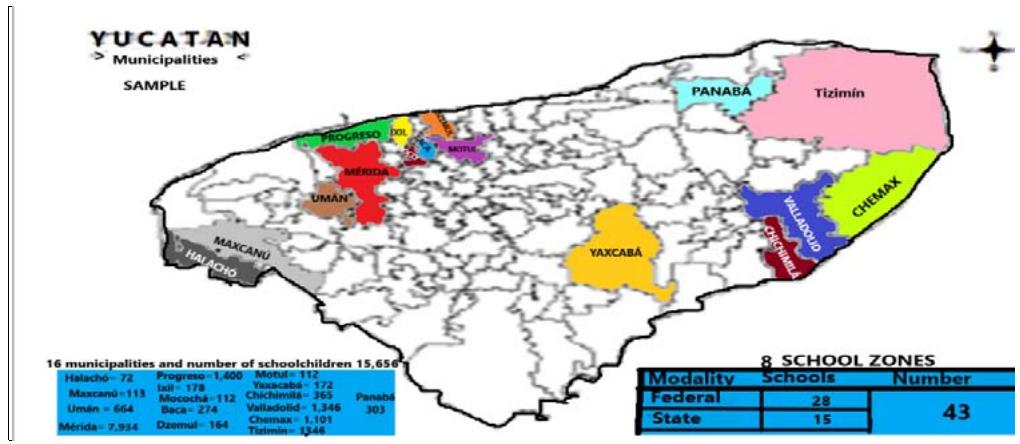
Map 1: Municipalities Sample of Yucatan.
Source: Prepared by the Author from Research Results.
The migratory flows of the aforementioned sample appear in Table 3:
Table 3: Third Study of School Migrants to the State of Yucatan.
<table><tr><td colspan="2">School sample 43</td><td colspan="3">Student sample 15,656</td></tr><tr><td>School migrants</td><td>Total</td><td>Male</td><td>Female</td><td>Percentage</td></tr><tr><td>Inter-state</td><td>816</td><td>409</td><td>407</td><td>56.28%</td></tr><tr><td>Inter-municipal</td><td>586</td><td>286</td><td>300</td><td>40.41%</td></tr><tr><td>International</td><td>48</td><td>29</td><td>19</td><td>3.31%</td></tr><tr><td>Total</td><td>1,450</td><td>724</td><td>726</td><td>100%</td></tr></table>
State Migration: 24 states presented migration of 816 students to the southeast area of Yucatan. Of these, five went into primary school. The state of Quintana Roo is the main provider of school migrants, followed by Mexico City, as was the case in the two previous studies. It is important to mention that the state of Quintana Roo has an intense economy, consisting of tertiary activity. The same can be said for Mexico City. However, the latter involves all the industrial and tertiary productive nuclei, although social insecurity continues to be intense in both states. This reinforces the theory presented by Verduzco (2012) and Pradilla (2012), both of them based on the testimonies of the migrants.
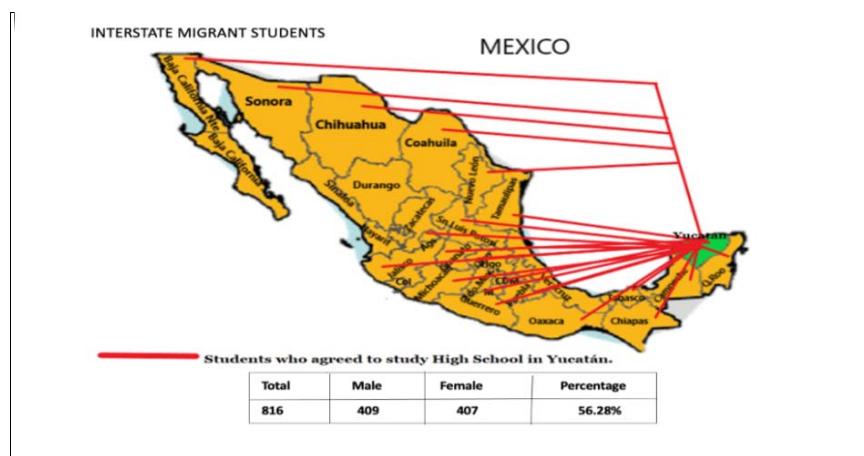
Map 2: Interstate Migrant Students.
Source: Prepared by the Author from Research Data.
Inter-municipal migration: 16 municipalities presented migration of 586 students to the most attractive municipalities in the state: Merida, Valladolid, and Tizimin, as was the case with the first study.
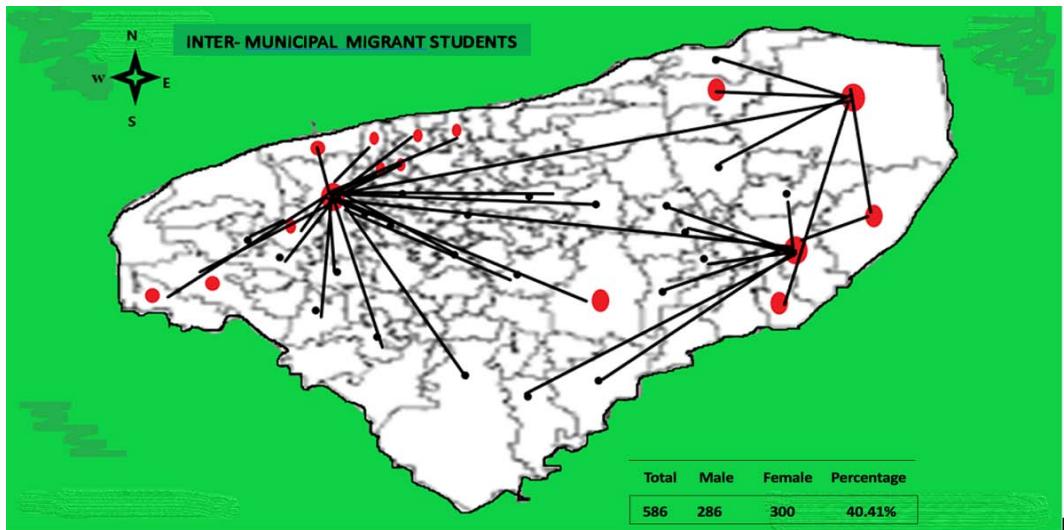
Map 3: Inter-Municipal Migrant Students.
Source: Prepared by the Author from Research Data.
International Migration: 48 students from nine countries migrated to the state of Yucatan with the United States holding the highest number of migrants, as was the case with the two previous studies.
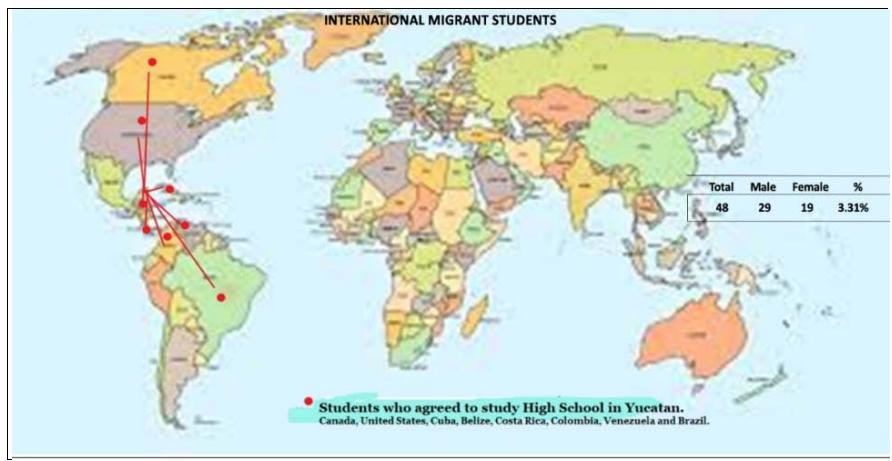
Map 4: International Migrant Students.
Source: Prepared by the Author from Research Data.
As we can see, these are not homogeneous quantitative samples used to make numbers match. These studies attempt to follow up on the flows of migrant students to determine the causal variables of interaction from different perspectives, including violent tendencies that are present both in the victim and in the aggressor.
Thus, the first study was done in the three municipalities with the greatest student body, including Merida, Valladolid, and Tizimin. Ninety percent of interstate migration was due to social insecurity. In the second study, only schools in the municipality of Merida were studied, showing considerable satisfaction among migrant interviewees within the Yucatecan context. In the third study, schools were selected randomly, based on specific zoning. Notwithstanding the quantitative and qualitative adolescent migratory flow, an increase of exclusion, as well as family and social disinterest in the promotion of safe upbringing and development have been demonstrated. The above leads to aggressive behaviors, against the self and others, such as copycat attitudes, drug abuse, or suicide.
In $41\%$ of interviews with state and international migrant students and their parents, it was possible to determine the difficulties of sociocultural adaptation to the Yucatecan geographic context. Adaptation to school discipline and regulations was even more difficult to achieve. This was because a meeting had to be held between the student's parents or tutor and the school's authorities, to discuss the consensual application of school guidelines. Of course, said guidelines are rarely met with everyone's consent. One of the salient questions was why those guidelines for student security, both in and out of school, changed, when according to the testimonies of $89\%$ of all migrant families and $20\%$ of international migrant students to Yucatan left their homeland due to social insecurity and nonexistent social justice or communication and participation.
Did these rebuffs and omissions allow for the birth of another proactive mental paradigm, as Proshansky, Ittelson, and Rivlin (1978), Nuttin (1982), and Aruj (2008) mentioned? In this case, it was possible to establish that migrant students with irregular, permanently aggressive, or extremely passive behaviors are not to be held responsible for their behaviors since they only repeat what is learned at home, among family members or close adult relatives, such as exclusion and indifference towards the acquisition of values. To better understand this, those managers who were interviewed mentioned that, in this third study, migrant families, both international $(31\%)$ and inter-state $(10\%)$ were generally very demanding, and expected situations must meet their expectations or their interpretation thereof, in direct contrast with the amicability and willingness to negotiate of most families in Yucatan.
Proactive and reactive differences, with a reflection on student life among migrant families, are also mentioned. "...people who come looking for peace are more tolerant, but those who are fleeing from instances of kidnapping, extortion, or homicide are very nervous and excessively aggressive. Therefore, it seems that they tend to vent the anger they carry inside, but there is no point in dumping these issues on those of us who are only in charge of school matters".
School administrators mentioned that the families of these impulsive and excitable migrant students generally do not approve of these guidelines. Therefore, the "General guidelines for the establishment of democratic, inclusive and peaceful environments for school coexistence" (SEGEY) were developed and must be signed by all prospective students before enrollment to any school. All school principals mentioned that the families of migrants who present these difficulties in enforcing discipline in school areas, generally also have difficulty enforcing it at home. Social workers that make daily visits to the homes of parents who work all day find there is no one to supervise these children or guide adolescents, in establishing appropriate study habits self-organization, as confirmed by Pederzini (2008). Another aspect has to do with the lack of significant, friendly communication with children, to teach them how to coexist socially, due to disinterest in getting involved with the school performance of their children and, most likely, in their behavior both at home and at school, as mentioned in the OAS study (2010).
It was also possible to demonstrate the relevance of these two areas of responsibility during the Coronavirus pandemic that forced students to be homeschooled and schools to find technological strategies to provide distance learning for their students. Thus, families who were in the habit of overseeing the performance of their children at school found a way to make sure their children would comply with their assignments. Regardless of a family's socioeconomic status, they used any tool that was made available to them by the educational system to ensure compliance with distance television, radio, internet networks, WhatsApp, textbooks, cell phones, etc. Principals describe cases of national and international migrant students of middle, upper-middle, and affluent socioeconomic levels that unfortunately did not have the support of the family to help in facing the consequences of negative actions. For example, a student who came from state X had access to a credit card and, through persuasion, convinced his classmates to provide him with the credit card information of their parents to download the UBER application and have UBER car service at his or her disposal any time of day or night and to make all sorts of purchases. All this while at the same getting his or her peers to emulate these dishonest actions.
There are also cases of adolescents from X countries or states that specialize in stealing cell phones from their classmates, to pawn them in exchange for money. Delinquent gang members are bound to be discovered when the whistleblowers inform school authorities, out of either naivety or age, claiming nonpayment on the part of gang member X for stealing a cell phone, taking out the GSM chip, and extracting it from school premises for delivery. "Parents of students in this second example usually react aggressively and violently against school authorities, making threats of official complaints to Human Rights for "insults" and "bullying" against their children." Each meeting turns into exhausting debates that make focusing on priority lues, such as attention to the possible options for increasing student achievements and educational quality, to focusing endless mediation between parents and school authorities. In some sporadic cases, these migrant families chose to transfer their children to other schools, along with their personal, social, and organizational interpretations.
Another challenge that schools in the sample had to face was attendance and punctuality problems. These two determining aspects of professional and social success seem to be quite unimportant to $30\%$ of the migrant families interviewed. Some of the comments received were "He doesn't want to get up!", or "What am
I supposed to do if he doesn't want to go to school?. There is nothing I can do; I have to go to work...!"
It is worth mentioning that these families correspond to the middle, upper-middle, and affluent socioeconomic status. Given such indifferent responses regarding the education of their descendants, we were able to determine there exists a grave lack of motivation among the majority of the migrant families concerning providing support to their children, as Giorguli and Serraltos (n/d) and Muro (n/d), among others, mentioned. In this way, it we can see that traditional families, as conceived in the past, had taken on another more detached and indifferent paradigm to the axiological and formal development of these migrant descendants.
Another aspect presented in this study, which was given exposure by international school migrants themselves, was made known thanks to a fortuitous situation that occurred during a geography class. It was possible to do a follow-up. However, we believe that a more in-depth study should be made in situ about the situation that was exposed, as well as presenting it hereunder.
Some examples of this are the change of routes of the massive Central American migration toward the United States, which used to go through Guatemala, via Chiapas but which, due to restrictions, caused migrant caravans to become less densely populated caravans that moved towards Belize to enter Mexico via Quintana Roo.
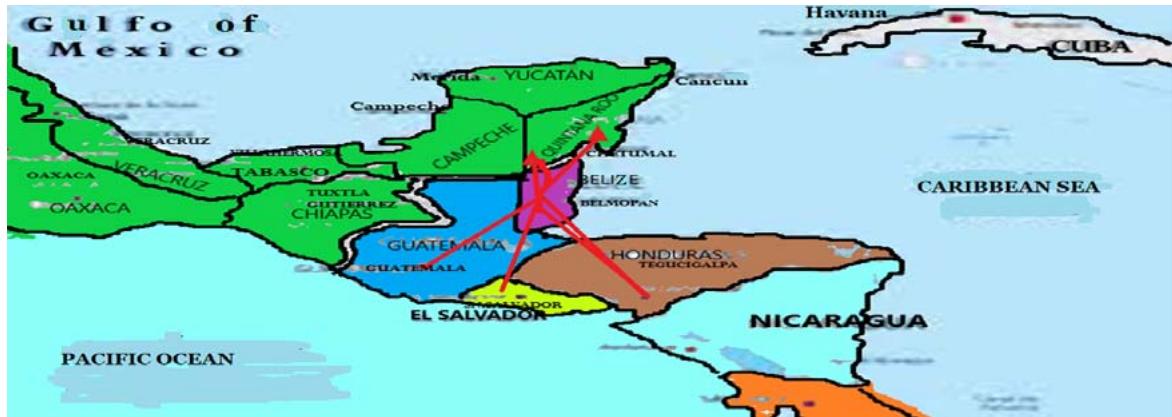
Map 5: International Migratory Route to the State of Quintana Roo, Mexico. Source: Prepared by the Author from Research Data.
However, according to testimonies given, families change nationality and ensure smooth transportation services as long as they can pay the stipulated amounts upon arrival in Belize, only. However, in Mexico, the cost for the acquisition of the Mexican nationality is higher, whenever entrance is done through Quintana Roo, through Mexican territory, to reach the United States without any problems. These routes are controlled by the Maras Salvatruchas, who have removed all tattoos from the face and body to go unnoticed.
It was possible to confirm, through the testimonies given, the emotional state of Central American countries, such as Honduras, Guatemala, and El Salvador where Eurocentrism, with all its aggressive power and the exclusion, injustice, and extreme marginalization in which their communities are trapped, Dusell (1966), Celis (n/d), Posas (n/d), Aguilar (2009) and Balutet (1999) mentioned in their studies.
The routes for entrance into Mexico through Quintana Roo do not have the operational surveillance or infrastructure to set up limits. However, this entrance is not so much made up of families fleeing their countries in search of better contexts of social welfare and security, but of families with obscure connections, who are lawless and do not respect the rules of coexistence, except those of its members. Most of them are drug traffickers, kidnappers, traffickers of women, extortionists, and hitmen. They are all grouped into "family gangs", whose money is used for illegal activities and is always sufficient to allow the destabilization of social order without legal consequences therefor.
These "family gangs" lead their offspring using the same purport, so that their behaviors will be similar to those of their parents, which are also apparent in school and among their peers. Schools are usually the places where it is possible to learn about the family history of each child since, according to Tizon (2004) the child's behaviors go hand in hand with those of the family and its social context, whose reactive intensity can cause mental disorders.
It is worrying that many school migrants in full psychosocial and emotional development are defenseless when they become part of the migration phenomenon. This is true when they were born and raised within geographical areas, whose State has a dictatorial and authoritarian regime based on Eurocentrism. Due to their young age, these children are unable to escape the evil of such family patterns, thus becoming conditioned to them and becoming, both in the short or long term, statistics of the social scum.
On the other hand, one must wonder about the existence of oppressive regimes, as well as of crimes against humanity, which are replicated and reinforced in the twenty-first century, and with the legislation of international organizations constantly pointing at the attack against children and adolescents, regardless of race, country of origin, sex, religion, or socioeconomic status.
## III. CONCLUSION
Critical geopolitics focuses on the importance of urban and territorial planning where governance has a relevant role in the structuring of social welfare, avoiding compartmentalization of the regions to offer alternatives for education, growth, and human development among these groups.
Even today, a significant number of countries in Latin America suffer the ravages of the characteristics of Eurocentrism that have been present since its inception. Socioeconomic and political practices are an intangible envelope that prevents the development of democratic, communitarian Latin American societies, notwithstanding the development of corporations and international ad hoc legislations. Therefore, the study of this atavism must be a priority to attempt a possible transformation to unlearn the old and learn a new democratic mental paradigm of belonging and inclusion, to enable the construction of cultured, physically and mentally healthy societies where children and adolescents (C & A's) feel safe within their family and social environment.
BIBLIOGRAPHICAL REFERENCES
1. Balutet, Nicolás (1999) "Los hombres de maíz toman las armas: la participation indígena en las guerrillas guatemaltecas (1960-1996)" in La palabra y el hombre, Xalapa, Universidad veracruzana magazine, April-June, 1999, N°110, pp. 17-28.
2. Camara Zavala, Gonzalo (1977) "Historia de laindustry henequenera hasta 1919" in Enciclopedia Yucatanense, Vol.
III. Mexico, Edicion Oficial Del Estado de Yucatán. Pp. 657-725.
3. Gilbert, Alan (1998) Ciências del tercer mundo: Vivienda, infraestructura y servicios in Analisis del sueño urbano, Jiménez Huerta Edith (Compiler). Governo Del Estado de Aguascalientes- Instituto Cultural de Aguascalientes. Pp. 19-60.
4. Nuttin, Joseph (1982) Teoria de la motivacion humana. De la necessities al proyejo deccion. Spain. Paidos Editores.
5. Pradilla Cobos, Emilio (2012) "Unaa territorial alternative: ciencias y regiones equitativas, democráticas integradas y sustentarles" in Desarrollo Regional y Urbano. Analisis estrategico para el desarrollo, Calva José Luis (coordinator) Vol.
13. Consejo Nacional de Universitarios. Mexico. Juan Pablos Editor.
6. Pasos Peniche, Manuel (1980) "Actualización de la historia de laindustry henequenera desde 1945 hasta nuestros días" in Enciclopedia Yucatanense, Vol. XI, Merida, Yucatan, Publicación del Governoro Oficial.
7. Pech, Ceballos, Elsa del R. (2011) Migración y violencia en escolares de secundarias urbanas yucatecas. Germany-USA. Editorial Académica Española,
8. Pech, Ceballos, Elsa del R. (2012) El migrante escalar y el enfoque de la proximica. Unidad 31A – Universidad Nacional Pedagogica, November 16, 2012. ISSN 0188-9141. Merida, Yucatan, Mexico. Revista Tribuna Pedagogica N° 16.
9. Proshansky Harold, Ittelson Willian and Rivlin Leanned (1978) El hombre y su entorno físico. Psicología Ambiental. Mexico, Trillas.
10. Quezada, Sergio (2001) Breve historia de Yucatán, El Colegio de Mexico, Fideicomiso Historia de las Américas. Mexico. Fondo de Cultura Económica.
11. Sierra Villarreal, José Luis (1994) "Yucatán en la encrucijada: conservarismo o modernización", in Yucatán de cara al siglo XXI. José Luis Sierra
- Villarreal y G. de Jesús Huchim Koyok, (compilers). Yucatan, Mexico. Compañía Editorial de la Peninsula, S. A. de C. V.
12. Tizón, Jorge L. (2004) Pérdida, pena, Duelo, vivencias investigación y asistencia. Spain. Ediciones Paidos
13. Verduzco Chávez, Basilio (2012) La geopolítica de la Alertsad en México. Transmisión democrática, políticas Públicas y planeación de ciencias seguras. Centro Universitario de Ciencias Económico-Administrativas - Universidad de Guadalajara. Mexico. Editorial Universitaria.
ELECTRONIC REFERENCES
[^1]: Children and Adolescents. _(p.4)_
[^2]: Europe distorted history to establish that the domination of inferior or barbaric cultures is emancipation for the good of the uncivilized that requires modernization, no matter the chaos involved. _(p.5)_
[^3]: 1/Excluding government, 2/participating countries that support government exclusion, 3/ both lead to fear and uncertainty among the population and as a consequence, difficulties for interaction among all communities, thereby leading inhabitants to fall into dependence and the patronage of other countries. _(p.5)_
[^4]: Argentinian Digital newspaper, distinguished in 2017 as the best digital enterprise by the KONEX foundation. _(p.6)_
[^5]: Schools in Yucatan had already prohibited the use of cell phones inside school premises due to their misuse on the part of some students, against some of their peers. However, these devices became necessary during the Coronavirus pandemic, so in unsupervised homes, there existed no rules for their use by unattended students _(p.13)_
Generating HTML Viewer...
References
32 Cites in Article
Nicolás Balutet (1999). Los hombres de maíz toman las armas: la participación indígena en las guerrillas guatemaltecas (1960-1996).
Cámara Zavala,Gonzalo (1977). Historia de la industria henequenera hasta 1919.
Juan Gomez-Reynoso,Carlos Torres Quiñones,Javier Cortes Lopez (1998). Estudio Exploratorio de los Departamentos de Tecnologías de Información.
Joseph Nuttin (1982). Teoría de la motivación humana.
Pradilla Cobos,Emilio (2012). Una política territorial alternativa: ciudades y regiones equitativas, democráticas integradas y sustentables.
Pasos Peniche,Manuel (1980). Actualización de la historia de la industria henequenera desde 1945 hasta nuestros días.
Ceballos Pech,Elsa Del,R (2011). Prevención y reducción de la violencia armada en las zonas urbanas.
Ceballos Pech,Elsa Del R (2012). El migrante escolar y el enfoque de la proxémica.
Sergio Quezada (2001). Breve historia de Yucatán, El Colegio de Mexico.
Sierra Villarreal,José Luis (1994). Yucatán en la encrucijada: conservadurismo o modernización.
Basilio Verduzco Chávez (2012). La geopolítica de la inseguridad en México. Transición democrática, políticas públicas y planeación de ciudades seguras.
Carlos Aguilar (2009). ¿Cómo y por qué el golpe de estado en Honduras?: La sinopsis de un proceso de pacificación y democratización fallido en la región.
Roberto Aruj (2008). Causa, consecuencias, efectos e impacto de las migraciones en Latinoamerica.
Manuel Castillo,Ángel (2001). Los flujos migratorios en la frontera sur de México.
Castro Suárez,Roque (2011). El golpe en Honduras. Ofensiva conservadora y resistencia.
Carrera Castro,Silvia (2015). Huellas de la modernidad-colonialidad en el análisis de las causas históricas y los métodos utilizados durante el conflicto armado de Guatemala (1960-1996) en.
Coronel Berrios,Franz Harold (2013). Efectos de la migración en el proceso de aprendizaje-enseñanza y su tratamiento desde la escuela.
Dussel Ambrosini,Enrique (1966). Hipótesis para el estudio de Latinoamerica en la historia universal.
Wilver García (2009). LOS DESASTRES DE LA GUERRA.
Silvia Georguili,Serratos López Itzam (s/a) El impacto de la migración internacional sobre la asistencia escolar en México: ¿paradojas de la migración? Consulted in.
Infobae (2020). Cómo se formó y organizó la mara salvatrucha, la narco pandilla salvadoreña.
Muro González Francisco(s/a) Deserción escolar y cultura de la migración en Zacatecas.
Carolina Stefoni,Elaine Acosta,Marcia Gaymer,Francisca Casas-Cordero (2010). El derecho a la educación de los niños y niñas inmigrantes en Chile.
Pederzini Villareal,Carla (2008). La migración es un peligro para la educación en México.
Mario Posas (1866). 1866-1948.
Jorge Ramos (2017). Migración y educación.
D Rodgers,A Baird (2016). Entender a las pandillas en América Latina: una revisión de la literatura.
N Salas,D Castillo,C San Martín,F Kong,E Thayer,D Huepe (2017). Inmigración en la escuela: caracterización del prejuicio hacia escolares migrantes en Chile.
Varela Llamas,Ocegueda Rogelio,Juan Hernández,A Castillo Ponce Ramón (2017). Migración interna en México y causas de su movilidad.
Mario Benavides Lara,Pamela Manzano Gutiérrez (2017). Evaluación curricular e investigación. Un recuento de lo hecho en el INEE de México.
No ethics committee approval was required for this article type.
Data Availability
Not applicable for this article.
How to Cite This Article
Elsa Del Rosario Pech Ceballos. 2026. \u201cMass Migration of Students: Analysis of the Geopolitical and Social Contexts of Origins\u201d. Global Journal of Computer Science and Technology - G: Interdisciplinary GJMBR-G Volume 23 (GJMBR Volume 23 Issue G1): .
Explore published articles in an immersive Augmented Reality environment. Our platform converts research papers into interactive 3D books, allowing readers to view and interact with content using AR and VR compatible devices.
Your published article is automatically converted into a realistic 3D book. Flip through pages and read research papers in a more engaging and interactive format.
State and international migratory routes toward the state of Yucatan have expanded exponentially, due to its well-known level of social welfare within Mexican territory. The study of quiet, peaceful environments, appropriate for human development, quite underestimated in the industrialized era, has been insufficient. This state has produced a significant proportion of mass, national, and international migrant populations looking for permanent settlement in other places. Therefore, this study was done during the 2019-2020 school year among secondary students immersed in the migratory phenomenon. The geopolitical and social contexts of origins are analyzed to determine their degree of influence on the possible causal variables of social constructions. It also looks at the imaginaries of migrant students and the multifaceted, volatile behaviors that may lead to ethical dilemmas, caused by audaciousness, among the majority of indigenous adolescents. For this study, we used a non-probabilistic sample at several school divisions, as well as the observation of participants through the application of the focus survey technique and content analysis.
Our website is actively being updated, and changes may occur frequently. Please clear your browser cache if needed. For feedback or error reporting, please email [email protected]
Thank you for connecting with us. We will respond to you shortly.