The abstract outlines the content of a review on Math Modules, a program designed to facilitate the learning of foundational math skills through cognitive training techniques that are based on theory with a special focus on planning and executive functions, encompassing cognitive flexibility, attentional control, and working memory. The guiding educational principle is drawn from Vygotsky’s concept of zones of proximal development, highlighting the belief that children can accomplish tasks with assistance that they may struggle with independently. In a way, the structure of cognitive training Modules can be viewed as an attempt at construct validity. A review of historical roots of Math modules is presented at some length. The program begins with the division of training the two key components of math proficiency: computing and solving word problems. Both rely on five essential skills.
## I. INTRODUCTION
a) Math Modules: What Is It All About?
By mid-elementary school, some children have completely lost interest in learning math. Although there are multiple causes for disinterest and frustration, the most obvious is that students experience great difficulties in learning mathematical concepts. Two conditions affect their inability to learn: failure of instruction in school and children's specific cognitive deficiencies. The good news is that scientific research has introduced various rules and tools to help. This manual applies some of those rules and tools as it seeks to strengthen children's foundations of mathematical concepts. Furthermore, it proposes remedial methods guided by research.
The motivation for writing this manual is to facilitate and improve math learning. Modules for Math targets basic math skills and includes training programs that are expected to improve them. The conceptual framework of this manual is not the only one that may be valid; consider it as a reasonable approach that gives a rational base for remedial programs.
Mathematics and science have come to have an undeniable importance in today's society. It will be a great pity if a significant number of children fail to develop an interest and ability due to early experiences of failure. Often, these types of experiences lead to anxiety, fear of punishment and poor self confidence in mathematics.
Current reputable books on math learning include The Mathematical Brain (Butterworth), Number Sense (Dehane), and insightful studies on how children do mathematics (Nunes & Bryant). There is a paradigm shift in regarding 'intelligence' and 'ability' as malleable rather than stable traits throughout an individual's life. A child's first attempt on an intelligence or standardized test is not a 'true' measure of his or her potential. As advocated by Vygotsky, the modules in this program allow ample opportunity for discovery, creativity and learning in collaboration with others.
Processing strategies are obviously important for competent performance in both reading and math. Specific strategies for math undergo changes as the material demands flexibility. A sign of maturity in a child learning math occurs as a shift from counting with fingers to doing basic operations in mental arithmetic. Similarly, strategies for estimating an answer in long additions, subtractions, multiplications and/or divisions are used when the answer cannot be accurately given (Siegler & Booth, 2004). This may appear to be specific for math; however, in coping with reading short and long words and comprehending the meaning of a word from its context involves processes shared with math. Change in strategies, or flexibility in strategy use is a central requirement of Planning. Good planning is almost synonymous with flexibility, lack of rigidity, heeding feedback and correcting one's approach to solution.
### b) Self-talk
Self-talk or verbalization is recommended as a technique for organizing strategies while doing a math problem. 'Verbalization' or training that facilitates the use of planning. Both Vygotsky (1962) and Luria (1966) have regarded language as a tool for controlling behavior. A simple intervention by the teacher did not focus on the student's specific mistakes on the worksheet but adhered to the principle of facilitating guided discovery of strategies that the student had adopted and verbalized. We suggest verbalization as a mediating procedure that enhances not only local operations such as multiplication and division, but also facilitates transfer of training to improvements in basic math skills. This entails recognition of differences between magnitude and value, number-line, and between numerosity and working memory.
Each training session comprised a 10-minute math worksheet and a 10-minute planning facilitation described below, to check improvement in performance. The 10-minute group discussions, known as planning facilitation, during the intervention phase were designed to encourage self-reflection. The goal of these sessions was to assist the children in understanding their need for the use of planning and employing effective strategies. In this manner, the children could strengthen their use of planning, self-reflection, verbalizing the methods employed, and self-evaluation (Iseman and Naglieri, 2011, p.189).
The teachers provided probes such as: "Can anyone tell me anything about these problems?" "Let's talk about how you did the work." "What was the same or different about the new problems?" "What could you do to make this seem easier?" "Why did you do it?"
We suggest verbalization as a mediating procedure that enhances not only local operations such as multiplication and division, but also facilitates transfer of training to improvements in basic math skills. This entails recognition of differences between magnitude and value, number-line, and between numerosity and working memory.
Let us Remember One Thing: What a child cannot do today, he or she can do it tomorrow with help. -Vygotsky (1962).
## II. REVIEW
Math difficulties share many commonalities with reading difficulties. The general approach to remediating reading disability overlaps with math disability. So how do we show the shared and non-shared features between the two disabilities? Let us begin by distinguishing between general and specific features, and abilities in reading and math. In other words, between 'domain-general' and 'domain-specific' features and specific abilities involved in competent performance in math and reading.
Cognitive Training programs, such as Prep & Cogent (Das, 2009) have been proven effective for reading. We now focus on the enhancement of math performance in Modules for Math. Some suggestions from researchers (Geary, 2004; Busse, Berninger, Smith & Hildebrand 2001) who have knowledge of both disabilities are considered and summarized in this introduction. We have attempted to cast their views within the PASS theory framework (Das, Naglieri & Kirby, 1994).
Roots of Math Modules: A historical review of constructs in Vygotsky & Luria
More on Vygotsky---The function of signs in the development of higher psychological processes
The role of language and speech as a tool for thinking (Vygotsky, 1962; Rene van der Veer & Jaan Valsiner, 1994). Chapter 7 The Vygotsky Reader. Oxford, Blackwell
Problem solving is the central role of speech. It is important for attaining a goal. Especially in complex problem solving. We can facilitate the use of speech in providing tasks that allow child to verbalize the strategy that they are using as they go through solving a math problem. Speech is not only used to communicate to others what they are doing, but also use it in making themselves aware of their own plans. Use of 'inner speech' has been discussed at length by Luria and Vygotsky (1926; 1997 Educational Psychology).
Both Vygotsky and Luria (chapter 7 discussed the importance of language and the social-cultural environment in learning and generally in education. As presented by Ratner (1997), Vygotsky and Luria argued that a significant cultural reconstruction has to take place in order for the child to shift from the stage of primitive perceptions to the stage of competent forms of adaptation to the external world. This cultural reconstruction involves other people prompting, guiding, rewarding, punishing, restraining, imitating, and modeling the child's behavior. Higher mental functions such as attention, planning, and the two main modes of processing information, simultaneous and successive processing, also require social-cultural interactions.
Psychological functions, including language, are important cognitive tools in human evolution. Individual differences in psychological functions are therefore due to differences in exposure to social experiences that provide the social means for performing psychological activities. Individuals think, evaluate, analyze, synthesize, abstract, and select from social influences (Das, 2009, 2018)
### a) Language as a tool for planning
Some may suppose that language is separate from planning. Because speech is external whereas planning needs reflection, and therefore it is an internal process. This may appear to be true. However, language or speech is transformed into internal speech that is private and does not need the external form of grammar or syntax. Having had an external origin, it gradually begins to influence thought or planning through children's developmental period and to control activity or behavior. Thus, speech and thought begin to overlap. Yet even in adolescence, speech is not entirely rational or thoughtful, and thinking may not be verbal (Vygotsky 1962). In contemporary literature on consciousness, this has been accurately described – some thoughts are accessible to consciousness and others may remain inaccessible (Ned Block see further discussion in Das (2014).
### b) Cognitive Framework for Math Modules
The figure below outlines the components of Math Proficiency, which is the collective aim of Modules for Math. It shows the familiar division of Math Proficiency into computing and word problems. C (Geary, 2013), we propose, is subsumed in Planning/EF, whereas simultaneous processing comprises logical-grammatical relations (following Luria, in PASS theory). The last level highlights the two components of EF, Inhibition and Shifting. For word problems, logical and grammatical divisions are to be measured by non-verbal (matrices-type tests), and verbal -simultaneous tests. (Figure Copyright J.P. Das)
The following review provides the foundation of Math Modules in Vygotsky & Luria's essential theoretical constructs.
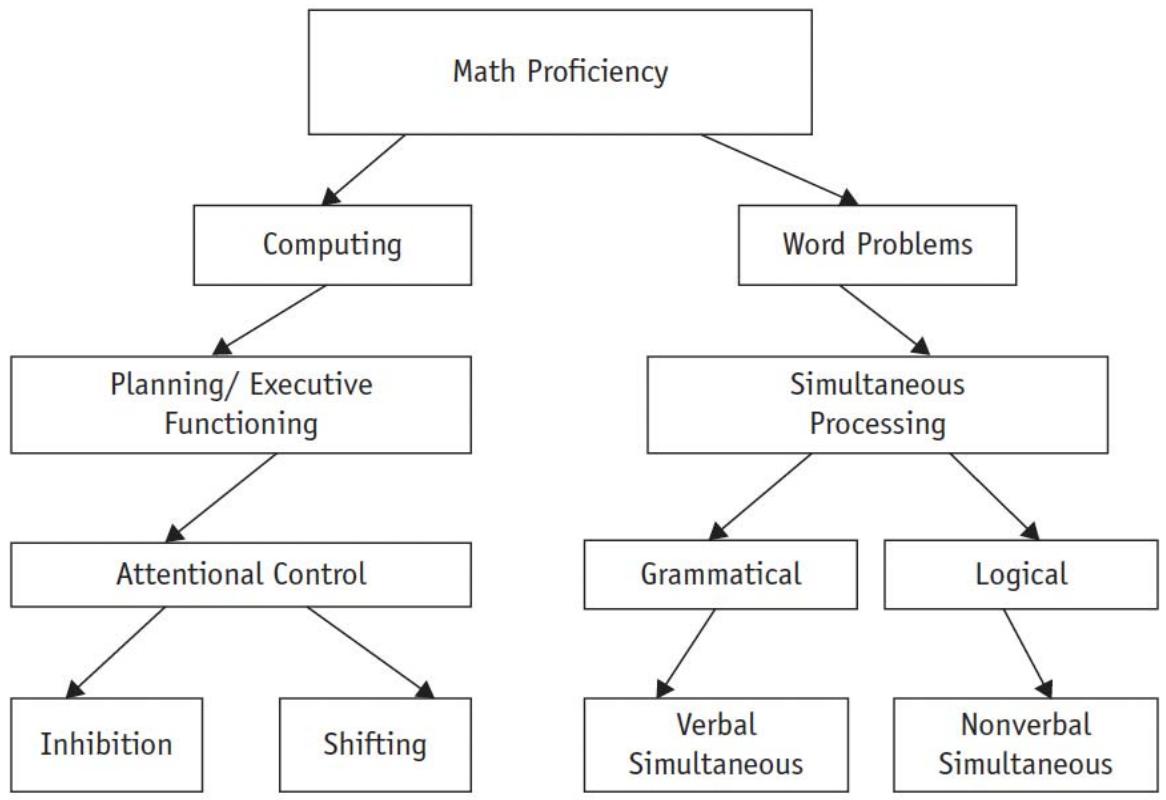
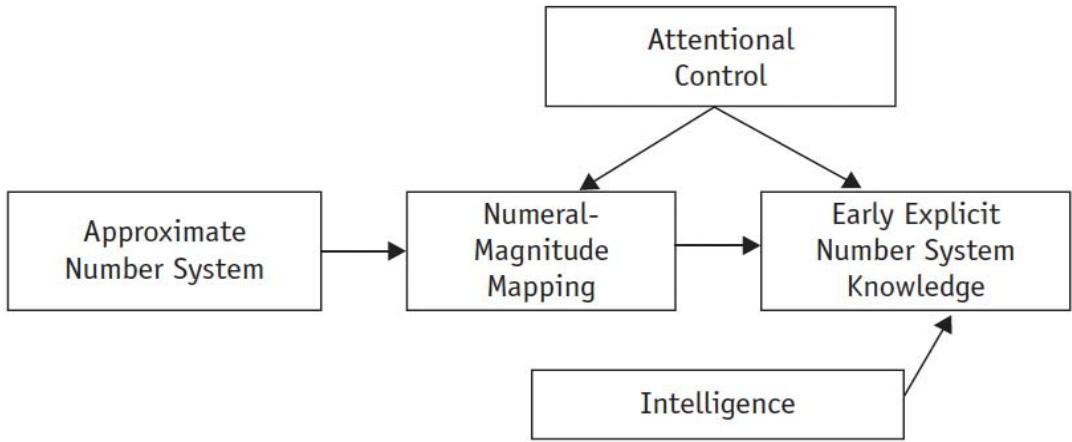 Figure 1: Overview of essential concepts of cognitive structure and functions of Math Modules
"Children who have a better ability to maintain effortful attentional control and focus— including a better ability to inhibit irrelevant internal distractions (e.g., something "popping up in mind) and external distractions (e.g., another child)— more quickly than their less attentive peer to maintain goal-relevant information in mind while processing other information, as measured by working memory" (Geary, 2013, pp. 23-24).
### c) More About Basic Skills In Learning Math
The Math Module Manual comprises specific modules related to basic skills required in math such as Number Line, Differentiating Size of numbers and Value, Visual search, Selective attention as in Stroop-like training tasks, Numerosity (counting), Simultaneous verbal and nonverbal reasoning, and Working Memory. Modules in the manual focus on the cognitive foundations of these skills as well as their application to
Basic curricula in math. We have attempted to cover 'the elements that are active in the beginning of children's math learning,' as Geary mentioned: the Approximate Number System, Numeral Magnitude Mapping, and Early Explicit Knowledge of Number Systems.
Several modules focus on EF enhancement, with tasks that fit the construct. Two types of processing have been identified within the construct of EF: Inhibition of a habitual response and shifting the response when a task changes (Chan et al 2008). Working memory and memory updating (a variation of the executive component of working memory) is a third type of task. Each of these will be discussed further as specific tasks for training are presented in Modules. Additionally, modules for Simultaneous Processing were made of common components of tests that assess the generic process adapted specifically for arithmetic problems and appreciation of geometry.
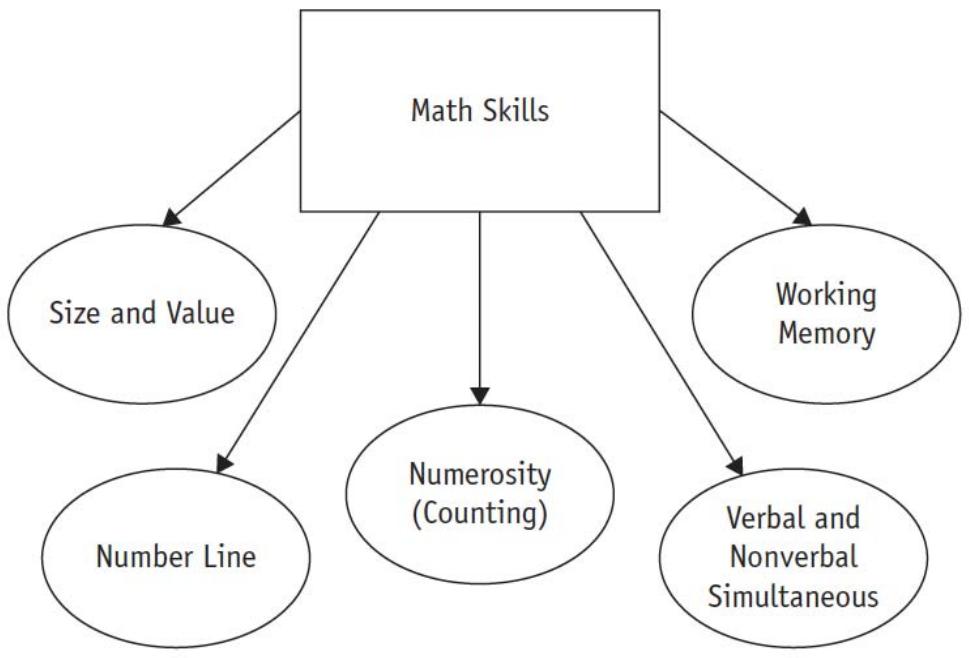 Figure 3: Five Math skills.
Note: This figure addresses Math Skills that are learned in beginning math. We have selected five skills that are most frequently mentioned in current literature and academia. They are presented in this figure in preparation for the specific modules that target and seek to improve 5 different mathematical operations taught through tasks that fit the concept or construct. These are the modules that are described below.
This manual comprises specific modules related to basic skills required in math such as Number Line, Differentiating Size of numbers and Value, Visual search, Selective attention as in Stroop-like training tasks, Numerosity (counting), Simultaneous verbal and nonverbal reasoning, and Working Memory (Figure 4). Modules in the manual focus on the cognitive foundations of these skills as well as their application to basic curricula in math. We have attempted to cover 'the elements that are active in the beginning of children's math learning' as Geary mentioned, the Approximate number system, Numeral magnitude mapping, and Early explicit knowledge of number system.
Several modules focus on EF enhancement, with tasks that fit the construct. Two types of processing have been identified within the construct of EF: Inhibition of a habitual response and shifting the response when a task changes (Miyake et al, 2008, Chan et al 2008). Working memory and memory updating (a variation of the executive component of working memory) is a third type of task. Each of these will be discussed further as specific tasks for training are presented in Modules.
Additionally, modules for Simultaneous Processing were made of common components of tests that assess the generic process adapted specifically for arithmetic problems and appreciation of geometry.
This figure highlights the titles of the different modules within this manual. Each module's objective is one of the Math Skills from the previous figure. These objectives are directly beneath each module title, italicized in brackets.
## The Modules
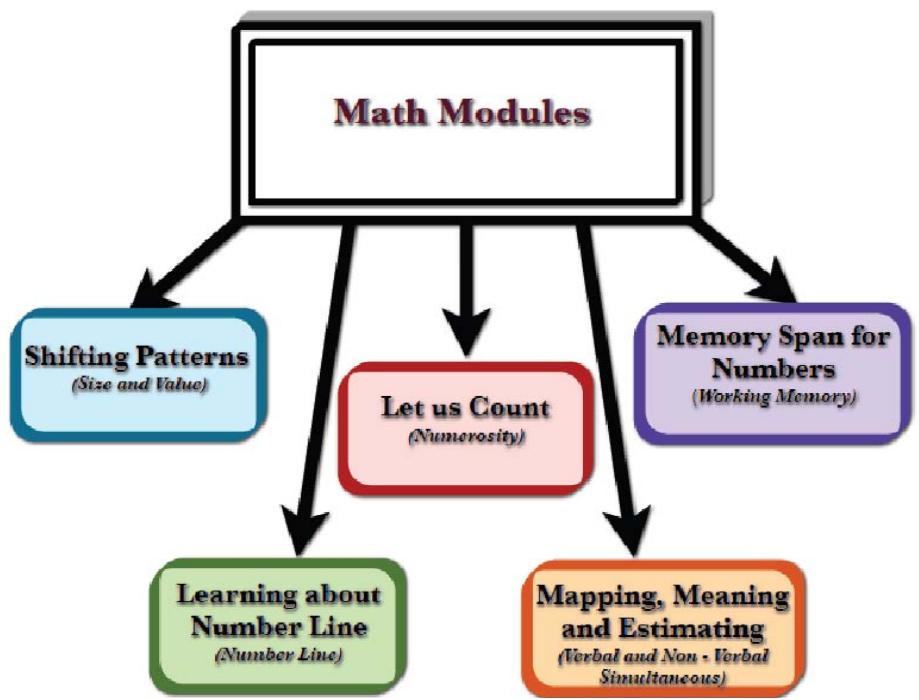 Figure 4: The Modules
Each Module contains an introduction and background discussion specific to the central focus of the module. Several items for training the cognitive operations required for the module. small group activities, which may also be administered as partner or individual activities Notice that the activities do not focus on practicing the mechanics of arithmetic: how to add, subtract, multiply and divide for example. They do not emphasize over-learning specific skills and computations. In other words, to make the procedures and concepts understood rather than learned by heart. Evidence shows that principles can be generalized to new problems, whereas practicing a particular skill is too specific to encourage transfer of learning.
Applying math knowledge also requires children to understand how to use special tools and procedures to complete specific operations that children do; add, subtract, multiply and divide. Children must be taught to understand the nuances and specific terms and conditions for carrying out even these basic operations. Children Doing Mathematics (Nunes & Bryant, 1996) is an excellent resource outlining how children should be helped to develop an understanding of simple arithmetic procedures and representation of rational numbers.
- Following your instructions for how to complete a particular task, always ask students to explain the instructions in their own words before they begin.
- Avoid using the tasks as "drill and practice" exercises to perfect students' performance.
- In tasks that involve arithmetic, don't let students struggle with numbers or they may become overly frustrated. Instead, move on to the next task.
- Encourage children to use verbalization so they can become aware of their own use of strategies Rather than being taught strategies by the instructor.
### d) Zone of Proximal Development
- "The distance between the child's actual developmental level as determined through independent problem-solving and that demonstrated under adult guidance".
e) Scaffolding
- Learning occurs as a result of scaffolding, which is the guidance and support provided to children as
they learn. It is temporary. As the learner becomes more and more capable, support is gradually withdrawn. Given below are stages of scaffolding.
- Interaction and collaboration are two critical keys to learning. Be sure to use the small group activities!
#### Stages of Prompting
#### Stage 1:
Provide a minimal amount of assistance and allow students to acquire strategies through experience.
#### Stage 2:
Guide students through task again without providing any specific strategies. Remember, your goal is to help the students develop their own strategies.
#### Stage 3:
Demonstrate the task and have the students attempt to explain the strategies that you used to complete the task.
As mentioned above, each Module contains an introduction and background discussion specific to the central focus of the module.
### A Module: Working Memory Training
MOUDULES FORMATH
### USING WORKING
### MEMORY
#### WORKING MEMORY (WM)
Two key components of learning to do mathematics are working memory and inhibition of distracting thoughts. Children's competence in mathematics now and at higher levels depends on these components and shifting strategies, when required. All three components are related. It is proposed that children of lower mathematical ability have a "lack of inhibition and poor working memory, which result in problems with switching and evaluation of new strategies for dealing with a particular task" Bull & Scerif (2001, P.273). These children are typically off task and frustrated.
Working memory (WM) involves two activities that must be carried out simultaneously -- storage and processing of information. It becomes especially difficult to do both when children are asked to solve a problem in their head. Since processing and storage compete for attention, and attention is a limited resource, we cannot really attend to two things at the same time. We are obliged to switch attention from one to the other. This is possible "through the incessant and rapid switching of attention between processing and maintenance" (Barrouillet & Campos, 2012, p. 414).
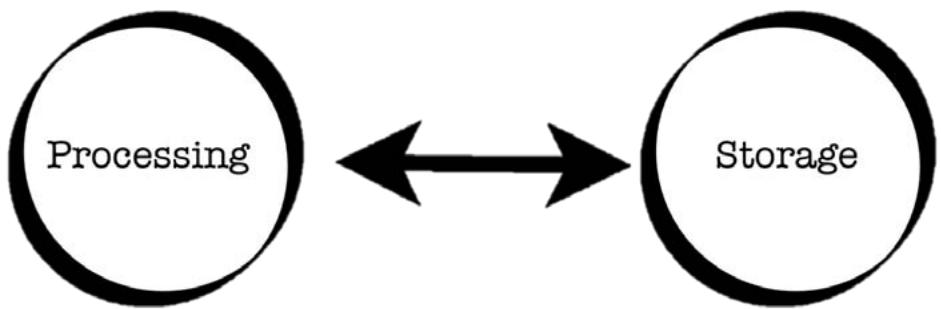 Figure 2: Attentional Control in Geary's Model
How can we improve working memory? Memory storage suffers if processing information takes more time. For example, let us compare easier and harder tasks in mathematics, particularly addition. A study on working memory was done with two different ages of children, 8-year-olds, and 11-year-olds. Both would be asked to add 1 to three different numbers and then the results would be compared. As we expect, older children will do better in recalling the numbers because they can process the information and add faster, leaving more time for memory storage. However, suppose we already have research to show that the speed of solving problems becomes equal if the 11-year-olds are asked to add 2. Their speed of processing is then the same as adding 1 for 8-year-olds. What would we expect --- equal time for recall, no difference between the older and the younger children? This indeed was confirmed by Barrouillet and Campos (2012).
Cross Modality Memory Span: from Visual to Speech
Domain General Training in Working Memory
Cross modal coding from visual presentation of "do-do" stimuli to mimic response in speech involves in all three units in the WM Model. These are the Central Executive and the two subsidiary divisions, phonological and visual/spatial units. Since integration of the two sources of information is required, we may include the episodic buffer (Baddley 2012). See Figure of revised WM Model up above.
We have constructed the WM intervention task that consists of two parts. In Part A, Cross Modal task requires visual/spatial presentation of dot clusters as shown below. The length of the rows of dots increases through trial by trial; recall is required in speech sounds "do-do do-do-do do" for the first panel, and the number of dots is increased in the second panel.
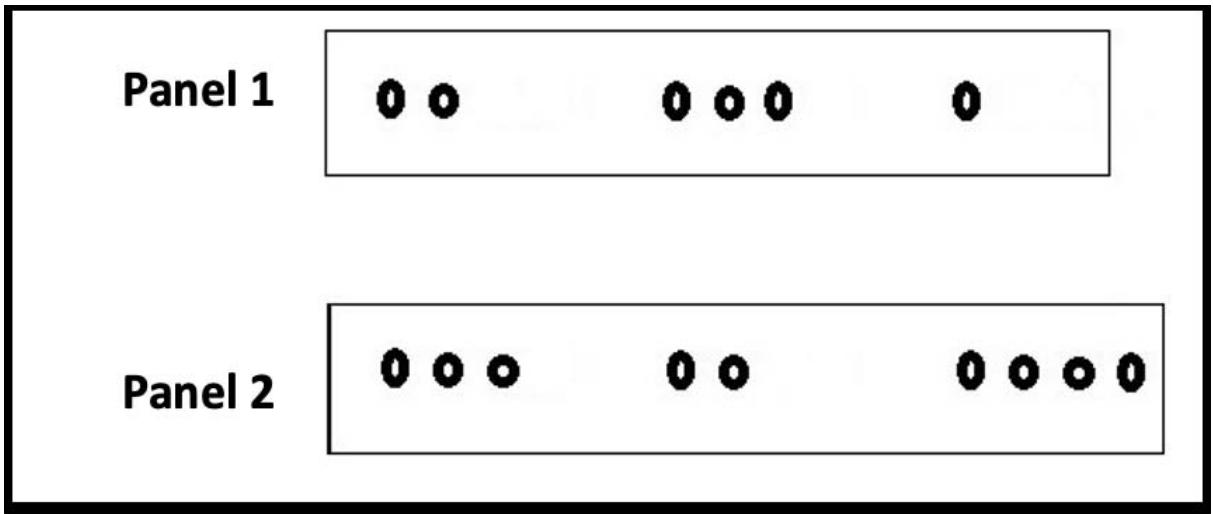
In the second part, Part B, backward recall is required. Therefore, the first panel backward or reverse response is "do/do-do-do/do-do." Backward span is accepted as a test of WM. An additional feature in this WM task is to give a break in the middle of session, and introduce 'self talk'. Participants are asked to think about how they did the task and what changes should they make in strategies for doing the reversal task, then do the remainder of the task. Self-talk has been shown to improve performance, and is used in cognitive training programmes such as Math Modules. (For more on Self-talk see page 8 in Introduction to the Math Module)
Domain Specific Curriculum Related Training
Task: Visual & Auditory (Alternate in Presentation)
#### DEMONSTRATION A
What the administrator says and does:
"We are going to play a game. I am going to give you a number such as 4 2 1 or 3 8 5 to remember. Sometimes I will show you the number printed on a card (Visual), or sometimes you will hear me tell the number (Auditory). Your job is to tell me the numbers you saw (visual) or heard (auditory) immediately after I either show or say the numbers. Let's practice!"
Examiner exposes the numbers 4 2 1 in print in the VISUAL condition OR says the numbers 3 8 5 in the AUDITORY condition. Wait for student to respond. "Let's practice again." Then switch and present the other stimulus. In other words, if you begin with the visual stimulus, present the auditory next. You will alternate between the visual and auditory.
After completing a practice round with both a visual and auditory stimulus ask the student, "Do you need more practice? If the student does not understand the task, or gets the practice items incorrect, or simply wants more practice say "Let us practice again." If NO, and student demonstrates comprehension of the task, go straight to Demonstration B on the next page.
Task: Visual & Auditory ADD 1 (+1)
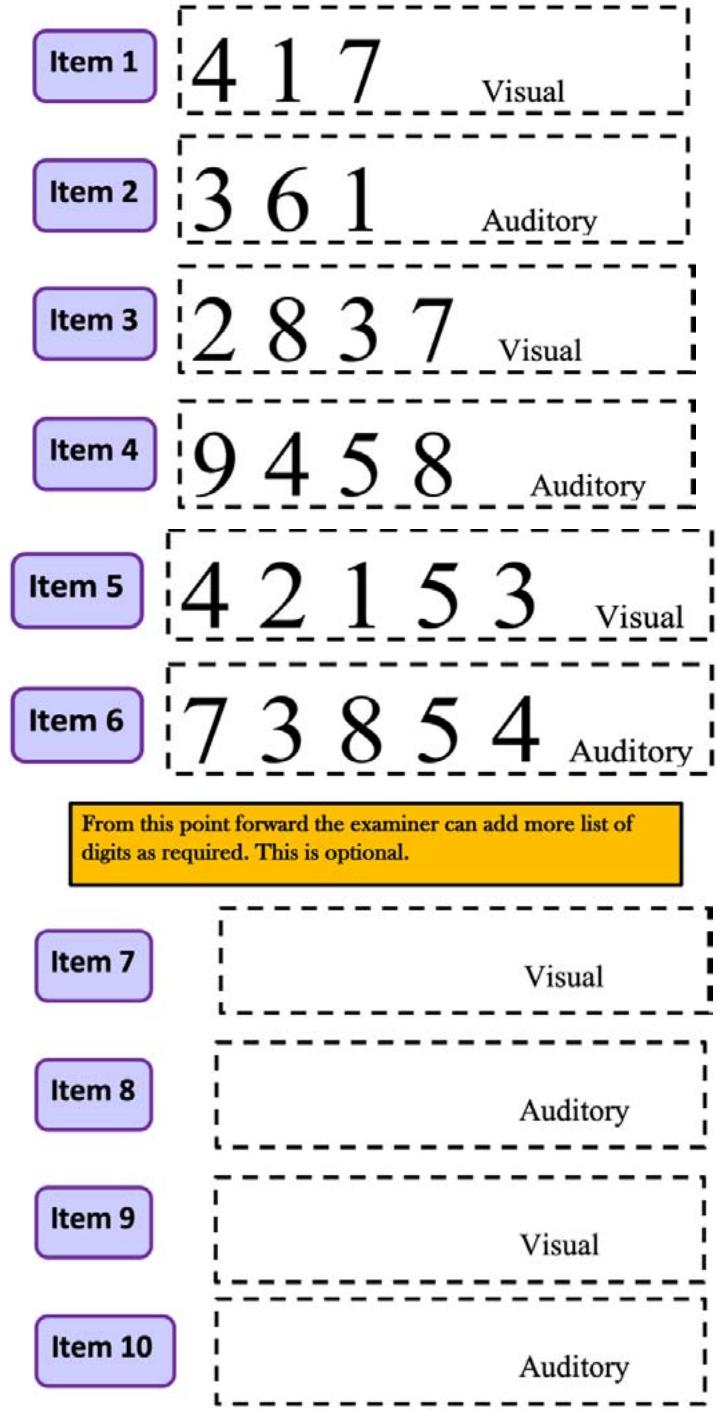
#### TEST ITEMS 1-6
What the administrator says and does:
"Now that we did a few practice rounds, let's do the real thing. There will be more numbers this time. Are you ready?" Alternate between visual and auditory, as labelled on the cards. In the Visual condition, SHOW the card to the student. Whereas, in the Auditory condition, SAY the numbers on the card to the student (DO NOT SHOW). The test items are listed below.
Immediately correct ALL errors. Provide additional help as needed.
Examiner can add more lists of digits (as required).
Two Empirical Research Reports on Efficacy of Math Modules:
Math Modules Training improves Math Achievement & associated cognitive processing.
Manuel Deano, Sonia Alfonso, Antonio M. Diniz, Valentín Iglesias-Sarmiento, and J.P. Das
Previous research points to a correlation between mathematical skills and cognitive processes involved in planning and simultaneous processing. Consistent with multicomponent models of mathematical achievement (domain-general and domain-specific skills), PASS theory appears to be very useful as a multifactorial framework that provides specific tests to monitor the development of mathematical competence and to direct intervention procedures and improve mathematical skills. Objective: This study was conducted to assess the impact of the Math Modules Cognitive Training Program on the mathematical competence of typical 2nd-grade students in calculation, problem-solving, and underlying mental functions, compared to a control group. The program was designed to optimize the Planning/FE, Attention, Simultaneous, and Successive cognitive processes through a series of tasks. Participants: The study involved 60 students aged between 6 and 8 years $(\mathrm{Mdn} = 7$ years and 7 months), who were in the second grade of two urban public schools. Method: The program focused on mathematical skill tasks related to fluent calculation and mathematical problem solving that requires PASS cognitive processes for successful completion. The intervention group received the Math Modules program, and the control group followed their usual classroom program. Students were evaluated in calculation, problem-solving, and PASS cognitive processes. Results: Our results showed that the Math Modules Cognitive Training Program focused on calculation and problem-solving skills were effective in improving children's mathematical performance and their PASS cognitive processes, generating gains not achieved by the control group. Conclusions: Our study suggests that fluid calculation and problem-solving math tasks, based on planning and simultaneous processing, could foster curricular math competency.
Report 2: Journal of Intelligence (in press)
Improvement of math ability and cognitive processing in children with low attention: A math intervention study
Yongjing Ge, Dan Cai[^1], Mingyue Wang[^2] Ada W.S. Leung
The study investigates the effects of math intervention among 8- to 9-year-old students with low attention ability. Fifty-six students with low attention ability were divided into 24 in the treatment and 32 for the control group. Pre-test and post-test assessments included math problem-solving, calculation fluency and PASS cognitive processing tests for both the treatment and control participants. Children in treatment intervention group received 3 days of intervention per week for a total of 21 days using The Children's Mathematics and Cognition Training Manual in Chinese (Das & Cai, 2017) based on the Math Modules (Das, 2020; Das & Misra, 2015). Results show that math intervention programmes are successful for improving math problem-solving in children with low attention. Notably, the Math Module intervention enhanced the cognitive performance on CAS2 in planning, attention, and simultaneous processing tests. Finally in conclusive remarks we discuss the high and low roads to transfer, and Vygotsky's Zones of Proximal Development.
## III. LIMITATIONS
The present review does not provide a contemporary picture of Math Cognition. It does refer to widely known authorities such as Butterworth, Dehaene and the views of Nunes & Bryant on how children learn mathematics. However, it does not contain a masterly review and critique of the ideas and writings of these and other 'authorities' working with math cognition.
About providing several studies that examine the efficacy of Math Modules by following the usual design of evidence-based studies –random assignment of participants to treatment and control groups, and double-blind examiners. Not only in or two studies, but preferably by a fair number of studies. We have been warned that without such 'evidence' the programme will not sell. We are in a catch 22 situation—if the program will not be used unless we provide such iron-clad evidence, none may use it, and unless several people use the program, we cannot gather such evidence.
Another line of research that has not been included is Neuroscience-informed math understanding, but also how important it is to model intervention informed by neuroscience in training Working Memory or enhancement of Executive functions. This is an agenda for future research.
## IV. CONCLUDING REMARKS
Let us think again. Are we seeking testimony from the authorities? Probably collecting more and more empirical 'proofs? empirical evidence? Alternatively, we are interested in constructing validity of the program, a theoretical construct. Construct validity is a concept used in research to ensure that the measurements being used truly represent the theoretical constructs they are supposed to assess. To extend this line of thinking, we construct a hypothesis that is derived from a theoretical base and test if it is true or false. A hypothesis is fallible. Fallibility then leads to propose another hypothesis. It is an infinite process. And that is how knowledge expands (Deutsch, 2011).
Back to validity of Math Modules. Since construct validity ultimately leads to a theory, like in our case, validity of math modules based on well-defined theoretical constructs. We are not limited by multiple direct observations. That is by collecting evidence after evidence. Quoting Popper—all observations are theory laden. Thus, we are left with a plausible theory. The theory is a brain-based hypothesis (Das, 2018).
A brain-based approach can provide a framework for intelligence, for integration of biology and cognitive processes that have direct implications for education and brain plasticity. Cognitive processes specifically link with functional systems in the brain (Luria, 1966, 1970; Goldberg, 2001).
Proving the efficacy of the theory in terms of sales is not the major consideration. In our quest for a theory or explanation in science, we are not to judge the theoretical justification of Math Modules in terms of its popularity.
At the beginning of the present review, a citation from Vygotsky served the binding 'mantra' LET US REMEMBER ONE THING: What a child cannot do today, he or she can do it tomorrow with help. The Math Module book is dedicated to Vygotsky. Pivotal concepts of Vygotsky motivated the construction of Math the cognitive training program and guided its structure. Actualizing Vygotsky's major approach has been possible through the execution of the problems in each module. The instructors invariably encourage children to use verbalization so they can become aware of their own use of strategies. Rather than being taught strategies by the instructor, in doing so, move ahead through Zone of Proximal Development (ZPD) 'the distance between the child's actual developmental level as determined through independent problem-solving and that demonstrated under adult guidance strategies. Scaffolding is an elaboration of ZPD. Learning occurs because of scaffolding, which is the guidance and support provided to children as they learn. It is temporary. As the learner becomes more and more capable, support is gradually withdrawn. Interaction and collaboration are two critical keys to learning.
The sole aim of a cognitive program is not to be evaluated in terms of instant increase in achievement scores, but to enhance cognition.
So, at the end of the day, what motivates us is to propose a theoretical base for Math Module. To repeat, Deutsch emphasizes that while applications_of scientific knowledge often emerge as by-products of successful theories, the fundamental goal of science is to develop explanations that increase our understanding of the natural world.
The task of man is to drop a pebble into the pond of time, and we may not see the ripple touch the distant shore. We may plant the seed but may not see the harvest—Radhakrishnan.
Supplementary Materials: The Math Module are available from the publisher. Publisher: Total Solutions, Hyderabad c/o Dr. Pooja Jha.
Generating HTML Viewer...
References
29 Cites in Article
P Barrouillet,V Camos (2012). As time goes by: Temporal constraints in working memory.
B Butterworth (1999). Change of “Editor-in-Chief” of Metabolic Brain Disease.
R Bull,G Scerif (2001). Strategy generation and evaluation in children's solutions of simple arithmetic problems: The role of executive processes.
Julie Busse,Virginia Berninger,Donna Smith,Denise Hildebrand (2001). Assessment for Math Talent and Disability: A Developmental Model.
R Chan,E Chen,D Shum,T Toulopoulou (2008). Assessment of executive functions: Review of instruments and identification of critical issues.
J Das (2009). Reading Difficulties and Dyslexia: An Interpretation for Teachers.
J Das,Sasi Misra (2015). Cognitive Planning and Executive Functions: Applications in Management and Education.
J Das,K Dunn,G Georgiou (2020). The relationship of cognitive processes with reading and mathematics achievement in intellectually gifted children.
J Das,J Naglieri,J Kirby (1994). Assessment of cognitive processes: The PASS theory of intelligence.
J Das (2014). Consciousness Quest: Where East Meets West: On Mind, Meditation, and Neural Correlates.
J Das (2018). Brain-Based Approaches to the Study of Intelligence.
S Dehaene (1997). The Number Sense.
D Deutsch (2011). The beginning of infinity.
David Geary (2004). Mathematics and Learning Disabilities.
David Geary (2013). Early Foundations for Mathematics Learning and Their Relations to Learning Disabilities.
E Goldberg (2009). The New Executive Brain.
Jackie Iseman,Jack Naglieri (2011). A Cognitive Strategy Instruction to Improve Math Calculation for Children With ADHD and LD: A Randomized Controlled Study.
A Luria (1970). Traumatic aphasia: Its syndromes, psychology, and treatment.
A Luria (1973). The working brain.
Aleksandr Luria (1966). Investigation of the Higher Visual Functions.
A Miyake,N Friedman (2012). The Nature and Organization of Individual Differences in Executive Functions: Four General Conclusions.
A Miyake,N Friedman,M Emerson,A Witzki,A Howerter,T Wager (2000). The unity and diversity of executive functions and their contributions to complex "Frontal Lobe" tasks: a latent variable analysis.
T Nunes,P Bryant (1996). Children Doing Mathematics.
I Pavlov (1941). Lectures on Conditioned Reflexes. Volume II: Conditioned Reflexes and Psychiatry.
(1994). René van der Veer and Jaan Valsiner. Understanding vygotsky: A quest for synthesis: Cambridge: Blackwell, 1991. 450 pp. (Reviewed by Carl Ratner).
Robert Siegler,Julie Booth (2004). Development of Numerical Estimation in Young Children.
Explore published articles in an immersive Augmented Reality environment. Our platform converts research papers into interactive 3D books, allowing readers to view and interact with content using AR and VR compatible devices.
Your published article is automatically converted into a realistic 3D book. Flip through pages and read research papers in a more engaging and interactive format.
The abstract outlines the content of a review on Math Modules, a program designed to facilitate the learning of foundational math skills through cognitive training techniques that are based on theory with a special focus on planning and executive functions, encompassing cognitive flexibility, attentional control, and working memory. The guiding educational principle is drawn from Vygotsky’s concept of zones of proximal development, highlighting the belief that children can accomplish tasks with assistance that they may struggle with independently. In a way, the structure of cognitive training Modules can be viewed as an attempt at construct validity. A review of historical roots of Math modules is presented at some length. The program begins with the division of training the two key components of math proficiency: computing and solving word problems. Both rely on five essential skills.
Our website is actively being updated, and changes may occur frequently. Please clear your browser cache if needed. For feedback or error reporting, please email [email protected]
Thank you for connecting with us. We will respond to you shortly.