
I. INTRODUCTION
In the literature, we find PVC in many sectors especially in packaging, electronics, electrical, aeronautical, naval, automotive, building construction, household, toys, entertainment and many others. PVC offers the advantages of mixing with other materials without complications, especially during its manufacture or shaping. This characteristic makes polyvinyl chloride (PVC) plastics a material that is financially accessible to all .
Engineers use the materials in constructions according to specifications. In order to respect them, the engineer looks for the performances and the general characteristic parameters of the materials that they must use to satisfy his customers.
The work of characterization of plastic materials loaded with calcium carbide has known several advances because calcium carbide is the load by excellence used in the past. Its availability and especially its low cost and its shaping techniques facilitate its predominance in the world of plastic as a load. For this reason, in the characterization of plastic materials loaded with calcium carbides, several results are already recorded in journals and international standards already have banks of results in various characterizations.
It should be noted in passing that the plastic material loaded with calcium carbide has had a long period of negativity, particularly in the area of environmental pollution, due to its non-biodegradability and non-recyclability at the end of its life . The consequences of this have led the human communities of the world to draw the attention of the public power, which has led the researchers to find a solution. This solution, which turned out to be positive by the addition or total substitution of the calcium carbide load by vegetable fillers in the chemical composition during the production of my plastic material, began to be a concern of researchers: hence the appreciation of the work here present.
Thus, several works in the substitution of calcium carbide by another load today is in full evolution. More and more, publications in scientific journals confirm the feasibility of using vegetable and animal loads in the production of plastics as a load especially for reinforcement .
The validation of the work in new materials goes through a series of characterization, in order to determine the intrinsic properties of the materials. These properties allow the engineer to validate and enhance the new material by using it in construction in general and allow international standards through publications to generalize them.
Thus, the work presented here, which consists of a study of the influence of palm kernel shell powder on the thermal behavior of extruded PVC tubes, this new material as those encountered in the literature, , must highlight the characteristic thermal parameters of the said material leading engineers to use it in constructions.
This work will consist in elaborating mathematical models to determine the characteristic parameters of PVC tubes to be extruded as a function of the dosage of palm kernel shell powder from the results of the practical thermal characteristic parameters of extruded PVC tubes loaded with palm kernel shell powder at dosages ranging from 0% to 51.02%
Taking into account the studies in the use of the shells of palm kernel dura as load for the polymers and that of the elaboration of the tubes PVC loaded with the powder of shells of palm kernel , we obtained by the results that the shells of palm kernel are integral part of the materials that absorb heat and conserve it for a long duration. This study allows us to validate the use of palm kernel shells as a new material for heat conservation, since it was designed to solve thermal problems for engineers.
In the same way, this study allows to extend the research on the use of the shells of palm kernel on several polymers with the aim of solving the problems of exchange and exploitation of the heats for the resolution of the problems of the humans I quote coating of the walls, clothes for stays in localities with cold climate, protection of the objects requiring the conservation of the energies.
Then, a brief presentation of the materials (tubes extruded PVC loaded with the powder of shells of palm kernel dura) obtained in the previous works , then the results from the tests in laboratory of the thermal analyses carried out will be made. Then, mathematical models will be elaborated and presented, which will allow the engineer to choose the dosage of the shell powder according to the thermal characteristics of the PVC tubes to be extruded, or to choose the thermal characteristic parameters of the tubes (plastic materials) from the solicitations calculated according to the dosage of shell powder. Also the study of the heat absorption as a function of the decrease in the mass of the PVC loaded with palm kernel shell powder will be carried out. Finally an application of the obtained mathematical models will be carried out to determine the characteristic parameters of the extruded PVC tubes at calculated dosages whose analyses could not be carried out.
II. MATERIALS AND EXPERIMENTAL METHODS
a) Materials
i. Materials of the study
The materials are PVC tubes which were elaborated industrially according to the methodology described in the work of Djomi and his team [9]. They were elaborated in the company SOFAMAC (Société de Fabrication des Matériaux du Cameroun) located in SOA, city of Yaoundé in Cameroon [10]. As a reminder, we used an industrial twin screw extruder for the extrusion. The extrusion was carried out continuously without interruption. The working conditions were the same. The dosages in terms of extrusion additive remained the same as when using calcium carbide as load. The only load used here is micronized palm kernel shell powder, the processing and characterization of which was described in the work of Djomi et al [8].
The raw PVC used was purchased from DANSUK & Cie [11] by SOFAMAC, one of the company's customers. The additives are those commonly used by SOFAMAC to satisfy the Cameroonian people in terms of plastic materials for construction for many years.
We produced the unloaded PVC tubes which we called F0, then we produced the PVC tubes loaded with micronized palm kernel shell powder with the following percentages: 4.01% called F4.01; 12.54% which we called F12.54; 23.03% called F23.03; 32.01% called F32.01; 38.02% which we called F38.02 and 51.01% called F51.0.
The tubes were checked by the team of the standards of the company in accordance with the respect of the laws that regulate the production of plastic materials in the companies of the production of plastic materials.
Figure 1 shows the photographs of the elaborated tubes for each formulation. We point out here after that we will call each tube by the percentage of the dosage of palm kernel shell powder as shown in figure 1.
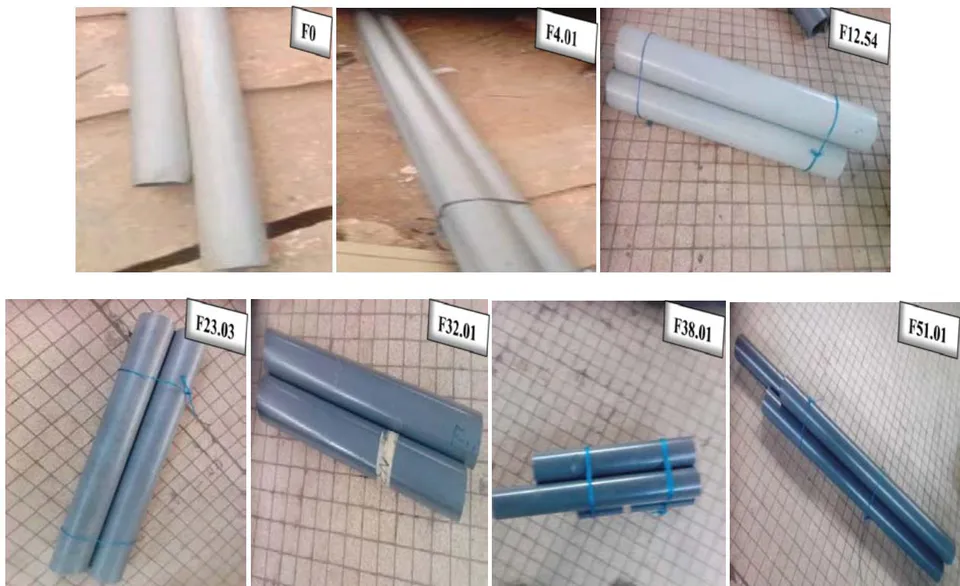
From figure 1, we will say as a reminder that:
– All tubes are perfectly round.
The colors go from light grey for F0 to black grey for F51.01 passing through grey and dark grey, confirming the presence of the purple color of the load of the micronized palm nut shell powder and the presence of the carbon black of the extrusion additives.
The surfaces range from smooth shiny for F0 tubes to rough for F51.01 tubes confirming the presence of the micronized palm kernel shell powder in the tubes.
The diameters are exactly 82mm for the internal diameter and 90 for the external diameter confirming the qualities of the dies and the seriousness of the company.
ii. Materials for the characterization:
Preparation of the specimens:
- 01 sieve: the sieve is AFNOR grade .
Machine of analysis:
The machine used for testing have been described in several works in which the laboratory was requested for thermogravimetric and differential analysis [8, 9, 12, 13]. As a reminder, the analysis machine is a Instrument brand LENSEIS; TGA/HDH Automatic robot, software incorporated into the machine with data acquisition controlled by computer; crucibles aluminum oxide, capacity 150mg; having a wide range of speed of measurement. The combustion gas is oxygen or nitrogen.
b) Experimental methods
i. Preparation of the specimens
We take the tube of a given formulation. We cut out some strips that we make into powder with an ordinary scraper. The powder is poured into the mortar and with the pestle we reduce the powder of the scraper into a very fine powder. We use the sieve to obtain a sufficient quantity which will be weighed with the balance before conditioning to await the analysis.
ii. Thermogravimetric and differential analysis
This methodology has been described in several works in which the laboratory has been requested for thermogravimetric and differential analysis .
As a reminder: The thermogravimetric and thermodifferential analyses were carried out on a LINSEIS STA PT-1000 C thermal analyser with the type Platinum Evaluation V1.0.182, coupled to a computer and programmed for this purpose. The thermal treatment of the device ranges from room temperature (20-35°C) to 1000°C. The heating rate varies between 1°C and 100°C. The crucible is made of alumina oxide with a capacity of 150 mg and a control crucible of alumina. The mass of the powder to be characterised is
20 to 25 mg. The load mass is between 100mg and 125mg; the initial heating temperature depends on the ambient temperature at the time of measurement. The heating rate according to the literature is . The computer plots the ATG/DSC thermograms by recording the data. We carry out the analyses in the Laboratories of Physicochemistry of Materials of the Faculty of Sciences of the University of Yaoundé 1-Cameroon.
III. RESULTS AND DISCUSSIONS
a) Results of the preparation of the samples
The specimens prepared for the thermogravimetric and thermodifferential analyses are
i. Curves obtained from the analysis machine of each tube
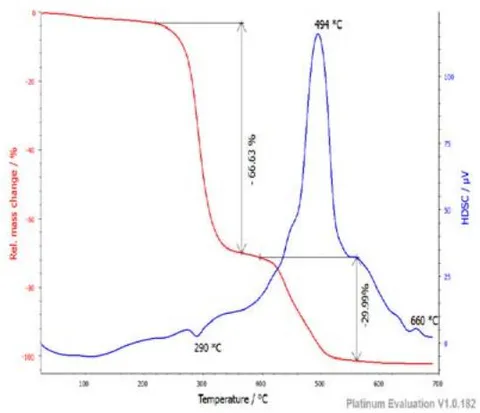
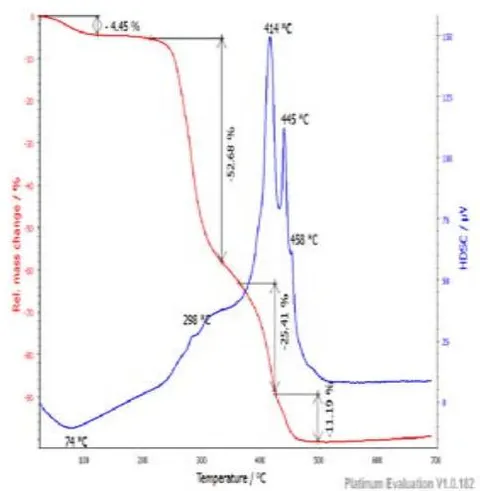
Figure 2 is the TG/DSC thermogram of PVC tubes unloaded with palm kernel shell powder while Figure 3 is that of F12.54 of PVC tubes loaded with 12.54% of palm kernel shell powder. Then, Figure 4 is the TG/DSC thermogram of F32.01 of the PVC tubes loaded with 12.54% of palm kernel shell powder while powders crushed with a pestle and mortar and then packaged in plastic bags to comply with the standard.
b) Results of thermogravimetric and differential analyses of elaborated tubes
We elaborated 7 materials and we were given 4 thermograms with the data of the recordings of the curves. The figures 2, 3, 4 and 5 represent the curves of the elaborated tubes obtained from the LENSEI machine.
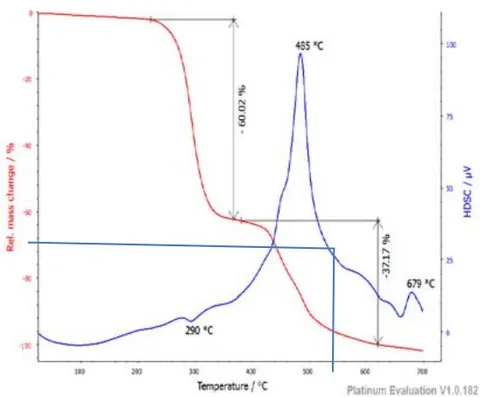
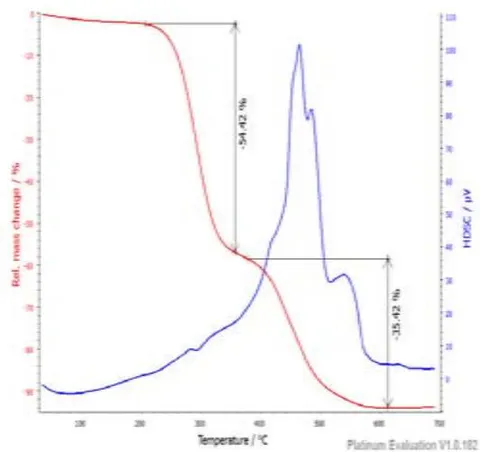
Figure 5 is that of F51.01 of the PVC tubes loaded with 51.01% of palm kernel shell powder.
We obtain from the 4 curves that all have the same curves representing the curves of PVC in general according to the literature [8, 14, 15].
We note for the 4 curves that the particular point which marks the temperature at which the TG curve meets the DSC curve is totally different for all formulations. This divergence reassures that the thermal characteristic parameters of the material will be different
ii. TG/DSC curves obtained from the recordings of each tube
from one formulation to another. This explains precisely why palm kernel shell powder influences the thermal properties of PVCs loaded with palm kernel shell powder
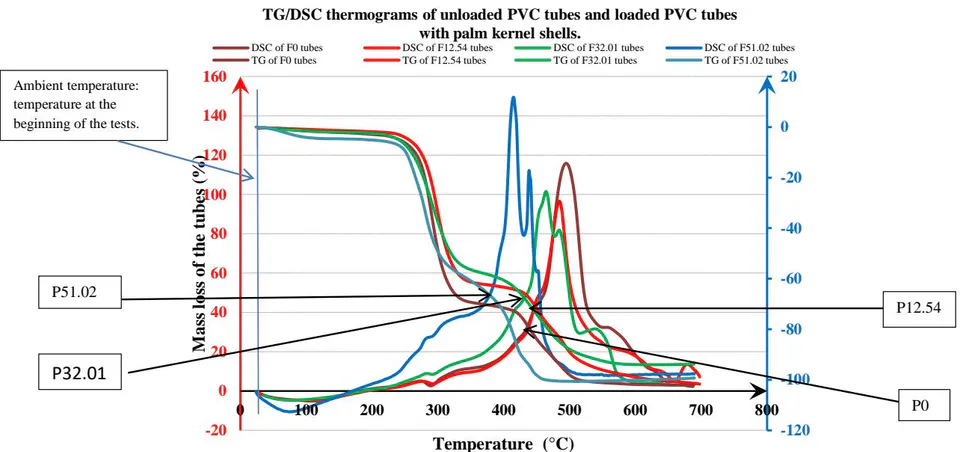
We obtain from figure 6 that the point P which is the particular point representing the meeting of the TG and DSC thermograms of the tubes of each formulation is totally different from each other justifying the differences in the thermal results of the tubes of each formulation. We obtain that the temperatures of P0, P12.54, and P32.01 are very close explaining that the thermal behaviors will also be different but close.
The point P51.01 is very low, below C while the other points are almost above this temperature, we can undoubtedly understand that the 4 materials will have a tendency to present a ductile mechanical behavior for low loads in palm kernel shell powder as from F0 to a neighborhood of F12.54, that the material of the tubes F31.01 and its neighborhood will have a tendency to a semi-fragile behavior and those of F51.01 will have a tendency to a fragile behavior.
Moreover, we note that all the tubes have the start of the recordings higher than 0 (zero), which means that the start of the analyses is a function of the temperature at the time of the tests (ambient temperature). But this ambient temperature does not affect the quality of the results of the analyses. Also, we obtain that all the temperatures of phase change that it is in the TG as in the DSC, as close as it is, are all different.
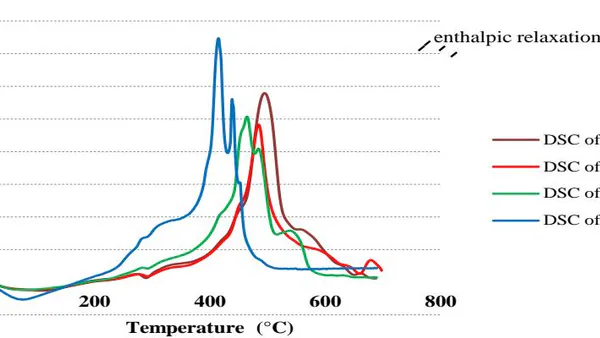
Finally, let us point out the very strong heat absorption of the overloaded tubes (F51.01) before the relaxation. This can be explained by the work on the characterization of dura palm kernel shells from
Cameroon as a load for synthetic polymers: case of PVC [8] where we note that palm kernel shells absorb heat slowly and retain it for a long time while PVC absorbs heat quickly and calcines quickly. This explains the double enthalpy relaxation when the PVC is overloaded and the amount of heat required to reach the ash high.
From the data of the recordings, we present the separate TG and DSC thermograms of the tubes in order to better observe the physical behavior of the materials and the evolutions of the heat absorption until the degradation. This will allow us to highlight the results resulting from the analysis of each material at different phase changes .
iii. DSC curves of the analyzed tubes
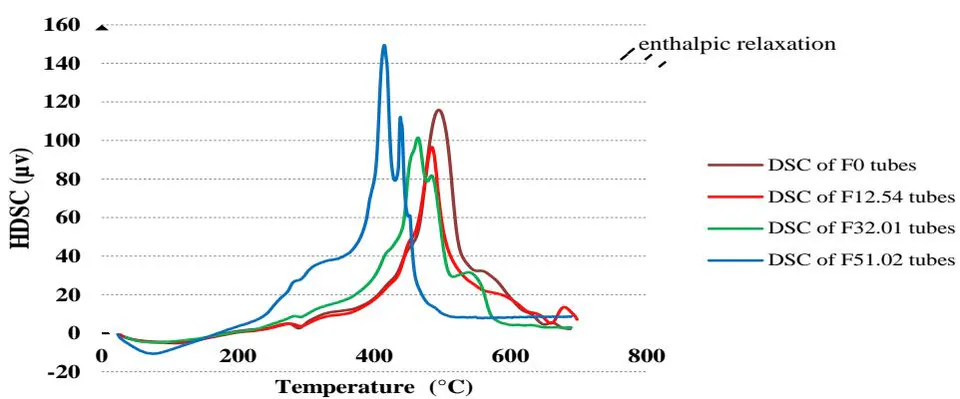
We obtain from Figure 7 for all materials the classical domains for a PVC [14] namely: the wet domain sanctioned by its moisture content (Th), followed by the glassy domain at temperatures below the glass transition (Tg); the rubbery domain, between Tg and cold crystallization (Tcf), the semi-crystalline domain between cold crystallization and melting (Tf). The molten liquid domain (Tlf) and finally the ash domain (Tce). We observe, confused with the glass transition, a fine endothermic peak reflecting a phenomenon called enthalpic relaxation [16]. Cold crystallization is a typical phenomenon of high molecular weight polymers. During the cooling of the molten (liquid) polymer, the latter, because of its high molar masses and the great length of its macromolecular chains, does not manage to crystallize. The liquid polymer then freezes in a disordered state which is the glassy state. When this amorphous polymer is heated, its chains start to vibrate and eventually acquire enough energy to start moving and eventually, after the passage of the glassy transition, adopt positions favorable enough to crystallize before passing to the ash state. This phenomenon has been observed in the literature , and then argued in work based on PVC thermogravimetry .
iv. TG curves of the analyzed tubes
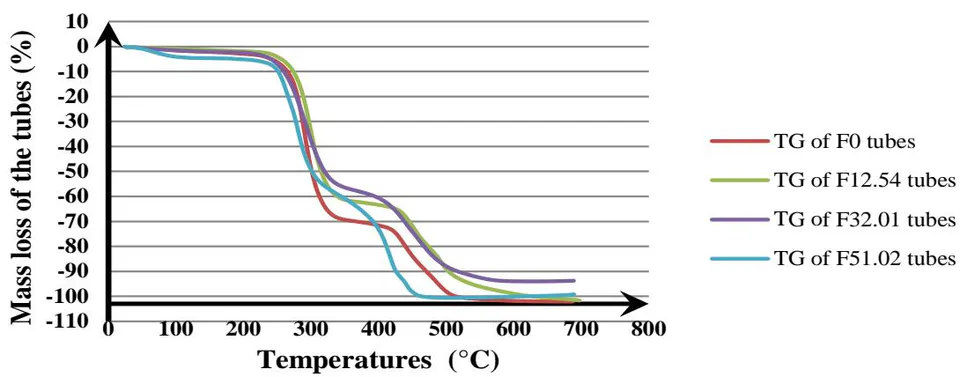
From figure 8, we obtain for all materials that:
The dehydration starts around and ends at the temperature Th and leads to a loss of mass Mh. it is the disappearance of free water (H2O).
The dehydrochlorination begins towards the temperature THCl by losing a mass MHCl. This phase corresponds to the disappearance of HCl and polyene structures, and the possible formation of benzene, naphthalene and phenanthrene.
The condensation starts around the temperature TCO by losing a mass MCO. A significant amount of HCl is released, the polyene molecules rearrange and, through cyclization reactions, the cross-links form aromatic hydrocarbons and cullet.
The fragmentation starts around the temperature Tfr losing a mass Mfr. The C-C bonds that formed the polymer chains and the hydrocarbons are broken. A large part of the material is pyrolyzed. A residual cullet remains at temperature Tcar losing a residual Mcar mass.
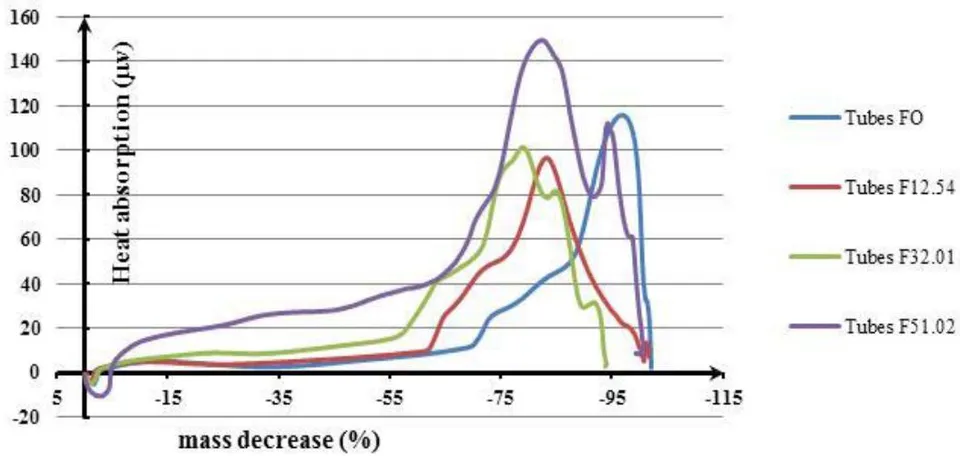
PVC tubes are subjected to an increasing temperature rise of C/min. Thus, to reach total ash, a material must absorb heat. Thus, Figure 9 above represents the thermal behavior curve of the physics of heat absorption as a function of mass decrease). This means that a plastic material that has been obtained using PVC as matrix and palm kernel shell powder as load, when subjected to a temperature rise (case of fires or case of heated enclosures such as heat engine environments and habitats in areas with strongly cold climate), then:
For unloaded PVC and PVC weakly loaded with palm kernel shell powder, we get that the PVC first contracts by losing a quantity of mass, this loss of mass allows it to take its thermal equilibrium and enter the glass transition. When the heat continues to increase, it absorbs heat very weakly (less than ) by decreasing its mass very quickly (up to more than 60%). The phenomenon of physical mass concentration results in the entry into the melting zone where the PVC is considerably softened and ready to flow. At this point, the removal of heat can still allow the material to solidify, but with a noticeable physical deformation. The PVC is already in its crystallization zone. Further heat absorption pushes the PVC to melt followed by fluidization. We observe a strong conservation of the mass and a brutal absorption of heat which leads to an ignition followed by a total combustion of the whole material.
On the other hand, for PVC tubes loaded with hull powder in large quantities, the materials subjected to a continuous rise in temperature first contract and then equilibrate. This is a phenomenon specific to PVC. This is the entry into the glass transition. As a result of their rise in temperature, the loaded PVC tubes absorb a considerable amount of heat (more than ) while also decreasing its mass (more than 60%), especially when it is loaded with palm kernel shell powder with a high percentage. The increase in heat shows that, the material absorbs heat suddenly and enters in combustion. The end of the combustion shows that a phenomenon called relaxation occurs before the total ash is concentrated. This phenomenon of the relaxation is translated by the absorption of the residues of the material which could not absorb sufficient heat to the combustion and sees itself obliged to reabsorb again before being transformed into total ash. This is justified by the curve of heat absorption as a function of mass decrease obtained in the work on the characterization of palm kernel shells as a load for polymers [8], where it is found that palm kernel shells absorb about of heat, retain it for a long time while decreasing in mass and immediately become ash. Thus, the phenomenon of relaxation is reflected in the fact that the PVC rises suddenly in temperature, the shell load has not yet absorbed the amount of heat necessary to become ash. So this powder absorbs heat again so that the entire initial mass of the material becomes the ash.
Physically and practically, when PVC takes on heat, it absorbs a large amount of heat without deforming: this is the behavior of PVC that allows plumbing departments to change the diameter of tubes without having to use bends. Thus, a scientific approach to the practice of pipe bending research shows that when the amount of heat to be supplied to the PVC is insufficient, such as glass transition, then increasing the bending diameter becomes impossible. Also, if the PVC is supplied with abundant heat, it will rather deform and the tube will create a kind of burning in the concerned area. Many such situations are applied in companies by engineers.
At the same time, we get from the point of view of experimental physics and applied PVC loaded with palm kernel shell powder that, the PVC absorbs very
c) Results of the Thermal Parameters of the Elaborated Tubes
i. Thermo differential analyses results of extruded tubes
little heat and to become very light (up to more than 70% of its mass down). By observing the behavior of palm kernel shells raised in temperature, these shells absorb a quantity of heat, retaining it for a long time before entering the combustion.
This phenomenon can be exploited by several constructions especially aeronautical constructions where the device must first be light and must systematically operate in a considerably cold and icy environment, by providing heat to the material, it becomes very light and it retains heat for a long time.
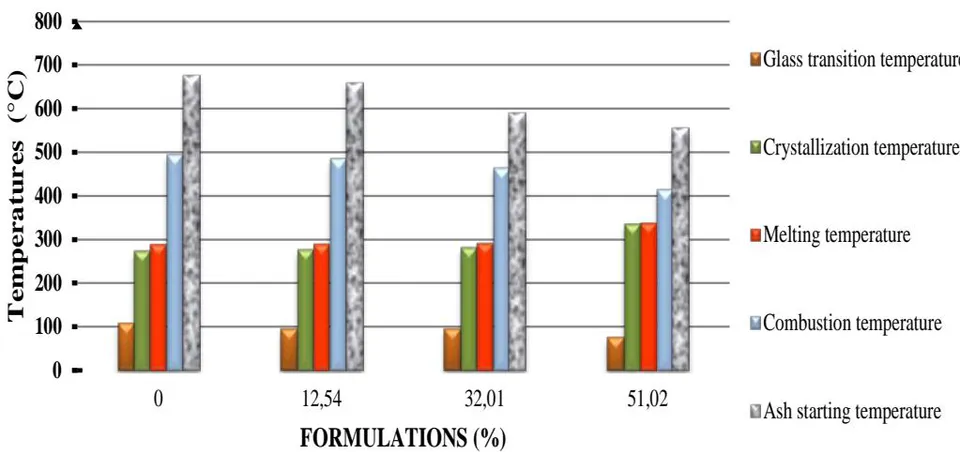
From the thermograms Figure 7 of the thermo differential analyses, in Figure 10, we obtained that:
The glass transition temperature (Tg) of the unloaded PVC tubes is Tg=108.78°C, that of the 12.54% loaded PVC tubes is Tg=98.58°C, that of the 32.01% loaded PVC tubes is Tg=96°C and that of the 51.02% shell powder loaded tubes is Tg=76.56°C.
The thermal combustion temperature (Tc) of the unloaded PVC tubes is Tc=494.71°C, that of the 12.54% loaded PVC tubes is Tc=485.58°C, that of the 32.01% loaded PVC tubes is Tc=464°C, that of the 51.02% loaded PVC tubes is Tc=414.56°C.
The temperature of the beginning of the ash (Tce) of the unloaded PVC is Tce=475.71°C, that of the PVC tubes loaded to 12.54 is Tce=659.58°C, that of the PVC tubes loaded to 32.01% is Tce=591°C, and that of the PVC tubes loaded to 51.02% of the palm kernel shell powder is Tce=555.56°C.
The DSC results confirm the observations of Corbet in his memotech [20] and Trotignon in "Précis de matières plastiques" [21]. These same observations are comparable to those obtained in several works validated by several newspapers . We obtained the glass transition of at unloaded PVC while the literature gives at unloaded PVC. This may be due to the percentage of plasticizer used. We have observed that the plasticizer rates used are higher than ours. Also Trotignon and Corbet reported that a high plasticizer content lowers the glass transition temperature of polymers . On the other hand, we observe, as in some works, that the vegetable fillers modify the glass transition temperature and associated with the plasticizer, this glass transition temperature is doubly affected when the rate of charge or reinforcement is high .
ii. Results of the thermal gravimetric behavior
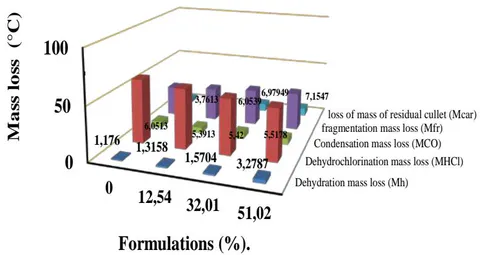
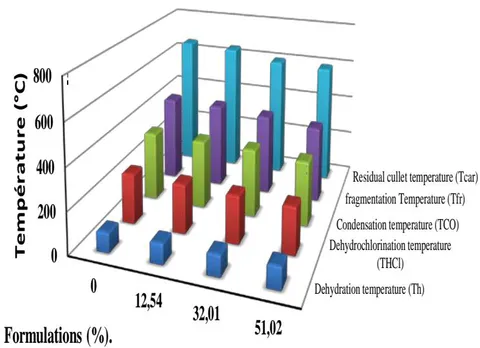
From the thermograms of the thermo gravimetric analyses of figure 8, we obtained the results of the phase change of the tubes. We consigned them in figures 11 and figure 12.
It appears that:
The dehydration temperature of the unloaded PVC tubes is Th=96.71°C and its mase loss is 1.176%, similarly the dehydration temperature of the 12.54% loaded PVC tubes is Th=99.58°C and its mase loss is 1.3158%, then the temperature of dehydration of PVC tubes loaded to 32.01% is Th=103°C and its mass loss is 1.5704%, finally the temperature of dehydration of PVC tubes loaded to 51.01% is Th=107.56°C and its mase loss is 3.2787%.
The dehydrochlorination temperature of unloaded PVC tubes is THC=244.71°C and its mase loss is 60.4106%, similarly the dehydrochlorination temperature of loaded PVC tubes at 12.54% is THC=238.58°C and its mase loss is 56.0327%, then the temperature of dehydrochlorination of PVC tubes loaded to 32.01% is THC=271°C and its mass loss is 51.8931%, finally the temperature of dehydrochlorination of PVC tubes loaded to 51.01% is THC=227.56°C and its mase loss is 48.5464%,
The condensation temperature of unloaded PVC tubes is TCO =335.71°C and its mase loss is 6.0513%, similarly the condensation temperature of loaded PVC tubes at 12.54% is TCO =333.58°C and its mase loss is 5.3913%, then the condensation temperature of the PVC tubes loaded at 32.01% is TCO =331°C and its mass loss is 5.42%, finally the condensation temperature of the PVC tubes loaded at 51.01% is TCO =314.56°C and its mase loss is 5.5178%,
The fragmentation temperature of unloaded PVC tubes is Tfr =420.71°C and its mase loss is 28.6009%, similarly the fragmentation temperature of loaded PVC tubes at 12.54% is Tfr =416.58°C and its mase loss is 31. 2063%, then the fragmentation temperature of the PVC tubes loaded to 32.01% is Tfr =357°C and its mass loss is 34.13701%, finally the fragmentation temperature of the PVC tubes loaded to 51.01% is Tfr =272.56°C and its mase loss is 35.5024%,
The ash starting temperature of unloaded PVC tubes is Tcar=657.71°C and its mase loss is 3.7613%, similarly the ash starting temperature of 12.54% loaded PVC tubes is Tcar=646.58°C and its mase loss is 6.0539%, then the starting temperature of the ashes of the PVC tubes loaded at 32.01% is Tcar=603°C and its mass loss is 6.97549%, finally the starting temperature of the ashes of the PVC tubes loaded at 51.01% is Tcar=594.56°C and its mase loss is 7.1547%
iii. Distribution of mass losses at phase transitions of thermogravimetric degradation of the analyzed tubes
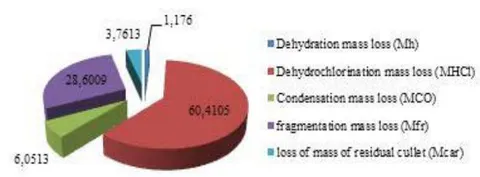
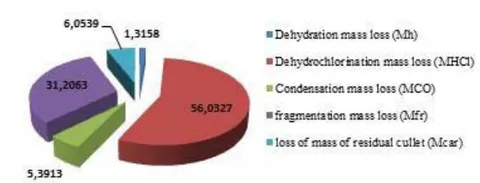
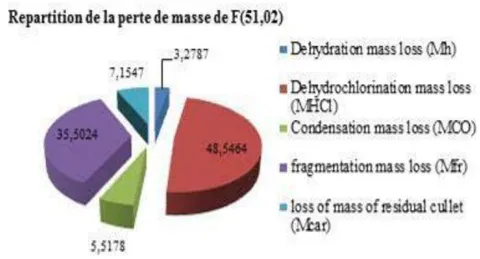
Figures 13, 14, 15, 16, below represent the distribution of mass lost during thermal degradation of tubes for each formulation.
Formulation F0: During the total dehydration of the unloaded PVC processed at 96.71°C, we record that it loses 1.176% of its initial mass: this is the free water that evaporates. The further rise in temperature causes the dehydrochlorination of the PVC which begins at 244.71 °C and ends at 335.71 °C losing 60.41% of its initial mass before condensing. At the end of its condensation at 420.71 °C, it loses 6.05% of its initial mass and then enters fragmentation, the totality of which is reached at around 657.71 °C, leaving residual cullet of 3.76% of the initial mass of the material: this is the ash. See figure 13.
Formulation F12.54: During the dehydration of PVC loaded to 12.54% of the powder of palm kernel shells at a temperature of 99.58 °C, we obtain that it loses 1.315% of its initial mass: this is the disappearance of free water. Then the rise in temperature creates the dehydrochlorination of PVC that begins at 238.58 °C and ends at 333.58 °C losing 56.032% of its initial mass before entering the condensation. Once condensation is complete at 420.71°C, there is a reduction in its mass equivalent to 6.05% of its initial mass, then fragmentation begins, which ends at 657.71°C, leaving residual cullet of 6.053% in the crucible: this is the ash. See figure 14.
Mass loss distribution of the F12,54 tubes
Formulation F32.01: During the dehydration of the PVC loaded with 32.01% of the shell powder in the vicinity of 103 °C, the free water equivalent to 1.176% of its initial mass evaporates. The further rise in temperature causes the dehydrochlorination of the PVC which starts at 231 °C and ends at 335 °C losing 51.89% of its initial mass before condensing. At the end of condensation at 397°C, it loses 6.979% of its initial mass and fragmentation begins and ends at 657.71°C leaving residual cullet of 6.979% of its initial mass: this is the ash that remains in the crucible. See figure 15.
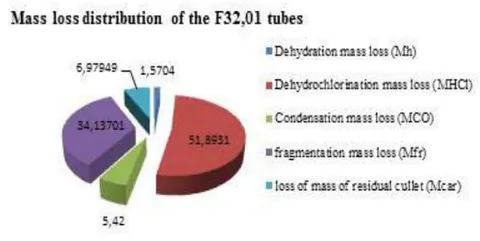
Formulation F51.02: During the dehydration of the unloaded PVC processed at C, we record that it loses 3.278% of its initial mass: this is the free water that evaporates. The further rise in temperature causes the dehydrochlorination of the PVC which begins at C and ends at C losing 48.546% of its initial mass before condensing. At the end of the condensation towards C, it loses 5.517% of its initial mass then enters the fragmentation whose totality is reached towards C leaving residual cullet of 73154% of its initial mass as ash in the crucible. See figure 16.
d) Development of mathematical models for the calculation of thermal parameters of the tubes according to the dosage with shell powder
i. Mathematical models for the calculation of thermodiférential parameters (DSC) of tubes
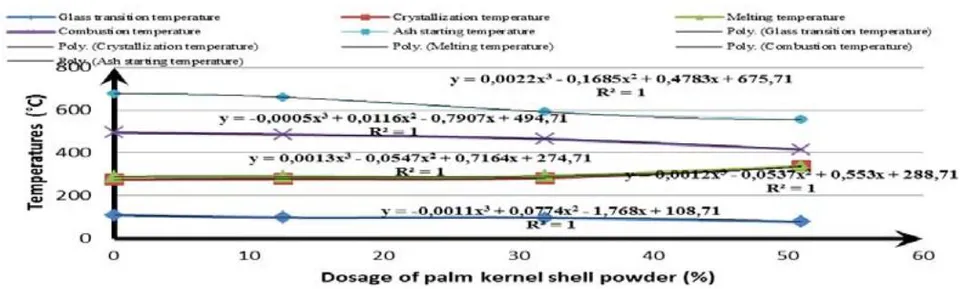
Figure 17 shows the results of the influence of palm kernel shell powder on the phase change temperatures, namely: glass transition temperature (Tg), melting temperature (Tf), crystallization temperature (Tcf), combustion temperature (Tc) and the ash temperature (Tce) of the elaborated PVCs. We observe that:
The glass transition temperature of PVC F0 is Tg = 108.71, that of F12.54 is Tg = 96.58, that of F32.01 is Tg = 96 and F 51.02 is Tg = 76.56. The temperatures decrease as the loading rate of the palm kernel shell powder increases. The regression of the results shows that Tg has a polynomial trend. The arrangements of the results on the right hand side show that the mathematical equation governing the glass transition results is with the regression coefficient . This correlation shows the reliability of the results as obtained in some works in the literature [18, 19, 22].
In the same way as for the F0 formulation (unloaded PVC tubes), from the F0 formulation to the F51.02 formulation, the results of the Tg, Tc and Tce measurements progressively decrease while those of Tf and Tcf, rather increase. The straight lines connecting the results of the measurements of each temperature have trends whose equations are polynomials of the type (where y represents the Thermal Properties and x the loading rate of the palm kernel shell powder in the tube). The arrangements of the results with respect to the lines show that they pass through all the points representing the measured temperature results. The calculated correlations are exactly 1, showing that the errors in formulation, elaboration and analysis are negligible, allowing us to write the mathematical models for the calculation of the thermo differential properties of the PVCs loaded with palm kernel shell powder in Table 1
| Properties | Mathematical models | Types | Correlations |
| Glass transition temperature (Tg) | Polynomial | ||
| Crystallization temperature (Tcf) | Polynomial | ||
| Melting temperature (Tf) | Polynomial | ||
| Combustion temperature (Tc) | Polynomial | ||
| Ash temperature (Tce) | Polynomial |
Table 1 above shows that the mathematical models for calculating the characteristic parameters in the phase transition temperatures are mathematical models of the polynomial type. The degree of the polynomials is 3 (two). The R2 correlation obtained for each equation in the phase transitions is exactly 1.
So, since we obtained a mathematical equation whose degree is 3, it shows that there were small errors somewhere during the practices. The degree of the polynomial should have been 1. So:
√ Maybe we can say that the errors come from the elaborated tubes;
√ Can we say that the errors come from the additives?
√ Can we say that the errors come from the assumptions of the characterization;
But the regression coefficient brings us answers in the sense that the errors observed are negligible given that the degree of the polynomials has remained at 3 for all the equations. So we can use these mathematical models to calculate the dosage of shell powder or to calculate the thermal parameters of the tubes during its elaboration according to the parameters or technical assumptions that we have available.
ii. Mathematical models for the calculation of thermogravimetric (TG) parameters of tubes
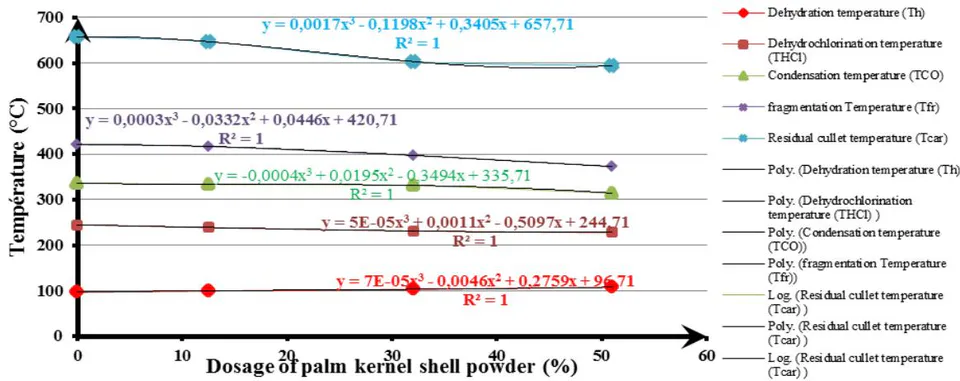
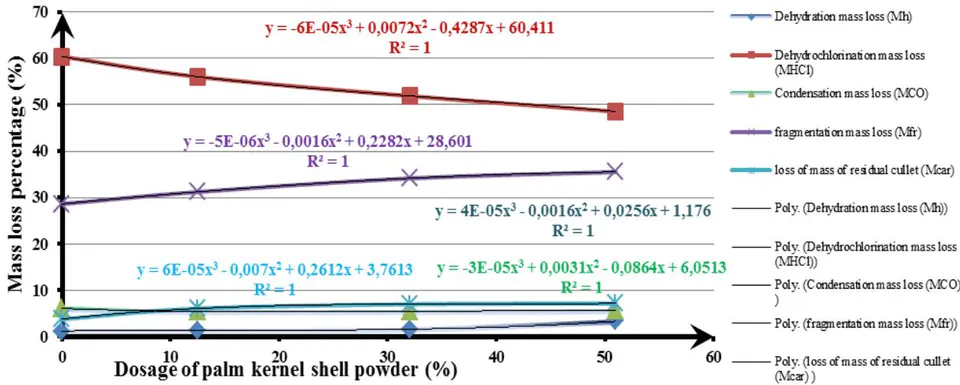
Figure 18 shows that the THCI, Tco Tfr and Tcar measurement results obtained in Figure 11 vary from the F0 formulation to the F51.02 formulation. The trend lines connecting each point representative of the results of each formulation remain polynomial of the type y=ax3+bx2+cx+d (where y represents the Thermal Properties and x the loading rate of the palm kernel shell powder in the tube). The layouts of the results show that all points pass through the different straight lines. The regression of the measurements shows that it is exactly 1 presenting the precision in the formulations, elaborations and analyses.
In the same way, when we go through the results of the thermal decrease of the masses of the unloaded PVC tubes to the PVC tubes loaded with 51.02% of the palm kernel shell powder figure 12, we obtain that the results of the decrease of mass at the phase transitions of dehydration (Mh), dehydrochlorination (MHCl), condensation (Mco), fragmentation (Mfr) and residual calcination (Mcar) have the same observations as those observed at the temperatures of the phase transition. Thus, we obtain in figure 19 that the trend lines connecting each point representative of the results of each formulation remain polynomial of the type y=ax3+bx2+cx+d (where y represents the Thermal Properties and x the rate of load of the palm kernel shell powder in the tube), and The regression of the measurements shows that it is exactly 1, confirming the accuracy in the formulations, elaborations and analysis of the tubes.
Table 2 shows the mathematical models to be used for the calculation of the thermogravimetric phase transition properties of PVCs with palm kernel shell powder as load.
| Properties | Mathematical models | Types | Correlations | ||
| Phase transition temperature s | Dehydration (Th) | Polynomial | |||
| Dehydrochlorination (THcl) | Polynomial | ||||
| Condensation (Tco) | Polynomial | ||||
| Fragmentation (Tfr) | Polynomial | ||||
| Ash (Tcar) | Polynomial | ||||
| Decrease in mass at the phase transitions | Dehydration (Mh) | Polynomial | |||
| Dehydrochlorination (MHcl) | Polynomial | ||||
| Condensation (Mco) | Polynomial | ||||
| Fragmentation (Mfr) | Polynomial | ||||
| Ash (Mcar) | Polynomial | ||||
e) Application: calculation of phase transitions of elaborated tubes from the obtained mathematical models
We unloaded tubes to formulations of F0 (0% loading), F4.01 (4.01% loading), F12.54 (12.54% loading), F23.03 (23.03% loading), F32.01 (32.01% loading), F38.02 (38.02% loading), F51.01 (51.01% loading). We only performed thermodifferential analyses
| Properties | Formulations | ||||||||
| F0 | F4.01 | F12.54 | F23.03 | F32.01 | F38.02 | F51.01 | |||
| Results of the thermo gravimetric analyses | Phase transition temperatures | Dehydration temperature (Th) | 96,71 | 97,7469 | 99,5844 | 101,4792 | 103,124 | 104,3951 | 108,108 |
| Dehydrochlorination temperature (THCI) | 244,71 | 242,687 | 238,589 | 234,165 | 231,161 | 229,671 | 228,208 | ||
| Condensation temperature (TCO) | 335,71 | 334,596 | 333,606 | 333,119 | 331,386 | 328,635 | 315,520 | ||
| Fragmentation ( ) | 420,71 | 420,374 | 416,640 | 407,792 | 397,959 | 390,913 | 376,406 | ||
| Cendre ( ) | 657,71 | 657,258 | 646,493 | 622,777 | 601,615 | 601,6153 | 589,0101 | ||
| Decrease in mass at the phase transitions | Dehydration mass loss (Mh) | 1,176 | 1,256 | 1,324 | 1,406 | 1,668 | 2,034 | 3,630 | |
| Dehydrochlorination mass loss (MHCI) | 60,411 | 58,804 | 56,049 | 53,624 | 52,098 | 51,223 | 49,312 | ||
| Condensation mass loss (MCO) | 6,0513 | 5,753 | 5,396 | 5,339 | 5,478 | 5,599 | 5,728 | ||
| fragmentation mass loss (Mfr) | 28,601 | 29,490 | 31,201 | 32,947 | 34,102 | 34,689 | 35,415 | ||
| loss of mass of residual cullet (Mcar) | 3,7613 | 4,700 | 6,054 | 6,797 | 6,918 | 6,871 | 6,835 | ||
| Results of the thermo differential analyses | Phase transition temperatures | Glass transition temperature (Tg) | 108,710 | 102,794 | 96,541 | 95,608 | 95,345 | 92,926 | 73,894 |
| Crystallization temperature (Tcf) | 274,710 | 276,787 | 277,656 | 278,076 | 284,232 | 294,302 | 341,524 | ||
| Melting temperature (Tf) | 288,710 | 290,141 | 289,567 | 287,622 | 290,747 | 298,044 | 336,509 | ||
| Combustiontemperature (Tc) | 494,710 | 491,694 | 485,633 | 476,545 | 464,886 | 453,957 | 418,160 | ||
| Ash starting temperature (Tce) | 657,710 | 657,060 | 641,549 | 606,228 | 572,526 | 553,262 | 535,676 | ||
for each formulation and found that they follow a logic that we sought to find. The search for this logic led us to elaborate mathematical models allowing us to calculate either the dosage with palm kernel shell powder when we know the thermal properties of the plastic tubes we are looking for, or to determine the thermal properties of the plastic bubbles we are soliciting when we have the dosage in palm kernel shell powder. Thus, we obtained results that we represented respectively on figures 17, 18 and 19. These results summarized in Tables 1 and 2 have allowed us to present in Table 3 the results of the thermal properties of elaborated PVC tubes loaded with palm kernel shell powder. We have highlighted the results of the properties of the PVC tubes we elaborated (F4.01, F23.03 and F38.02) but which were not analyzed. From the observations, we found a logic in the results of the thermal parameters of all the elaborated tubes.
We can say that the elaborated mathematical models are applicable. These results show that all the tubes have been:
➢ Characterized under the same assumptions;
➢ Elaborated with the same assumptions and under the same working conditions;
➢ Analyzed with the same laws and in the same standards.
Thus, the engineer has mathematical models to determine the thermal parameters of plastics loaded with palm kernel shell powder in the company.
In the same launches, we propose for the future, that after the validation of this fastidious work, we will lean on the conception and the realization of a computer program having to manage the calculations of the thermal properties of the plastic materials when we will use the powder of shells of palm kernel micronized.
At the same time, in the same objectives, we will consider the creation of abacuses allowing to find the thermal characteristic parameters of plastics according to the dosage of palm kernel shell powder. This method of abacuses was formerly used in research especially after the manufacture of machine tools allowing the operators and the workers on machine to determine the parameters of work without each time to resort to calculations, which makes it possible to limit the displacements and to support the industrial productivity.
IV. CONCLUSION
The availability of palm kernel shells in the world in general (South-East Asia, Africa), and Cameroon in particular is real. Their use as load for the production of plastic tubes in PVC was the subject of work. The research of the characterization and the tests of the valorization of these tubes remain the concerns related to the success of the shells of palm kernel as the only load for the synthetic polymers.
The thermal characterization of the tubes of some formulations was done according to the standard, with a LENSEI apparatus which provided us with TG/DSC thermograms of the tubes for each formulation. The careful analysis of these thermograms and the data from the TG/DSC recordings gave us the results of the thermal parameters of the tubes of each formulation. We plotted the heat absorption curves as a function of the decrease in mass of the loaded PVCs which showed us that the loaded PVCs absorb a considerable amount of heat but gradually before burning out completely.
The analysis of these results allowed us to elaborate mathematical models allowing to establish the laws of behavior of all the elaborated tubes and to be able to determine the thermal characteristic parameters of the tubes to be elaborated with a given formulation whatever the dosage of palm kernel shells powder and, Reciprocally, these models also allow to determine the dosage of the tubes by the palm kernel shells powder with precision when the engineer calculated and obtained the thermal parameters of the tubes for his construction. Thus, the knowledge of these technical data represents a favorable asset for the engineers because the risks of supplying the manufacturers without sure data are minimized. Finally, the data obtained during this work leads us to apply the results not only for tubes but also for many other forming methods depending on the construction to be performed by the engineer.
V. DECLARATION OF INTERESTS
The authors declare that they have no financial interests or personal relationships that could influence the work reported in this article.
ACKNOWLEDGEMENT
I cannot thank the General Manager of SOFAMAC who was willing to take the risk of putting a whole production line of PVC tubes at my disposal for an experiment.