## I. MOTIVATION AND BASICS OF OUR
### "MATHEMATICALLY ORIENTED REFORM" OF ENGLISH ORTHOGRAPHY
The desire to shorten texts to reduce the effort of writing has always been very popular. Among others, this has led to the invention and common use of stenography (e.g. by secretaries). However, use of stenography is demanding a non-negligible learning effort. Therefore, people were looking for alternatives requiring much less learning expenditure.
An example for a completely different approach to shorten texts is represented by the kind of writing which is popular, in particular, among our current young generation, e.g., when writing and sending SMS messages or e-mails. Here, formulations such as "CU" or "CU" (for "see you"), "UR..." (for "you are..."), "coffee 2 go" (for "coffee to go"), "tea 4 U" (for "tea for you"), "2 4 1" (for "two for one"), etc are pretty common.
Some time ago, when I tried to find some means to achieve students' relaxation in the courses I was teaching at the University of Hamburg, the idea came to my mind to invent a mathematically oriented reform of the German language. In my approach, suggested as a new way of writing texts, I did not only use numbers and single letters pronounced as in the alphabet, as it is quite common nowadays. As a new idea, I decided to also use well-known mathematical symbols, such as $+, -, \bullet, /, \sqrt{}$, etc. I applied my reform of orthography to the German language only and published the results in a first book entitled "Um etliche Ecken ged8" (Shaker Media publisher, first version in 2012; Version 2.0 in 2018 [1]). During public presentations of the book in reading events, somewhat regularly, there were suggestions to this author to try to apply the rules of his orthography reform to the English language, too. Finally, it became too difficult to resist this exciting new challenge. And the latest book in English is the result of the corresponding efforts also to cover
English texts: It comprises the innovative proposal for a reform of English orthography.
The two most important goals underlying the reform of English orthography as invented by us, are the following ones:
1. We aim for compression factors which are as large as possible, namely we try to compress words or complete phrases to 1/3 or even 1/4 of the original size (in terms of symbols required originally to write the word/phrase), cf. our short investigation of compression factors achieved by us.
2. A second goal we had in mind (equally important – or even more important!) has been to discover very creative new ways of writing words/phrases which are non-evident at first and, moreover, as humorous as possible.
Let us shortly mention some examples satisfying one of the two or even both goals to some extent:
a) he lost $40^{\text{th}}$ [abbreviating: he lost four teeth]
b) I h8 2 B l8@the g8 + miss my fl 8 [abbreviating: I hate to be late at the gate and miss my flight] $\rightarrow$ being very close to a poem
c) YRU so Z 2dA? [abbreviating: why are you so sad today?]
The most essential rules on which our reform of English orthography is based are.
1. Mathematical operations do not have to be used in a mathematically correct manner. Example: "-tax" for "tax reduction" or "h+" for "hand" are acceptable expressions though a mathematician would be much more happy seeing a difference or a sum always with two operands.
2. Typically, only lowercase letters are used. If letters are used as capital letters they will always be pronounced as in the ABC. It is also allowed to mix small and capital letters in single words to indicate "ABC pronunciation" – just the capital letters.
Examples: $B$ will denote "be", "bee", etc; $C$ will denote "see", "sea", etc; $X$ will denote "ex" or "cross"; $Tn$ will denote "teen"; $B4$ will denote "before"; $NTT$ will denote "entity"; $idNTT$ will denote "identity"; etc.
3. Words can be written so that pronouncement is facilitated and not necessarily written in an orthographic correct manner.
Example: ar/me or even R/me (for "army division") is not necessarily abbreviated by ar/my to facilitate the reading.
4. Blanks can always be omitted.
Example: In $n$ -ew or $n$ -U which abbreviates "new product", the blank between both words is missing.
#### 5.... and last but not least:
Creativity in the invention of new kinds of writing is always given priority over a strict application of mathematical or orthographic rules!
The transition from German to English orthography is far from being trivial: Pronunciation of (capital) letters according to their ABC pronunciation is completely different which also holds for digits as well as for mathematical symbols. Moreover, we are looking at completely different languages with different syntax and semantics of words and phrases.
Fortunately, e.g., the following two properties of the English language facilitate our desired reform of English orthography:
1. Usage of capital letters being pronounced as in the alphabet is quite promising because a lot of different letters are rather well suited to compress
the English language (as opposed to the German language, where in particular the vowels do not offer good support for compression). Examples: U for "you", R for "are", Y for "why", C for "see" or "sea", etc.
2. Moreover, quite a few digits can be used advantageously, e.g., 8 in "great", "late", "gate", "afraid", etc.
4 in "for", "before", "forward", "forth", etc.
in "one", "anyone", "no one", "once", etc.
0 in "love", "lovely", "beloved", "loveless", etc. (if "0" is not pronounced as "zero" but as "love" - like in tennis).
Let us terminate our introduction with a short investigation of the potential compression factors achieved by our compression methods of English texts.
As a compression factor, $C_f$, let us define:
$$
C _ {f} = \frac{L 0 - L k}{L 0}, \text{where}
$$
- $L0$ denotes the number of symbols, i.e., letters (without blanks) of the original text, and
- $Lk$ denotes the number of symbols of the encoded text resulting in the application of our compression method; we assume that $Lk$ is including all mathematical symbols and digits.
As the following examples demonstrate, compression factors of up to nearly $80\%$ are reached. Here are just some nice examples:
- $\varnothing$ is $-Nd$ abbreviating: nothing is endless, i.e., $L0 = 16$, $Lk = 6 \Rightarrow C_f = \frac{10}{16}$, therefore $C_f$ (in%) = 62,5% [Remark: As it is common, the symbol $\varnothing$ represents the "empty set" (i.e., nothing)]
- $4 \forall U r 0$ abbreviating: for all your love, i.e., $L_0 = 14$, $L_k = 5 \Rightarrow C_f = \frac{9}{14}$, therefore $C_f \approx 64.3\%$ [Remark: As it is common, the symbol $\forall$ represents "for all"]
- CU abbreviating: see you, i.e., L0=6, Lk=2 ⇒ Cf = $\frac{4}{6}$, therefore Cf = 66 $\frac{2}{3}$ %
- U2 abbreviating: you two, i.e., L0=6, Lk=2 ⇒ Cf = $\frac{4}{6}$, therefore $C_f = 66\frac{2}{3}\%$
- 241 abbreviating: two for one, i.e., $L0 = 9$, $Lk = 3 \Rightarrow C_f = \frac{6}{9}$, therefore $C_f = 66\%$
- $T 4 U$ abbreviating: tea for you, i.e., L0=9, Lk=3 $\Rightarrow \mathsf{C}_{\mathrm{f}} = \frac{6}{9}$, therefore $\mathsf{C}_{\mathrm{f}} = 66 \frac{2}{3} \%$
- $\frac{R}{my}$ abbreviating: army division, i.e., $L0 = 12$, $Lk = 4 \Rightarrow C_f = \frac{8}{12}$, therefore $C_f = 66\frac{2}{3}\%$
- $+y1 \emptyset$ abbreviating: Andy won nothing, i.e., $L0 = 14$, $Lk = 4 \Rightarrow C_f = \frac{10}{14}$, therefore $C_f \approx 71.4\%$.
- $\forall 4 \emptyset$ abbreviating: all for nothing, i.e., $L0 = 13$, $Lk = 3 \Rightarrow C_f = \frac{10}{13}$, therefore $C_f \approx 77\%$
- $\emptyset 4U$ abbreviating: nothing for you, i.e., $L0 = 13$, $Lk = 3 \Rightarrow C_f = \frac{10}{13}$, therefore $C_f \approx 77\%$.
## II. BRAIN JOGGING BASED ON OUR "MATHEMATICALLY ORIENTED REFORM" APPLIED TO ENGLISH TEXTS
Let us now consider different degrees of difficulty based on which we are going to present puzzle tasks (riddles) to the reader. Here, we distinguish the following levels of difficulty:
a) Beginners
b) Playing with Capital Letters
c) Advanced Persons
d) Experts
e) Geniuses
- Category a): Solving the riddles of this category should be quite evident without demanding specific knowledge (besides very basic mathematical education).
- Category $b$ ): As the name of this category already indicates it comprises riddles which are just based on the intensive usage of capital letters.
- Category c): The riddles of this category should be solvable for an average reader after having gained
- some basic understanding of the possibilities resulting from the five fundamental rules underlying our proposed reform of English orthography.
- Category d): This category should still be rather evident to persons, who are sufficiently creative and/or have a good mathematical background.
- Category e): Solutions of the riddles of this category will typically be non-evident a priori and may require a non-negligible amount of think-time (even for persons, who are able to quickly solve the riddles of categories a) to d)).
The mapping of puzzle tasks to the five categories (as distinguished in the following) is somewhat subjective. Anyway, we want to cheer up the reader by adding humorousistic illustrations into the text of the riddles, which also should allow us to considerably facilitate the process of finding solutions for each category of riddles. All illustrations have been produced by the creative illustrator Rico W. Hasselfang (aka: Sascha Wolfinger).
The solution for all of the puzzle tasks will be presented in Subsection 2.2, together with precise and detailed justification of all solutions.
Excerpt of Puzzle Tasks
Allocation of the puzzle tasks to the five degrees of difficulty:
### a) Beginners:
B1:√66
B2: the $Q$ is $> B 4$
B3: he lost $40^{th}$
B4: $\varnothing$ compares 2 U
B5: with U, I Njoy T 4 2
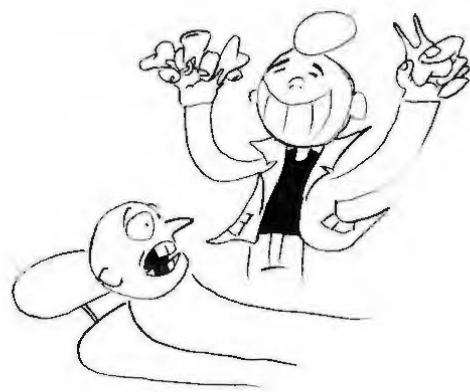
### b) Playing with Capital Letters:
S1:XLNt
S2: 2 DYd
S3: RTQ18
S4:DcaPt8
S5: Br bR

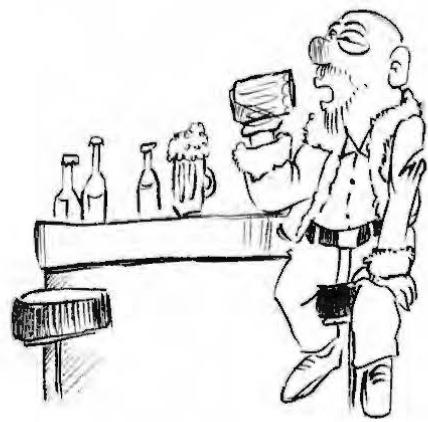
### c) Advanced Persons:
A1: I h8 2 B l8@the g8 + miss my f18 [Remark: @ ≡ at]
A2: YRU so $\{up\}$? [Remark: $\{\ldots\} \equiv set$ ]
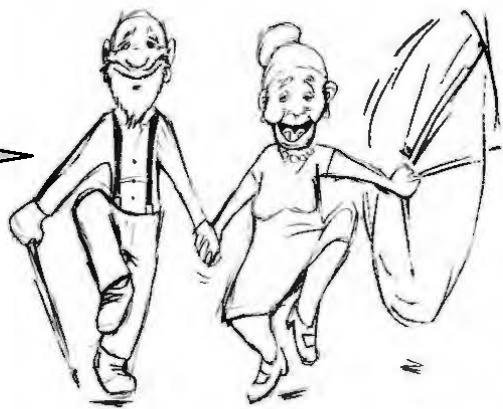
A3: $(gr + pa) + (gr + ma)$ still 0 2 walk $h + in h+$ [Remark: $0\equiv$ love (like in tennis); not zero]
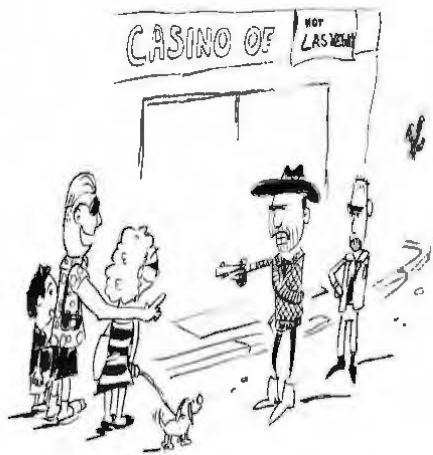
A4: $\forall c@s R grA$ by n8
A5: $1^{st}$, she asked $40 +$ then 4 coffE, 2
### d) Experts:
- E1: the strategy V chose 4 our (2·s) in 10is was " $\forall$ or $\emptyset$ "
- E2: the $c + id8$ prSNTd by the nU pRT was knOn 2 nearly no 1
- E3: VR fascin8ed by $\forall$ the 1 Rmed $b+$ its in reno
- E4: V0 2 C th@ $\forall$ of our $(nU\cdot s)R\forall$ most sold out
- E5: Y do U Blieve th@ he is the $\sqrt{\forall\text{evil}}$?
### e) Geniuses:
- G1: the teacher was |ly| frustrated to C th@$\forall$most$\forall$pupils knU$\varnothing$- G2: V (had + sleep) - n8s B4 V could B |ly| sure th@ V could cover$\forall$costs - G3: l8ly, gramma (became + what) agetful - G4: R U sure th@$\forall$this$\Rightarrow \emptyset$? - G5: I C 1derful h@s + buy$1 / 4$elma
Solutions of the Puzzle Tasks Accompanied with Detailed Justifications
Let us now give the solutions for all the riddles presented in Subsection 2.1. To simplify the interpretation of the solution's justification, we have decided to apply formatting decisions that should help the reader to understand the solutions better. In particular, we have put in italics all mathematical symbols, numbers and capital letters and, in addition, mathematical symbols are all underlined. Moreover, in the solutions, blanks are sometimes indicated by a point, if this potentially facilitates the readability.
Solutions accompanied with justifications:
- B1: Solution: Route 66 [because: Root-sixty-six]
- B2: the queue is larger than before [the-Q-is-larger-than-B-four]
- B3: he lost four teeth [he-lost-for.tieth] → Remark: $40^{\text{th}}$ is pronounced as "fortieth"
- B4: nothing compares to you [nothing-compares-two-U] $\rightarrow$ Remark: $\varnothing$ denotes "nothing" B5: with you, I enjoy tea for two [with-U-I-N-joy-T-four-two]
- P1: excellent [because: X-L-N-t]
- P2: to divide [two-D-Y-d]
- P3: articulate [R-T-Q-I-eight]
- P4: decapitate [D-cap-P-t-eight]
- P5: beer bar [B-r-b-R]
A1: I hate to be late at the gate and miss my flight [because: I-h-eight-two-B-I-eight-@-the-g-eightand-miss-my-fl-eight]
A2: why are you so upset? [Y-R-U-so-up-set?] → Remark: {...} denotes a "set"
A3: grandpa and grandma still love to walk hand in hand [gr-and-pa-and-gr-and-ma-still-love-twowalk-h-and-in-h-and] $\rightarrow$ Remark: 0 is pronounced as "love" (like in tennis)
A4: all cats are grey by night [all-c-@-s-R-gr-A-by-n-eight] → Remark: @ is pronounced as "at"
A5: first, she asked for tea and then for coffee, too [first, she-asked-for.ty-and-then-four-coff-E, two] $\rightarrow$ Remark: 40 is pronounced as "forty"
E1: the strategy we chose for our doubles in tennis was "all or nothing" [because: the-strategy-Vchose-four-our-double-s)-in-ten-is-was-"all-or-nothing"] $\rightarrow$ Remark: " $\forall$ or $\emptyset$ " is pronounced as "(for) all or nothing"
E2: the candidate presented by the new party was known to nearly no one [the-c-and-id-eight-pr-S-N-T-ed-by-the-n-U-p-R-T-was-kn-O-n-two-nearly-no-one]
E3: we are fascinated by all the one-armed bandits in Reno [V-R-fascin-eight-ed-by-all-the-one-Rmed-b-and-its-inreno]
E4: we love to see that all of our new products are almost sold out [V-love-two-C-th-@-all-of-our-n-U-product-s-R-all-most-sold-out] $\rightarrow$ Remark: (nU [] s) is pronounced as "nU Product s"
E5: why do you believe that he is the root of all evil? [Y-do-U-B-lieve-th-@-he-is-the-root-of-all-evil] → Remark: "√∀evil" is pronounced as "root of 'all evil'"
- G1: the teacher was absolutely frustrated to see that almost all pupils knew nothing [because: the-Tcher-was-absolute-ly-frustr-eight-ed-two-C-th-@-all-most-all-pupils-kn-U-nothing]
- G2: we had some sleepless nights before we could be absolutely sure that we could cover all costs [Vhad-sum-sl-Ep-less-n-eight-s-B-four-V-could B-absolute-ly-sure-th-@-V-could-cover-all-costs]
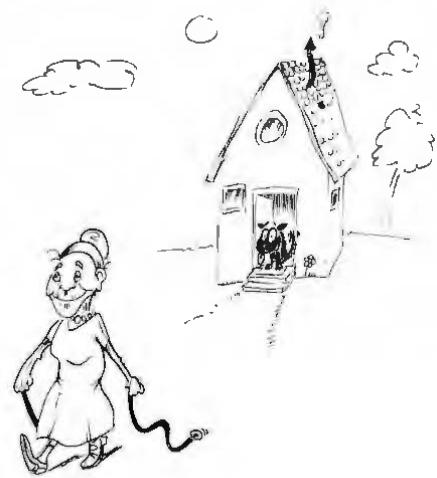
- G3: lately, grandma became somewhat forgetful [l-eight-ly, gr-and-ma-B-came-sum-what-four-getful]
- G4: are you sure that all this implies nothing? [R-U-sure-th-@-all-this-implies-nothing?] $\rightarrow$ Remark: " $\forall$ this $\Rightarrow \emptyset$ " is pronounced as "(for) all this implies nothing"
- G5: I see wonderful hats and buy one for Thelma [I-C-one-derful-h-@-s-and-buy-one four.th-elma] → Remark: " $1/4$ elma " is pronounced as "one for (th elma)"
The large variety of examples discussed up to now should allow most readers to accomplish the level of "Advanced Persons". To reach even the levels of "Experts" or even "Geniuses" let us refer such persons to the author's book entitled "How 2 Shor10 English Texts", which was published by Shaker Media. This book [2] contains numerous further riddles with various levels of difficulty accompanied by a large number of humoristic illustrations (again all designed by the illustrator R. W. Hasselfang).
Generating HTML Viewer...
References
2 Cites in Article
Rolf Windenberg,R Hasselfang (2018). Um etliche Ecken ged8.
R Windenberg,R Hasselfang (2017). How 2 Shor10 English Texts.
No ethics committee approval was required for this article type.
Data Availability
Not applicable for this article.
How to Cite This Article
Rolf Windenberg. 2026. \u201cMathematical Playfulness: A Humorous Approach to Reforming English Orthography\u201d. Global Journal of Computer Science and Technology - H: Information & Technology GJCST-H Volume 24 (GJCST Volume 24 Issue H1): .
Explore published articles in an immersive Augmented Reality environment. Our platform converts research papers into interactive 3D books, allowing readers to view and interact with content using AR and VR compatible devices.
Your published article is automatically converted into a realistic 3D book. Flip through pages and read research papers in a more engaging and interactive format.
Our website is actively being updated, and changes may occur frequently. Please clear your browser cache if needed. For feedback or error reporting, please email [email protected]
Thank you for connecting with us. We will respond to you shortly.