
I. INTRODUCTION OF THE STUDY
Medical assistance is a need for each and every human being irrespective of demographic or social settings. Health problems pose a serious threat to health, and require specific treatment and management to cure the problem. Medical care aims not only at improving health status but also to respond to patient needs and wish to ensure their satisfaction with care. The quality of service by a hospital is the number one factor that will either turn a customer/patient away or ensure satisfaction and faith. More and more hospitals are competing for greater shares in the market, and customer-driven quality management is becoming the preferred method for improving the performance of hospitals. Patient judgement on medical care also contributes to medical outcomes. In the case of in-patient care, it has been clearly shown that satisfied patients are more likely to cooperate with treatment, to maintain a continuing relationship with a practitioner and thus enjoy a better medical prognosis. This happens consistently in multi-specialty hospitals which adequately provide support to patients.
Service Quality is defined as a "Global judgment or attitude relating to the overall superiority of the service" (Parasuraman et al.). In service organizations, customer perceived service quality is considered as one of the key determinants of business performance (Parikh). The issue of how best to conceptualize and operationalize service quality is still a subject of heated debate (Cronin and Taylor). However, it is generally agreed that Service Quality is a multidimensional or multi-attribute construct. Good service quality means that the customers' perception on service performance meets or exceeds their expectations or what the service firm should provide. The applicability of SERVQUAL in a different culture is to be considered. Consumers varied in both their overall expectations with regard to service quality and their expectation of each of the service quality dimensions as a result of cultural orientation.
II. OBJECTIVE OF THE STUDY
- To measure the specialized quality of services provided by the hospitals and overall satisfaction of patients in select multi-speciality hospitals in Coimbatore.
III. STATEMENT OF THE PROBLEMS
Hospital is a place where people who are ill or injured are treated and taken care of by specialized doctors, staff and nurses. In the past, the hospitals were set up as charity institutions, especially for poor and weaker sections. The only function of those institutions was to care for the sick and poor. The patients also approached the hospitals with disinclination, anxiety and fear of death, but today the hospitals are set up with a motto to serve all sections of the society. The set-up of the hospitals has been spoiled by preferential treatment. Some hospitals are running with below average staff and doctors, and the hospitals are under - utilizing their staff due to improper management, policies and other medical requirements. In other words, the managerial administrative atmosphere is sick at times. Most of the patients often prefer medical treatment in Government hospitals, some private clinics, dispensaries and primary healthcare centers, while they fail to provide quality health care services both the curative and promotive cares and some of them offer poor quality service. The above scanning of the problems reveals that the concept of health services has changed a great deal. Thus, there is a widespread belief that better management of health services is essential if higher standards of healthcare are to be achieved. Best services will lead to greater success.
IV. NEED FOR THE STUDY
The service industries, so as to bring themselves to a better position in the market, promote promotional programs, provide advanced equipment's and render high quality services to their patients. It is also important to note here that only if these services are able to create a good positive impact on the target group, they will be successful and vice-versa. In this study the opinion was collected from the patients of select multi - hospitals in Coimbatore city.
V. HYPOTHESIS OF THE STUDY
- There is no significant difference between Hospitalization of in-patients for treatment and specialized services (T-Test and ANOVA).
- There is no significant difference between demographic variables and patients.
VI. LITERATURE REVIEW
Sharama O.P. (1970) in his research concludes that in the present era of scare hospital resources, high cost of hospital operations and increasing demand of hospital services, the development of patient satisfaction assumes great significant for the hospital administrations. The public, general patients and their relatives can be almost fully satisfied in existing conditions available in hospitals. The study suggests no extra funds are necessary. Change in attitude and approach is required. Fitzpatrick and Hopkins (1983) stated that expectations have affective and cognitive components and are multidimensional. They are the result of complex cognitive processes, modified by previous experiences and other influences. Some investigators focus on what patients think will happen (probability or realistic expectations) and others on what patients would like to happen (value or ideal expectations). Predicted or expectancy probability expectations are judgments about the likelihood of an event occurring, for example based on past experience, self-confidence or perceived difficulty of the goal.
a) Service Quality
The position of the patient in the hospital is that of a paying guest. The person going to medical attention provisions for physical comfort and protection. Every arrangement and every people working in the hospital are aiming at the same goal of patient care. Therefore, the service quality dimension.
b) Dimensions of Service Quality
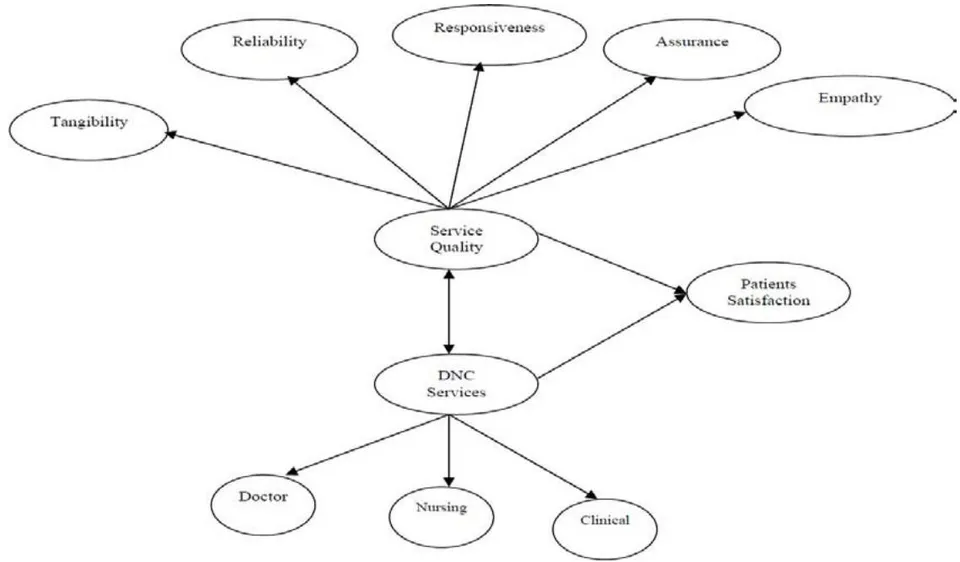
Tangibles: The appearance of physical facilities, equipment's appearance of personnel and communication materials.
Reliability: The ability of hospital to perform the promised service dependable and accurately (that is, when something is promised, it is done and provision of services at the time promised). Responsiveness: The willingness of hospitals personnel to help (patients) and provide prompt service.
Assurance: The knowledge and courtesy of hospital employees and their ability to inspire trust and confidence.
Empathy: The caring individualized attention the hospital provides to its customers (patients) (that is, employees understand specific needs and employees give personal attention.
VII. RESEARCH METHODOLOGY
The objective and systematic method of finding solution to a problem systematic collection, recording, analyzing, interpretation and reporting of information about facts of a phenomenon under study". The sources of data included both primary as well as secondary data. Questionnaires were used for the primary data collection whereas secondary data collection was made based on the information provided by the hospital officials. Questionnaire was adopted as research instrument. The questionnaires were administrated through distribution specific to the patient's undergoing treatment in the select multi-specialty hospitals. The survey was conducted among various patients who are specifically taking treatment in the select multi speciality hospitals in the study area. The sample size of the study is 810 inpatients. The sampling technique selected for the study is on multi stage sampling method. The researcher has circulated the instrument only to the inpatients for data collection. The objectives framed for the present study formed the basis of the identification of the relevant statistical techniques such as Structural Equation Modeling (SEM) with the support of AMOS 16 to deliver statistical implications.
VIII. LIMITATIONS OF THE STUDY
The respondents felt time and cost constraints during data collection. The study is conducted to know the facilities provided in the hospital of the patient's views and the information provided by the patients are expected with some personal bias.
IX. ANALYSIS AND RESULTS
This study attempted to understand the reasons for taking the services from select multi- specialty hospitals for which categorical variables are classified based on illness, treatment, affordability and service quality aspects. Followed by descriptive statistics using weighted mean, three specialized service quality constructs viz (DNC) Doctor, Nursing and Clinical services are analyzed along with the overall satisfaction of the services provided by the select hospitals as dependent variable are further compared using correlation and regression analysis.
X. MODEL AND CONCEPTUAL FRAMEWORK
A theoretical model is projected to compute the Service quality with regards to Patients Perception and Expectation heading to overall Satisfaction of Services delivered excellently by private multi-specialty hospitals of Coimbatore City. The intermediation outcome is calculated by means of unique service provisions such as Doctors, Nurses and Clinical services. The dependent variable is the Overall Satisfaction of the patients surveyed and model computed by means of Structural Equation Modeling (SEM) with the support of AMOS 16 to deliver statistical implications.
Conceptual Model Measuring Direct and Mediation Effect of Patients Service Quality Perception and Overall Satisfaction Mediated by Specialized (DNC) Services
a) Descriptive Statistics on Specialized Services (Doctors, Nursing and Clinical Quality + Safety)
Frequency is measured for three constructs in which agreement level was found to be the dominant among patients' opinion towards doctors, nurses and clinical services is also considered as DNC services.
Therefore, for the likert type five-point scale all positive set of items carry weightage from 5 to 1 for the agreement to disagreement levels therefore an appropriate rank using a weighted average is computed that explains the best and least rating by the patients for all three constructs.
Doctor Services (Frequency Analysis)
| Opinion | Strongly Disagree | Disagree | Neutral | Agree | Strongly Agree | |
| The doctors are always kind and caring about my health that makes me feel easy to get medical care in the hospital | Count | 64 | 115 | 115 | 159 | 357 |
| Row N% | 7.90% | 14.20% | 14.20% | 19.63% | 44.07% | |
| Doctors exhibit professional skills and elevates trust in the hospital | Count | 56 | 115 | 210 | 156 | 273 |
| Row N% | 6.91% | 14.20% | 25.93% | 19.26% | 33.70% | |
| Doctors and nurses team work reassures the quality of service in this hospital | Count | 304 | 105 | 138 | 132 | 131 |
| Row N% | 37.53% | 12.96% | 17.04% | 16.30% | 16.17% | |
| The doctors always properly diagnose and explain the disease and further treatment | Count | 343 | 151 | 159 | 76 | 81 |
| Row N% | 42.35% | 18.64% | 19.63% | 9.38% | 10.00% | |
| The doctor is neither hasty nor rude | Count | 158 | 117 | 238 | 141 | 156 |
Patients' opinion towards specialized doctors' services reveals that the doctors are always kind and caring about the patient health which makes the patients to feel easy to get medical care in the hospital for which strongly agreed, agreed, disagreed and opined neutral and the remaining strongly disagreed to the statement. Patients' opinion about doctors exhibits professional skills and elevates trust in the hospital for which strongly agreed, agree, opined neutral, disagreed and strongly disagreed. Patients' opinion about doctors and nurses team work reassures the expected quality of service in the select hospitals for which strongly disagreed, opined neutral, agreed, strongly agreed and disagreed. Patients' opinion about doctors properly diagnoses and explain the disease and further treatment in the select hospitals for which strongly disagreed, stated neutral, disagreed, strongly agreed and agreed. Patients' opinion about doctors are neither haste nor rude to detail of the patient about health condition and duration of stay for treatment in the select hospitals for which opined neutral, strongly disagreed, strongly agreed, agreed and disagreed. Patients' opinion about doctors visiting the patients as a daily routine and also ensures immediate attention in case of emergencies in the select hospitals for which strongly disagreed, opined neutral, disagreed, agreed and strongly agreed.
Doctor Service (Weighted Mean)
| Opinion | Mean | Std. Deviation | Rank |
| The doctors are always kind and caring about my health that makes me feel easy to get medical care in the hospital | 3.77 | 1.347 | 1 |
| Doctors exhibit professional skills and elevates trust in the hospital | 3.58 | 1.271 | 2 |
| Doctors and nurses team work reassures the quality of service in thishospital | 2.60 | 1.512 | 4 |
| The doctors always properly diagnose and explain the disease and further treatment | 2.26 | 1.352 | 6 |
| The doctor is neither hasty nor rude to detail the patient about the health condition and duration of stay for treatment | 3.02 | 1.367 | 3 |
| The doctor's visit the patients as a daily routine and also ensure immediate attention in case of emergencies | 2.29 | 1.297 | 5 |
Patients rating on doctors service construct and subsequent ranking using weighted average shows first rank towards "The doctors are always kind and caring about my health that makes me feel easy to get medical care in the hospital: M=3.77"; followed by "Doctors exhibit professional skills and elevates trust in the hospital: M=3.58"; "The doctor is neither haste nor rude to detail the patient about the health condition and duration of stay for treatment: M=3.02"; "Doctors and nurses team work reassures the quality of service in this hospital: M=2.60"; "Doctors visiting the patients as a daily routine and also ensures immediate attention in case of emergencies: M=2.29"; and finally, "The doctors always properly diagnose and explain the
disease and further treatment: ". Cronbach's value shows high reliability for the doctors' service construct.
Nursing Services (Frequency Analysis)
| Opinion | Strongly agree | Agree | Neutral | Disagree | Strongly Disagree | |
| The nurses treat me with courtesy and respect | Count | 475 | 123 | 118 | 58 | 36 |
| Row N% | 58.64% | 15.19% | 14.57% | 7.16% | 4.44% | |
| The nurses listen carefully to me when I address any problem | Count | 461 | 161 | 93 | 49 | 46 |
| Row N% | 56.91% | 19.88% | 11.48% | 6.05% | 5.68% | |
| The nursing staff respond immediately to my call bell | Count | 493 | 144 | 110 | 33 | 30 |
| Row N% | 60.86% | 17.78% | 13.58% | 4.07% | 3.70% | |
| The nurses explain things in a way that I could understand | Count | 399 | 182 | 139 | 52 | 38 |
| Row N% | 49.26% | 22.47% | 17.16% | 6.42% | 4.69% | |
| Sufficient nurses are on-duty to assist the patients in the hospitals | Count | 453 | 126 | 151 | 40 | 40 |
| Row N% | 55.92% | 15.56% | 18.64% | 4.94% | 4.94% | |
| I have confidence and trust in the nurses treating me | Count | 531 | 105 | 110 | 32 | 32 |
| Row N% | 65.56% | 12.96% | 13.58% | 3.95% | 3.95% |
Patients' opinion towards specialized nursing services in the select hospitals reveals that the nurses treat patients with courtesy and respect in the select hospitals for which strongly agreed, agreed, opined neutral, disagree and the remaining strongly disagreed. Patients' opinion is that the nurses listen carefully to patients when they address any problem in the select hospitals for which strongly agreed, agreed, opined neutral, disagreed and strongly disagreed. Patients' opinion is that nursing staff respond immediately to patients call bell for which strongly agreed, agreed, opined neutral,
4.07% disagreed and 3.7% strongly disagreed. Patients' opinion is that staff nurses explain things in the way that the patients could understand for which 49.26% strongly agreed, 22.47% agreed, 17.16% opined neutral, 6.42% disagreed and 4.69% strongly disagreed. Patients' opinion on sufficient staff nurses are on duty to assist the patients in the hospitals for which 55.92% strongly agreed, 15.56% agreed, 18.64% opined neutral, 4.94% disagreed and 4.94% strongly disagreed. Patients' opinion on having trust and confidence in the treatment given by nurses in the select hospitals for which 65.56% strongly agreed, 12.96% agreed, 13.58% opined neutral, 3.95% disagreed and 3.95% strongly disagreed.
Nursing Service (Weighted Mean)
| Opinion | Mean | Std. Deviation | N |
| The nurses treat me with courtesy and respect | 4.16 | 1.180 | 3 |
| The nurses listen carefully to me when I address any problem | 4.16 | 1.188 | 4 |
| The nursing staff respond immediately to my call bell | 4.28 | 1.078 | 2 |
| The nurses explain things in a way that I could understand | 4.05 | 1.158 | 6 |
| Sufficient nurses are on-duty to assist the patients in the hospitals | 4.13 | 1.171 | 5 |
| I have confidence and trust in the nurses treating me | 4.32 | 1.096 | 1 |
Patients rating on nursing service construct and subsequent ranking using weighted average shows first rank towards "I have confidence and trust in the nurses treating me: M=4.32"; "The nursing staff respond immediately to my call bell: M=4.28"; "The nurses treat me with courtesy and respect: M=4.16"; "The nurses listen carefully to me when I address any problem:
M=4.16"; "Sufficient nurses are on-duty to assist the patients in the hospitals: M=4.13"; "The nurses explain things in a way that I could understand: M=4.05". Cronbach's value (α=0.875) shows high reliability for the nursing service construct.
Clinical Quality and Safety Services (Frequency Analysis)
| Opinion | Strongly | Disagree | Neutral | Agree | Strongly | |
| Disagree | Agree | |||||
| Clinical services are intentionally patient-centered | Count | 126 | 177 | 236 | 170 | 101 |
| Row N% | 15.56% | 21.85% | 29.14% | 20.99% | 12.47% | |
| Effective doctor-patient communication to promote compliance in medication | Count | 125 | 150 | 310 | 184 | 41 |
| Row N% | 15.43% | 18.52% | 38.27% | 22.72% | 5.06% | |
| Psychological support to get rid of the emotional anxiety and fear | Count | 157 | 165 | 330 | 144 | 14 |
| Row N% | 19.38% | 20.37% | 40.74% | 17.78% | 1.73% | |
| I feel healthy and protected environment to ensure patients safety and effectiveness of the hospital | Count | 84 | 190 | 304 | 203 | 29 |
| Row N% | 10.37% | 23.46% | 37.53% | 25.06% | 3.58% | |
| The hospital guarantee safety to dispose hazardous medical waste | Count | 82 | 141 | 315 | 237 | 35 |
| Row N% | 10.12% | 17.41% | 38.89% | 29.26% | 4.32% |
Patients' opinion towards specialized clinical services in the select hospitals reveals that the clinical services are intentionally patient-centered for which opined neutral, disagreed, agreed, strongly disagreed and the remaining strongly agreed. Patients' opinion about the effective doctor-patient communication to promote compliance in medication shows opined neutral, agreed, disagreed, strongly disagreed and the remaining strongly agreed. Patients' opinion about psychological support to ally the emotional anxiety and fear shows opined neutral, disagreed, strongly disagreed, agree and the remaining strongly agreed. Patients' opinion about feeling healthy and protected environment to ensure patients safety and effectiveness of hospital shows opined neutral,
agreed, disagreed, strongly disagreed and the remaining strongly agreed. Patients' opinion about the hospital guarantee safety to dispose hazardous medical waste shows opined neutral, agreed, disagreed, strongly disagreed and the remaining strongly agreed.
Clinical Quality and Safety Service (Weighted Mean)
| Opinion | Mean | Std. Deviation | Rank |
| Clinical services are intentionally patient-centered | 2.92 | 1.243 | 2 |
| Effective doctor-patient communication to promote compliance in medication | 2.83 | 1.098 | 4 |
| Psychological support to get rid off the emotional anxiety and fear | 2.62 | 1.040 | 5 |
| I feel healthy and protected environment to ensure patients safety and effectiveness of the hospital | 2.88 | 1.014 | 3 |
| The hospital guarantees safety to dispose hazardous medical waste | 3.00 | 1.022 | 1 |
Patients rating on clinical service construct and subsequent ranking using weighted average shows that the first rank towards "The hospital guarantee safety to dispose hazardous medical waste:: M=3.00"; "Clinical services are intentionally patient-centered:: M=2.92"; "I feel healthy and protected environment to ensure patients safety and effectiveness of the hospital::M=2.88"; "Effective doctor-patient communication to promote compliance in medication:: M=2.83" and finally, "Psychological support to ally (get rid of) the emotional anxiety and fear:: M=2.62". Cronbach's value shows high reliability for the clinical service construct.
XI. SUGGESTIONS AND RECOMMENDATIONS
- Employee discipline and appearance were satisfying the tangibility aspects not only at the individual level but also at the hospital administration level. Still, patients' feel that the multispeciality hospitals should concentrate neatness, Hospital-acquired infections increase the risk of death and disease, and add to the cost of care and the duration of stay in a hospital. Standard precautions are essential to prevent hospital-acquired infections. These include washing hands with soap and water or alcohol-based hand rub before and after examining a patient, safely storing and disposing of infectious waste and sharp objects, and sterilizing and disinfecting instruments it controls the communicable spreading disease in the hospitals.
- The selected multi-specialty hospitals give reliability to the in-patients as they were satisfied with the staff accessibility, immediate response on calls or emergency. Though, few patients feel that hospitals should give more attention to the emergency patients with priority and readiness.
XII. CONCLUSION
In present scenario, different types of hospitals face a lot of problems and the patients are the ultimate sufferer. The most of the patients often prefer medical treatment in Government hospitals, few in private clinics, dispensaries and primary healthcare centers, while they fail to provide quality healthcare services. So that I purposively select multi-specialty hospitals, to measures the patient's perception and expectation of Service Quality (SERVQUAL) scale according to the native settings and to measure the level of satisfaction towards specialized services and DNC services (Doctors, Nursing and Clinical). Healthcare system is a noble cause for the society while the three services such as Doctors' Services (professional), Nursing Service (Assisting professional) and Clinical Services (supporting in all spheres such as administration, safety of patients, etc.). Hence modern healthcare services have to be improved a lot more than from what they were used to be few years ago. Patients in the modern days are not merely patients suffering from ailments; they are in search of treatment options, with good service related to their health and well-being. A good health care service will definitely assure higher level of patients' satisfaction than the difference identified from the results. Therefore, considering these suggestions will further help to improve the facilities to retain the goodwill of the hospitals lending to the welfare of the society.