




I. INTRODUCTION
The aquaculture industry world enjoys an exceptionally profitable market in the whole world and deals with various valuable marine and fresh water vertebrate and invertebrate species (Chakrabarty 2015). In China, the Chinese mitten crab (Eriocheir sinensis) is ranked as one of the most economically important aquaculture species which is mainly attributed to its taste and nutritious value (Zhang 2013). The native range of the Chinese crab extends from the coastal estuaries of Korea in the North to the Fujian province of China to the south (Li 2016). Despite its wide distribution in the Northeast and South of China, the population of the Chinese crabs in the Yangtze River has the best reputation which is attributed to its big size and specific taste (Chang 2008). The wild populations of E. sinensis have however experienced a dramatic decline in the past decades which has been attributed to over fishing and water pollution (Li 2006). According to a study by (Chang 2006), the populations of the Chinese crabs particularly in the Yangtze River have diminished for several years and this has been attributed to dam construction, overfishing, and water pollution. In the same river, a study conducted by (Tang 2000) indicated that the number of crab fry has decreased significantly from 70 tons in the 1960's to less than 10 tons in 1980 and to less than 0.2 tons in 1998.
The basic production technology of mitten crab populations has had a long history in China, with the conventional selective breeding programmes based on phenotypic assessment. Presently, attributed to the declining stocks in the natural water bodies such as the Yangtze River, the yield of almost completely an attribute of artificial breeding (Li 2016). According to (Zhang 2004), culture of the Chinese crabs has increased rapidly mainly in the inland provinces of China. With the intensification of culture systems however, various diseases have emerged and these have gravely affected the production of . Of the various diseases attacking populations of under culture conditions, the "trembling disease" (TD) has caused serious economic losses since 1996. This "trembling disease" has been reported in the main culture provinces of Jiangsu, Zhejiang, Anhui and Shanghai (Zhang 2004). Crabs with TD exhibit signs like;
trembling of legs, sluggishness, and loss of appetite (Zhang 2004, Shen 2015).
According to (Wang 2006), TD of E. sinensis was first reported in culture ponds in Jiangsu province, China in 1994. Before then, a number of different virus-like particles had been observed in E.sinensis since 1996 (Jiang 1996, Lu 1999, Gong 2000, Zhang 2002). Studies conducted by Lu et al. (2009), (Gong 2000) and (Zhang 2002) proved that some of the viruses are pathogenic to E. sinensis. However, none of these studies have definitely confirmed the etiological agent of TD, although a rickettsia-like organism was reported to be the causative agent of TD by (Wang 2002) and (Chen 2011).
A double-stranded RNA virus that has 9 to 12 linear genome segments has been reported to having been found in many host species, including vertebrate and invertebrate animals and plants (Attoui 2005, Attoui 2006, MohdJaafar 2008, Chen 2011). A recent study by (Shen 2015) came up with the near-full length genome sequence of the novel reovirus from the Chinese mitten crab. Till lately, only one full-length genome sequence of a crab-originating reovirus (Scylla serrata reovirus SZ-2007 [SsRV]) has been sequenced (Chen 2011, Chen, Xiong et al. 2012, Deng, Lu et al. 2012). Using a deep-sequencing approach of a novel reovirus obtained from Chinese mitten crabs displaying signs of TD, a study by (Shen 2015) reported the near-full-length genome sequence of the novel reovirus from the Chinese mitten crab.
The "trembling disease" has been reported to cause severe economic losses in recent years, as the mortality of crabs with TD reaches up to 70% (Chen 2011). A number of breeding programmes have been conducted on the Chinese mitten crab in order to come up with a line that is resistant to diseases such as the trembling disease. It is well known that some resistant phenomena always lie in the repository of nature itself (Chakrabarty 2015). According to the law of nature, some individuals are always favored over the other individuals that are less fit hence nature tends to select for them. The favored individuals have better existence and resistance as well as preventive capability against any kind of odds like natural and artificial disasters. According to this law, it is more than clear that some kind of disease resistance phenomena might be present in the Chinese mitten crabs and some special genomic fingerprints may be responsible for such resistance. In this research, we examine crabs from the Yangtze River for their resistance against TD using micro-satellite markers.
A number of DNA fingerprinting techniques are employed in population genetic studies, genetic diversity analysis, classifying germplasm and selective breeding in plants and animals for disease resistance (Welsh 1990, Williams and 6535. 1990, Penner and Fedak 1993, Rao, Lakshminarasu et al. 2002, McElroy,
Dekkers et al. 2005). Due to their preferable characteristics such as reproducibility, co-dominant expression type, even genomic distribution, small locus size and polymorphism, micro-satellite markers are vastly used. The enriched knowledge about DNA fingerprinting can be very useful in the isolation of resistant individuals from an economically important species and culturing them selectively as per the suitable genomic content (Chakrabarty 2015).
Micro-satellites or simple sequence repeats (SSRs) are tandemly repeated units of one to six nucleotides and have been abundant in all prokaryotic and eukaryotic genomes that have been analyzed to date (Weber 1990, Field and Wills 1996). Micro-satellite markers provide a powerful tool in genome researches due to their wide distribution, co-dominant inheritance and high polymorphism (Li 2016). Approximately, to-date, 83 micro-satellite markers have been developed and applied to E. sinensis(Hanfling 2003, Chang 2006, Zhu 2006, Mao 2008, Gao 2010, Xiong 2012). Because of the large diploid number of chromosomes of E. sinensis (2n=146), much more works still need to be undertaken so as to identify more useful micro-satellite markers. This study is therefore intended to identify micro-satellite DNA markers that are associated with resistance to the trembling disease in the Chinese mitten crab (E. sinensis).
II. MATERIALS AND METHODS
a) Specimens (crabs) used during the study
A total number of 48 crabs were used for conducting the experiments of this study. The crabs used in this study were collected from an aquatic breeding farm in Yandu District, Yancheng city, Jiangsu Province in China. Twenty four (24) crabs were harvested from a pond heavily infested with the trembling disease and all these clearly manifested the signs of the disease. The remaining twenty four (24) crabs were collected from a pond that was free of the trembling disease infestation and these manifested no sign of the disease. To confirm that the healthy crabs were not infected by TD, they were grown in water tanks separately under natural photoperiod and fed with a commercial crab diet once a day for additional two weeks.
The crabs were collected from the farm during the month of August (autumn season in China) and then transported to the Fresh water Fisheries Research Center of Nanjing Agricultural University where the experiments were carried out from.
Muscle samples from the crabs were collected and stored in 100% ethanol at . It is from these muscle samples that DNA was later extracted using the standard phenol-chloroform protocol as demonstrated by (Sambrook 2001).
b) DNA extraction
Genomic DNA was extracted from the leg muscles of the crabs using the phenol/chloroform method as elaborated by (Sambrook 2001). The genomic DNA obtained from the specimens was re-suspended in TE buffer (10mM Tris-HCL pH7.6, 0.1mM EDTA) forming a final concentration of 100ng/μl
c) Micro-satellite amplification and analysis
The amplifications of the collected DNA samples were done in a 25 l reaction containing 100ng of the DNA template, 0.8mM of the forward and reverse primers, 2.0mMMgCl , 0.2mM of each dNTP and 1.0 unit of Taq DNA polymerase.
| Loci | Primer Sequences (5'-3') | Annealing temperature (°C) |
| locus75 | F:GGCAAACAAAGAGAGAAGGGAGAC | 58 |
| R:GAAGAATTGAAAGACAGACACAAGCA | ||
| locus62 | F:GAAGGTCAGTTACTTTTCCTCCCC | 58 |
| R:ACATCACACACGTCTTCTGGGTTA | ||
| locus57 | F:CTCAAGGCACCAGGACACTTATCT | 58 |
| R:CACCTCTCCTCTCTAAATCACCCA | ||
| locus4 | F:TTTCAACTTTTCTCCGGGTTGTTA | 58 |
| R:CGGTGATCCTAATTACATTCTGGG | ||
| locus1 | F:AACGGAGAGTACGAGAACACCAAG | 58 |
| R:CGTACATATCACTCGCTTGGATTG | ||
| locus254 | F:AAGCGCTGTACACCTCCCTTTAC | 58 |
| R:CATCTACTTCATCCTCGTCCTCGT | ||
| locus753 | F:ATAACAGATGCAAGTGGAGGTGGT | 58 |
| R:TCTCCCCTCACAAGGACAAAACTA | ||
| locus977 | F:GGAGAGCTTTAAGATGATGCCAAA | 58 |
| R:TTGGAGGCAAGAAAGTTAGTGGAG | ||
| locus358 | F:TTTGTGTGGTTTCTCGTTTGAAGA | 58 |
| R:ATTCACATTTTTCCTTTCGTCAGC | ||
| locus45 | F:GGGAGTGTTATTTAAATCCTCGTCG | 58 |
| R:AAACACCAACACAGCATTCCTTCT |
Amplifications of the micro-satellites were carried out in PCR machine with the following protocol; three minutes (3) at 94°C, 35 cycles of 30 seconds at 94°C, 30 seconds at annealing temperature and 30 seconds at 72°C, 72°C for seven minutes and a final extension at 10°C for 10 minutes. These PCR reactions were performed in triplicates for each DNA sample. The products obtained from the PCR experiments were then denatured and visualized on an eight percent (8%) denaturing polyacrylamide gel (PAGE). In order to visualize the bands, silver staining was then employed. The results obtaining from the silver staining process were the collected using a scanner after the gel had dried and analyzed using POPGENE.
d) Statistical analysis
At each locus, the number of alleles (Na), mean polymorphic information content (PIC) and the expected heterozygosity (He) were calculated.
Association of individual genotypes with their respective resistance to trembling disease were analyzed by the Shannon Diversity Index in POPGENE; Population Genetic Analysis (Version 1.32; 32-bit).
III. RESULTS
a) Micro-satellite loci analysis
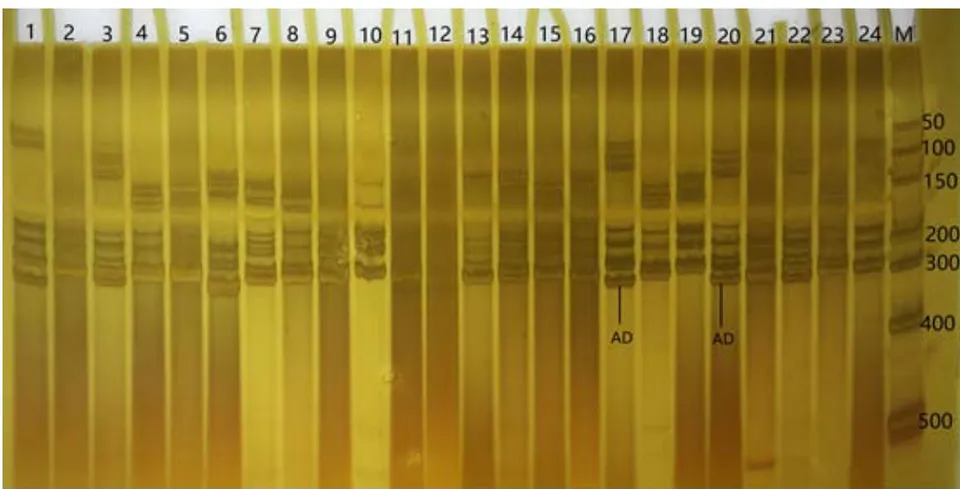
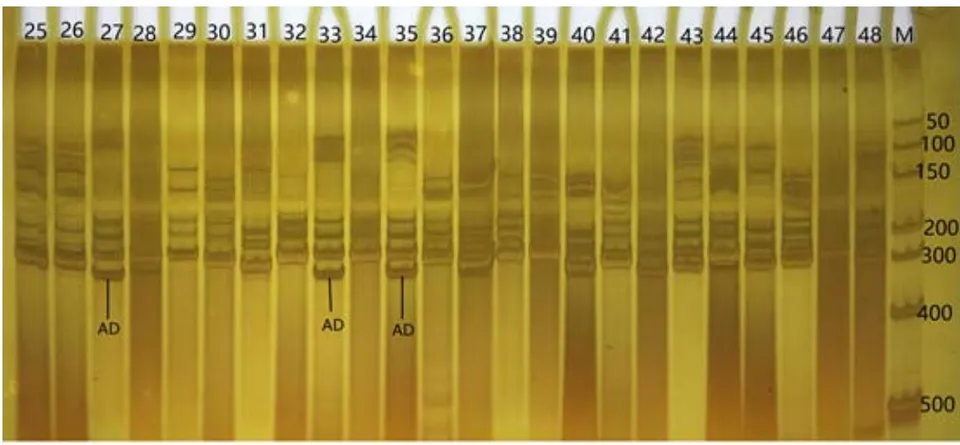
Figure 1 clearly demonstrated the results of electrophoresis and the genotypes manifested by the healthy and sick individuals at loci 57.
Table 2 showed the mean number of alleles (Na), mean number of effective alleles (Ne), mean Shannon index (I), mean expected heterozygosity (He), mean observed heterozygosity (Ho) and the mean polymorphic information content (PIC) were 4.2, 3.2, 0.6628, 0.6466, 0.6221 and 1.2, respectively.
| loci | Mean number of alleles | Mean number of effective alleles | Mean Shannon Index I | Mean expected heterozygosity | Mean observed heterozygosity | Mean polymorphic information content PIC |
| loci75 | 4 | 2 | 1 | 0.5132 | 0.766 | 0.491 |
| loci62 | 4 | 3.3 | 1.3 | 0.7078 | 0.8478 | 0.672 |
| loci57 | 4 | 3.7 | 1.4 | 0.7419 | 0.5 | 0.685 |
| loci4 | 4 | 3.3 | 1.3 | 0.7062 | 0.5106 | 0.656 |
| loci1 | 4 | 3.8 | 1.4 | 0.7458 | 0.4167 | 0.689 |
| loci254 | 3 | 3.5 | 1 | 0.5996 | 0.7447 | 0.553 |
| loci753 | 9 | 4.3 | 1.8 | 0.7772 | 0.5319 | 0.741 |
| loci977 | 4 | 4 | 1.4 | 0.7558 | 0.8 | 0.734 |
| loci358 | 3 | 1.8 | 0.7 | 0.435 | 0.5652 | 0.396 |
| loci45 | 3 | 2.8 | 1 | 0.6452 | 0.7826 | 0.604 |
| mean | 4.2 | 3.2 | 1.2 | 0.6628 | 0.6466 | 0.6221 |
| loci | genotypes | length /bp | positive/all sick individual | Probability of sick individual | positive/all healthy individual | Probability of healthy individual | P |
| locus 57 | AD | 290/314 | 0/24 | 0 | 5/24 | 21% | 0.022 |
| locus 57 | AA | 290/290 | 1/24 | 4% | 5/24 | 21% | 0.043 |
| locus57 | AC | 290/308 | 5/24 | 21% | 1/24 | 4% | 0.043 |
| locus 45 | BB | 390/390 | 7/23 | 30% | 13/23 | 57% | 0.011 |
| locus 62 | BB | 400/400 | 9/22 | 41% | 5/24 | 21% | 0.043 |
| locus 254 | BB | 340/340 | 13/23 | 57% | 9/24 | 38% | 0.043 |
| locus 358 | BC | 315/321 | 5/22 | 23% | 10/24 | 42% | 0.022 |
| locus 977 | BB | 393/393 | 3/23 | 13% | 7/25 | 28% | 0.043 |
Through association analysis, micro-satellite loci of 57, 62 and 254 were associated to the sick individuals of Eriocheirsinensis (P<0.05) while microdifferences were tested for the associations between their genotypes and sick traits. The observed genotypes for sick individuals were AC (290/308) at loci of 57, BB (400/400) at loci of 62 and BB (340/340) at loci of 254.
The favorable genotypes for healthy individuals were AD (290/314) at loci of 57, AA (290/290) at loci of 57, BB (390/390) at loci of 45, BC (315/321) at loci of 358 and BB (393/393) at loci of 977.
b) Association analysis of micro-satellite DNA markers at the 10 loci of the sick and health individuals
Association analysis suggested that micro-satellite loci of 57, 62 and 254 were significantly associated with the sick population (P<0.05); microsatellite loci of 57, 45, 358 and 977 were significantly associated with the healthy population (P<0.05).
The observed genotypes for sick individuals were AC (290/308) at loci of 57, BB (400/400) at loci of 62 and BB (340/340) at loci of 254. The favorable genotypes for healthy individuals were AD (290/314) at loci of 57, AA (290/290) at loci of 57, BB (390/390) at loci of 45, BC (315/321) at loci of 358 and BB (393/393) at loci of 977.
IV. Discussion
In aquaculture species, a number of Quantitative Trait Loci (QTL), have been mapped and characterized (Jackson 1998, Danzmann 1999, Sakamoto 1999, Ozaki 2001, Perry 2001, Robison 2001, Shirak 2002, Xiong 2012, Qiu 2016). In our study, four (4) (Table 2) loci were discovered and these were associated with the resistance to trembling disease in the Chinese mitten crabs. Through association studies, the effects of distinct genotypes (Table 2) at the eight (8) loci were significantly different. The results obtained in this study are expected to play a significant role for future marker-assisted selection (MAS) programmes in the Chinese mitten crab.
With crab mortalities reaching 70% (Chen 2011), the trembling disease has been reported to cause major economic losses to crab farmers in China. In order to come up with a family of crabs resistant to the trembling disease, a number of breeding programmes have been undertaken though no study to date had endeavored to associate resistance of trembling disease to micro-satellite markers in the Chinese mitten crab. In this study, however, we demonstrated the potential use of marker-based analysis in the association between resistance to disease and co-dominant DNA markers. Crabs were selected depending on their manifestation of the characteristics of the trembling disease as described by (Shen 2015)&(Zhang 2004). Crabs that showed all the characteristics of the trembling disease were considered to be susceptible while those that manifested no signs of the disease were considered to be resistant. It is on this basis that a micro-satellite marker analysis was conducted in order to establish the association of moro-satellite DNA markers with resistance to trembling disease in the Chinese mitten crab.
In a study carried out by (Xiong 2012), a total number of 15,000 simple sequence repeats (SSR) or micro-satellite markers were isolated from mitten crabs which were reported to be suitable for construction of genetic linkage maps. In a more recent study by (Qiu 2016), nine quantitative trait loci (QTL) associated with growth traits and two QTL related to sexual precocity in the mitten crabs were identified on a linkage map. All the micro-satellite markers that have been reported to date are quantitative trait loci (QTL). To the best of our knowledge, there hasn't been any genetic linkage study associating micro-satellite DNA markers with resistance to the trembling disease in the Chinese mitten crab (Eriocheirsinensis).
This study demonstrated a total of four (4) micro-satellite markers that can be associated with resistance to the trembling disease in the Chinese mitten crab. These results are expected to be used as a baseline for future marker-assisted selection programmes in the Chinese mitten crab. The study, being the first of its kind is further expected to pave way for future related studies. More studies in the same line are necessary in order to come up with more micro-satellite markers that can be associated to disease resistance in the Chinese mitten crab.
V. CONCLUSION
In this study, were able to identify four micro-satellite markers that are associated with resistance to the trembling disease in the Chinese mitten crab; Eriocheirsinensis. There is however need to develop more micro-satellite DNA markers that are associated with resistance to trembling disease in E. sinensis which are expected to paint a much clearer picture about the polygenic status of trembling disease resistance in E. sinensis. Further establishment of the role of these mirco-satellite DNA markers to the trembling disease resistant populations of E. sinensis will be of additional importance. There is need to carry out more such studies on bigger numbers of E. sinensis which can be a good representative of the entire E. sinensis populations. This study therefore suggests that future studies of molecular pathogenicity in E. sinensis are inevitable. This study will provide the theoretical basis for molecular marker-assisted breeding in Eriocheirsinensis in future.
VI. ACKNOWLEDGEMENTS
This study was funded by the Government of the People's Republic of China through the Ministry of Finance and Commerce.
Conflict of interest (s)
The authors of this study herein disclaim any conflict (s) of interest (s).


