


Mimicry in Ted Elemeforo’s Fountain of Betrayal

1
Ayebanoa Timibofa
Ayebanoa Timibofa

Send Message

To: Author

GJHSS Volume 22 Issue H7

Article Fingerprint

ReserarchID

TZ6LR

Mimicry in Ted Elemeforo’s Fountain of Betrayal Banner
  • English
  • Afrikaans
  • Albanian
  • Amharic
  • Arabic
  • Armenian
  • Azerbaijani
  • Basque
  • Belarusian
  • Bengali
  • Bosnian
  • Bulgarian
  • Catalan
  • Cebuano
  • Chichewa
  • Chinese (Simplified)
  • Chinese (Traditional)
  • Corsican
  • Croatian
  • Czech
  • Danish
  • Dutch
  • Esperanto
  • Estonian
  • Filipino
  • Finnish
  • French
  • Frisian
  • Galician
  • Georgian
  • German
  • Greek
  • Gujarati
  • Haitian Creole
  • Hausa
  • Hawaiian
  • Hebrew
  • Hindi
  • Hmong
  • Hungarian
  • Icelandic
  • Igbo
  • Indonesian
  • Irish
  • Italian
  • Japanese
  • Javanese
  • Kannada
  • Kazakh
  • Khmer
  • Korean
  • Kurdish (Kurmanji)
  • Kyrgyz
  • Lao
  • Latin
  • Latvian
  • Lithuanian
  • Luxembourgish
  • Macedonian
  • Malagasy
  • Malay
  • Malayalam
  • Maltese
  • Maori
  • Marathi
  • Mongolian
  • Myanmar (Burmese)
  • Nepali
  • Norwegian
  • Pashto
  • Persian
  • Polish
  • Portuguese
  • Punjabi
  • Romanian
  • Russian
  • Samoan
  • Scots Gaelic
  • Serbian
  • Sesotho
  • Shona
  • Sindhi
  • Sinhala
  • Slovak
  • Slovenian
  • Somali
  • Spanish
  • Sundanese
  • Swahili
  • Swedish
  • Tajik
  • Tamil
  • Telugu
  • Thai
  • Turkish
  • Ukrainian
  • Urdu
  • Uzbek
  • Vietnamese
  • Welsh
  • Xhosa
  • Yiddish
  • Yoruba
  • Zulu

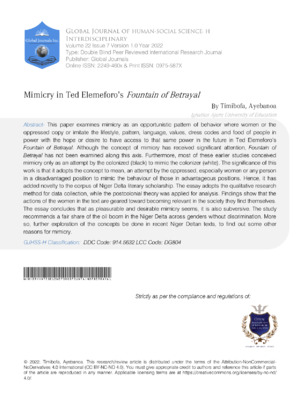
This paper examines mimicry as an opportunistic pattern of behavior where women or the oppressed copy or imitate the lifestyle, pattern, language, values, dress codes and food of people in power with the hope or desire to have access to that same power in the future in Ted Elemeforo’s Fountain of Betrayal. Although the concept of mimicry has received significant attention, Fountain of Betrayal has not been examined along this axis. Furthermore, most of these earlier studies conceived mimicry only as an attempt by the colonized (black) to mimic the colonizer (white). The significance of this work is that it adopts the concept to mean, an attempt by the oppressed, especially women or any person in a disadvantaged position to mimic the behaviour of those in advantageous positions. Hence, it has added novelty to the corpus of Niger Delta literary scholarship. The essay adopts the qualitative research method for data collection, while the postcolonial theory was applied for analysis. Findings show that the actions of the women in the text are geared toward becoming relevant in the society they find themselves. The essay concludes that as pleasurable and desirable mimicry seems, it is also subversive. The study recommends a fair share of the oil boom in the Niger Delta across genders without discrimination. More so, further exploration of the concepts be done in recent Niger Deltan texts, to find out some other reasons for mimicry.

Funding

No external funding was declared for this work.

Conflict of Interest

The authors declare no conflict of interest.

Ethical Approval

No ethics committee approval was required for this article type.

Data Availability

Not applicable for this article.

Ayebanoa Timibofa. 2026. \u201cMimicry in Ted Elemeforo’s Fountain of Betrayal\u201d. Global Journal of Human-Social Science - H: Interdisciplinary GJHSS-H Volume 22 (GJHSS Volume 22 Issue H7): .

Download Citation

A detailed study on mimicry and betrayal in Ted Elemero's Fountain of Betrayal, emphasizing psychological and literary analysis.
Journal Specifications

Crossref Journal DOI 10.17406/GJHSS

Print ISSN 0975-587X

e-ISSN 2249-460X

Keywords
Classification
GJHSS-H Classification: DDC Code: 914.5632 LCC Code: DG804
Version of record

v1.2

Issue date

November 14, 2022

Language

English

Experiance in AR

The methods for personal identification and authentication are no exception.

Read in 3D

The methods for personal identification and authentication are no exception.

Article Matrices
Total Views: 1581
Total Downloads: 20
2026 Trends
Research Identity (RIN)
Related Research

Published Article

This paper examines mimicry as an opportunistic pattern of behavior where women or the oppressed copy or imitate the lifestyle, pattern, language, values, dress codes and food of people in power with the hope or desire to have access to that same power in the future in Ted Elemeforo’s Fountain of Betrayal. Although the concept of mimicry has received significant attention, Fountain of Betrayal has not been examined along this axis. Furthermore, most of these earlier studies conceived mimicry only as an attempt by the colonized (black) to mimic the colonizer (white). The significance of this work is that it adopts the concept to mean, an attempt by the oppressed, especially women or any person in a disadvantaged position to mimic the behaviour of those in advantageous positions. Hence, it has added novelty to the corpus of Niger Delta literary scholarship. The essay adopts the qualitative research method for data collection, while the postcolonial theory was applied for analysis. Findings show that the actions of the women in the text are geared toward becoming relevant in the society they find themselves. The essay concludes that as pleasurable and desirable mimicry seems, it is also subversive. The study recommends a fair share of the oil boom in the Niger Delta across genders without discrimination. More so, further exploration of the concepts be done in recent Niger Deltan texts, to find out some other reasons for mimicry.

Our website is actively being updated, and changes may occur frequently. Please clear your browser cache if needed. For feedback or error reporting, please email [email protected]
×

This Page is Under Development

We are currently updating this article page for a better experience.

Request Access

Please fill out the form below to request access to this research paper. Your request will be reviewed by the editorial or author team.
X

Quote and Order Details

Contact Person

Invoice Address

Notes or Comments

This is the heading

Lorem ipsum dolor sit amet, consectetur adipiscing elit. Ut elit tellus, luctus nec ullamcorper mattis, pulvinar dapibus leo.


High-quality academic research articles on global topics and journals.

Mimicry in Ted Elemeforo’s Fountain of Betrayal

Ayebanoa Timibofa
Ayebanoa Timibofa

Research Journals




























































