


1. Introduction
The banking industry has undergone significant transformation with the advancement of information and communication technologies, leading to the growth of digital and mobile-based financial services. Mobile banking has emerged as an important digital banking channel because it enables customers to access financial services without the limitations of time and physical location (Shaikh & Karjaluoto, 2015). The adoption of mobile banking is strongly associated with customers’ perceptions of convenience, usefulness, ease of use, trust, security, and service quality (Davis, 1989; Venkatesh & Davis, 2000; Alalwan et al., 2018). The Technology Acceptance Model (TAM) suggests that perceived usefulness and perceived ease of use are major determinants of users’ acceptance of information systems (Davis, 1989). In mobile banking research, these constructs have been widely used to explain why customers adopt and continue using mobile banking applications (Shaikh & Karjaluoto, 2015). Alalwan et al. (2018) further observed that customers’ adoption of digital banking services is influenced by technology-related factors as well as perceived risk. Similarly, Kumar et al. (2023) found that performance expectancy, effort expectancy, perceived trust, perceived risk, and financial cost are important in explaining mobile banking adoption among young Indian customers. Service quality is also central to customer experience in mobile banking. The SERVQUAL model identifies reliability, responsiveness, assurance, empathy, and tangibility as important dimensions of service quality (Parasuraman et al., 1988). In digital banking, these dimensions are reflected in transaction reliability, response speed, security assurance, customer support, and interface quality. Jun and Palacios (2016) found that mobile banking service quality includes dimensions such as ease of use, convenience, accuracy, security, and continuous improvement. Kaura et al. (2015) also showed that service quality and service convenience significantly influence customer satisfaction and loyalty in banking services.
The Indian banking sector has experienced rapid digital transformation due to increasing smartphone usage, digital payment infrastructure, and policy initiatives supporting cashless transactions. The Unified Payments Interface (UPI), launched by the National Payments Corporation of India, has become a major driver of India’s digital payments ecosystem. In October 2024, UPI processed 16.58 billion financial transactions worth ₹23.49 lakh crore, indicating the scale of digital payment adoption in India (Press Information Bureau, 2024) [10]. This expansion has increased the importance of mobile banking applications as banks compete to provide faster, safer, and more user-friendly digital services. Customer experience has become a critical issue in mobile banking because users evaluate applications not only in terms of technological functionality but also in terms of service delivery. Positive customer experiences are associated with satisfaction, trust, loyalty, and continued usage, whereas negative experiences may arise from transaction failures, login problems, poor responsiveness, security concerns, and technical glitches (Jun & Palacios, 2016; Kumar et al., 2023). Since mobile banking applications involve sensitive financial transactions, perceived security and trust are especially important determinants of user confidence and continued usage (Kumar et al., 2023).
Online customer reviews have become an important source of understanding user experience because they reflect customers’ actual perceptions, complaints, and satisfaction after using a service. Oh and Kim (2021) demonstrated that consumer-generated mobile banking app reviews can reveal important satisfaction factors such as ease of use, convenience, security, and customer support. Their text-mining analysis showed that positive comments related to security and convenience improved mobile banking app ratings, while negative comments related to insecurity, poor support, discomfort, and complexity reduced user ratings. Dey et al. (2023) also emphasized that text mining of online customer reviews can help researchers understand customer perceptions of mobile banking applications using unstructured review data.
In India, SBI YONO and HDFC Mobile Banking App are two prominent mobile banking platforms that provide a wide range of digital banking services. These applications allow users to perform activities such as fund transfers, account monitoring, bill payments, card management, investment services, and other banking transactions. However, despite their popularity, customer reviews often indicate varying experiences related to ease of use, reliability, security, responsiveness, technical issues, and customer support. These aspects make both applications suitable for a comparative review-based study of customer experience and user perception. Existing studies on mobile banking have contributed significantly to understanding technology adoption, service quality, perceived risk, customer satisfaction, and trust (Alalwan et al., 2018; Jun & Palacios, 2016; Kaura et al., 2015; Kumar et al., 2023; Shaikh & Karjaluoto, 2015). However, most of these studies are based on surveys and structured questionnaires. Relatively fewer studies have examined customer-generated online reviews as a direct source of user experience in mobile banking (Oh & Kim, 2021; Dey et al., 2023). Moreover, comparative studies focusing specifically on SBI YONO and HDFC Mobile Banking App remain limited in the Indian context.
Against this backdrop, the present study undertakes a comparative analysis of customer reviews of SBI YONO and HDFC Mobile Banking App. Drawing upon the Technology Acceptance Model (TAM) and the SERVQUAL model, the study seeks to examine the technological and service-quality dimensions that shape customer experience and user perception. By analysing customer-generated reviews, the study contributes to the growing literature on digital banking while providing practical insights for improving mobile banking service delivery and customer satisfaction.
2. Problem Identification
The rapid growth of mobile banking has transformed the manner in which banking services are delivered and consumed, making mobile banking applications a critical channel for customer interaction and service delivery (Shaikh & Karjaluoto, 2015). Moreover, Indian banking sector has experienced significant digital transformation through the expansion of mobile banking services and digital payment systems. Among the leading mobile banking platforms, SBI YONO and HDFC Mobile Banking App have gained widespread adoption and serve millions of customers. As mobile banking usage continues to expand, customer experience has emerged as a key determinant of customer satisfaction, trust, loyalty, and continued usage intentions. Previous studies have consistently reported that factors such as perceived usefulness, perceived ease of use, reliability, security, responsiveness, and service quality significantly influence customers’ evaluations of mobile banking services (Davis, 1989; Parasuraman et al., 1988; Jun & Palacios, 2016).
Despite the substantial body of literature on mobile banking adoption and service quality, existing studies have predominantly relied on survey-based methodologies and structured questionnaires to examine customer perceptions and behavioural intentions (Shaikh & Karjaluoto, 2015; Alalwan et al., 2017). While these approaches provide valuable insights, they may not fully capture customers’ spontaneous experiences and actual concerns encountered during the use of mobile banking applications. Moreover, studies comparing customer experiences across SBI YONO and HDFC Mobile Banking App using customer-generated review data remains limited. Furthermore, previous studies have generally examined technology acceptance and service quality independently, leaving a gap in the literature regarding the integrated application of TAM and SERVQUAL for understanding customer experiences reflected in online reviews. Existing studies have largely focused on adoption intentions rather than actual user experiences expressed through review platforms. As a result, important insights relating to customers’ satisfaction, dissatisfaction, usability concerns, service quality perceptions, and technical challenges remain insufficiently explored.
Therefore, there exists a need for a comprehensive comparative investigation of customer experience and user perception regarding SBI YONO and HDFC Mobile Banking App using customer-generated review data. By integrating the Technology Acceptance Model (TAM) and SERVQUAL framework, the present study seeks to address this gap by examining how technological factors and service-quality dimensions influence customer experiences and perceptions. The findings of the study are expected to contribute to the existing literature on digital banking and provide practical insights for improving mobile banking applications and enhancing customer satisfaction.
3. Review of Literature
3.1. Thematic review
3.1.1. Mobile Banking adoption and Digital Banking Transformation
Mobile banking has emerged as one of the most significant developments in the digital transformation of the banking sector. It enables customers to access banking services through mobile devices, thereby reducing dependence on physical bank branches and improving convenience, accessibility, and service efficiency. Shaikh and Karjaluoto (2015) observed that mobile banking adoption is influenced by several technological and behavioural factors, including perceived usefulness, perceived ease of use, perceived risk, trust, and compatibility. Similarly, Alalwan et al. (2017) found that customers’ adoption of digital banking services is shaped by performance expectancy, effort expectancy, perceived risk, and trust. These studies indicate that mobile banking adoption is not determined by technological availability alone but also by customers’ perceptions of usefulness, ease, security, and service reliability.
In the Indian context, mobile banking has gained considerable importance due to the growth of smartphones, internet connectivity, and digital payment infrastructure. Mobile banking applications have become an important channel through which banks provide services such as fund transfers, bill payments, account monitoring, card management, and investment services. As customers increasingly rely on digital channels, banks are required to improve the quality, reliability, and usability of their mobile applications. This makes the study of customer experience and user perception highly relevant in the contemporary banking environment.
3.1.2. Technology Acceptance model and Mobile Banking Usage
The Technology Acceptance Model (TAM), introduced by Davis (1989), is one of the most widely used frameworks for understanding technology adoption. The model explains that perceived usefulness and perceived ease of use are major determinants of users’ acceptance of a technological system. Perceived usefulness refers to the extent to which users believe that a system improves their performance, while perceived ease of use refers to the extent to which the system is free from effort (Davis, 1989). In mobile banking, these constructs are highly relevant because customers are more likely to use applications that help them complete banking tasks quickly and easily. Venkatesh and Davis (2000) extended TAM and demonstrated that perceived usefulness and ease of use continue to influence users’ behavioural intention and technology usage. In mobile banking studies, TAM has been widely applied to explain why customers adopt and continue using digital banking applications (Shaikh & Karjaluoto, 2015). For the present study, TAM is useful for interpreting review themes such as ease of use, convenience, interface simplicity, app functionality, and overall usefulness of SBI YONO and HDFC Mobile Banking App.
3.1.3. Service quality in Mobile Banking
Service quality is an important determinant of customer satisfaction in banking services. Parasuraman et al. (1988) developed the SERVQUAL model, which identifies five dimensions of service quality: reliability, responsiveness, assurance, empathy, and tangibility. Although the model was originally developed for traditional service settings, its dimensions remain relevant in mobile banking. In digital banking applications, reliability refers to successful and error-free transactions, responsiveness refers to speed of service and issue resolution, assurance refers to security and trust, empathy refers to customer support, and tangibility may be reflected in the design and interface of the application. Jun and Palacios (2016) found that mobile banking service quality is influenced by factors such as reliability, convenience, ease of use, security, accuracy, and continuous improvement. Kaura et al. (2015) also emphasized that service quality and service convenience significantly influence customer satisfaction and loyalty in banking services. Therefore, customer reviews mentioning transaction failures, poor support, slow service, app crashes, or security concerns can be meaningfully interpreted through the SERVQUAL framework.
3.1.4. Customer Experience and User Perception in Mobile Banking
Customer experience in mobile banking refers to users’ overall perceptions and responses arising from their interaction with banking applications. Positive experiences may result from fast transactions, easy navigation, secure payments, and reliable services, while negative experiences may result from login failures, transaction delays, app crashes, poor customer support, or security concerns. Previous studies have shown that customer satisfaction and loyalty are strongly influenced by service quality, convenience, and trust (Jun & Palacios, 2016; Kaura et al., 2015).
User perception is particularly important in mobile banking because customers directly interact with the application rather than with bank employees. As a result, the application itself becomes a major representation of the bank’s service quality. If the application is difficult to use, unreliable, or slow, customers may develop negative perceptions of the bank’s digital service quality. Therefore, analysing customer reviews provides an opportunity to understand how users perceive SBI YONO and HDFC Mobile Banking App based on their actual experiences.
3.1.5. Security, Trust, and Reliability in Mobile Banking
Security and trust are central to mobile banking because users conduct sensitive financial transactions through digital platforms. Customers are more likely to adopt and continue using mobile banking applications when they believe that their personal data, account details, and financial transactions are safe. Alalwan et al. (2017) found that perceived risk influences customers’ adoption of digital banking services. Similarly, Shaikh and Karjaluoto (2015) identified trust and security as important factors affecting mobile banking adoption. Reliability is also essential because customers expect mobile banking applications to perform transactions accurately and consistently. Frequent transaction failures, login issues, server problems, or technical glitches may reduce customer trust and satisfaction. Within the SERVQUAL framework, reliability and assurance are especially relevant for analysing mobile banking reviews because they capture users’ concerns about transaction success, system stability, safety, and confidence in digital banking services.
3.1.6. Online Reviews and Customer Experience Analytics
Customer-generated online reviews have become an important source of understanding customer experience and service quality perceptions. Unlike survey responses, online reviews often capture spontaneous and experience-based opinions expressed by actual users. Oh and Kim (2021) demonstrated that mobile banking app reviews can reveal important factors affecting customer satisfaction, including ease of use, convenience, security, customer support, and technical problems. Their study shows that app review analysis can provide valuable insights into both positive and negative customer experiences.
For the present study, online reviews are particularly useful because they allow a comparative analysis of SBI YONO and HDFC Mobile Banking App based on actual user feedback. Review-based analysis can help identify recurring themes such as usability, transaction failure, login issues, app performance, security concerns, responsiveness, and customer support. Therefore, customer-generated reviews provide a suitable empirical basis for examining customer experience and user perception in mobile banking applications.
3.2. Empirical review
Several empirical studies have examined mobile banking adoption, service quality, customer satisfaction, trust, and user experience. These studies provide an important foundation for understanding customer experience and user perception of mobile banking applications.
Davis (1989) examined user acceptance of information technology and found that perceived usefulness and perceived ease of use significantly influence users’ acceptance of technological systems. The study established the Technology Acceptance Model (TAM), which remains one of the most widely used frameworks for studying technology adoption. This study is relevant to mobile banking because customers are more likely to use mobile banking applications when they perceive them as useful and easy to operate. Venkatesh and Davis (2000) extended the Technology Acceptance Model by examining additional factors influencing users’ behavioural intention and system usage. Their findings confirmed that perceived usefulness and perceived ease of use remain strong determinants
of technology acceptance. In the context of mobile banking, this implies that customers continued use of banking applications depends largely on whether the applications are perceived as efficient, convenient, and user-friendly.
Shaikh and Karjaluoto (2015) conducted a literature review on mobile banking adoption and identified key determinants influencing customers’ adoption of mobile banking services. Their study found that perceived usefulness, perceived ease of use, perceived risk, trust, compatibility, and facilitating conditions are among the major factors affecting mobile banking adoption. The study is important for the present research because it demonstrates that mobile banking adoption is shaped by both technological and behavioural factors. Alalwan et al. (2018) examined factors influencing customers’ intentions and adoption of internet banking by extending the UTAUT2 model with perceived risk. Their findings revealed that performance expectancy, effort expectancy, hedonic motivation, price value, and perceived risk significantly influence customers’ adoption intentions. Although the study focused on internet banking, its findings are relevant to mobile banking because both forms of digital banking depend on users’ perceptions of usefulness, ease of use, risk, and trust.
Parasuraman et al. (1988) developed the SERVQUAL model to measure service quality through five dimensions: reliability, responsiveness, assurance, empathy, and tangibility. Although the study was originally conducted in traditional service settings, the model has been widely applied in banking and digital service research. For mobile banking, these dimensions are useful for evaluating transaction reliability, service responsiveness, security assurance, customer support, and interface quality. Jun and Palacios (2016) examined the key dimensions of mobile banking service quality and found that mobile banking users evaluate service quality based on dimensions such as convenience, accuracy, ease of use, security, reliability, and continuous improvement. Their study is particularly relevant because it shows that mobile banking applications should be assessed not only as technological tools but also as service delivery platforms. This supports the present study’s use of both TAM and SERVQUAL perspectives. Kaura et al. (2015) investigated the relationship among service quality, service convenience, price fairness, customer satisfaction, and customer loyalty in Indian banking services. Their findings indicated that service quality and service convenience significantly influence customer satisfaction and loyalty. This study is relevant to the present research because mobile banking applications are expected to provide convenient, efficient, and reliable services that enhance customer satisfaction. Oh and Kim (2021) applied text mining analysis to mobile banking app reviews and examined factors that improve customer satisfaction. Their study collected 96,140 app reviews from four major U.S. banks and identified important customer satisfaction dimensions such as ease of use, convenience, security, and customer support. The findings showed that positive comments related to security and convenience improve app ratings, whereas negative comments about insecurity, poor customer support, discomfort, and complexity reduce ratings. This study is highly relevant because it supports the use of customer-generated app reviews for understanding mobile banking customer experience. Dey et al. (2023) applied text mining techniques to understand customer perception of mobile banking applications. Their study highlighted that online reviews can provide meaningful insights into customers’ satisfaction, dissatisfaction, usability concerns, security perceptions, and technical issues. This supports the present study’s approach of using customer-generated reviews as a secondary data source for examining user perception of SBI YONO and HDFC Mobile Banking App.
Recent studies on mobile banking review analytics have further shown that user-generated reviews provide rich data for identifying recurring customer experience issues. Hentati (2025), in a systematic review of text mining applications in mobile banking user satisfaction, found that sentiment analysis, topic modelling, and word cloud analysis are commonly used to examine mobile banking reviews. The study also indicated that security, ease of use, and software updates are frequently identified as major drivers of user satisfaction in mobile banking contexts.
Overall, the reviewed empirical studies show that mobile banking customer experience is influenced by both technology-related and service-quality factors. TAM-based studies emphasize perceived usefulness, ease of use, and adoption intention, whereas SERVQUAL-based studies emphasize reliability, responsiveness, assurance, empathy, and tangibility. However, much of the existing literature relies on surveys and structured questionnaires. Comparatively fewer studies have used customer-generated app reviews to compare mobile banking applications. Therefore, the present study contributes to the literature by examining customer reviews of SBI YONO and HDFC Mobile Banking App through an integrated TAM–SERVQUAL framework.
3.3. Research Gap
Existing studies on mobile banking have primarily relied on survey-based approaches to examine technology adoption, service quality, and customer satisfaction. Although TAM and SERVQUAL have been widely applied in mobile banking research, limited attention has been given to customer-generated online reviews as a source of understanding user perceptions and experiences. Furthermore, comparative studies examining customer reviews of SBI YONO and HDFC Mobile Banking App remain scarce. Therefore, the present study addresses this gap by analysing user-generated reviews through an integrated TAM–SERVQUAL perspective to compare customer experience and user perception across two leading mobile banking applications in India.
3.4. Conceptual framework
The conceptual framework of this study integrates the Technology Acceptance Model (TAM) developed by Davis (1989) and the SERVQUAL model proposed by Parasuraman et al. (1988) to examine customer experience and user perceptions of mobile banking applications. The integration of these two theoretical perspectives enables customer-generated app reviews to be analysed from both technology-acceptance and service-quality perspectives. While TAM explains users’ perceptions and attitudes toward the adoption and use of technology, SERVQUAL provides a complementary framework for understanding service-quality attributes reflected in users’ digital banking experiences.
The TAM component comprises four constructs: Perceived Usefulness (PU), Perceived Ease of Use (PEOU), Attitude Toward Use (ATU), and Behavioural Intention (BI). Perceived Usefulness refers to the extent to which users perceive that a mobile banking application improves the efficiency and effectiveness of their banking activities. Perceived Ease of Use reflects the extent to which the application is perceived as easy to learn, understand, and operate. Attitude Toward Use captures users’ overall favourable or unfavourable evaluations of the application, whereas Behavioural Intention reflects users expressed intentions to continue using or recommend the application. The SERVQUAL component comprises five dimensions: Reliability (REL), Responsiveness (RES), Assurance (ASS), Empathy (EMP), and Tangibles (TAN). Reliability concerns the consistent and dependable delivery of banking services and is reflected in the present study particularly through users’ reports of technical failures or unreliability, such as transaction failures, application crashes, login problems, server downtime, and service interruptions. Responsiveness relates to the promptness of customer support and issue resolution. Assurance represents users’ perceptions of security, trust, and confidence in the application and its services. Empathy refers to perceptions of personalised attention, understanding, and customer support, while Tangibles capture aspects of interface design, visual appeal, navigation, and other observable features of the mobile application.
The integration of TAM and SERVQUAL is intended primarily to provide a comprehensive theoretical framework for classifying and interpreting customer-generated app-review content. TAM captures technology-related perceptions concerning usefulness, ease of use, attitude, and behavioural intention, whereas SERVQUAL captures complementary service-quality dimensions associated with users’ digital banking experiences. The integrated framework therefore enables the review data to be examined simultaneously from technological and service-delivery perspectives. Importantly, the integration of TAM and SERVQUAL does not imply that all constructs are expected to occur with equal frequency in customer reviews or that every construct must necessarily be included in inferential modelling. App-store reviews are spontaneous, unstructured, and user-driven; consequently, users may discuss certain dimensions extensively while making little or no reference to others. All identified TAM and SERVQUAL constructs are therefore retained in the descriptive analysis to preserve the theoretical breadth of the framework. However, inferential analysis is restricted to constructs with sufficient empirical occurrence to support meaningful and stable statistical estimation. This distinction allows the integrated framework to provide comprehensive theoretical coverage while ensuring that the statistical analysis remains appropriate to the characteristics of the observed review data.
For the inferential component of the study, user rating, measured on a five-point ordinal scale ranging from one to five stars, serves as the dependent variable. The mobile banking application (SBI YONO or HDFC Mobile Banking) is included to account for differences between the two applications. Selected TAM and SERVQUAL-related constructs with adequate empirical occurrence are examined in relation to user ratings. Accordingly, the framework does not assume that every theoretical construct must enter the statistical model; rather, the inclusion of constructs in inferential analysis is determined by their empirical representation in the review dataset.
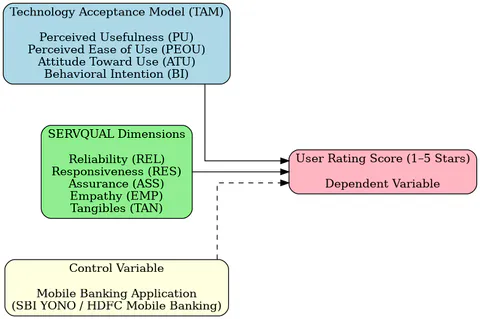
As illustrated in Figure 1, the framework conceptualises mobile banking customer experience as encompassing both technology-acceptance and service-quality dimensions. TAM provides the technology-related constructs through which users’ perceptions and attitudes toward the applications can be classified, while SERVQUAL provides dimensions for interpreting service-quality experiences communicated through customer reviews. These constructs are manifested to varying degrees in the review content and provide the analytical basis for systematically comparing customer-generated experiences and perceptions of SBI YONO and HDFC Mobile Banking.
4. Methodology Adopted
4.1. Research design
This study adopted a comparative quantitative research design using secondary data obtained from user-generated reviews of mobile banking applications. A content analysis approach was employed to examine customer experiences and user perceptions of SBI YONO and HDFC Mobile Banking applications. The study integrated the Technology Acceptance Model (TAM) and SERVQUAL framework to identify the key factors influencing user evaluations and ratings.
4.2. Data Source
The data for this study consists of public user reviews extracted from the Google play store. Android reviews were chosen exclusively because Android holds the majority of the market share in India, providing large volumes of publicly available user feedback and serve as important channels through which customers express their experiences, opinions, and concerns regarding mobile banking applications.
4.3. Sampling Framework and Time-frame
This study employs a stratified sampling approach to ensure balanced representation across different rating categories. Reviews were stratified according to their star ratings (1-star to 5-star), and an equal number of reviews were selected from each category. The final sample comprised 2,000 reviews, including 1,000 reviews for SBI YONO and 1,000 reviews for HDFC Mobile Banking. For each application, 200 reviews were selected from each rating category, resulting in an equal distribution of ratings across the sample.
The study analysed user reviews posted between 1 January 2023 and 31 December 2025. A three-year sampling period was selected to capture recent customer experiences and perceptions of SBI YONO and HDFC Mobile Banking applications. The selected period was considered appropriate because it captures recent developments in mobile banking while providing a sufficiently large and diverse sample of user reviews. A shorter period could limit data availability, whereas a longer period might include outdated reviews that no longer reflect current application features and user experiences.
4.4. Measurement and Operationalisation of Variables
This study integrates the Technology Acceptance Model (TAM) and SERVQUAL framework to examine customer experience and user perceptions of SBI YONO and HDFC Mobile Banking applications. The TAM constructs considered in the study include Perceived Usefulness (PU), Perceived Ease of Use (PEOU), Attitude Toward Use (ATU), and Behavioural Intention (BI). The SERVQUAL dimensions include Reliability (REL), Responsiveness (RES), Assurance (ASS), Empathy (EMP), and Tangibles (TAN). A content analysis approach was employed to code the user reviews according to the constructs of the Technology Acceptance Model (TAM) and SERVQUAL framework. Keywords and phrases associated with each construct were identified from prior literature and refined through a manual review of the selected app-store reviews. The coding process involved examining each review to determine the presence or absence of construct-related expressions. Each TAM and SERVQUAL construct was operationalised as a binary variable, where a value of 1 indicated the presence of a construct-related expression in a review and a value of 0 indicated its absence. The dependent variable of the study is the user rating score, measured on a five-point ordinal scale ranging from 1 star to 5 stars. The type of mobile banking application was included as a control variable and coded as 1 for SBI YONO and 2 for HDFC Mobile Banking.
To improve coding validity, the identification of TAM and SERVQUAL constructs was not based solely on isolated keyword matching. Each review was examined in its contextual form, and negations and syntactic qualifications were considered during manual coding. For example, expressions such as “not easy to use” were not coded as positive evidence of Perceived Ease of Use merely because the phrase contained the keyword “easy.” Similarly, statements such as “never useful” were interpreted according to their complete contextual meaning rather than the presence of the word “useful.” Where the meaning of a phrase was ambiguous, the broader sentence context was considered before assigning the construct code. The coding procedure therefore combined dictionary-assisted identification of relevant terms with manual contextual verification. This approach was adopted to reduce the risk of false-positive classification arising from simple keyword matching. However, because the coding was conducted by the researcher rather than through independent multiple-coder assessment, a formal inter-coder reliability coefficient such as Cohen’s Kappa was not calculated. This is acknowledged as a methodological limitation of the study.
Table 1: Operational Definition, Measurement Criteria, and Coding of TAM and SERVQUAL Constructs
| Construct | Framework | Operational Definition | Measurement Criteria | Coding |
|---|---|---|---|---|
| Perceived Usefulness (PU) | TAM | The extent to which users perceive that the mobile banking application improves the efficiency, convenience, and effectiveness of banking transactions. | Reviews mentioning benefits, convenience, efficiency, time savings, or improved banking performance. | 1 = Present; 0 = Absent |
| Perceived Ease of Use (PEOU) | TAM | The extent to which users perceive the application as easy to learn, navigate, and use. | Reviews mentioning ease of navigation, simplicity, user-friendliness, or difficulty of use. | 1 = Present; 0 = Absent |
| Attitude Toward Use (ATU) | TAM | Users’ overall positive or negative evaluation of the mobile banking application. | Reviews expressing overall satisfaction, dissatisfaction, likes, dislikes, or general opinions. | 1 = Present; 0 = Absent |
| Behavioural Intention (BI) | TAM | Users’ intention to continue using or discontinue the mobile banking application in the future. | Reviews indicating continued use, discontinuation, recommendations, or switching intentions. | 1 = Present; 0 = Absent |
| Reliability (REL) | SERVQUAL | The ability of the application to perform banking services accurately, consistently, and dependably. | Reviews referring to transaction success or failure, system stability, login issues, application crashes, or technical performance. | 1 = Present; 0 = Absent |
| Responsiveness (RES) | SERVQUAL | The willingness and ability of the bank to provide timely assistance and support through digital channels. | Reviews discussing customer support, response speed, or issue resolution. | 1 = Present; 0 = Absent |
| Assurance (ASS) | SERVQUAL | Users’ perceptions of security, privacy, trustworthiness, and confidence in the application. | Reviews referring to security, trust, privacy, authentication, or fraud protection. | 1 = Present; 0 = Absent |
| Empathy (EMP) | SERVQUAL | The degree to which users perceive personalised attention and understanding of their needs. | Reviews mentioning personalised support or attention to user needs. | 1 = Present; 0 = Absent |
| Tangibles (TAN) | SERVQUAL | The visual and functional aspects of the application interface and associated digital resources. | Reviews discussing application design, appearance, layout, or visual features. | 1 = Present; 0 = Absent |
Source: Developed by the researcher based on Davis (1989) and Parasuraman et al. (1988).
4.5. Variable Screening and Selection for Inferential analysis
An initial frequency analysis was conducted to examine the distribution of the TAM and SERVQUAL constructs across the dataset. Constructs with occurrence rates below 5% were excluded from inferential analyses because sparse distributions can produce unstable parameter estimates and reduce statistical power.
Accordingly, Perceived Ease of Use (PEOU), Attitude Toward Use (ATU), and Reliability (REL) were retained for chi-square tests and ordinal logistic regression. Perceived Usefulness (PU), with an occurrence rate of 4.6%, was retained for descriptive purposes only. Behavioural Intention (BI), Responsiveness (RES), Assurance (ASS), Empathy (EMP), and Tangibles (TAN) were excluded from inferential analyses due to their low frequencies.
4.6. Analytical framework
This study adopts an integrated analytical framework based on the Technology Acceptance Model (TAM) developed by Davis (1989) and the SERVQUAL model proposed by Parasuraman et al. (1988) to examine customer experience and user perceptions of mobile banking applications.
The Technology Acceptance Model explains users’ acceptance and evaluation of information systems through four key constructs: Perceived Usefulness (PU), Perceived Ease of Use (PEOU), Attitude Toward Use (ATU), and Behavioural Intention (BI). In the context of mobile banking applications, these constructs capture users’ perceptions regarding the usefulness, ease of operation, overall evaluation, and future usage intentions associated with the applications. The SERVQUAL model complements TAM by incorporating service quality dimensions relevant to digital banking services. The dimensions include Reliability (REL), Responsiveness (RES), Assurance (ASS), Empathy (EMP), and Tangibles (TAN). These constructs assess users’ perceptions of system performance, customer support, security, personalised services, and interface design.
The analytical framework consists of three stages. First, user reviews were coded according to the TAM and SERVQUAL constructs. Second, frequency analysis and chi-square tests were conducted to compare the prevalence of the identified constructs between SBI YONO and HDFC Mobile Banking applications. Finally, ordinal logistic regression was employed to examine the influence of the selected constructs and application type on user ratings.
Based on the variable screening procedure, Perceived Ease of Use (PEOU), Attitude Toward Use (ATU), and Reliability (REL) were retained for inferential analyses due to their sufficient occurrence frequencies. User rating score served as the dependent variable, while application type was included as a control variable.
4.7. Data analysis techniques
The data were analysed using IBM SPSS Statistics. Frequency distributions and percentages were used to examine the occurrence of TAM and SERVQUAL constructs within the review dataset. Chi-square tests of independence were conducted to compare the prevalence of selected constructs between SBI YONO and HDFC Mobile Banking. Ordinal logistic regression analysis was employed to examine the influence of Perceived Ease of Use (PEOU), Attitude Toward Use (ATU), Reliability (REL), and application type on user ratings. A significance level of 5% () was adopted for all statistical tests.
5. Results and discussion
Table 2: Frequency Distribution of TAM and SERVQUAL Constructs
| Construct | Framework | Frequency | Percentage (%) |
|---|---|---|---|
| PU | TAM | 92 | 4.6 |
| PEOU | TAM | 144 | 7.2 |
| ATU | TAM | 955 | 47.8 |
| BI | TAM | 18 | 0.9 |
| REL | SERVQUAL | 208 | 10.4 |
| RES | SERVQUAL | 19 | 1.0 |
| ASS | SERVQUAL | 55 | 2.8 |
| EMP | SERVQUAL | 1 | 0.1 |
| TAN | SERVQUAL | 58 | 2.9 |
Source: Computed by the Author.
The frequency analysis revealed that Attitude Toward Use (ATU) was the most frequently identified construct, appearing in 955 reviews (47.8%). Reliability (REL) emerged as the most prominent SERVQUAL dimension, occurring in 208 reviews (10.4%). Perceived Ease of Use (PEOU) and Perceived Usefulness (PU) were identified in 144 reviews (7.2%) and 92 reviews (4.6%), respectively. Behavioural Intention (BI), Responsiveness (RES), Assurance (ASS), Empathy (EMP), and Tangibles (TAN) were identified in only a small proportion of reviews, indicating that users rarely discuss future usage intentions or interpersonal service quality dimensions in app-store reviews. These findings suggest that users primarily evaluate mobile banking applications based on their overall experiences, usability, and service reliability.
Table 3: Comparative Analysis of TAM and SERVQUAL Constructs by Mobile Banking Application (N=2,000)
| Construct | SBI YONO (n = 1,000) | HDFC Mobile Banking (n = 1,000) | p-value | Result | |
|---|---|---|---|---|---|
| n (%) | n (%) | ||||
| Attitude Toward Use (ATU) | 454 (45.4%) | 501 (50.1%) | 4.427 | .035 | Significant |
| Perceived Ease of Use (PEOU) | 56 (5.6%) | 88 (8.8%) | 7.663 | .006 | Significant |
| Reliability (REL) | 115 (11.5%) | 93 (9.3%) | 2.597 | .107 | Not significant |
Source: Computed by the Author.
Note: Values represent the frequency and percentage of reviews in which each construct was identified. Statistical significance was determined at the 5% level ().
The chi-square analysis revealed significant differences between the two applications regarding Attitude Toward Use and Perceived Ease of Use. HDFC Mobile Banking recorded a higher proportion of attitude-related expressions (50.1%) than SBI YONO (45.4%), and the difference was statistically significant (, ). Similarly, HDFC Mobile Banking reviews more frequently discussed ease-of-use aspects (8.8%) than SBI YONO reviews (5.6%), and the difference was statistically significant (, ). However, no significant difference was observed regarding Reliability (, ). Reliability-related concerns appeared in 11.5% of SBI YONO reviews and 9.3% of HDFC Mobile Banking reviews, indicating that users perceived both applications to have similar levels of reliability. Overall, the findings suggest that HDFC Mobile Banking performs better in terms of user attitudes and perceived ease of use, whereas both applications exhibit comparable reliability.
Table 4: Ordinal Logistic Regression Analysis of User Ratings and Selected Review Constructs
| Predictor | Estimate () | Std. Error | Wald | p-value | Odds Ratio () |
|---|---|---|---|---|---|
| App (SBI YONO) | 0.079 | 0.080 | 0.977 | .323 | 1.08 |
| PEOU (Absent) | -0.003 | 0.155 | 0.000 | .985 | 1.00 |
| ATU (Absent) | -0.808 | 0.083 | 95.193 | 0.45 | |
| REL (Absent) | 1.423 | 0.140 | 102.527 | 4.15 |
Source: Computed by the Author.
Note: The dependent variable is the user rating measured on a five-point ordinal scale (1–5 stars). HDFC Mobile Banking is the reference category for the application variable. For PEOU, ATU, and Technical Failures/Unreliability, “Present” is the reference category. Therefore, the reported coefficients for these constructs represent the effect of their absence relative to their presence. Odds ratios greater than 1 indicate higher odds of receiving a higher user rating, whereas odds ratios less than 1 indicate lower odds of receiving a higher user rating. The overall model was statistically significant, , .
The ordinal logistic regression model was statistically significant, indicating that the selected TAM and SERVQUAL constructs contributed to explaining variations in user ratings (, ). The results showed that Attitude Toward Use significantly influenced user ratings (, ). Reviews expressing stronger attitudes toward the applications were more likely to receive higher ratings. Reliability also emerged as a significant predictor of user ratings (, ). Reviews mentioning reliability-related issues were more likely to be associated with lower ratings. In contrast, Perceived Ease of Use (, ) and the type of mobile banking application (, ) did not significantly influence user ratings. Overall, the results suggest that customer evaluations of mobile banking applications are primarily influenced by users’ overall attitudes and perceptions of reliability rather than by ease of use or the specific application being used.
6. Findings
The study found that Attitude Toward Use (ATU) was the most frequently identified TAM construct, while Reliability (REL), reflected primarily through technical failures and unreliability, was the most prominent SERVQUAL dimension in the customer reviews. In contrast, other SERVQUAL dimensions, including Responsiveness, Assurance, Empathy, and Tangibles, occurred relatively infrequently. However, their low frequency should be interpreted as a characteristic of the spontaneous and technology-mediated nature of app-store reviews rather than as evidence that these dimensions are theoretically irrelevant to mobile banking services. The comparative analysis revealed that HDFC Mobile Banking had a significantly higher frequency of reviews containing Attitude Toward Use and Perceived Ease of Use content than SBI YONO. However, no statistically significant difference was found between the two applications in the occurrence of reliability-related content. These results indicate differences in the frequency with which users expressed particular experiences and perceptions in their reviews and should not be interpreted as direct evidence that one application performed better overall than the other. The ordinal logistic regression analysis further showed that Attitude Toward Use and technical failures/unreliability were significantly associated with user ratings, whereas Perceived Ease of Use and application type were not statistically significant. Specifically, the absence of technical failures or unreliability was associated with higher odds of being in a higher user-rating category. Overall, the findings suggest that users’ overall attitudes and experiences with the technical dependability of mobile banking services are closely associated with the ratings they assign, while application type and Perceived Ease of Use did not independently show significant associations with user ratings in the estimated model.
7. Implications of the study
The findings of this study have important theoretical, managerial, and methodological implications. Theoretically, the study demonstrates the usefulness of integrating the Technology Acceptance Model (TAM) and SERVQUAL framework to analyse customer experiences in mobile banking environments. The findings indicate that Attitude Toward Use and reliability-related factors play important roles in shaping user ratings. In particular, the findings provide an integrated interpretation of the relationship between technical reliability and user attitude in digital banking. In a mobile banking environment, the application itself constitutes the primary interface through which customers experience banking services. Consequently, technical stability, successful transaction processing, dependable login functionality, and uninterrupted access may form basic conditions for positive user evaluations. When these functional expectations are not met, users are more likely to express dissatisfaction through negative attitudes and lower app ratings. The significant association between Attitude Toward Use and user ratings, together with the importance of reliability-related problems, therefore suggests that technical performance and overall user attitude are closely interconnected in app-based banking experiences. This relationship also helps explain why interpersonal SERVQUAL dimensions such as empathy and responsiveness occurred less frequently in the present review data. In traditional branch banking, customers interact directly with employees and can evaluate interpersonal service behaviours. Mobile banking, in contrast, is predominantly a self-service environment in which users interact directly with the technological interface. As a result, customer-generated app reviews may naturally emphasise functional dimensions such as system reliability, transaction success, usability, and application performance rather than interpersonal aspects of service delivery. The low frequency of empathy, responsiveness, and related constructs should therefore be interpreted cautiously as a characteristic of the review context rather than as evidence that these service-quality dimensions are theoretically irrelevant. From a managerial perspective, the findings suggest that banks should prioritise enhancing the overall user experience and improving system reliability by reducing application crashes, transaction failures, login issues, and other technical problems. Since technical performance is closely associated with users’ overall evaluations of mobile banking applications, maintaining a stable and dependable application is important for improving customer experience. The results also show that app-store reviews can serve as a valuable source of real-time customer feedback for monitoring user perceptions and identifying areas requiring service improvement. Methodologically, the study highlights the potential of using user-generated app reviews as an alternative and complementary source of data to traditional survey-based approaches for examining customer experience and evaluating digital banking services. Such reviews provide naturally occurring expressions of users’ experiences and perceptions and can therefore offer useful insights into the technological and service-quality issues that customers encounter while using mobile banking applications.
8. Limitations and Direction for Future study
This study has several limitations that should be considered when interpreting the findings. First, the study relied exclusively on customer reviews obtained from the Google Play Store. Consequently, the findings primarily represent the experiences and perceptions of Android users and may not fully capture those of customers using iOS-based devices. Differences in device characteristics, operating-system environments, application interfaces, update cycles, and user interaction patterns may influence how customers experience and evaluate mobile banking applications. Therefore, the findings should not be generalised to the entire population of SBI YONO and HDFC Mobile Banking users across both Android and iOS platforms. Future studies could incorporate reviews from both the Google Play Store and Apple App Store to examine whether platform-specific differences influence customer experience, usability perceptions, technical problems, and service-quality evaluations. Second, the study employed a stratified sampling approach with equal allocation across the five rating categories, with 200 reviews selected from each rating category for each application. Although this procedure ensured balanced representation of ratings from one to five stars, the resulting sample does not reflect the natural distribution of ratings available on the Google Play Store. Consequently, the sampled rating distribution should not be interpreted as representing the actual proportion of positive, neutral, or negative evaluations among the overall population of app users. Third, several theoretically relevant TAM and SERVQUAL constructs, including Behavioural Intention, Responsiveness, Assurance, Empathy, and Tangibles, occurred relatively infrequently in the sampled reviews and were therefore not included in the inferential analysis. Their low occurrence may reflect the spontaneous and unstructured nature of app-store reviews, in which users tend to discuss issues that are most salient to their immediate experiences. It may also partly reflect the sensitivity of the coding dictionary used to identify the constructs. Accordingly, the low frequencies should not be interpreted as evidence that these constructs are theoretically unimportant. They were retained in the descriptive analysis, while inferential analysis was restricted to constructs with sufficient empirical occurrence to support more stable statistical estimation. Fourth, although dictionary-assisted coding was supplemented by contextual verification to account for expressions involving negation and contextual meaning, the coding procedure may not fully capture complex linguistic features such as sarcasm, implicit meanings, mixed emotions, and nuanced expressions. In addition, the coding was undertaken by a single researcher; therefore, formal inter-coder reliability statistics such as Cohen’s Kappa were not calculated. This should be recognised as a methodological limitation of the study. Future research could employ multiple independent coders and assess inter-coder agreement using appropriate reliability measures. Future studies may further address these limitations by incorporating reviews from multiple app platforms, using larger and naturally distributed review datasets, employing multiple independent coders, and applying advanced text-analytic approaches such as machine-learning-based sentiment analysis and natural language processing. From a statistical perspective, future research may also consider alternative modelling approaches, including multinomial logistic regression or generalised ordered logit models, where appropriate, to provide deeper and more robust insights into customer experiences and perceptions of mobile banking applications.
9. Conclusion
This study examined customer experience and user perceptions of mobile banking applications through a comparative analysis of SBI YONO and HDFC Mobile Banking reviews using an integrated Technology Acceptance Model (TAM) and SERVQUAL framework. The analysis was based on 2,000 user reviews collected from the Google Play Store between 1 January 2023 and 31 December 2025, comprising 1,000 reviews from each application. The integrated framework enabled customer-generated review content to be examined from both technology-acceptance and service-quality perspectives. The descriptive findings revealed that Attitude Toward Use (ATU) was the most frequently identified TAM construct, while Reliability (REL), operationalised primarily through expressions relating to technical failures and unreliability, was the most frequently identified SERVQUAL dimension. The comparative analysis further showed that HDFC Mobile Banking had a significantly higher frequency of reviews containing ATU and Perceived Ease of Use (PEOU) content than SBI YONO. However, no statistically significant difference was observed between the two applications in the frequency of reliability-related review content. These findings should be interpreted as differences in the occurrence of coded constructs within customer reviews rather than as direct measures of the overall performance of the two applications. The ordinal logistic regression analysis further demonstrated that Attitude Toward Use and technical failures/unreliability were significantly associated with user ratings, whereas Perceived Ease of Use and application type were not statistically significant. In particular, the absence of technical failures or unreliability was associated with higher odds of being in a higher user-rating category. These results indicate that users’ overall attitudes and experiences with the technical dependability of mobile banking services are closely associated with the ratings they assign, while application type alone does not significantly explain differences in user ratings. The study contributes to the growing literature on digital banking by demonstrating the usefulness of integrating TAM and SERVQUAL as complementary theoretical frameworks for classifying and interpreting customer-generated app-review content. The findings also indicate that some interpersonal SERVQUAL dimensions, such as responsiveness and empathy, are less frequently expressed in app-store reviews. However, their low occurrence should not be interpreted as evidence of theoretical irrelevance. Rather, it may reflect the predominantly self-service and technology-mediated nature of mobile banking and the spontaneous, unstructured characteristics of customer-generated reviews. From a practical perspective, the findings highlight the importance of enhancing overall user experience and maintaining reliable application performance. Banks should prioritise reducing technical problems such as application crashes, transaction failures, login difficulties, server downtime, and other service interruptions. Continuous monitoring of app-store reviews may also provide banks with valuable customer feedback for identifying recurring concerns and supporting improvements in digital banking services. Despite these contributions, the findings should be interpreted in light of certain limitations. The study relied exclusively on Google Play Store reviews and therefore primarily represents the experiences of Android users. In addition, the equal allocation of reviews across rating categories does not reflect the natural distribution of app ratings, several low-frequency TAM and SERVQUAL constructs could not be included in the inferential analysis, and the coding was undertaken by a single researcher without formal inter-coder reliability assessment. Future research could address these limitations by incorporating reviews from both Google Play Store and Apple App Store, using larger and naturally distributed review datasets, employing multiple independent coders, and applying advanced text-analytic techniques such as sentiment analysis, natural language processing, and machine learning. Alternative statistical approaches, including multinomial logistic regression and generalised ordered logit models, may also provide deeper insights into customer experiences and perceptions of mobile banking applications.