
I. INTRODUCTION
Dear reader, in the proposed article, the concepts familiar to you are debunked: the orbits of electrons in an atom, the regular Rutherford-Bohr planetary model of the atom, two types of quarks that form the nucleus of an atom and six flavors of quarks along with six flavors of leptons and many other concepts received in the Standard Model status of physical concepts. In the quark model of the American physicist M. Gell-Mann, one quark should have a positive electrical charge of 2/3 of the charge of the electron, and the other quark should have a negative charge of 1/3. Professor M. Gell-Mann called this charge difference between quarks flavors. New experiments and modeling of the behavior of black holes - these factories of baryonic and dark matter - have made it possible to discover the accurate physical picture of the structure of matter. It turned out that when describing the design of the atomic nucleus, guided by the principle of "Okaama's razor" and cutting off all unnecessary things, including hypothetical quarks and all the perfumery of aromas, one can obtain an actual model of the atomic nucleus. I want to remind you of the words of A. de Saint-Exupery: "Truth is not at all something that can be convincingly proven it is something that makes everything simpler and clearer."
II. ATOM MODEL
The atomic model proposed by Professor Lev Sapogin [1] does not contradict the latest new ideas about the internal structure of atoms. Unitary quantum theory makes it possible to explain the strange behavior of electrons in an atom when the electron orbitals of the p- and d-states of the bit look like figure eights with nodal points in the atomic nucleus (Fig. 1) [2].
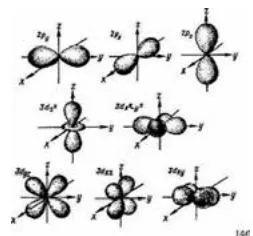
Since the areas allowed by quantum mechanics for an electron to reside in them are only the internal regions of these orbitals to get from one half-branch of the "eight" to the opposite, the electron must jump through the nucleus of the atom. This allows us to take a new look at the mechanism of the mysterious K-capture of an electron in an atom. Electron capture, as is known, consists in the fact that the nuclei of atoms of some isotopes of chemical elements, in some mysterious way, sometimes capture an electron from the inner (K- or L-) electron shell of the atom. Physicists have long been tormented by the question of how such a capture occurs if the electron in an atom, according to existing concepts, is very far (on nuclear scales) from the nucleus. But if an electron constantly tunnels through the nucleus of an atom, then everything becomes clear. In Lev Sapogin's model, electrons inside an atom do not fly in orbits, as in Rutherford's model, but are a standing electromagnetic wave that does not have an orbit and coordinates, but has a certain frequency and amplitude. A similar conclusion follows from the law of formation of the spectra of the hydrogen atom corresponding to the stationary energy levels of the electron. The law of spectroscopy does not have a component corresponding to the orbital motion of the electron, which means the absence of orbital motion of the electron in the atom. Therefore, to describe the behavior of electrons in an atom, the concept of the energy level of an electron in an atom is introduced, instead of the existing concepts of orbit and orbital. This representation of the atom allows for electron tunneling through the atomic nucleus. Lev Sapogin explained tunneling by the fact that the electric charge of an elementary particle is not constant in time, but periodically changes (oscillates) with a monstrously high frequency, sometimes increasing to a maximum, sometimes decreasing to zero according to the harmonic law. Therefore, quantum theory operates with time-averaged values of the effective charge of a particle and its mass, which also oscillates in time according to a harmonic law ranging from zero to maximum [2]. To tunnel, the particle must approach the potential barrier in a phase when the amplitude of the wave packet is small, and the particle, in the absence of a charge, overcomes the barrier without "noticing" it. Moreover, at the moment of tunneling, the instantaneous values of the charge and mass of the electron are close to zero and, due to the law of conservation of momentum, at this time the electron must develop a very high speed of movement through the nucleus of the atom. However, if the tunneling process is disrupted, the electron is either captured by the nucleus, or a nonlinear interaction begins, and the particle can be reflected from the barrier. In this case, not the entire electron is captured, but only its electric charge and most of the mass, which are attached to one of the positively charged protons P of the nucleus, which turns into a neutron N, the mass of which is greater than the mass of the proton. But the remainder of the electron in the form of an electron neutrino flies far beyond the boundaries of the atom. Physicists suggest that in this case a process occurs in the nucleus of the atom:
which, however, has never been observed in experiments on the bombardment of protons by beams of accelerated electrons [1]. This confirms experiments of Andras Kovacs, Valery Zatelepina, and Dmitry Baranov related to the discovery of the nuclear electron and the measurement of its mass [3]. Andras Kovacs, Valery Zatelepina, and Dmitry Baranov measured the mass of a nuclear electron and obtained two values: for , the capture measurement gives 1554 keV, and for 1H, it gives 1553 keV. Thus, the average value of the mass of a nuclear electron will be 1553.5 keV. The neutron is made up of a proton and a nuclear electron. The mass of a nuclear electron is 1553.5 keV. As a free particle, the nuclear electron has a short, but not zero, half-life. A nuclear electron is stabilized by binding to one or more protons. The binding energy between a proton and a nuclear electron is 260 keV [3]. Andras Kovacs, Valery Zatelepina, and Dmitry Baranova established the existence of much experimental evidence for the presence of negative elementary charges in nuclei. A possible explanation may be the K-capture of an electron by the nucleus, in which the total positive charge of the nucleus decreases by one (in units of proton charge). Therefore, during K-capture, the nucleus turns into the nucleus of an atom of one of the isotopes of the chemical element that appears in the periodic table before the original chemical element. In the article "The Energy of Our Future," 1931 Nikola Tesla wrote: "The worst of the modern theories is probably the electron theory. Of the four or five theories of atomic structure proposed today, not one is probable. No more than one in a thousand scientists believe that an electron - whatever it may be - can exist only in the ideal vacuum of intermolecular and interstellar space" [4]. This statement was brilliantly confirmed by the experiments of Andras Kovacs, Valery Zatelepin, and Dmitry Baranov [3].
III. QUASARS - FACTORIES OF BARYONIC AND DARK MATTER
In September 2021, Professors Xavier Calmett and Folkert Kuipers from the Department of Physics and Astronomy at the University of Sussex published a report that the structure of black holes is more complex than previously thought, and quantum gravity can lead to pressure black holes on the quantum environment. Xavier Calmett said: "Our finding that Schwarzschild black holes have a pressure as well as a temperature is even more exciting given that it was a total surprise. Hawking's landmark intuition that black holes are not black but have a radiation spectrum similar to that of a black body makes black holes an ideal laboratory to investigate the interplay between quantum mechanics, gravity, and thermodynamics" [5]. At the edge of a black hole, the physical vacuum is in a conditionally stressed state, as a result of which it is polarized in a quantum manner. Nothing of the kind follows from Einstein's General Theory of Relativity. Einstein's general relativity, in general, is incompatible with quantum concepts. Studying the behavior of quantum fields near a black hole, Stephen Hawking predicted that a black hole necessarily radiates particles into outer space and thereby loses mass [6]. This effect is called Hawking radiation (evaporation). Vacuum polarization occurs under the influence of monstrous gravitational and magnetic fields, as a result of which the formation of not only virtual but also real particle-antiparticle pairs is possible. According to Hawking, on the surface of the event horizon, the direction of expansion of the generated particles ceases to be random, i.e., becomes polarized, namely, orthogonal to the surface of the black hole [6]. The existence of stable Hawking radiation - the process of emission of various particles by a black hole - was first proved by specialists from the Israel Institute of Technology [7]. A report of the production of a substance with properties identical to plasma in the vicinity of a black hole also appeared in a joint work of Russian, Japanese and French researchers from the LaPlaz Institute, the National Research Nuclear University MEPhl and the CELIA laboratory of the University of Bordeaux, published in 2020 [8]. Black hole accretion disks were obtained in laboratory conditions. This structure results from the fall of diffuse material with spinning momentum onto a massive central body
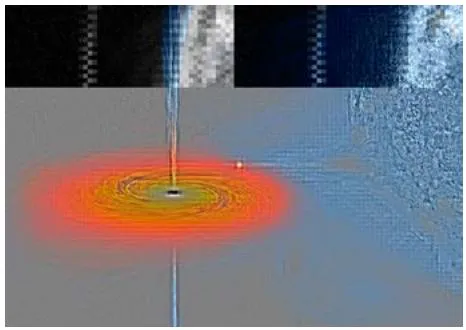
(accretion) around neutron stars and black holes. Compression of matter, as well as the release of heat due to friction of differentially rotating layers, leads to heating of the accretion disk. Therefore, the accretion disk emits thermal electromagnetic and X-ray radiation. Experiments have shown that the technique developed by an international group makes it possible to create not only quasi-stationary magnetic fields of record magnitude, but also to simulate the state of plasma emerging in them with a high energy density of matter - particles per . The uniqueness of the experiment is that the parameters of the resulting plasma do not need to be scaled; they correspond to the real parameters of the plasma in the vicinity of the black hole of binary systems like Cygnus X-1 (Fig. 2) [8].
Later, researchers at the University of Manchester, led by Nobel Prize winner Andre Geim, discovered that inside graphene, it is possible to recreate conditions identical to those in which matter emerges from the vacuum in the vicinity of black holes and other space objects [9]. In laboratory experiments, they reproduced the Schwinger effect using very narrow strips of graphene. In this case, super-powerful electric or magnetic fields will act on the vacuum in such a way that virtual particles and antiparticles forming dipole structures - positronium - will break apart and form very real positrons and electrons [9].
The experiment showed that the technique developed by the international group makes it possible to create quasi-stationary magnetic fields of record magnitude, and to simulate the state of the plasma arising in them with a high energy density of matter and electromagnetic energy. As a result, we get an electron-positron mixture near of the black hole, consisting of approximately equal numbers of negative electrons and positive positrons. In a free state, electrons and positrons annihilate - this is an indisputable fact. However, in the accretion disk, electrons and positrons are not entirely free. They continue to rotate by inertia within the plasma disk at about the speed of light. And it is this speed, or rather the force of inertia, keeps them from direct collisions and complete mutual destruction. At this stage, electrons and positrons form dipole structures - positroniums. Experimentally, such a pair was discovered in 1951 by the German physicist Martin Deutsch (Figure 3) and reliably established by Professor DB Cassidy and his assistant A. P. Mills, Jr. in 2007 [10].
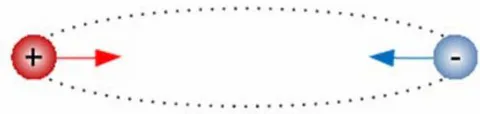
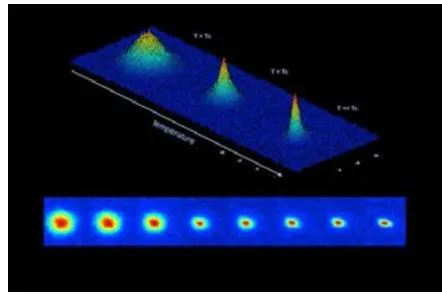
Positronium has stable, compact states with high binding energies, which can be interpreted as particles and unit cells of the quantum vacuum structure. Positronium has a mass of two electronic, and its energy in the ground state of 161411854 eV. In the work of RAS Academician RF Avramenko, it is says that the future opens with a quantum key [11]. Cassidy and Mills calculated that in their experiment, the density of positronium atoms was per . Calculations show that with an increase in this density by three orders of magnitude, these atoms at a temperature of 15 kelvin will merge into a single quantum system — Bose-Einstein condensate [10]. Now physicists say that instead of studying empty space, they can create a Bose-Einstein condensate. When cooled to just above absolute zero, the atoms slow down enough to overlap and form a high-density cluster of atoms, acting as a single "super-atom". In it, sound particles and photons become audible in a background vacuum. The sound is not produced by the detector, but is heard due to acceleration. The Unruh effect creates a thermal response of an accelerated detector as it moves in a vacuum [12]. In June 2020, a Bose-Einstein condensate was successfully recreated in Earth orbit on the International Space Station (ISS). Only there was it possible to weaken the Earth's gravity and create all the conditions for the emergence of the quantum fifth state of matter within a few seconds, but this was enough for scientists to get the idea that dark matter moves as a single whole [13].
Atomic nuclei are born in the plasma of quasars at a density of particles per , monstrous magnetic fields and pressure. It was precisely this pressure of Pascal that Professor Volker Berkert from the Jefferson Laboratory discovered in the nuclei of protons during experiments by bombarding protons with electrons [14]. An article by astrophysicists from Finland, published on June 1, 2020, states that "the matter inside the most massive stable neutron stars is interpreted as plasma that filled the newborn Universe approximately 20 microseconds after the Big Bang, which cooled to the state of "ordinary" matter and filled the Universe" [15].
However, the massive appearance of neutrons on the outskirts of the plasma disk marks a fundamentally new stage in formation of mother in the infinite Universe, the evolution of which does not require a Big Bang and has no beginning and end. From this moment on, the conveyor for the production of chemical elements begins to operate. Experimental physics has reliably established that a free neutron decays into a proton and an electron in about 15 minutes. Thanks to this, the most common substance in the Universe is born - hydrogen. Hydrogen atoms gradually accumulate around the rotating disk of protoplasm and envelop it in a reasonably dense layer. At some point, the density of the hydrogen blanket reaches a critical value, and the free escape of neutrons from the plasma disk becomes difficult. The next cycle of synthesis of atoms of matter begins. This is the next chemical element of the periodic table - helium. Such processes of wrapping a neutron centrifuge in a gas cushion are repeated for each new chemical element. The further we move along the periodic table, the denser the outer nucleon layer becomes, and the fewer atoms of a new substance are formed at the output. Therefore, in our Universe hydrogen makes up of the total mass of all chemical elements. The described process allows us to understand how the synthesis of all chemical components of the universe proceeds. This is not explosive thermonuclear fusion in the depths of several generations of stars still the careful assembly of atoms of chemical elements from elementary particles using a high-speed plasma centrifuge. Our further task is to understand the principle of the formation of atomic nuclei based on protons and neutrons, which have, respectively, the charge and magnetic moment of the proton, as well as the magnetic moment of the neutron and its lack of charge. The presence of magnetic moments in these particles gives us grounds to assert that they have magnetic poles. The magnetic forces of the opposite poles of the magnetic fields of the proton and neutron are the only forces capable of connecting these particles with each other. The experimentally measured values of the magnetic moments of the proton and neutron are and , where the magnetic moments are measured in nuclear magnetons, which are approximately 2000 times smaller than the Bohr magneton . The negative value of the neutron magnetic moment is due to the fact that the vector of the neutron magnetic moment is directed in the opposite direction from the neutron spin Sn. The directions of the vectors of the proton's magnetic moment and its spin Sp coincide. The difference between the magnetic moments of the proton and neutron from the Dirac values indicates that these particles are not point particles, but have a complex internal structure. The proton and neutron are considered as two charge states of one particle - the nucleon. The electrostatic forces of protons are the only forces that limit the proximity of protons in the nucleus. However, the existence of nuclear forces that connect protons and neutrons in the nuclei of atoms has also been experimentally established. If we take into account the enormous magnetic field strength near the center of symmetry of the proton Tesla and assume that it is approximately the same for the neutron, then there is reason to believe that the magnetic forces of the proton and neutron, acting at distances close to their geometric centers, are those forces that are called nuclear. Then we can assume that nuclear forces are actually magnetic forces acting at extremely small distances between the centers of mass of protons and neutrons. The absence of orbital motion of electrons creates the conditions under which each electron must interact with one proton of the atomic nucleus. It follows from this that protons must be located on the surface of the nucleus. Then, to weaken the repulsive forces acting between protons, they must combine with neutrons so that there are necessarily neutrons between the protons. This condition is met if the neutron has six magnetic poles. And then, Professor A.V. Rykov determined the force of elastic deformation inside the nucleon [16]. It is this enormous force that counters the Pascal pressure force discovered by Burkert inside the core and directed outward. Thus, there is no need for such concepts as gluon plasma inside the nucleus, which glues quarks together and resists internal pressure.
IV. NUCLEAR INTERACTION
Vacuum is involved in all fundamental interactions, but if the polarization of the void in electromagnetic interactions is accompanied by the formation of electron-positron pairs with the participation of exchanged virtual photons, then in nuclear interaction the polarization of the quantum vacuum is accompanied by the construction of three unstable -mesons ( , , ) with the participation of virtual exchange pions and the subsequent creation of short-lived protons and antiprotons. At the same time, the energy spectrum of the birth of new particles and antiparticles changes, which indicates a difference in the structure of the quantum vacuum when it is included in the nuclei of atoms [17]. Professor Anatoly Rykov called the medium of virtual pi-mesons, participating as exchange particles in atomic interactions, the meson ether. Next, I will give an excerpt from Rykov's work [16], published in 2000 but still relevant today: "It is easy to see that the structural element is the mass of the dipole. Multiplying it by , we get a value very close to pion . This coincidence turns out to be significant. If in the previous case the "photon exchange" was reduced to the deformation of the photon ether, then the pion exchange forms the basis of the strong interaction. How do pions deform the ether so that the acting forces during the deformation of the "pion" structure of the ether correspond to intranuclear forces? The existence of three types of "nuclear" pions can, apparently, be somehow taken into account in the structure of the meson ether in order, in a similar way to photon exchange, to find a new interpretation of meson exchange in nucleons, eliminating the need for physics to artificially introduce exchange processes using particles. At the moment we have only one "fact" - in the structure of the photonic ether there is a cluster with a mass that acts during the photoelectric effect and during electromagnetic interaction and is formed by electron + positron pairs. Pions have an independent "life" and are unique clusters, as if formed from electrons and positrons. A pion contains an integer 264.2 electron and positron masses plus 0.2 elementary masses. The integer defines the zero charge of the pion . Pions contain an odd number of 273 electron and positron masses. Nature seems to suggest that there is one excess positron, and one excess electron. One thing is clear that pions represent a single whole (indivisible quantum systems capable of virtual and real existence in accordance with their short lifetimes). The lack of charge pion masses can be interpreted as a bond mass defect or binding energy . For the pion, two variants of the mass defect can be assumed: , or . The variants can be distinguished by the lifetime of the pion. Since the -pion has a lifetime shorter than that of charge pions, the first option should be accepted, that is, . Let us assume that the meson structure of the ether is formed by a triple of pions . This is a significant difference from the structure of the ether, which has an electron + positron pair. At the same time, a certain analogy appears to the qualitative "triple" structure of the nucleus - 2 protons and 1 neutron. They must form an elementary quasi-stable structure according to the polarization scheme proton (+) (-neutron-) (+) proton. In fact, a stable structure of 2 protons is organized only with the help of 4 neutrons, the polarization of which, apparently, best suits the stable spatial structure of the nucleus. From the above it follows that pi-mesons and protons can be represented as formed from the only elementary particles - electrons and positrons" [16].
V. CONCLUSION
Thus, we can conclude that Dmitry Mendeleev reasonably placed ether (physical vacuum) in the first place in the periodic table, which is polarized in the monstrous gravitational, electric and magnetic fields of black holes, generating particles and antiparticles that form atoms. The absence of ether in the periodic table today is a clear indicator of the level of modern science and a gross distortion of Mendeleev's scientific heritage. The second conclusion from the article is the rejection of speculative structures of quarks in the atomic nucleus. Indirect evidence of the existence of quarks in the nucleus is hadronic jets that arise during the inelastic scattering of electrons, muons and neutrinos on a nucleon. However, the interpretation of their nature as a manifestation of the quark structure of nucleons is not as unambiguous as apologists of modern nuclear physics try to present it.