Rivers State University of Sc. and Tech. Port Harcou...
To: Author
Article Fingerprint
ReserarchID
QE246

Choose where you want to hide AI Takeaway. Your site-wide choice will be remembered in this browser.
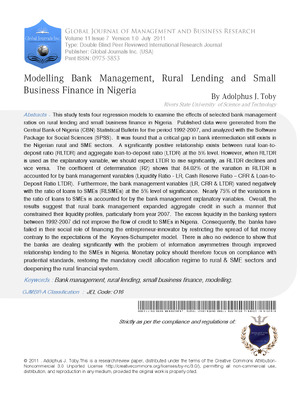
This study tests four regression models to examine the effects of selected bank management ratios on rural lending and small business finance in Nigeria. Published data were generated from the Central Bank of Nigeria (CBN) Statistical Bulletin for the period 1992-2007, and analyzed with the Software Package for Social Sciences (SPSS). It was found that a critical gap in bank intermediation still exists in the Nigerian rural and SME sectors. A significantly positive relationship exists between rural loan-todeposit ratio (RLTDR) and aggregate loan-to-deposit ratio (LTDR) at the 5% level. However, when RLTDR is used as the explanatory variable, we should expect LTDR to rise significantly, as RLTDR declines and vice versa. The coefficient of determination (R2) shows that 84.02% of the variation in RLTDR is accounted for by bank management variables (Liquidity Ratio -LR, Cash Reserve Ratio -CRR & Loan-to-Deposit Ratio LTDR). Furthermore, the bank management variables (LR, CRR & LTDR) varied negatively with the ratio of loans to SMEs (RLSMEs) at the 5% level of significance. Nearly 75% of the variations in the ratio of loans to SMEs is accounted for by the bank management explanatory variables. Overall, the results suggest that rural bank management expanded aggregate credit in such a manner that constrained their liquidity profiles, particularly from year 2007. The excess liquidity in the banking system between 1992-2007 did not improve the flow of credit to SMEs in Nigeria. Consequently, the banks have failed in their social role of financing the entrepreneur-innovator by restricting the spread of fiat money contrary to the expectations of the Keynes-Schumpeter model. There is also no evidence to show that the banks are dealing significantly with the problem of information asymmetries through improved relationship lending to the SMEs in Nigeria. Monetary policy should therefore focus on compliance with prudential standards, restoring the mandatory credit allocation regime to rural & SME sectors and deepening the rural financial system.
Dr. Toby. 1970. "MODELLING BANK MANAGEMENT, RURAL LENDING AND SMALL BUSINESS FINANCE IN NIGERIA". Global Journal of Management and Business Research - A: Administration & Management GJMBR-A Volume 11 (GJMBR Volume 11 Issue A7).

Crossref Journal DOI 10.17406/GJMBR
Print ISSN 0975-5853
e-ISSN 2249-4588
v1.2
Explore published articles in an immersive Augmented Reality environment. Our platform converts research papers into interactive 3D books, allowing readers to view and interact with content using AR and VR compatible devices.
Your published article is automatically converted into a realistic 3D book. Flip through pages and read research papers in a more engaging and interactive format.
Total Score: 106
Country: Nigeria
Subject: Global Journal of Management and Business Research - A: Administration & Management
Authors: Dr. Adolphus J. Toby (PhD/Dr. count: 1)
View Count (all-time): 193
Total Views (Real + Logic): 7653
Total Downloads (simulated): 700
Publish Date: 2011 05, Sun
Monthly Totals (Real + Logic):
We use cookies and similar technologies to improve site performance, understand traffic, and enhance your publishing experience. Cookie Policy
Choose which optional cookies Global Journals can use. Your preference applies across this platform and can be updated any time.
These cookies are required for core website functionality and security.

Lorem ipsum dolor sit amet, consectetur adipiscing elit. Ut elit tellus, luctus nec ullamcorper mattis, pulvinar dapibus leo.