
I. INTRODUCTION
Leadership is a very important factor in an organization because it determines most of its success and failure. From the mid-1980s, visionary leadership emerged with its emphasis on follower commitment to the vision of the future (Sosik & Jung, 2018). Over the past two decades, visionary also known as transformational leadership emerged as one of the most popular approaches to understanding leader effectiveness (Mitul & Kabir, 2019). Transformational leadership blueprint as therequired leadership in that, such leaders transform the norms and values of employees, whereby the leader motivates the workers to perform beyond their expectations (Nguyen et al., 2017). Here the leader focuses on the enhancement of followers' involvement with the goals of the organization leading to employee engagement first to their jobs and then to their organizations in the long run (Zineldin, 2017).
Transformational leadership is an important subject in the fields of organizational behavior, strategic management, strategic human resource management, and management in general (Alrowwad, Obeidat & Aqqad, 2017). Whatever kind of leadership style one looks at, a leader's capability determines the ability of the management to initiate a collaborative effort among the team members. This was the basis for transformational leadership since a transformational leader gains people's trust and allows collaboration among team members. Organizations require transformational leaders of high moral standing and excellent performance to spearhead the goals and objectives of the institutions (Sahibzada, Kakakhel & Khan, 2016).
It could be said therefore that in the current hyper-competitive and globalized world, to achieve success in government projects and sustained relevance, leaders must adopt effective leadership styles that are responsive to the dynamic operating environment (Mitul & Kabir, 2019). According to Ayacko, K'Aol, and Linge (2017), re-conceptualizing professional learning in turbulent times, put forth a caution to those exercising leadership authorities through various styles. They assert that sustained effectiveness will largely hinge on continuous improvement and development. Even with the much-admired transformational style of leadership, in terms of its organization-wide gains. Public sector leaders must come up with strategies that can inspire workers to go beyond their stated job requirements (Teske & Schneider, 2016). Such strategies will create a high-performance oriented workforce, which is vital for the public sector and organizations to grow. Innovative strategies do harness human capabilities, talents, and uprightness in employees, which are vital leadership attributes (Ayacko, 2017). Alrowwad, Obeidat, and Aqqad (2017) posit that a transformational leader inspires and challenges subordinates to have a vision, mission, and to own the organization's goals. The leader does urge and inspires subordinates to be articulate in the execution of duties, while heorshe takes care of them in a very individualized manner.
II. STATEMENT OF THE PROBLEM
Kenya's public sector institutions have had problems related to the absence of transformational leadership and management inadequacies Ndisya and Juma (2016). Failure to understand, transformational leadership of projects is regarded as one of the factors which have led to underperformance of the projects being funded by the Kenyan government (Omondi, 2017; Kiarie & Wanyoike, 2016; Gitee, 2018; Muchelule, 2018). The Ministry of Education in 2013 started the Digital Literacy Program but failed to take off due to a shortage of funds to run the program. During 2013/2014 the Ministry received Ksh 24.5 Billion to cater to the four components of the project. In 2014 attempts to jump-start the program again did not succeed because of procurement hitches. At this point, an additional Ksh.17.5 billion was allocated for the project (Republic of Kenya, 2018).
In 2015, the government restructured the program to have it implemented by the Ministry of ICT through the ICT Authority on considering the high level of technology involved. Further, other agencies and departments such as Rural Electrification Authority, Kenya Power & Lighting, Kenya Institute of Curriculum Development, Treasury, The Attorney General's office, parents' association (PTA), the universities, Teachers Service Commission, Kenya National Union of Teachers among others all came together to support and implement this program. After this restructuring, the government was able to implement the program. The program is considered one of the Kenya government flagship projects among others in their National ICT Master Plan (Republic of Kenya, 2018).
Otieno and Moronge (2017) on the drivers of effective implementation of inter-agency government projects in Kenya: the case of Kenya Coastal development project and concluded that the implementing agencies should adopt best practices in financial planning & management and project leadership from the agencies to focus on the project team. However, the study only focused on the drivers of effective implementation. Owuor (2018) on the effects of transformational leadership style on organizational performance in Kenya: a case study of Kenya Breweries Limited concluded that all the four elements idealized influence, inspirational motivation, intellectual stimulation, and individualized consideration of transformational leadership affected the overall performance of the organization. However, the study was based on organizational performance and did not address the issue of implementation of the national government multi-agency project program. Following the above studies that differ in contexts, it is evident that none of the studies has addressed the role of transformational leadership on the implementation of multi-agency government projects in Kenya which is a research gap this study proposed to establish.
III. RESEARCH OBJECTIVES
a) General Objectives
The general objective of this study was to analyze the role of transformational leadership in the implementation of a digital literacy program in Kenya.
b) Specific Objectives
The study was guided by the following objectives;
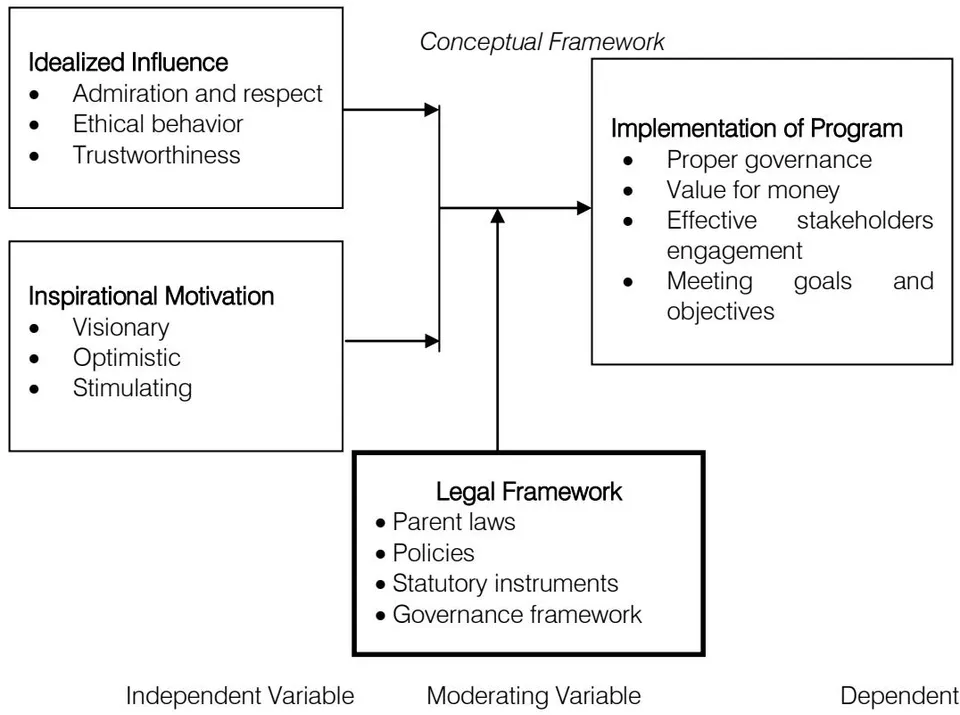
a. To examine the role of idealized influence on the implementation of a digital literacy program in Kenya.
b. To establish the role of inspirational motivation on the implementation of a digital literacy program in Kenya.
c. To examine the moderating role of the legal framework on the relationship between transformation leadership and implementation of a digital literacy program in Kenya.
IV. LITERATURE REVIEW
a) Transformational Leadership Theory
James McGregor Burns introduced the concept of transformational leadership in his 1978 book, "Leadership." He defined transformational leadership as a process where "leaders and their followers raise one another to higher levels of morality and motivation." Transformational leadership theory is a prominent representative of the new theories that have occupied center stage in leadership research in the last two decades (Yusuf, 1998). Yusuf (1998) established the concept of transformational leadership and emphasized that transformational leaders inspired groups to work towards achieving the common goals to attain a higher level of self-actualization desired instead of self-interest by instilling a clear mission and vision and building up trust and confidence among them.
Bass (1999) further developed and enhanced Burns' leadership theory by putting more focus on the followers' needs as opposed to the leaders' needs. Bass (1999) interpretation of transactional and transformational leadership suggested the theory of transformational leadership. Bass (1999) observed that an effective leader who possesses transformational attributes and abilities was able to transform his or her firm to greater heights to a position of achieving greater performance. Burns' theory of transformational leadership focuses to a greater extent on social reform by the moral elevation of followers' values and needs.
Bass focuses on attaining practical organizational objectives (Mahsud, Yukl & Prussia, 2010).
Transformational leadership theory describes how effective leaders inspire and transform followers by appealing to their ideals and emotions, whereby, transformational leaders make followers more aware of the importance and value of their work, thereby inducing them to transcend self-interest for the sake of the organization. The leaders develop follower skills and confidence to prepare them to assume more responsibilities and as a result, followers trust the leader and are motivated to do more than originally expected (Veale, Worthen & McKay, 2017).
b) The Contingency Theory of
The Contingency theory of leadership was developed by Fred Fiedler in 1958 during his research on leader effectiveness in group situations (Fiedler, 1964). Fiedler believed that one's effectiveness to lead depended on their control of the situation and the style of leadership (Shamir& Howell, 2018). The leader's effectiveness is contingent on the leader's style matching the situation, not adapting to. This theory assumes that styles are fixed and that they cannot be adapted or modified (Gupta, 2009). A leader is most effective when his or her attributes and style of leadership is matched with the situation and environment around them. The Contingency theory is not concerned with having the leader adapt to a situation, rather the goal is to match the leader's style with a compatible situation (Gupta, 2009).
Contingency theory supports transformational leadership since the leader relies on building relationships between themselves and followers. The Contingency Theory can be used to create leadership profiles for organizations, in which certain styles can be matched with situations that have proven to be successful (Kuhnert & Lewis, 2017). Companies can know what type of person would fit in each position of the organization whenever there is an opening. This theory also helps to reduce what is expected from leaders and instead emphasizes finding a match to the situation (Gupta, 2009). The theory helped in establishing the role of inspirational motivation on the implementation of multi-agency government projects in Kenya since it tries to predict and consider which style is best in which circumstance for a leader.
c) Empirical Review
i. Idealized Influence
instilling in followers a desire to work towards common goals (Saboe et al., 2015). The leader does this by articulating a group vision and fostering acceptance of group goals. Emphasizing group goals is important as it elevates follower values and goals from self-interest to social interest and thus cultivates group cohesion. The
The first-dimension idealized influence refers to leader actions that make group values and goals salient. The leader promotes cooperation and teamwork by leader demonstrates high ethical norms and becomes a role model for the subordinates (Bono & Judge, 2014).
In this element of transformational leadership, the leaders behave in ways that lead to them being role models for their followers. The leader, therefore, turns out to be admired, respected, and trusted by the followers who in turn want to emulate the leader. The followers also acknowledge extraordinary capabilities, persistence, and determination in their leader and the leader is willing to take risks to achieve organizational or personal goals but adopts ethical and moral conduct while doing that (Kark, Van Dijk, & Vashdi, 2018). Idealized influence can be explained within the organization in the context of knowledge creation. The term idealized influence means simply being influential over ideals. At the highest level of morality, leaders and their employees may dedicate themselves to the best ideals. By far the most effective trait-driven leadership style is charismatic (Waweru-Gathii & K'Obonyo, 2018).
Whereby, charismatic leaders have a positive influence on their followers and can change the self-focus of employees from negative to a positive focus (Mendelson et al., 2019). The result is that subordinates become more involved with the vision of the leader and are willing to make more sacrifices for that vision leading to a commitment to their organizations and achievement of organizational goals. Through idealized Influence, the leader provides role modeling for high ethical behavior and instill pride in their follower thereby they gain respect and trust of such followers. It is this attribute of a leader that motivates employees to contribute their best at work leading to organizational performance (Bono & Judge, 2014). Once employees feel motivated to perform at their best, they feel confident and enjoy their stay within their organizations. These employees thus become more committed not only to their jobs but their organizations (engagement) which ultimately leads to organizational performance (Judge & Piccolo, 2014).
d) Inspirational Motivation
Inspirational motivation is related to idealized influence but while charisma is held to motivate individuals, inspirational motivation is about motivating employees within the entire organization (Ayacko, 2017). Transformational leaders displaying inspirational motivation encourage their followers to become part of the overall organizational culture and environment (Zineldin, 2017). Leaders with inspirational motivation challenge followers with high standards and provide meaning to their tasks. This might be achieved through motivational speeches and conversations and other public displays of optimism and enthusiasm, highlighting positive outcomes, and stimulating teamwork. The followers are willing to invest more effort in their tasks, feel encouraged and optimistic about the future, and believe in their abilities (Oluseyi & Ayo, 2015).
Inspirational motivation arises from the use of both effective and communicative styles of influence. This behavior articulates the importance of leaders communicating high expectations to employees, inspiring and motivating them by providing meaning and challenge to the employees so that they can develop a shared vision in organizations (Owuor, 2018). Inspirational managers align individual and organizational objectives, thus making the achievement of organizational objectives an attractive means of achieving personal objectives (Gagne, 2018). Through the vision, the leader offers to the followers the opportunity to see meaning in their work. Followers are challenged with high standards and a leader encourages them to become part of the overall organizational culture and environment. Inspirational motivation might be achieved through motivational speeches and conversations by the leader and other public displays of optimism and enthusiasm, highlighting positive outcomes, and stimulating teamwork (Gagne, 2018).
Due to inspirational motivation, followers are willing to invest more effort in their tasks, feel encouraged and optimistic about the future, and believe in their abilities. In other words, the supervisor is optimistic and enthusiastic about the future. This leads to follower commitment to and contributions to their organizations. The idealized influence and inspirational motivation are strongly correlated and are sometimes combined to form a measure of Charisma (Mukwenda, 2017). Inspirational motivation makes use of behavior to motivate and inspire employees by offering a shared meaning and a challenge to the followers (Lewa et al., 2018).
The leader offers meaning and challenge that motivates and inspires the work of the employees. In this regard, the leader promotes team spirit, enthusiasm, and optimism in their followers by involving them in a positive vision of the future and by communicating high expectations that followers want to achieve (Ndisya & Juma, 2016). The alignment of individual needs with the needs of an organization is a fundamental strategy of inspirational motivation. Transformational leaders attempt to nurture the spirit of teamwork and commitment by clarifying the vision, mission, and strategic goals of the organization and creating a strong sense of determination among the employees (Martin, 2017).
e) Legal Framework
A legal framework encompasses the laws, regulations and policies that are put in place to govern an organization or an activity (Thai, 2009). According to Nteere (2012) government policy is the principle that is behind the actions taken up to help in digital project implementation. These actions are administrated in the form of laws, regulations and administrative practice.
Another definition of government policy provided by Pinto and Trailer (2014) provides that it is experimental or theoretical assumptions made on what is needed to solve a given issue or problem. The focus by governments to come up with public infrastructure projects and implement them to build trust and support from the citizens has also led to more policies being passed in this investment area.
Kerzner (2018) focused on projects that dealt with induced technology and noted that government sectors that focused on these projects relied on government policies to ensure that the projects were implemented within the provided guidelines and regulations. Although the policies provided do not make it a rule that the project recipients should be made part of the projects, the argument made by Kerzner (2018) is that the project should engage all the involved stakeholders to meet the project's post and prerequisites. Governments come up with policies focusing on the implementation of infrastructure projects to improve economic development, pursue social objectives and improve on the existing societal challenges (Nyakundi, 2015). Policies are also provided in the implementation of projects to ensure that resources are equitably distributed from one section of the country to the other to ensure equitable growth (Kerzner, 2018). Kerzner (2018) maintains that this goal should be achieved at the minimum cost.
According to Ngundo (2018), effective policies that are focused on the performance of projects should emphasize the effectiveness of these projects and the implementation process should ensure the project meets the socio-economical, regulatory and institutional goals of the recipients and also please the proponents of the project. Besides, an effective policy should advocate for effective implementation that ensures that the project is implemented in line with the cost budgeted for. The resources should also be used efficiently and there should be equitable in the treating of stakeholders and the project managers should do away with prejudice and discrimination and if there are confidentialities to be protected, this should be adhered to (Ting, 2016).
Musyoki and Gakuu (2018) explain that policies are provided to support the successful implementation of the project and also ensure there is integrity in the project management processes. Further, such policies ensure that the decisions made related to the project are transparent and made according to the provided regulations and these decisions are made based on accurate data. Gatti (2012) points out that transparency is an important factor in public infrastructure projects as it leads to clarity and openness. Therefore, government policies hope to be the bridge that links the public infrastructure projects, budgeting, planning, and the achievement of its financial goals when the implementation process is underway. Osman and
Kimutai (2019) noted that government policies played a crucial role in enhancing the implementation process of these projects concerning performance, structure, size, and conduct of the projects during the implementation phase.
f) Implementation Project
According to Silvius and Schipper (2015) implementation projects can be accessed via the analysis of three key indicators which are systemic, project benefits, and social development indicators. It is then from these indicators, that it is possible to establish the different factors that affect the implementation of a project. If the implementation is to be achieved, project teams ought to pay special attention to these three indicators especially during the planning phase of intended projects. Available technology, project process, organizational structure and culture influence the degree of implementation of projects (Kaimenyi & Wanyonyi, 2019). For a project outcome to exceed the target there is a need for oversight for policy and strategic guidance, coordination of project partners and key stakeholders, and implementation arrangements for delivering project services to beneficiaries. Project oversight mechanisms are included in institutional arrangements to provide policy and strategic guidance to ensure delivery of the project outcomes and achievement of the project objectives and goals (Kerzner, 2018).
Project oversight entities normally consist of stakeholders with a direct interest in the project. Their tasks include providing advice on work plans and budgets, monitoring the quality of the project as it develops, providing advice about changes to the project, including harmonization and alignment with government priorities and policies, regulatory environment and legislative changes (Meredith, Mantel & Shafer, 2017). The continuity of a project and the resulting benefits are of great interest to all stakeholders since a lot of resources are invested by the donors. Road construction is perhaps most prominently promoted as a means of bringing economic benefits or encouraging economic development (Van Asselt et al., 2015). The intention can be that economic benefits would flow from the road's use in unlocking new areas of land for development, or by reducing the distance traveled between places or by enabling time-saving for road users by reducing congestion. The quality of life and socio-economic conditions of living of people may get significantly affected by the speed and ease with which they can move and carry their goods (Kerzner, 2017).
2017). According to Herington (2017) stakeholder participation is the process through which stakeholders influence and share control over development initiatives and the decision and resource which affect them. When projects are successful continued participation of stakeholders is supposed to make the development demand-driven and effective. Through continued participation, stakeholders feel ownership of projects and solutions; encourage transparency and accountability of the organizations offering service. Also, there will be better monitoring of project activities and the stakeholders will gain a better understanding of the strengths and weaknesses of their activities, identify the procedures of other projects that are beneficial and those that are obstructive and redundant. A truly participatory monitoring and evaluation process will, therefore, lead to both stakeholder empowerment and their ownership of other projects in the future (Meredith, Mantel & Shafer, 2017).
g) Research Methodology
The study employed a descriptive and explanatory research design. The positivism research philosophy was appropriate for this study based on the underlying assumptions of this paradigm relative to social constructivism. The target population was 300 project managers with the key mandate of governance of various digital literacy programs in the following institution KICD, TSC, KPLC, ICT Authority, and the Ministry of education. For the data collection, the appropriate sample size was computed to achieve the true proportion at a confidence level. To calculate the sample size, the Yamane's formula (1967) was employed. The researcher took a random sample from each stratum proportionate to the population proportion to come up with 171 respondents.
The study utilized primary data collected in the form of questionnaires. A Pilot study that involved 15 employees from the 5 corporations was carried out which is of the sample to check the suitability of the instruments to collect the required data. Content validity was employed to measure the degree to which data collected using a particular instrument represents a specific domain or content of a particular concept. Cronbach's alpha methodology, which is based on internal consistency, was used to test the reliability of the data. Cronbach's alpha, which is above the acceptable level of 0.70 which is acceptable reliability (Bryman & Bell, 2013).
Data collected was both quantitative and qualitative. The descriptive statistical tools helped the researcher to describe the data and determine the extent used. The analysis was done quantitatively and qualitatively by the use of descriptive statistics. These included frequency distributions, tables, percentages, mean and standard deviation. Besides, advanced statistical techniques (inferential statistics) were considered. Data analysis was done with the use of SPSS Version 24.0 for windows. This generated quantitative reports through tabulations, percentages, and measures of central tendency. Tables were used to summarize responses for further analysis and facilitate comparison.
A multiple regression model was used to assess the collective effect of four independent variables and the dependent variable. F-test was carried out in the study at a 95% confidence level. The significance of each independent variable was evaluated based on the value of the t-statistic and corresponding p-value in the regression output. The null hypothesis was rejected whenever the p-value was less than 5%. Qualitative data was analyzed through thematic analysis while multiple regression models were used to test the hypotheses. Correlation analysis determines the relationship between the dependent and independent variables.
h) Research Results
The study distributed 171 questionnaires but only 156 questionnaires were returned having been dully filled which translated to 91.2%. As Mugenda and Mugenda (2013) explained, a response rate of 50% and above is adequate for analysis and reporting, a response rate of 60% and above is adequate while that of 70% and above s excellent.
Descriptive Statistics Idealized Influence
| Mean | Std. Dev. | |
| I always portray good ethical behaviour that can be admired by my project team | 4.49 | 1.056 |
| I always go beyond my self-interest for the good of the whole project team | 4.43 | .937 |
| I always guide all the employees in my team on the importance of teamwork | 4.41 | 1.034 |
| I always make personal sacrifices for the benefit of the whole project team | 4.40 | .907 |
| I always admire and respect all the employees and stakeholders involved in implementing any project | 4.35 | 1.076 |
| I always instill pride and like to be associated with my whole project team | 4.32 | .997 |
| I always trust the employees involved in the implementation of any project work | 4.14 | .940 |
| I always display a sense of power and confidence when passing instructions to my project team | 3.37 | .851 |
From the findings in Table 1, the respondents agreed that they always portray good ethical behaviour that can be admired by their project team as indicated by a mean value of 4.49 and standard deviation of 1.056; that they always go beyond their self-interest for the good of the whole project team as indicated by a mean value of 4.43, standard deviation.937; and that they always guide all the employees in their team on the importance of teamwork as shown by a mean value of 4.41, standard deviation 1.034. The findings also showed that they agreed that they always make personal sacrifices for the benefit of the whole project team as shown by a mean value of 4.40, standard deviation 0.907; that they always admire and respect all the employees and stakeholders involved in implementing any project as shown by a mean value of 4.35, standard deviation 1.076.
Also, they agreed that they always instill pride and like to be associated with the whole project team as shown by a mean value of 4.32, standard deviation 0.997; that they always trust the employees involved in
Inspirational Motivation the implementation of any project work as shown by a mean value of 4.14, standard deviation 0.940. The findings further showed that respondents had neutral opinions on the idea that they always display a sense of power and confidence when passing instructions to their project team as shown by a mean value of 3.37 and a standard deviation of 0.851.
These findings agree with those of Mendel son et al., (2019) that a charismatic leader has a positive influence and the result is that subordinates become more involved with the vision of the leader and are willing to make more sacrifices for that vision leading to a commitment to their organizations and achievement of organizational goals. Through idealized Influence, the leader provides role modeling for high ethical behavior and instill pride in their follower thereby they gain respect and trust of such followers. It also concurs with Bono and Judge (2014) that it is the attribute of a leader that motivates employees to contribute their best at work leading to organizational performance.
| Mean | Std. Dev. | |
| I am optimistic that the Digital Literacy Program will work | 4.32 | 1.059 |
| I always create an environment where employees can be passionate in their job | 4.26 | 1.036 |
| I always create an environment where employees can be imaginative in their job | 4.25 | .968 |
| I always create an environment where employees can be creative in their job | 4.24 | .980 |
| I always articulate a compelling vision for the future regarding all the projects to be undertaken | 4.24 | .991 |
| I always motivate the employees in my team to enable them to perform their roles effectively | 4.19 | 1.036 |
| I always inspire the employees to be relevant and dynamic in whatever task they undertake | 3.38 | .868 |
The findings in Table 2 shows that the respondents agreed that they are optimistic that the Digital Literacy Program will work as indicated by a mean value of 4.32 and standard deviation of 1.059; that they always create an environment where employees can be passionate in their job as indicated by a mean value of 4.26, the standard deviation of 1.036. They also agreed that they always create an environment where employees can be imaginative in their job as shown by a mean value of 4.25, standard deviation of 0.968; and that they always create an environment where employees can be creative in their job as indicated by a mean value of 4.24, the standard deviation of 0.980.
The findings also show that the respondents agreed that they always articulate a compelling vision for the future regarding all the projects to be undertaken as shown by a mean value of 4.24 and a standard deviation of.991. They also agreed that they always motivate the employees in their team to enable them to perform their roles effectively as shown by a mean value of 4.19 and 1.036. Besides, respondents had moderate opinions that they always inspire the employees to be relevant and dynamic in whatever task they undertake as shown by a mean value of 3.38 and a standard deviation of.868.
The study findings agree with those of Mukwenda (2017) that the dimensions of inspirational motivation indicate that respondents have the enthusiasm to carry out tasks because the leader can arouse the aspirations of subordinates, and subordinates are also able to advance team spirit in all tasks at hand. Accordingly, they argue that inspirational motivation sets the basis for sharing knowledge, which is key to enhancing job autonomy and the general performance of the organization.
Legal Framework
| Mean | Std. Dev. | |
| The ICT policy in place has ensured that the implementation of the Digital Literacy Program is effective | 3.81 | 1.100 |
| There are good regulations and administrative practice as to the operations and management of the Digital Literacy Program | 3.62 | .993 |
| There is proper state legislation as to the operations and management of the Digital Literacy Program | 3.59 | 1.053 |
| The education policy in place has ensured that the implementation of the Digital Literacy Program is effective | 3.49 | 1.044 |
| The budgeting policy in place has ensured that the implementation of the Digital Literacy Program is effective | 3.46 | 1.160 |
| There is sufficient public participation in the implementation of the Digital Literacy Program is effective | 3.33 | 1.012 |
| All the stakeholders are involved in implementing, monitoring, and evaluating the Digital Literacy Program is effective | 3.29 | 1.230 |
Based on the findings presented in Table 3, the respondents agreed that the ICT policy in place has ensured that the implementation of the Digital Literacy Program is effective as shown by a mean value of 3.81 and a standard deviation of 1.100. They also agreed that there are good regulations and administrative practices as to the operations and management of the Digital Literacy Program as shown by a mean value of 3.62, and a standard deviation of 0.993. Respondents also concurred that there is proper state legislation as to the operations and management of the Digital Literacy Program as shown by a mean value of 3.59 and a standard deviation of 1.053.
The findings also show that the respondents had moderate opinions that the education policy in place has ensured that the implementation of the Digital Literacy Program is effective as shown by a mean value of 3.49 and a standard deviation of 1.044. They also explained that the budgeting policy in place has ensured that the implementation of the Digital Literacy
Program is effective as shown by a mean value of 3.46 and a standard deviation of 1.160. Besides, they moderately agreed that there is sufficient public participation in the implementation of the Digital Literacy Program is effective as shown by a mean value of 3.33 and a standard deviation of 1.012. Furthermore, they concurred that all the stakeholders are involved in implementing, monitoring, and evaluating the Digital Literacy Program are effective as shown by a mean value of 3.29 and a standard deviation of 1.230.
The study findings agree with those of Pinto and Trailer (2014) that the focus by governments to come up with public infrastructure projects and implement them to build trust and support from the citizens has also led to more policies being passed in this investment area. It also concurs with Kerzner (2018) that government sectors rely on government policies to ensure that the projects were implemented within the provided guidelines and regulations.
Implementation of Projects
| Mean | Std. Dev. | |
| The Digital Literacy Program has enhanced the quality of learning in schools | 3.78 | 1.193 |
| The Digital Literacy Program projects in various regions have been implemented in time | 3.65 | 1.162 |
| There has been continued stakeholder support as to the implementation of the Digital Literacy Program | 3.60 | 1.185 |
| The Digital Literacy Program has met the required government standards | 3.55 | 1.097 |
| There are proper risk mitigation controls to monitor the sustainability of the Digital Literacy Program | 3.30 | 1.155 |
| The target of the Digital Literacy Program has exceeded the expectations | 3.24 | 1.090 |
Based on the findings in Table 4, the respondents agreed that the Digital Literacy Program has enhanced the quality of learning in schools as shown by a mean value of 3.78 and a standard deviation value of 1.193. They agreed that the Digital Literacy Program projects in various regions have been implemented in time as shown by a mean value of 3.65 and a standard deviation value of 1.162. Also, there has been continued stakeholder support as to the implementation of the Digital Literacy Program as shown by a mean value of 3.60 and a standard deviation value of 1.185.
Findings also show that respondents agreed that the Digital Literacy Program has met the required government standards as shown by a mean value of 3.55 and a standard deviation value of 1.097. Besides, respondents had moderate views on the idea that there are proper risk mitigation controls to monitor the sustainability of the Digital Literacy Program as shown by a mean value of 3.30 and a standard deviation value of 1.155. They moderately agreed that the target of the Digital Literacy Program has exceeded the expectations as shown by a mean value of 3.24 and a standard deviation value of 1.090.
These study findings agree with Meredith, Mantel, and Shafer, (2017) that the continuity of a project and the resulting benefits are of great interest to
Correlation Analysis all stakeholders since a lot of resources are invested by the donors. It also agrees with Herington (2017) that stakeholder participation is the process through which stakeholders influence and share control over development initiatives and the decision and resource which affect. When projects are successful continued participation of stakeholders is supposed to make the development demand-driven and effective.
| Implementation of Program | Idealized Influence | Inspirational Motivation | ||
| Implementation of Program | Pearson Correlation | 1 | ||
| Sig. (2-tailed) | ||||
| N | 156 | |||
| Idealized Influence | Pearson Correlation | .739** | 1 | |
| Sig. (2-tailed) | .000 | |||
| N | 156 | 156 | ||
| Inspirational Motivation | Pearson Correlation | .815** | .243** | 1 |
| Sig. (2-tailed) | .000 | .000 | ||
| N | 156 | 156 | 156 | |
The findings presented in Table 5 shows that idealized influence has a strong positive relationship with the implementation of the program (r=0.739). The relationship was also found to be significant since the p-value (0.000) was less than the selected level of significance (0.05). The study also established that inspirational motivation had a strong positive relationship with the implementation of the program Multiple Regression Analysis
Model Summary Table 6: Model Summary for Regression Analysis
| Model | R | R Square | Adjusted R Square | Std. Error of the Estimate |
| 1 | .694 | .691 | .82018 | |
| a. Predictors: (Constant), Individualized Consideration, Idealized Influence, Intellectual Stimulation, Inspirational Motivation | ||||
From the findings in Table 6, the value of adjusted R square was 0.691 which suggests that 69.1% variation in the implementation of a digital literacy program can be explained by changes in idealized influence, inspirational motivation, intellectual stimulation, individualized consideration, and legal framework. The remaining 30.9% suggests that other factors can be attributed to variation in the implementation of a digital literacy program that was not discussed in this study. The correlation coefficient (R) shows the relationship strength between the study variables. From the findings, the variables were strongly and positively related as indicated r=0.833.
Analysis of Variance
| Model | Sum of Squares | Df | Mean Square | F | Sig. | |
| 1 | Regression | 40.330 | 4 | 10.083 | 14.988 | |
| Residual | 101.578 | 151 | .673 | |||
| Total | 141.908 | 155 | ||||
| a. Dependent Variable: Implementation of Program | ||||||
| b. Predictors: (Constant), Indiv, iidualized Consideration, Idealized Influence, Intellectual Stimulation, Inspirational Motivation | ||||||
The results in Table 7 indicate that the model was significant since the p-value (0.000) was less than 0.05 thus the model is statistical significance in establishing the effects of idealized influence, inspirational motivation, intellectual stimulation, individualized consideration, and legal framework on the
Coefficients of Regression Analysis implementation of a digital literacy program in Kenya. Further, the F-calculated (14.988) was greater than the F-critical (2.432) suggesting the significance of the model [Note: the f-critical value is obtained from the f-distribution table].
| Model | Unstandardized Coefficients | Standardized Coefficients | t | Sig. | ||
| B | Std. Error | Beta | ||||
| 1 | (Constant) | 1.362 | 0.135 | 10.089 | 0.000 | |
| Idealized Influence | 0.111 | 0.017 | 0.101 | 6.529 | 0.007 | |
| Inspirational Motivation | 0.405 | 0.079 | 0.38 | 5.127 | 0.015 | |
| a. Dependent Variable: Implementation of Program | ||||||
Hypothesis 1
The first research hypothesis of the study was: : There is no significant role of idealized influence on the implementation of a digital literacy program in Kenya.
The findings established that idealized influence had a significant influence on the implementation of a digital literacy program in Kenya since the p-value obtained (0.007) was less than the selected level of significance (0.05). The finding further showed that the influence of idealized influence on the implementation of a digital literacy program was positive ( ). Since the p-value was less than the selected level of significance (0.05) we reject the null hypothesis and conclude that there is a significant role of idealized influence on the implementation of a digital literacy program in Kenya.
Hypothesis 2
The second research hypothesis was: : There is no significant role of inspirational motivation on the implementation of a digital literacy program in Kenya.
The findings established that inspirational motivation had a significant influence on the implementation of a digital literacy program in Kenya since the p-value obtained (0.015) was less than the selected level of significance (0.05). The finding further showed that the influence of inspirational motivation on the implementation of a digital literacy program was positive ( ). Since the p-value was less than the selected level of significance, we reject the null hypothesis and conclude that there is a significant role of inspirational motivation on the implementation of a digital literacy program in Kenya.
Moderating Effect Regression Analysis
| Model | Unstandardized Coefficients | Standardized Coefficients | t | Sig. | ||
| B | Std. Error | Beta | ||||
| 2 | (Constant) | 1.749 | 0.248 | 7.052 | 0.000 | |
| Idealized Influence | 0.289 | 0.076 | 1.177 | 3.803 | 0.012 | |
| Inspirational Motivation | 0.427 | 0.126 | 0.025 | 3.389 | 0.032 | |
| X1M | 0.373 | 0.116 | 1.927 | 3.216 | 0.026 | |
| X2M | 0.235 | 0.034 | 0.182 | 6.912 | 0.001 | |
| a. Dependent Variable: Implementation of Program | ||||||
Hypothesis
The hypothesis tested was that there is no significant moderating role of the legal framework on the relationship between Idealized Influence and the implementation of a digital literacy programin Kenya.
The findings showed that the Idealized Influence* legal framework had a significant influence on the implementation of a digital literacy program in Kenya ( , p=0.026). Since the p-value was less than the selected level of significance (0.05), the study rejected the null hypothesis and accepted the alternative. The study, therefore, accepted the alternative hypothesis there is a significant moderating role of the legal framework on the relationship between Idealized Influence and the implementation of a digital literacy program in Kenya.
Hypothesis
The hypothesis tested was that there is no significant moderating role of the legal framework on the relationship between Inspirational Motivation and the implementation of a digital literacy programin Kenya.
The findings showed that the Inspirational Motivation * legal framework had a significant influence on the implementation of a digital literacy program in Kenya ( , p=0.001). Since the p-value was less than the selected level of significance (0.05), the study rejected the null hypothesis and accepted the alternative. The study, therefore, accepted the alternative hypothesis there is a significant moderating role of the legal framework on the relationship between Inspirational Motivation and the implementation of a digital literacy program in Kenya.
V. CONCLUSIONS
The first objective of the study was to examine the role of idealized influence on the implementation of a digital literacy program in Kenya. The study established that idealized influence had a significant influence on the implementation of a digital literacy program in Kenya. The finding further showed that the influence of idealized influence on the implementation of a digital literacy program was positive. These findings suggested that a unit increase in idealized influence would increase the implementation of a digital literacy program in Kenya. Based on the findings the study concluded that there is a significant role of idealized influence on the implementation of a digital literacy program in Kenya.
The second objective of the study was to establish the role of inspirational motivation on the implementation of a digital literacy program in Kenya. The study established that inspirational motivation had a significant influence on the implementation of a digital literacy program in Kenya. The study further established that the influence of inspirational motivation on the implementation of a digital literacy program was positive.
This means that a unit increase in inspirational motivation would increase the implementation of a digital literacy program. Based on the findings, the study concluded that there is a significant role of inspirational motivation on the implementation of a digital literacy program in Kenya.
The final objective of the study was to examine the moderating role of the legal framework on the relationship between transformation leadership and implementation of a digital literacy program in Kenya. The study found that there was a significant moderating role of the legal framework on the relationship between Idealized Influence, Inspirational Motivation, and the implementation of a digital literacy program in Kenya. Based on these findings, the study generally concluded that there is a significant moderating role of the legal framework on the relationship between transformation leadership and the implementation of a digital literacy program in Kenya.
VI. RECOMMENDATIONS
The study found that inspirational motivation has a positive significant influence on the implementation of a digital literacy program in Kenya. Therefore, there is a need for project leaders to practice the use of inspirational motivation more. This will allow them to use their charisma to challenge their teams with high standards and provide meaning to the task. To achieve this, they can use motivational speeches and conversations to display optimism and enthusiasm, highlighting positive outcomes, and stimulating teamwork. Also to avoid demotivation, there is a need to ensure there is clarity. Mostly, de-motivation arises when the next step in the project is unknown or the reason for doing something isn't clear. This has been dealt with by revisiting the project goals and values and making sure that if there is a shift in an aspect because of change in time, adjustments are made.
The study also established that Intellectual Stimulation positively and significantly influences the implementation of digital literacy program. The study thus recommends organization leaders to adopt this form of leadership. There is a need to motivate staff through training where they get to boost their skills. They should also encourage their team members to approach problems from different perspectives; by doing so, the members become thinkers, and thus their involvement with project activities increases.
a) Suggestions for Further Studies
The main objective of this study was to analyze the role of transformational leadership in the implementation of a digital literacy program in Kenya. This study was limited to the digital literacy program; there is a need for other studies to be conducted among other government projects to facilitate the generalization of research findings. Such projects could include the implementation of CBC (Competency-Based Curriculum). The study targeted only leaders of these projects; there is a need for a study to be conducted among all the parties involved in the implementation process including the staff members to get an in-depth understanding of the role of transformational leadership in the implementation process. Thre is a need to focus on other leadership styles, such as autocratic and democratic, that are used during the program implementation process.