The aim of this work on DM is to confine it whether it belongs to the dark periodic table or is part of a single very small dark element as mentioned in [10] making it possible to improve the works presented by the undersigned in the bibliography for example teleportation [7] could be improved with elements inserted in a certain way from the dark periodic table: in the W spiral of the classical periodic table, or in the antigravity ‘ Poynting vector’ in fig. 3 [5].
## I. INTRODUCTION
In this work we propose to use artificial intelligence and the seed of discernment [12] to evaluate whether the dimension we found in the previous work [10] by varying its dimensions in the "bucolic" equation and how the size of the dark matter particle varies accordingly; but, if this dimension wanted to vary more or less gradually as the atomic numbers of the periodic table can be gradual, therefore relating to the hypothetical periodic table of dark matter; or, if we discover that by varying even the size of the drop, in this case, the other dimension varies so little that it could be said that dark matter is made up of a single element.
## II. METHODS AND TOOLS
This is, let's say, the main objective: is dark matter made up of several elements or a single element? One of the key steps to resolve this dilemma is to confine the dark matter: what if it appears intangible?
Confinement could then be achieved if we could construct objects made of dark matter from the dark periodic table; or, for example, by taking the hypothetical iron elements, which would presumably confine the dark oxygen elements.
Well, this is, let's say, what we would like to address; otherwise, we would confine the aggregate dark matter. The problem is: how can we aggregate the DM? Since no container exists, since we cannot create the first one; what would we use, in ancient times, to collect some water from the stream? By joining hands! This seems like a fascinating problem for us, because a virtual container that would confine the DM could be part of a "single element" or a dark table or a virtual container; a container that creates movement and confines the DM in a restricted environment, so for example, a solenoid that would act on iron: how can I block the dark iron? Drip it, grill it, making it a little more tangible, less obscure? Or with a thermal chamber or ice, which would likely carry elements of dark iron.
Using the double NN with the seed of discernment to discern whether the DM is a single element or belongs to different elements, thus constituting the hypothetical so-called 'Dark Periodic Table' determinable thanks to the variation in the diameter of the bucolic inputs 'drops' and the cosmological outputs, and therefore verifying the functioning of the neural network and what it would tell us: we would have certain elements available to us and we would teach the NN that certain atoms belonging to the classical periodic table such as air, water, etc., etc., and with the elements of the dark periodic table. This is a very important leap, because it would mean that we could insert a dimensional factor into the DM to be able to observe if what we are saying has a certain validity, otherwise it would be like saying: there is a certain distance between the elements of the same "dark" periodic table, however, we are not sure, if instead we assign a dimensional factor to the DM as input to the NN then yes, we could use it as a seed of discernment to observe if the AI answers us affirmatively: the DM is most likely made up of different elements, or no: the DM is made up of a single element.
This, just said, appears to be the main objective, other objectives will not be considered.. One could create a table with different "drops" of water and observe whether the dimensions of the DM vary greatly and whether this variation can be interpreted with the scale factor, from classic training elements of the classical periodic table; there shouldn't be many problems with generating the database, because it is the concept, the idea seems viable. We don't want to use a NN in reality, it would be absurd and unsustainable for the modest computer apparatus we have at our disposal, but it could be done: using a NN to try to understand if a dark periodic table exists or not, we discern this characteristic of the DM; like, by training a NN with a scale factor when we treat the DM (to be optimized, for example $10^{\wedge}18$ ) take "for granted" that the most probable drop [10] that, not accelerating while falling from the sky, has a diameter of $3\mathrm{mm}$, and the galaxy particle has an average size as in [10], the NN does not have to do a 'terrible' job on this difference between the input of the classical periodic table and the input of the dark periodic table; the scale factor should be in favor of the one observable in the classical sense, better a scale factor that greatly enlarges the elements of the DM. As depicted in the next figure fig. [1].
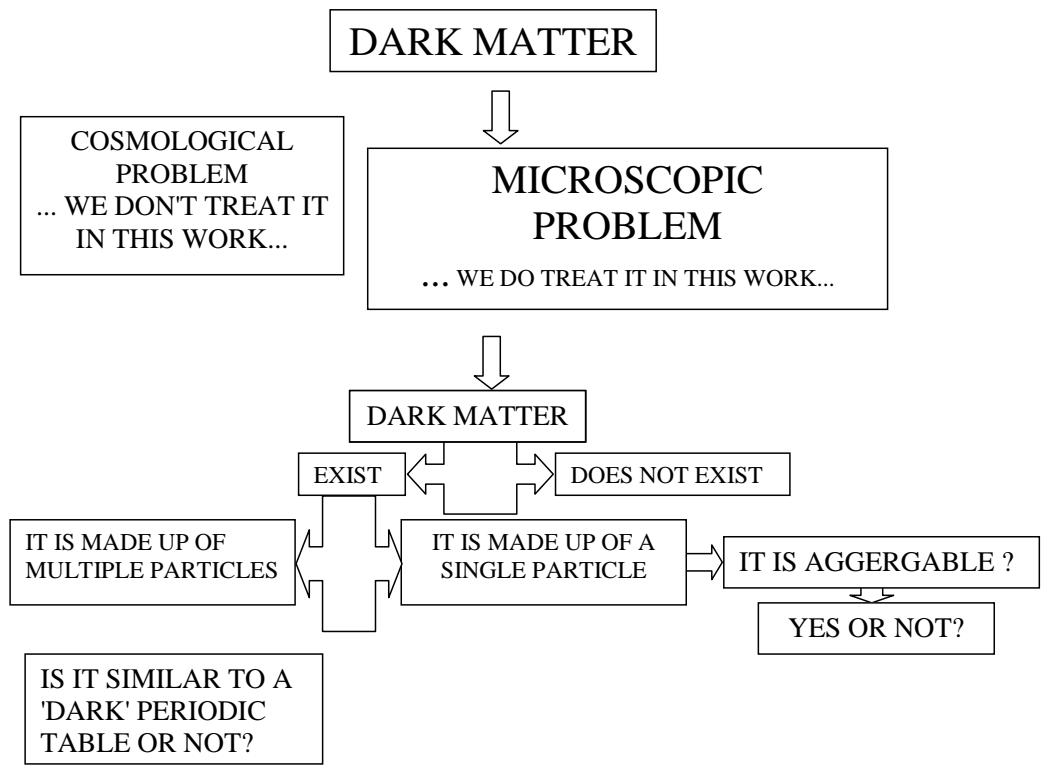 Fig. \[1\]: Representation of the different possibilities regarding the DM
Talking about dark matter is very fascinating because if one tries to study it from videos, on social media, one realizes that almost everyone feels its presence but no one can observe it: why? It does not interact with light, with other matter, it does not interact with anything. We have published an article [10], the problem that we want to address now is (the confinement of dark matter) because the dimensions have been calculated; therefore, now remains, as they say, giving variations in size to the observed objects in a "bucolic" way to calculate the approximate size of the dark object which fortunately is larger than the Planck constant and is smaller than the smallest "observable" element: it is in the middle.
By varying, the bucolic, observation of the object that allowed us to formulate a proportion, looking at the Milky Way, let's say, because in every galaxy the presence of this dark matter is felt. Therefore, by varying the size of the drop falling through the atmosphere, everything changes, and thus a new periodic table can be constructed. Let's say, how can we confine it? It passes through traditional matter, doesn't interact with light, and no one "sees" it.
So, the ideal scenario would be, if we could confine it... to group it; like, for example, two drops of lead ( $Pb$ with atomic number $Z = 82$ ) that, when heated until they melt, and brought together, merge into a single, more observable "drop." These considerations must be made, basing everything on classical physics techniques for the movement of matter, with the hope that we are discussing a hypothetical periodic table of dark matter: a set of elements that "correspond" phenomenologically, etc., to lead, iron, carbon.... The problem is how to confine them, how can we unite two dark matter elements of the same "type" or group them together if they are identical in constitution if this hypothetical dark periodic table does not exist. The fundamental problem that follows is to maintain a line of investigation in which we can assume the existence of a dark matter periodic table and its non-existence; that is, dark matter elements that do not have periodic characteristics.
An important aspect of dark matter is that one could calculate, in principle, the mass: by averaging the elements of the periodic table, the average density, the average radius, and then in addition to the weight also whether or not it belongs to a periodic table since only gravity exists which is inherited from a cosmological concept and, let's say, it is also valid for the microscopic aspect treated in this work.
The only solution for the confinement of DM is a DM container, so its aggregation for now remains the only way to contain it, therefore CHANDRA 2.0 or WEBB 2.0 telescopes; we need their layouts or to redesign them and put them into orbit with the necessary appropriate modifications: to be able to affirm its existence, whether there is a periodic table of DM or it is a single element.
Since the graviton doesn't help, let's say made up of lattices of atoms, it could, in the case where the DM passed through the orbitals, that would be a problem that could only be discovered by an extra- atmospheric examination, because since there is less mass, if there is DM it passes through the objects and therefore classical methods can be used, such as condensation, slowing down, aggregation, classic methods from the 1800s or thereabouts.
Some works published by the undersigned would be more feasible thanks to the possibility of manipulating the DM, such as antigravity [5] or teleportation [7].
## III. CONCLUSION
An important aspect of MD is that one could calculate, in principle, also the mass, by averaging the classical periodic table and the various densities and comparing it with the average radius; and then, in addition to the average weight, also the belonging or not to a periodic table; considering that the only thing common to the two matters is the gravity inherited from a cosmological vision and therefore also valid for a microscopic vision...
### ACKNOWLEDGMENT
An extraordinary thank you to all those who take care of people with physical and mental disabilities in particular at my lovely family.
Generating HTML Viewer...
Funding
No external funding was declared for this work.
Conflict of Interest
The authors declare no conflict of interest.
Ethical Approval
No ethics committee approval was required for this article type.
Data Availability
Not applicable for this article.
Dr. Francesco Pia. 2026. \u201cMonologue of Discernment About Dark Matter\u201d. Global Journal of Science Frontier Research - A: Physics & Space Science GJSFR-A Volume 25 (GJSFR Volume 25 Issue A4): .
The aim of this work on DM is to confine it whether it belongs to the dark periodic table or is part of a single very small dark element as mentioned in [10] making it possible to improve the works presented by the undersigned in the bibliography for example teleportation [7] could be improved with elements inserted in a certain way from the dark periodic table: in the W spiral of the classical periodic table, or in the antigravity ‘ Poynting vector’ in fig. 3 [5].
Our website is actively being updated, and changes may occur frequently. Please clear your browser cache if needed. For feedback or error reporting, please email [email protected]
×
This Page is Under Development
We are currently updating this article page for a better experience.
Thank you for connecting with us. We will respond to you shortly.