To: Author

Article Fingerprint
ReserarchID
BJE23
Choose where you want to hide AI Takeaway. Your site-wide choice will be remembered in this browser.
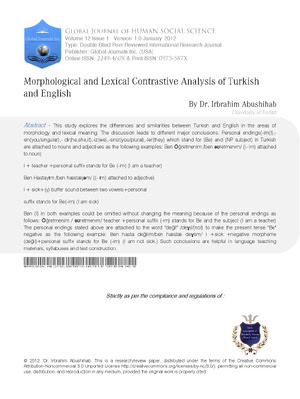
This study explores the differences and similarities between Turkish and English in the areas of morphology and lexical meaning. The discussion leads to different major conclusions. Personal endings(-im(I),-sin(you/singular),-dir(he,she,it),-iz(we),-siniz(you/plural),-ler(they) which stand for (Be) and (NP subject) in Turkish are attached to nouns and adjectives as the following examples:Ben Ŏğretmenim /ben əʊretmenım/ ((- im) attached to noun)I + teacher +personal suffix stands for Be (-im) (I am ateacher)BenHastay׀m /ben hæstæjəm/ ((- m) attached to adjective)I + sick+(y) buffer sound between two vowels+personal suffix stands for Be(-im) (I am sick) Ben (I) in both examples could be omitted without changing the meaning because of the personal endings as follows: Ŏğretmenim / əʊretmenım/ teacher +personal suffix (-im) stands for Be and the subject (I am a teacher) The personal endings stated above are attached to the word “değil” /deɣıl/(not) to make the present tense “Be” negative as the following example: Ben hasta değilim/ben hæstæ deɣılım/ I +sick +negative morpheme (değil)+personal suffix stands for Be (-im) (I am not sick.) Such conclusions are helpful in language teaching materials, syllabuses and test construction.
Dr. Irbrahim Abushihab. 1970. "Morphological and Lexical Contrastive Analysis of Turkish and English". Global Journal of Human-Social Science, Global Journal of Human-Social Science - A: Arts & Humanities GJHSS-A Volume 12 (GJHSS Volume 12 Issue A1).
Crossref Journal DOI 10.17406/GJHSS
Print ISSN 0975-587X
e-ISSN 2249-460X
v1.2
Explore published articles in an immersive Augmented Reality environment. Our platform converts research papers into interactive 3D books, allowing readers to view and interact with content using AR and VR compatible devices.
Your published article is automatically converted into a realistic 3D book. Flip through pages and read research papers in a more engaging and interactive format.
Total Score: 106
Country: Jordan
Subject: Global Journal of Human-Social Science
Authors: Dr. Irbrahim Abushihab (PhD/Dr. count: 1)
View Count (all-time): 236
Total Views (Real + Logic): 8642
Total Downloads (simulated): 745
Publish Date: 2012 01, Sun
Monthly Totals (Real + Logic):
We use cookies and similar technologies to improve site performance, understand traffic, and enhance your publishing experience. Cookie Policy
Choose which optional cookies Global Journals can use. Your preference applies across this platform and can be updated any time.
These cookies are required for core website functionality and security.

Lorem ipsum dolor sit amet, consectetur adipiscing elit. Ut elit tellus, luctus nec ullamcorper mattis, pulvinar dapibus leo.