I. INTRODUCTION
The genus Impatiens belongs to the order Ericales, family Balsalminaceae. There are 1,000 species mostly distributed in tropics and rarely in temperate regions (Mabberley, 2008) primarily in Asia and Africa, Europe and North America (Janssens et al., 2012). Species are territorial, no Africa species occurs naturally in Asia and no Asian species occur naturally in Africa (Christopher, 2013). The name Impatiens is derived from the fact that the seed capsule ejects from a flower when ripe. This action led botanists to suggest that the seeds were impatient to germinate (Christopher, 2013). Impatiens balsamina are annual herbs, and grow up to height of 60-100cm. Impatiens balsamina is widely cultivated as an ornamental for its attractive flowers. The flowers and leaves are often used across Asia for the traditional dyeing of a woman hair, nails, hands and feet (IPK Gatersleben, 2018). The stems, leaves and oil of the seeds are used in traditional Asian medicine for promoting blood circulation and for relieving pain and sore throats (Flora of China Editorial Committee, 2018; PROTA, 2018; USDA-ARS, 2018). The Chinese use Impatiens balsamina to counteract snakebites or the ingestion of poison fish. Juice extracted from the stem and added to rice liquor is known to reduce swelling and heal bruises. When dried, the stem may be pulverized and made into an ointment to relieve pain. Flowers are made into paste to treat back pain and neuralgia. The Vietnamese wash their hair with an extract of I. balsamina believing that it stimulates the follicles to grow hair.
Impatiens balsamina is cathartic, diuretic and emetic. The leaf juice is used as treatment against warts. The flowers are cooling, mucilaginous and tonic. The seed is expectorant and has been used in the treatment of cancer. The powdered seeds are given to women during labour in order to provide strength. A dye is obtained from the flowers and leaves for dyeing finger and toe nails. Regular ingestion of large quantities of Impatiens can be dangerous due to high mineral content especially for people with rheumatism, arthritis, gout and kidney stones.
Pollen characteristics have been used considerably in the taxonomy of angiosperms and can be applied in tracing the history of plant groups and species (Moore and Webb, 1978). Among some of the researchers who have worked extensively on the morphology of pollen grains and have emphasized the significance of pollen architecture in phylogeny are Patel and Datta (1958) and Sowunmi (1973). Palynological attributes of plants have attracted attention of many researchers in recent time (Adedeji, 2005; Arogundade and Adedeji, 2009). Nyananyo and Olowokudejo (1986) used seed coat morphology and palynological features of Talinum and Calandrinia to produce a more acceptable classification of the species in these taxa. Akinwusi and Illoh (1996) reported that palynology provides useful data for the taxonomy of the genus
Hibiscus. Similarly, Azeez and Folorunso, (2014) on the phenology and pollen studies of some species of Annonaceae in Nigeria provide data for the evolutionary development in the genera of Annonaceae. Edeoga et al., (1996) and (1998) have utilized pollen attributes to establish probable evidence of relationships among certain groups of flowering plants in Nigeria. The main characters of taxonomic value in pollen grain are the number and position of apertures (colpi and pores), pollen wall morphology and sizes of pollen grains.
Except for the global pollen project, which is not even complete, there is no reported work on the pollen morphology of Impatiens balsamina. The aim of this study is therefore to use the characters of pollen of the three varieties (pink, red and white) of Impatiens balsamina to delimit, classify and trace evolutionary relationships among the three varieties of Impatiens balsamina in Nigeria.
II. MATERIALS AND METHODS
Collection of Pollen grains
Pollen grains in anthers were collected every day for two weeks from mature plants of the three varieties (red petal, pink petal and white petal) of Impatiens balsamina. The collection sites are given in table 1. The collected pollen grains were stored in 70% ethanol before acetolysis was carried out.
| Species | Location | GPS |
| Impatiens balsamina (Red petal) | Department of Botany, Obafemi Awolowo University, Ile Ife | |
| Impatiens balsamina (White petal) | Department of Botany, Obafemi Awolowo University, Ile Ife | |
| Impatiens balsamina (Pink petal) | Department of Botany, Obafemi Awolowo University, Ile Ife |
The collected pollen grains were acetylsed according to the procedure of Erdtman (1960), with slight modifications;
The preserved pollen grains were macerated with stirring rod inside the vials to separate it into particles. The macerated pollen grains were poured into centrifuge tubes which were labelled A, B, C. Equal volume of alcohol was poured into each centrifuge tube. The samples were then arranged into the centrifuge facing each other. The specimens were centrifuged at 3,500rpm for 20 mins. After this, the ethanol was poured off, 5ml glacial acetic acid was added and the specimen was stirred properly with stirring rod. The sample was centrifuged again at 3,500rpm for 20 mins. The glacial acetic acid was poured off. Acetolysis mixture (sulphuric acid and acetic anhydride) was prepared in the ratio 1:6. 30ml of and 180ml of acetic anhydride was prepared and added to the sediment. Water was put in a beaker and heated on hot plate, the temperature was checked at intervals, on reaching 70°C, the test tubes were placed inside the beaker and allowed to boil to 100°C as the samples were boiling, they were being stirred. The samples were allowed to boil and bring out bubbles before the beaker was removed from the hot plate. The samples were removed from the test tubes and put inside wooden test tube holder and allowed to cool. The samples were placed inside the centrifuge again and centrifuged at 3,500rpm for 25 mins. The acetolysis mixture was decanted. 10ml glacial acetic acid was added to the sediment and stirred with stirring rod. The samples were centrifuged again at 3,500rpm for 25 mins. The glacial acetic acid was decanted. Distilled water was added and shaken well. The samples were centrifuged again at 3,500rpm for 25 mins. and decanted. The acetolysed pollen grains were stored in vials. 2ml dilute glycerine was added to the acetolysed pollen grains stored in vials.
Acetolysed pollen grains in dilute glycerine were properly examined under the light microscope. 20 pollen grains chosen at random were studied per variety. Measurements of the diameter of the pollen grains, furrow diameter and pollen wall thickness were taken for each variety with the aid of an ocular micrometer inserted in the eyepiece of the microscope. The measurements were later multiplied by an ocular constant with respect to power under which they were taken in order to convert them to micrometer. Other qualitative characters studied on the pollen grains are the shape of the pollen, the number of the furrows on the pollen wall and the colour of the pollen grains.
Photomicrographs of the acetolysed pollen grains were taken using Amscope MT microscope camera version 3.001 attached to a light microscope. Pollen structure description was according to Moore and Webb (1978).
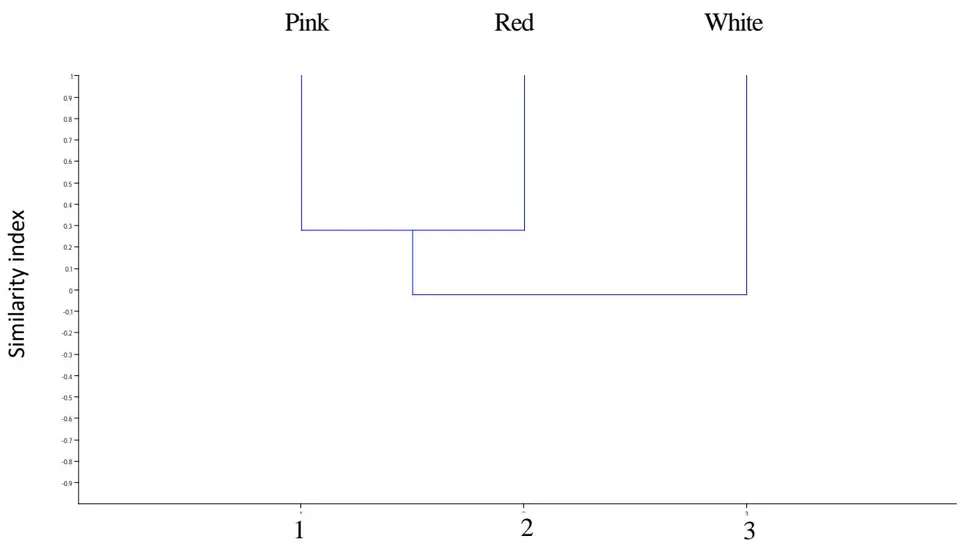
The mean of the data generated from this work was calculated. Statistical analysis for significance differences among the three varieties was carried out. A table illustrating the mean of the pollen characters measured was prepared and Cluster diagram of the values was also made using Paleontological Statistics Software Package (PAST). Duncan Multiple Range Test (DMRT) was also done using Statistical Package for the Social Sciences (SPSS) to determine if the means are significantly different.
III. RESULTS
The pictures of the varieties of Impatiens balsamina L. studied are as shown in Plate 1.
At reproductive stage, the following morphological studies were carried out on each variety of Impatiens balsamina L. for all identifiable character difference and similarities as shown in Tables 2 and 3 respectively.
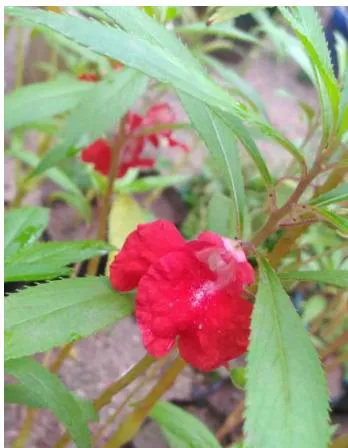
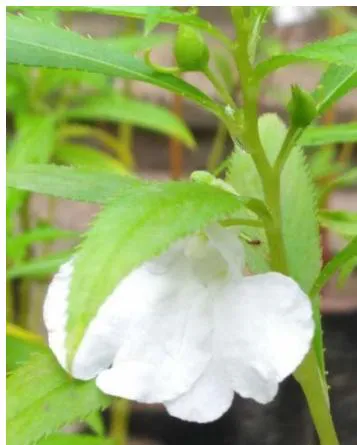
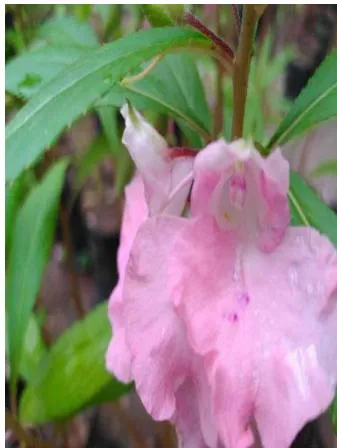
Plate 1: Pictures of the varieties of Impatiens balsamina L. studied Table 2: Qualitative Morphological Characters of the Varieties of Impatiens balsamina L
| Characters | Red | White | Pink |
| Leaf shape | Lanceolate | Lanceolate | Lanceolate |
| Leaf apex | Acuminate | Acute | Acuminate |
| Leaf margin | Serrate | Serrate | Serrate |
| Leaf texture | Glabrous | Slightly pubescent | Slightly pubescent |
| Leaf base | Cuneate | Acuminate | Cuneate |
| Leaf arrangement | Alternate | Alternate | Alternate |
| Venation pattern | Pinnately net-veined | Pinnately net-veined | Pinnately net-veined |
| Stipule | Absent | Absent | Absent |
| Petiole | Absent | Absent | Absent |
| Stem color | Red | Light green | Red |
| Fruit color | Light green | Light green | Light green |
| Fruit stalk color | Red | Light green | Red |
| Pedicel color | Red | Light green | Red |
| Anther color | White | White | White |
| Filament color | Red | White | Light red |
| Characters | Red | White | Pink |
| Leaf length (cm) | 10.41 | 10.28 | 10.16 |
| Leaf width (cm) | 1.74 | 1.57 | 1.79 |
| Internode distance (cm) | 1.74 | 1.36 | 1.60 |
| Number of leaf per stem | 82.00 | 61.00 | 80.00 |
| Plant height from soil (cm) | 69.71 | 60.50 | 57.31 |
| Petal width (cm) | 3.31 | 2.40 | 2.59 |
| Length of pedicel (cm) | 1.60 | 1.47 | 1.75 |
| Length of fruit stalk (cm) | 1.80 | 1.97 | 1.89 |
| Parameters | Red | White | Pink |
| Number of leaves per stem | |||
| Plant height from soil | |||
| Leaf length (cm) | |||
| Leaf width (cm) | |||
| Petal width (cm) | |||
| Length of pedicel (cm) | |||
| Internode distance (cm) | |||
| Length of fruit stalk (cm) |
This study reveals that the three varieties of Impatiens balsamina L. are erect herbs. All the three varieties are sessile and exstipulate leaves which are alternately arranged. The leaves of all the three varieties are pinnately net-veined, have serrate leaf margin and lanceolate leaf shape. The leaf base of red and pink Impatiens balsamina is cuneate while that of white Impatiens balsamina is acuminate. The leaf apex of red and pink Impatiens balsamina is acuminate while that of white Impatiens balsamina is acute. The leaf texture of white and pink Impatiens balsamina is slightly pubescent while that of red Impatiens balsamina is glabrous. The stem colour of red and pink Impatiens balsamina is red, while that of white Impatiens balsamina is light green. The pedicel of red and pink Impatiens balsamina is red in colour while that of white Impatiens balsamina is light green in colour. The anther colour of the three varieties is white. The filament colour of red Impatiens balsamina is red, that of white is white and that of pink is light red. The fruit colour of the three varieties is light green. The fruit stalk colour of red and pink Impatiens balsamina is red while that of white Impatiens balsamina is light green.
pore were present in the three varieties. Colpi were fissure-like or slit-like apertures, also known as furrows, while pores were reticulate. The pollen grains are light brown in colour.
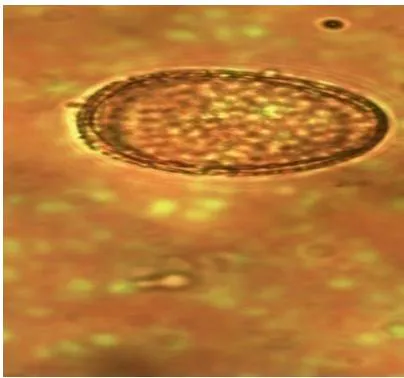
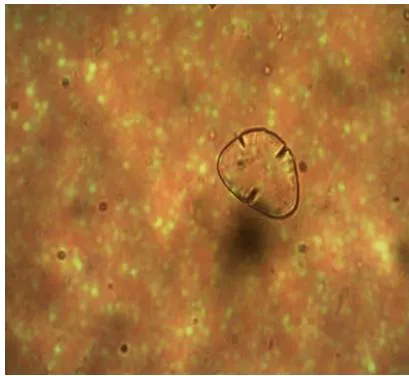
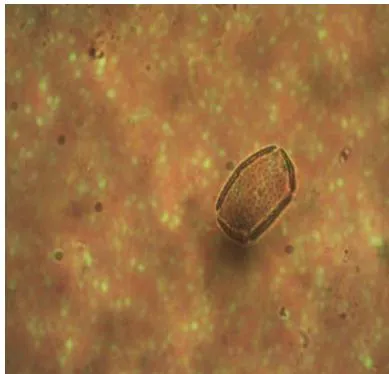
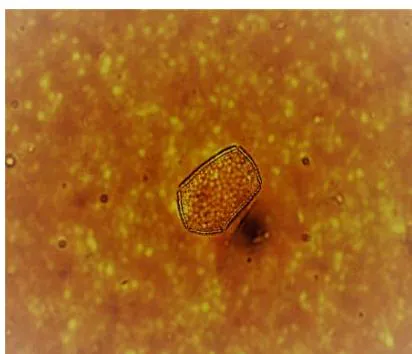
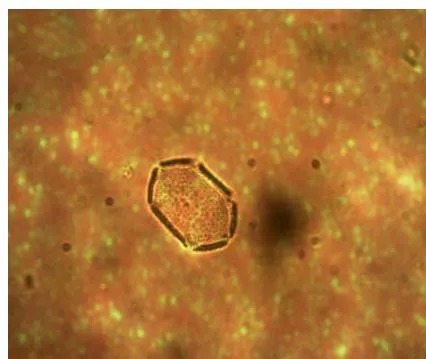
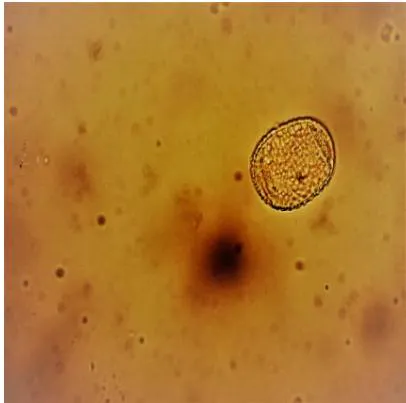
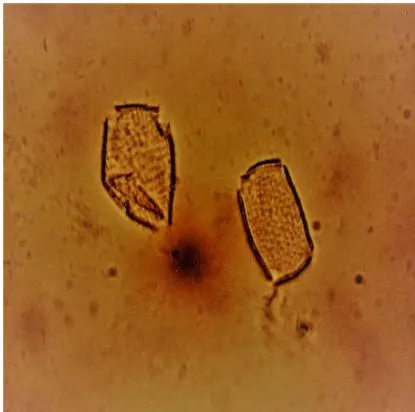
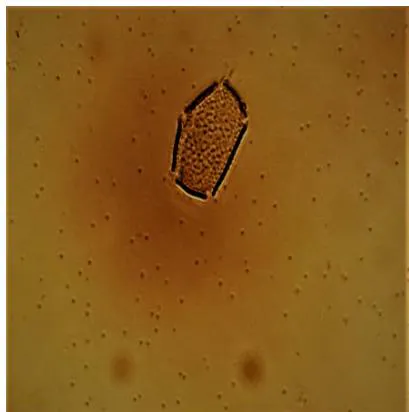
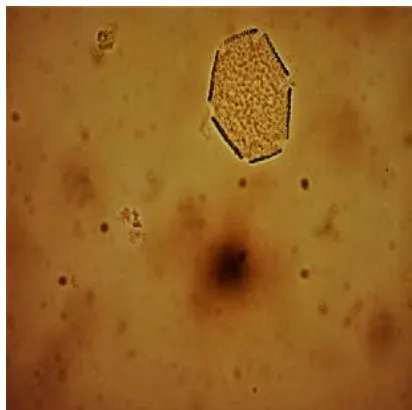
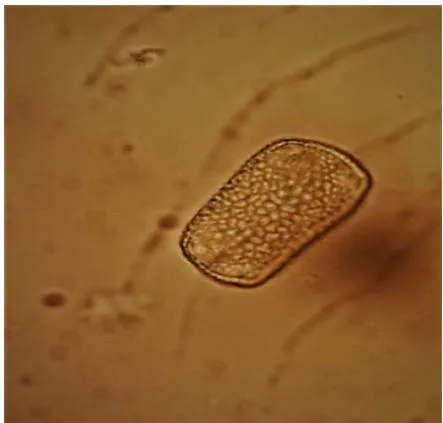
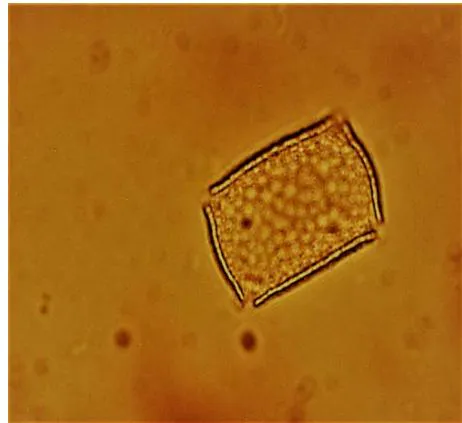
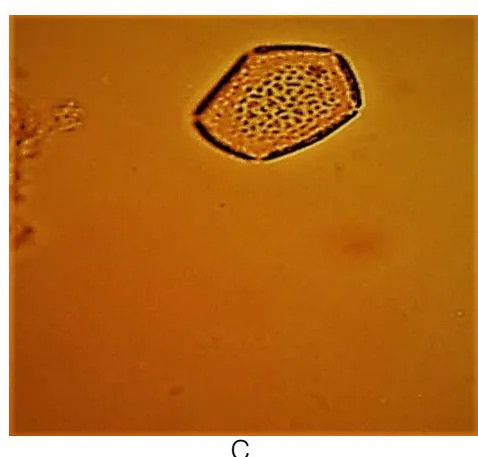
Generally, the shape of the pollen grains ranged from oval, to round, to rectangular, pentagonal shapes, with only hexagonal shape in white and red varieties (Plates 1-3). The two types of aperture, the colpi and the
Red Impatiens balsamina
The pollen types present were acolpate (Plate 2A), tricolpate (Plate 2B), tetracolpate (Plate 2C), pentacolpate (Plate 2D) and hexacolpate (Plate 2E). The mean diameter of the pollen grains was . The colpi were situated in the polar region only, while pores were found in the equatorial region of the pollen grains.
White Impatiens balsamina
The pollen types present were acolpate (Plate 3A), tetracolpate (Plate 3B), pentacolpate (Plate 3C) and hexacolpate (Plate 3D). The mean diameter of the pollen grains was . The colpi were situated in the polar region only, while pores were found in the equatorial region of the pollen grains.
Pink Impatiens balsamina
The pollen types present were acolpate (Plate 4A), tetracolpate (Plate 4B) and pentacolpate (Plate 4C). The mean diameter of the pollen grains was . The colpi were situated in the polar region only, while pores were found in the equatorial region of the pollen grains.
| Parameters | Red | White | Pink |
| Pollen diameter(um) | |||
| Pollen wall thickness(um) | |||
| Furrow diameter(um) | |||
| Number of colpi | |||
| Number of pollen grains per view | |||
| Pore diameter | |||
| Number of pores |
IV. Discussion
The pollen grains of the varieties of Impatiens balsamina L. studied are similar morphologically though there were some slight differences among them especially in white Impatiens balsamina which has the largest furrow diameter and has less number of pollen grains per view. There was also variation in the pollen shapes which ranged from oval to round to rectangular and pentagonal shapes in all the varieties with hexagonal shape only in white and red varieties.
The acolpate, tetracolpate and pentacolpate pollen grains were encountered in all the varieties studied. These three pollen types can therefore be affirmed as generic. Tricolpate pollen was found only in red Impatiens balsamina. Hexacolpate pollen was found in white and red varieties only. This separates the white and red varieties from the pink variety. It is also a mark of evolutionary advancement over the pink variety. Various researchers have separated species of plants based on the number of colpi on their pollens (Akinwusi and Illoh, 1996; Adedeji, 2005; Arogundade and Adedeji, 2009). Number of colpi on pollen grains has been a useful tool in tracing evolutionary relationship among the species of a genus. The advanced dicotyledons have more colpi than the primitive ones, with either a colpus (monocolpate) or none at all (acolpate) (Walker, 1976; Adedeji, 2005).
The shape of the pollen grains can also be employed in separating the varieties of Impatiens balsamina in this study. Oval, round, rectangular and pentagonal shapes were encountered in the three varieties of Impatiens balsamina studied, while hexagonal shape was found only in the red and white varieties of Impatiens balsamina. Arogundade and Adedeji, (2009) also separated some species of genus Ocimum based on their shape.
White Impatiens balsamina has the largest furrow diameter and the smallest number of pollen grains per view. This further separates white variety from red and pink varieties. The result of Duncan Multiple Range Test (DMRT) for means separation reveals that the pollen diameter, pollen wall thickness, furrow diameter and number of colpi of the three varieties of Impatiens balsamina are not significantly different from each other. Also, the number of pollen grains per view of white Impatiens balsamina is significantly different from that of red and white varieties of Impatiens balsamina.
Pollen grains have been classified into groups according to their size by Erdtman (1952) as Perminuta (diameter less than ), Minuta (diameter ), Media (diameter ), Magna (diameter ), Permagna (diameter ) and Giganta (diameter greater than ). Based on this classification, the pollen grain of the varieties of Impatiens balsamina could be described as media (diameter ). In a similar study, Akinwusi and
Illoh (1996) used pollen grain size to group some species of Hibiscus in Nigeria.
From the result of the cluster analysis, the dendrogram revealed that red and pink Impatiens balsamina are more closely related since they are clustered together at the same similarity level of 0.3, while white Impatiens balsamina stood out on its own.
In conclusion, this study revealed that pollen morphology provides data for the recent evolutionary development among the three varieties of Impatiens balsamina L. studied. Also, the presence of hexacolpate pollen grains in red and white varieties is a mark of evolutionary advancement among the three varieties of Impatiens balsamina L. studied. It also revealed the morphological characters that distinguished these three closely related varieties from one another.