I. INTRODUCTION
Currently, spacecraft made of propulsion system are used to travel in deep space. But the speed of rocket is very low compared to the speed of light. There are some hypotheses that describe how to travel at the speed of light. Dr. Harold "Sonny" White [1] It appear that the warp drive model has nearly all the desirable mathematical characteristics of true interstellar space drive, the metric has one less appealing characteristic – it violates all 3 energy conditions (strong, weak, and dominant) because of the need for negative energy density. Kevin L. G. Parkin [2] Breakthrough Starshot is an initiative to prove ultra-fast light-propelled Nano craft.
Our technology has not yet been developed enough to make the spacecraft described in these hypotheses. But I can move the spacecraft at the 99% speed of light at the present time using the technique of rotation.
II. METHOD
Before understanding the rotation technique, you need to know how it becomes a spacecraft.
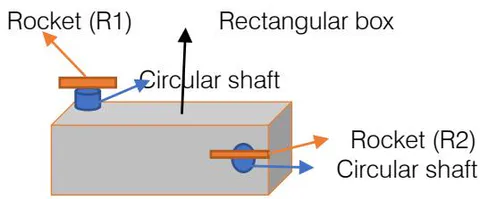
First, make a rectangular box. Take two rockets and connect them both with a circular shaft. Now connect the circular shaft to the rectangular box at the same point as shown in fig 1.1.
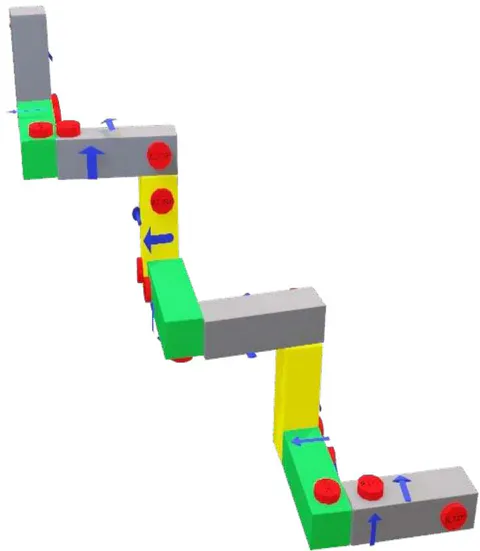
a) I will try to explain the rotation of rectangular box with the help of fig 1.2 In this fig 1.2 it is shown that when the rectangular box is rotated in two directions, what will be the position of the rectangular box at , , and .
When we look at the rotation path of a rectangular box in this fig 1.2, we find that it travels two direction at a time. In this fig 1.2, one path of the rectangular box is shown in green and the other in yellow. When the rectangular box rotates 360 degrees it travels 3 times on the green route and 2 times more than its size on the yellow route. We can use the green path shown in the fig 1.2 to run at 99% light speed.
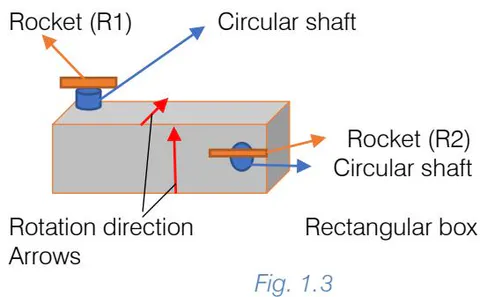
With the help of the direction arrow shown above the rectangular box in fig 1.3, we can know in which direction R1 and R2 will rotate the rectangular box.
The rotation speed of rectangular box will depend on the size of the spacecraft. If you want to build a small sized spacecraft, the rotation speed of the rectangular box must be increased.
Since the speed of the rocket is only 11,000m/s, therefore, we must reduce the size of the circumference of the circular shaft. So that we can increase the rotation speed of circular shaft. Which rotate the rectangular box.
To know this, we can use the formula given below:
There are two side of circular shaft whose circumference will be different. I named both side of the circular shaft as C1 and C2. C1 will always connect with the rockets and C2 will connect with the rectangular box. If you want to increase the speed of circular shaft the size of C1 circumference will always be 1 meter. And the size of C2 circumference will always be less than 1 meter.
I have prepared a formula by which we can know the speed of the spacecraft created by the rotation technique.
b) 3(Rotation speed of rectangular box × Length of rectangular box)
To use this formula, you must first decide the size of your rectangular box which you can take as your need. I'm taking the rectangular box length 200 meter. To get the speed of light we first need to know what will be the rotation speed of a rectangular box when the rectangular box is 200 meter in length.
{"code_caption":[],"code_content":[{"type":"text","content":"C2 = 0.900757686inch."}],"code_language":"txt"} And RPM2 is C2 = 500000/s
Now Diameter1 of C1 = 0.32meter
So, the diameter of C2 is {"code_caption":[],"code_content":[{"type":"text","content":"35730m/s÷500000/s = Diameter 2÷0.32m"}],"code_language":"txt"}
{"code_caption":[],"code_content":[{"type":"text","content":"C2 = 0.32m ÷ 13.99m"}],"code_language":"txt"}
Because the entire spaceship will be rotated by C2 shaft, it is very important for C2 shaft to be strong.
High quality graphene is the only material with ultimate tensile strength of 130 gig pascal. That can easily handle the weight of a spaceship.
III. CONTROLLING OF SPACECRAFT
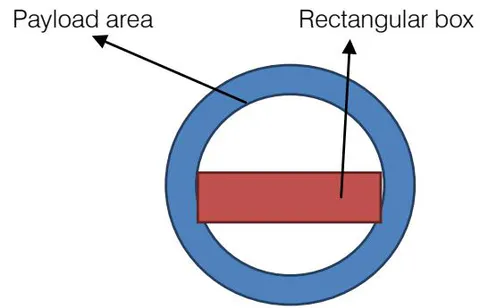
First know that the rectangular box is only one engine of the spacecraft. We have to cover the rectangular box with a spherical ball. So that the rectangular box rotates easily inside it and we will find a place to place the payload above the spherical ball. The rectangular box inside the spherical ball can rotate in any direction. But after starting the rocket, it will move only in one direction. Which can be any direction of the spherical ball. So we have to put rocket booster on 6 direction of spherical ball. Which will help us in the direction control of the spacecraft. It will also be very strong due to the spherical shape of the spacecraft.
Speed of spacecraft = 3(rotation speed of rectangular × length of rectangular box)
The rotation speed of rectangular box is equal to the rotation speed of C2.
So the speed of space craft = 3(500,000/s × 0.2km)
Currently, there is no Spacecraft that can travel at the 99% speed of light.
V. CONCLUSION
If we have to launch a spacecraft from earth, we have to consider other ways of rotating a rectangular box.
Because rocket engines can move spacecraft made by rotation technology at a speed of 299,729.009km/s only in space.