



1. Prelude
Poverty anywhere poses a threat to prosperity everywhere. Growth and development must progress together. Eliminating poverty in all its forms is the central objective of the United Nations’ 2030 Agenda for Sustainable Development. To achieve this, gaining a deeper understanding of poverty and adopting more meaningful methods to measure it is crucial. The MPI offers a solution by enhancing economic indicators. MPI deconstructs and reconfigures deprivation bundles, serving as an advanced metric for measuring poverty. Developed by the OPHI in collaboration with the UNDP, the MPI provides a more comprehensive view of poverty than traditional income-based metrics. Rather than focusing solely on income, it evaluates poverty across multiple dimensions and indicators, capturing its intricate and multifaceted nature. Against the backdrop of the significance of poverty discourse, and the importance of the MPI in policymaking, explaining its superiority over other methodologies of computing poverty, the paper states its key features and the method of its computation. The paper then discusses the concept in the case of India at the aggregate and disaggregated levels. This is followed briefly by stating the experience of a few other countries with the MPI. Finally, the limitations of the MPI are discussed, and suggestions for strengthening it are offered.
2. Literature review
The concept of multidimensional poverty has evolved significantly over time, with numerous scholars and organizations contributing to the understanding and measurement of this complex issue. In the paper "Multidimensional Poverty: An Analysis of Definitions, Measurement Tools, Applications and Their Evolution Over Time" by Ida D’Attoma and Mariagiulia Matteucci (2021), the authors provide a comprehensive overview of the various definitions and measurement tools used to assess multidimensional poverty. They highlight the need for new methodologies that can capture intangible aspects of poverty, such as social exclusion and lack of empowerment, which are often overlooked in traditional poverty measures.
In the context of India, the paper "Multidimensional Poverty and Inclusive Growth in India: An Analysis Using Growth Elasticities and Semi-Elasticities" by Sabina Alkire and Suman Seth (2015) offers a detailed examination of how economic growth has impacted multidimensional poverty in the country. The study covers the period between 2005-06 and 2015-16, using elasticity measures to analyze the inclusiveness of economic growth and its effect on poverty reduction. The findings suggest that while economic growth has contributed to poverty reduction, significant disparities still need to be addressed through targeted policies. Radhakrishna, R., Ravi, C., & Reddy, B. S. (2010) in their paper entitled “Can we really measure poverty and identify the poor when poverty encompasses multiple deprivations” refute the validity of the existing approaches and comprehensively bring out the need for MPI to measure multiple deprivations. This paper also evaluates states’ performance in the reduction of multidimensional poverty and ranks the states based on multiple deprivations.
The "Multidimensional Poverty Index- A Progress Review from India" by NITI Aayog (2021) provides a government perspective on the trends in multidimensional poverty in India from 2015 to 2023. This report highlights progress in reducing multidimensional poverty and underscores the importance of local-level research to inform policy decisions. It emphasizes the need for continuous monitoring and evaluation of poverty reduction programs to ensure they are effective and inclusive.
The literature review on MPI reveals the absence of papers on its superiority over other methods of measuring poverty, its disaggregated analysis, key limitations, suggestions to overcome them, and global experiences with the MPI.
2.1. Significance of poverty discourse
The discourse on poverty is of critical importance across academic, policy, and practical domains as it shapes our understanding, measurement, and strategies to address poverty. By exploring its multidimensional nature, the discourse enriches the ways we approach and combat this global challenge.
Understanding the complex nature of poverty is essential. Poverty is not merely the absence of income; it encompasses deprivations in health, education, housing, social participation, and agency. This multidimensional perspective allows policymakers to grasp the full extent of poverty’s impact. Additionally, discourses on poverty recognize the contextual relevance of these deprivations, framing poverty as a phenomenon influenced by cultural, economic, and political contexts. These discussions acknowledge the differences in how poverty manifests across regions and societies (Stiglitz, Sen, & Fitoussi, 2009). Poverty discourse plays a vital role in shaping policy and interventions. Discussions inform targeted solutions such as cash transfers, employment schemes, and subsidies tailored to specific population groups. Global frameworks like the Sustainable Development Goals (SDGs), particularly Goal 1, which aims to eradicate poverty in all its forms, are direct outcomes of these discourses. Furthermore, evidence-based approaches, such as the development of poverty metrics like the MPI, emerge from these discussions, guiding resource allocation and program design (Alkire, 2015). Poverty discourse frames inequality and justice through a human rights lens. It highlights that poverty is not merely an economic issue but also a violation of basic human rights, emphasizing the need for equitable systems. The intersectionality of poverty underscores how it intersects with gender, caste, ethnicity, disability, and other identities, necessitating inclusive approaches to address systemic inequities (Niti Aayog, 2023) [13].
Challenging stereotypes and narratives is another significant contribution to poverty discourse. It dismantles harmful stereotypes, such as the notion that poverty results from individual failings, and instead points to systemic issues like unequal resource distribution. It also reframes the poor as active agents capable of shaping their futures when provided with appropriate support (Stiglitz, Sen, & Fitoussi, 2009). Addressing global and local disparities is facilitated by poverty discourse. These discussions bridge grassroots movements and international aid, fostering global solidarity. Additionally, they shed light on systemic exclusion faced by marginalized groups, such as Indigenous populations, Dalits, and women, enabling targeted empowerment programs (Das, Ghosh, & Paria, 2023). Poverty discourse drives ethical and philosophical debates. These discussions often engage with moral questions, such as the obligations of wealthy nations or individuals to address poverty. They also challenge traditional development paradigms, advocating for inclusive and sustainable approaches that prioritize poverty eradication (Stiglitz, Sen, & Fitoussi, 2009).
Advocacy and public awareness benefit greatly from poverty discourse. These discussions inspire movements and campaigns addressing issues like homelessness, hunger, and child labor. By framing poverty as a shared concern, the discourse mobilizes governments, NGOs, businesses, and individuals to take collective action. Poverty discourse is essential for monitoring progress. Quantitative measures, such as poverty rates, Gini coefficients, and human development indices, emerge from these discussions, enabling the tracking of progress over time. Additionally, qualitative insights, including narratives and case studies, ensure that the lived experiences of poverty are not overshadowed by statistics, providing a more comprehensive understanding of its impacts (Niti Aayog, 2023) [13]
2.2. Significance of MPI in policymaking
The MPI is a pivotal tool for policymaking, offering a nuanced understanding of poverty that extends beyond monetary measures. By capturing deprivations across dimensions such as health, education, and living standards, the MPI enables governments and institutions to design targeted and effective poverty alleviation strategies. Below is an analysis of its significance:
2.2.1. Comprehensive understanding of poverty
The MPI provides multifaceted insights into poverty by revealing the overlapping deprivations people face. Unlike income-based measures, which often fail to capture the full scope of poverty, the MPI offers a more accurate picture. For instance, a household with sufficient income might still lack access to education, clean water, or healthcare (Alkire, 2015). Moreover, the MPI’s context-specific relevance allows policymakers to understand how poverty manifests differently in rural and urban settings or among diverse demographic groups (Stiglitz, Sen, & Fitoussi, 2009).
2.2.2. Targeted policy formulation
The MPI aids in identifying priority areas by disaggregating data based on region, age group, gender, and socioeconomic status. This enables policymakers to prioritize interventions where they are most needed. For example, in India, states like Bihar and Jharkhand exhibit higher MPI values, necessitating region-specific programs to address their unique challenges (Das, Ghosh, & Paria, 2023). Additionally, if the MPI indicates high deprivation in sanitation or education, governments can allocate resources to improve these sectors effectively.
2.2.3. Monitoring and evaluating progress
The MPI is invaluable for tracking poverty reduction over time. It allows governments to measure the effectiveness of poverty alleviation programs and make comparisons across regions and demographic groups to ensure equitable progress. Furthermore, the MPI aligns with global goals, such as the SDGs, particularly Goal 1, which aims to end poverty in all its forms everywhere.
2.2.4. Promoting inclusive development
By highlighting disparities among different groups, the MPI fosters inclusive development. It draws attention to inequalities faced by marginalized communities, such as women, children, and Scheduled Tribes in India, enabling policymakers to design interventions that promote equity (Niti Aayog, 2023) [13]. Moreover, the disaggregation of MPI data reveals significant rural-urban differences and inter-state disparities, guiding balanced development policies that address these gaps.
2.2.5. Supporting resource allocation
The MPI facilitates the efficient use of funds by pinpointing areas and dimensions of severe deprivation. For example, in regions where access to clean water is a major issue, funding can be directed toward water infrastructure projects. Additionally, the MPI justifies the allocation of international aid, ensuring that resources are directed toward addressing the most pressing needs (Das, Ghosh, & Paria, 2023).
2.2.6. Empowering evidence-based policymaking
The MPI provides robust, multidimensional data that strengthens the evidence base for crafting effective policies. By bridging the gap between academic research and practical governance, it empowers policymakers with data-driven insights. Moreover, the MPI’s findings can be used to tailor interventions to local needs, ensuring impactful results (Alkire, 2015).
2.2.7. Addressing vulnerabilities and resilience
The MPI helps policymakers assess vulnerability to shocks such as pandemics, natural disasters, or economic downturns. For instance, during the COVID-19 pandemic, MPI data guided governments in identifying and targeting vulnerable groups for relief measures. Furthermore, interventions informed by the MPI can reduce long-term vulnerabilities by addressing structural deprivations (Niti Aayog, 2023) [13].
2.2.8. Advocacy and public awareness
The clear and comprehensive data provided by the MPI fosters collaboration among governments, NGOs, and private sector actors. It strengthens advocacy efforts by highlighting the multidimensional nature of poverty and its societal impact. By breaking poverty into tangible dimensions, the MPI engages both the public and policymakers, generating greater support for poverty reduction initiatives.
3. Is MPI an improvement over other methodologies of computing poverty?
Multidimensional poverty represents a comprehensive approach to understanding and measuring poverty, one that extends beyond income levels to capture deprivations across various dimensions of human well-being. Unlike traditional methods that focus solely on financial metrics, this approach acknowledges that poverty also involves deficiencies in areas such as education, health, living standards, and access to basic services. This methodology is operationalized through tools like the MPI, which evaluates poverty using a combination of indicators.
| Aspect | Income-Based Poverty | Multidimensional Poverty |
|---|---|---|
| Focus | Monetary poverty (e.g., daily income threshold like $1.90/day). | Deprivations in multiple areas of well-being. |
| Key Limitation | Ignores non-monetary dimensions like health, education, or access to services. | Captures a broader spectrum of deprivations. |
| Granularity | Provides an aggregate figure (e.g., poverty line or headcount ratio). | Details the intensity and overlap of deprivations. |
| Policy Usefulness | Guides economic support programs like cash transfers. | Informs targeted interventions across health, education, and infrastructure. |
| Dynamic Nature | May not reflect transient poverty or vulnerabilities to shocks. | Considers vulnerabilities and resilience across dimensions. |
| Applicability | Suitable for comparing monetary poverty globally. | More relevant for the context-specific analysis of well-being. |
Multidimensional poverty goes beyond income-based measures to address a broader spectrum of deprivations that impact human well-being. This approach captures multiple aspects of poverty, providing a deeper understanding of its causes and consequences.
Addresses Non-Income Deprivations: Income alone is not always a reliable indicator of well-being. Multidimensional poverty directly evaluates access to essential services such as healthcare, education, and basic amenities, offering a more accurate picture of deprivation (Alkire, 2015).
Captures Overlapping Deprivations: This methodology identifies how deprivations are experienced simultaneously, offering valuable insights into their compounded effects on individuals and households. For instance, a family lacking access to education and clean water may face greater challenges compared to one experiencing only one form of deprivation (Stiglitz, Sen, & Fitoussi, 2009).
Provides Detailed Insights: By highlighting not only who is poor but also how they are poor, multidimensional poverty assessments enable policymakers to design more targeted and effective interventions. This granularity ensures resources are allocated to address the most pressing needs (Das, Ghosh, & Paria, 2023).
Adapts to Local Contexts: The flexibility of multidimensional poverty measures allows for the customization of indicators to reflect the priorities and challenges of specific countries or regions, making it a more relevant tool for policy design (Niti Aayog, 2023) [13].
Emphasizes Intensity of Poverty: In addition to identifying the number of poor people, this approach measures the depth or intensity of poverty. Understanding the severity of deprivations is essential for addressing extreme cases effectively (Alkire, 2015).
Informs Holistic Policy-Making: By capturing multiple dimensions of poverty, this methodology encourages governments to implement comprehensive poverty reduction strategies that address health, education, and living standards simultaneously.
3.1. Core dimensions and indicators
The MPI assesses poverty through three essential dimensions: health, education, and standard of living. The health dimension includes indicators such as child mortality, maternal health, and nutrition, reflecting the fundamental health outcomes of individuals and households. The education dimension evaluates access to and quality of education, using indicators like years of schooling and child enrollment. Lastly, the standard of living dimension encompasses factors such as access to clean water, sanitation, electricity, adequate flooring, cooking fuel, housing, bank accounts, and essential assets, representing the overall living conditions and resources available to individuals and households. Each of these dimensions is assigned equal weight in the MPI’s computation, and the indicators within each dimension are also weighted equally, ensuring a balanced and comprehensive measurement of poverty.
3.2. Calculation of MPI
The MPI is calculated through a two-step process:
Identification of the Poor: Households are identified as poor if they are deprived in one-third or more of the weighted indicators.
Aggregation: The MPI aggregates the information by multiplying the proportion of poor people (headcount ratio) with the average intensity of poverty across the poor (average deprivation score).
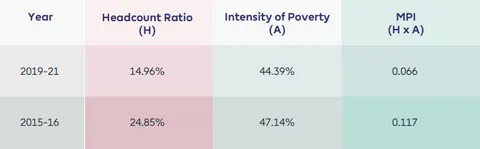
According to the Alkire-Foster (AF) methodology, an individual is considered MPI poor if their deprivation score equals or exceeds the poverty cutoff of 33.33%. Table 2 provides a peep into the extent and trends in multidimensional poverty in India.
Table 2. Snapshot of Multidimensional Poverty in India
Source: Niti Aayog, National Multidimensional Poverty Index: A Progress Review 2023, New Delhi, p26
According to Niti Aayog, India’s MPI estimates reveal a significant reduction in the national MPI value and a decline in the proportion of the population experiencing multidimensional poverty from 24.85% to 14.96% between 2015-16 and 2019-21. This 9.89 percentage point decrease translates to approximately 135.5 million people escaping poverty during this period, based on the projected 2021 population. This achievement represents a major milestone in progress toward SDGs target 1.2, which seeks to reduce by at least half the proportion of men, women, and children of all ages living in poverty in all its dimensions according to national definitions. India’s progress suggests that the country is on track to meet this target well ahead of the 2030 deadline.
Furthermore, the intensity of poverty, which measures the average deprivation experienced by individuals living in multidimensional poverty, also declined from 47.14% to 44.39% over the same period. This indicates not only a reduction in the number of people living in poverty but also an improvement in the quality of life for those who remain deprived.
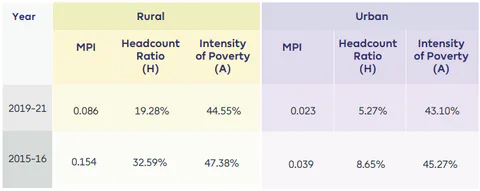
The MPI is also instrumental in identifying disparities between rural and urban areas. It helps policymakers understand the differing intensities of poverty across these regions, offering a nuanced perspective on where targeted interventions are most needed.
Table 3. Disparities in Multidimensional Poverty Across Rural and Urban Areas
Source: Niti Aayog, National Multidimensional Poverty Index: A Progress Review 2023, New Delhi, p26
According to the projections, the MPI value decreased more quickly in rural regions than in urban ones. Between 2015–16 and 2019–21, the poverty rate decreased from 8.65% to 5.27% in urban areas and from 32.59% to 19.28% in rural regions.
The percentage of the population in each state and Union Territory that is multi-dimensionally poor may be found using MPI. In each State and Union Territory, Figure 1 displays the headcount ratio of multidimensionally poor individuals based on data from the National Family Health Surveys (NFHS) 2019–21 and 2015–16.
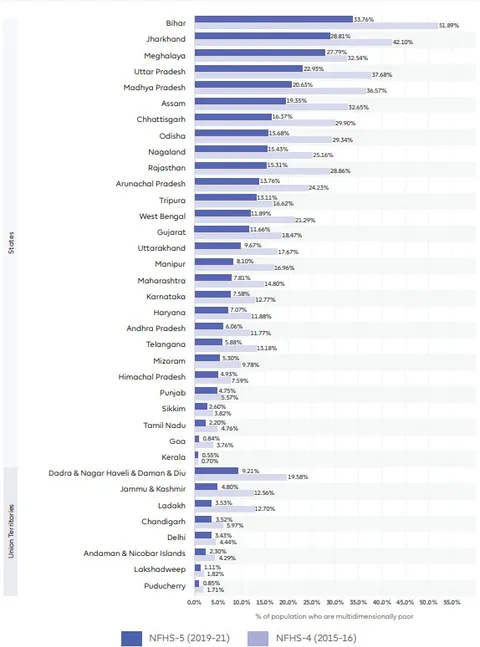
The states with the highest rates of multidimensional poverty were Bihar, Jharkhand, Meghalaya, Uttar Pradesh, and Madhya Pradesh. MPI may also show how the headcount ratio has changed over time.
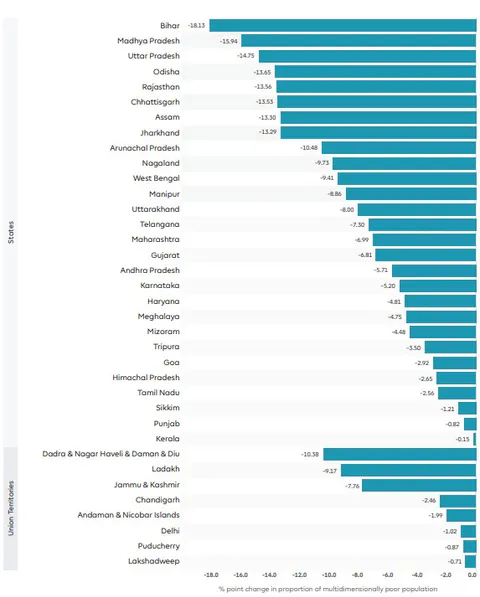
Figure 2 shows that Bihar, Madhya Pradesh, Uttar Pradesh, Odisha, and Rajasthan registered the maximum decline in multidimensional poverty.
Certain dimensions of deprivation continue to drive multidimensional poverty in India. Malnutrition, particularly among children, remains a pressing issue despite initiatives like Poshan Abhiyaan (Ministry of Women and Child Development, 2023) [11]. Education also faces challenges, with inadequate years of schooling and high dropout rates in poorer states. Additionally, access to basic amenities such as clean drinking water, improved sanitation, and clean cooking fuel shows pronounced disparities, particularly between urban and rural areas (International Institute for Population Sciences [IIPS], 2021).
Demographic disparities further compound the issue. Scheduled Tribes (STs) are disproportionately affected, with nearly 50% of ST households experiencing multidimensional poverty due to factors like geographical isolation and social exclusion (UNDP & OPHI, 2023). Scheduled Castes (SCs) also face higher poverty rates compared to the general population. Gender disparities are evident, as women and girls are more likely to be deprived of education and healthcare. Children constitute a large share of the multidimensionally poor, especially in states like Bihar and Uttar Pradesh (NITI Aayog, 2021) [12].
Addressing these challenges requires targeted policy interventions. The government has launched several initiatives, such as Ayushman Bharat to improve healthcare access, PM Ujjwala Yojana to provide clean cooking fuel, and Swachh Bharat Abhiyan to enhance sanitation. Programs like the Mid-Day Meal Scheme aim to tackle malnutrition and improve school attendance (Ministry of Health and Family Welfare, 2023) [10].
Tailored poverty alleviation strategies are essential, particularly for high-burden states. Prioritizing child and maternal welfare, improving rural development, and strengthening education systems are critical to further reducing multidimensional poverty in India.
4. Limitations of the Multidimensional Poverty Index
Despite its strengths, the MPI has several limitations that affect its application and interpretation. One significant challenge is the availability and quality of data. The MPI relies on extensive household surveys to collect information on its indicators. However, in many countries, especially those with high levels of poverty, these surveys are not conducted frequently or comprehensively. This lack of timely and accurate data can compromise the relevance and precision of MPI measurements.
Another limitation lies in the selection of indicators and their assigned weights, which can significantly influence MPI outcomes. Different regions may require tailored indicators to accurately reflect their unique poverty challenges, but the subjective nature of choosing and weighing these indicators often sparks debates about the fairness and validity of the Index. Similarly, the cultural and contextual relevance of the MPI is not always guaranteed. The indicators used may not fully capture poverty across diverse cultural and geographical settings, potentially leading to misinterpretations of poverty levels.
The MPI focuses primarily on absolute deprivations, neglecting relative poverty, which measures how poor individuals are in comparison to others in their community or country. It also fails to directly address inequality, a critical factor in understanding the broader dynamics of poverty. Additionally, the MPI provides only a static snapshot of poverty at a given point in time, making it less effective in capturing the dynamic nature of poverty and the transitions households make in and out of poverty over time.
Urban poverty presents another challenge for the MPI. The standard indicators often emphasize rural deprivation and may not adequately address unique urban issues such as overcrowding, pollution, and limited access to informal employment. While the MPI offers valuable guidance for policymakers, translating its findings into effective policy interventions can be difficult. The Index does not provide direct recommendations for specific policies that could address identified deprivations.
Moreover, the complexity of the MPI methodology makes it challenging for non-experts to understand. This lack of accessibility can reduce its effectiveness in advocacy and policymaking, where simple and easily interpretable metrics are often preferred. Finally, although the MPI captures multiple deprivations, it may not fully account for how these deprivations are interconnected and compound one another, which is critical for understanding the multifaceted nature of poverty.
5. Global experience with MPI
The MPI has been widely adopted by countries and international organizations to provide a more nuanced understanding of poverty than traditional income-based measures. However, its global application has revealed numerous challenges that can limit its effectiveness. One major issue is the availability and quality of data. In low-income and conflict-affected regions, reliable and comprehensive data across the MPI dimensions, such as health, education, and living standards, are often unavailable or outdated. For instance, some African countries lack consistent data on indicators like sanitation or school attendance, making accurate MPI calculations difficult.
In Mexico, the MPI has been part of its National Poverty Measurement System since 2009, including indicators for health, education, and housing conditions. The adoption of MPI allowed policymakers to more effectively target poverty reduction programs like PROSPERA, which now addresses multidimensional poverty by focusing on income, healthcare, education, and housing. However, Mexico faces challenges in collecting data from marginalized and rural areas with poor infrastructure, making it difficult to implement interventions that address multiple deprivations simultaneously.
Pakistan introduced MPI in 2016 to measure poverty more comprehensively, using indicators for education, health, and living standards. MPI has helped reveal poverty’s depth in regions where income alone fails to capture disparities, and it has been incorporated into programs like the Benazir Income Support Program (BISP). However, Pakistan faces difficulties with data consistency and quality, especially in rural areas, and the urban-rural divide means that poverty reduction programs must be tailored to specific regional needs.
In Bhutan, the MPI is integrated into its Gross National Happiness (GNH) framework, which emphasizes well-being over economic output. Bhutan’s MPI includes health, education, living standards, and psychological well-being, aligning with the country’s unique development philosophy. While this approach expands the concept of poverty to include mental health, challenges remain in collecting accurate data from Bhutan’s remote mountain areas, and balancing subjective indicators like psychological well-being with objective measures proves difficult.
Egypt began using MPI in 2016, with the support of UNDP and OPHI. The Egyptian MPI includes dimensions such as education, health, and living standards, helping the government to better understand poverty patterns and target interventions. Despite its usefulness, Egypt struggles with significant urban-rural disparities, especially in healthcare and education access, and difficulties in collecting data from rural and informal sectors complicate MPI’s use for policymaking.
In Indonesia, the MPI has been used to gain a more nuanced understanding of poverty, with indicators like school attendance and access to healthcare. It has enabled the identification of poverty hotspots that traditional income measures could not reveal. However, Indonesia’s many islands create challenges in applying a one-size-fits-all approach to MPI, and maintaining up-to-date data is difficult in remote regions with limited infrastructure.
Finally, in Brazil, the MPI is used to assess poverty and track progress in poverty reduction programs such as the Zero Hunger Program and Bolsa Família cash transfers. MPI data has enabled Brazil to design more comprehensive poverty alleviation strategies that address not only income but also healthcare, education, and sanitation. Nonetheless, Brazil faces the challenge of ensuring effective coordination among various social programs and addressing deep-rooted regional disparities and socioeconomic inequality.
In all these cases, the adoption of MPI has provided valuable insights into multidimensional poverty, but countries continue to face challenges related to data quality, regional disparities, and the complexities of translating MPI findings into effective policies.
6. Overcoming the limitations of the MPI
Addressing the challenges of the MPI requires a multifaceted approach that tackles its methodological, data-related, and contextual issues. Key strategies for enhancing the MPI’s effectiveness include:
Improving data quality and frequency through regular and comprehensive household surveys, supplemented by technology like satellite imaging and mobile data for hard-to-reach areas (Alkire & Santos, 2010). Customizing indicators and weights to local contexts ensures relevance by selecting appropriate measures based on specific regional poverty challenges, with input from local communities, experts, and policymakers (UNDP & OPHI, 2019) [20]. To address urban-rural disparities, separate indicators or distinct MPIs for urban and rural areas can more accurately reflect the diverse poverty experiences (Nussbaum, 2011). Incorporating relative poverty and inequality measures alongside the MPI offers a fuller understanding of poverty in different contexts (Atkinson, 2019).
Implementing dynamic poverty monitoring through longitudinal studies and panel data helps track changes in poverty over time and identifies the factors influencing households’ transitions in and out of poverty (Ravallion, 2018). To enhance policy relevance, the MPI’s findings should be translated into actionable recommendations, guiding interventions, and evaluating poverty reduction efforts (Laderchi et al., 2003). Simplifying MPI findings for broader accessibility ensures that policymakers, media, and the public can engage with the data more easily (Robeyns, 2017). Advanced statistical methods can be applied to better understand the interrelationships between deprivations, while fostering international collaboration among governments and organizations can help refine the MPI and align it with global poverty reduction goals, such as the United Nations Sustainable Development Goals (United Nations, 2015) [19]. Innovating measurement techniques, including multidimensional clustering, can further improve the MPI’s accuracy (Bourguignon & Chakravarty, 2003).
7. Conclusion
In conclusion, as Renita D’Souza aptly stated, “While India has successfully lifted millions out of poverty over the past few decades, the issue remains one of the foremost challenges confronting the country. One of the first crucial steps to solving the problem of poverty is to measure its extent” (D’Souza, 2019). Although a global consensus on a single poverty index remains elusive, the MPI represents an improvement over traditional poverty measures, offering a deeper understanding of the extent and causes of poverty, and contributing to the achievement of poverty reduction targets as outlined in Goal 1 of the Sustainable Development Goals (United Nations, 2015) [19].


