
Multicategory Classification Using Support Vector Machine for Microarray Gene Expression Cancer Diagnosis

Β§ Sree Saraswathi Thyagaja College, Pollachi

Send Message

To: Author

Multicategory Classification Using Support Vector Machine for Microarray Gene Expression Cancer Diagnosis

Article Fingerprint

ReserarchID

CSTNWZ66

Multicategory Classification Using Support Vector Machine for Microarray Gene Expression Cancer Diagnosis Banner

AI TAKEAWAY

Connecting with the Eternal Ground
  • English
  • Afrikaans
  • Albanian
  • Amharic
  • Arabic
  • Armenian
  • Azerbaijani
  • Basque
  • Belarusian
  • Bengali
  • Bosnian
  • Bulgarian
  • Catalan
  • Cebuano
  • Chichewa
  • Chinese (Simplified)
  • Chinese (Traditional)
  • Corsican
  • Croatian
  • Czech
  • Danish
  • Dutch
  • Esperanto
  • Estonian
  • Filipino
  • Finnish
  • French
  • Frisian
  • Galician
  • Georgian
  • German
  • Greek
  • Gujarati
  • Haitian Creole
  • Hausa
  • Hawaiian
  • Hebrew
  • Hindi
  • Hmong
  • Hungarian
  • Icelandic
  • Igbo
  • Indonesian
  • Irish
  • Italian
  • Japanese
  • Javanese
  • Kannada
  • Kazakh
  • Khmer
  • Korean
  • Kurdish (Kurmanji)
  • Kyrgyz
  • Lao
  • Latin
  • Latvian
  • Lithuanian
  • Luxembourgish
  • Macedonian
  • Malagasy
  • Malay
  • Malayalam
  • Maltese
  • Maori
  • Marathi
  • Mongolian
  • Myanmar (Burmese)
  • Nepali
  • Norwegian
  • Pashto
  • Persian
  • Polish
  • Portuguese
  • Punjabi
  • Romanian
  • Russian
  • Samoan
  • Scots Gaelic
  • Serbian
  • Sesotho
  • Shona
  • Sindhi
  • Sinhala
  • Slovak
  • Slovenian
  • Somali
  • Spanish
  • Sundanese
  • Swahili
  • Swedish
  • Tajik
  • Tamil
  • Telugu
  • Thai
  • Turkish
  • Ukrainian
  • Urdu
  • Uzbek
  • Vietnamese
  • Welsh
  • Xhosa
  • Yiddish
  • Yoruba
  • Zulu
Font Type
Font Size
Font Size
Bedground

Abstract

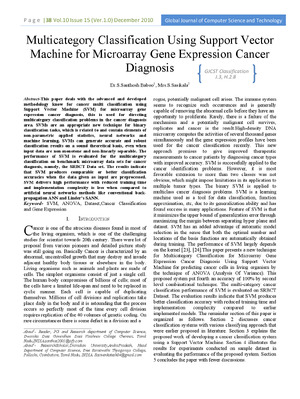
This paper deals with the advanced and developed methodology know for cancer multi classification using Support Vector Machine (SVM) for microarray gene expression cancer diagnosis, this is used for directing multicategory classification problems in the cancer diagnosis area. SVMs are an appropriate new technique for binary classification tasks, which is related to and contain elements of non-parametric applied statistics, neural networks and machine learning. SVMs can generate accurate and robust classification results on a sound theoretical basis, even when input data are non-monotone and non-linearly separable. The performance of SVM is evaluated for the multicategory classification on benchmark microarray data sets for cancer diagnosis, namely, the SRBCT Data set. The results indicate that SVM produces comparable or better classification accuracies when the data given as input are preprocessed. SVM delivers high performance with reduced training time and implementation complexity is less when compared to artificial neural networks methods like conventional backpropagation ANN and Linder’s SANN.

References

20 Cites in Article
  1. M Ringner,C Peterson,J Khan (2002). Analyzing Array Data Using Supervised Methods.
  2. G.-B Huang,C.-K Siew (2004). Extreme Learning Machine: RBF Network Case.
  3. D Serre (2002). Matrices: Theory and Applications.
  4. G.-B Huang,L Chen,C.-K Siew (2006). Universal Approximation Using Incremental Constructive Feedforward Networks with Random Hidden Nodes.
  5. S Dudoit,J Fridlyand,T Speed (2002). Comparison of Discrimination Methods for Classification of Tumors Using Gene Expression Data.
  6. Runxuan Zhang,Guang-Bin Huang,Narasimhan Sundararajan,P Saratchandran (2007). Multicategory Classification Using an Extreme Learning Machine for Microarray Gene Expression.
  7. Mark Schena,Dari Shalon,Ronald Davis,Patrick Brown (1995). Quantitative Monitoring of Gene Expression Patterns with a Complementary DNA Microarray.
  8. Sandrine Dudoit,Jane Fridlyand,Terence Speed (2002). Comparison of Discrimination Methods for the Classification of Tumors Using Gene Expression Data.
  9. R Linder,D Dew,H Sudhoff,D Theegarten,K Remberger,S Poppl,M Wagner (2004). The "Subsequent Artificial Neural 10) Network" (SANN) Approach Might Bring More Classificatory Power to ANN-Based DNA Microarray Analyses.
  10. G.-B Huang,Q.-Y Zhu,C.-K Siew (2004). Extreme Learning Machine: A New Learning Scheme of Feedforward Neural Networks.
  11. G.-B Huang,C.-K Siew (2004). Extreme Learning Machine: RBF Network Case.
  12. G.-B Huang,C.-K Siew (2005). Extreme Learning Machine with Randomly Assigned RBF Kernels.
  13. G.-B Huang,Q.-Y Zhu,K Mao,C.-K Siew,P Saratchandran,N Sundararajan (2006). Can Threshold Networks Be Trained Directly?.
  14. Ming-Bin Li,Guang-Bin Huang,P Saratchandran,N Sundararajan (2005). Fully complex extreme learning machine.
  15. Sridhar Ramaswamy,Pablo Tamayo,Ryan Rifkin,Sayan Mukherjee,Chen-Hsiang Yeang,Michael Angelo,Christine Ladd,Michael Reich,Eva Latulippe,Jill Mesirov,Tomaso Poggio,William Gerald,Massimo Loda,Eric Lander,Todd Golub (2002). Multiclass cancer diagnosis using tumor gene expression signatures.
  16. R Linder,D Dew,H Sudhoff,D Theegarten,K Remberger,S Poppl,M Wagner (2004). The "Subsequent Artificial Neural Network" (SANN) Approach Might Bring More Classificatory Power to ANN-Based DNA Microarray Analyses.
  17. Olga Troyanskaya,Michael Cantor,Gavin Sherlock,Pat Brown,Trevor Hastie,Robert Tibshirani,David Botstein,Russ Altman (2001). Missing value estimation methods for DNA microarrays.
  18. Mike West,Carrie Blanchette,Holly Dressman,Erich Huang,Seiichi Ishida,Rainer Spang,Harry Zuzan,John Olson,Jeffrey Marks,Joseph Nevins (2001). Predicting the clinical status of human breast cancer by using gene expression profiles.
  19. E Freyhult,P Prusis,M Lapinsh,J Wikberg,V Moulton,M Gustafsson (2005). Unbiased Descriptor and Parameter Selection Confirms the Potential of Proteochemometric Modelling.
  20. S Dudoit,M Laan,S Keles,A Molinaro,S Sinisi,S Teng Loss-Based Estimation.

Funding

No external funding was declared for this work.

Conflict of Interest

The authors declare no conflict of interest.

Ethical Approval

No ethics committee approval was required for this article type.

Data Availability

Not applicable for this article.

How to Cite This Article

MRS.S.SASIKALA, Dr.S.SANTHOSH BABOO, Dr.S.SANTHOSH BABOO. 1970. "Multicategory Classification Using Support Vector Machine for Microarray Gene Expression Cancer Diagnosis". Global Journal of Computer Science and Technology GJCST Volume 10 (GJCST Volume 10 Issue 15).

Download Citation

Journal Specifications

Crossref Journal DOI 10.17406/gjcst

Print ISSN 0975-4350

e-ISSN 0975-4172

Keywords
Classification
GJCST Classification J.3
H.2.8
Version of record

v1.2

Issue date
October 15, 2010

Language
English
Experiance in AR

Explore published articles in an immersive Augmented Reality environment. Our platform converts research papers into interactive 3D books, allowing readers to view and interact with content using AR and VR compatible devices.

Read in 3D

Your published article is automatically converted into a realistic 3D book. Flip through pages and read research papers in a more engaging and interactive format.

Article Matrices
Total Views: 8K
Total Downloads: 439
All Trends

Request Access

Please fill out the form below to request access to this research paper. Your request will be reviewed by the editorial or author team.
X

This is the heading

Lorem ipsum dolor sit amet, consectetur adipiscing elit. Ut elit tellus, luctus nec ullamcorper mattis, pulvinar dapibus leo.


High-quality academic research articles on global topics and journals.

Multicategory Classification Using Support Vector Machine for Microarray Gene Expression Cancer Diagnosis

MRS.S.SASIKALA
MRS.S.SASIKALA Sree Saraswathi Thyagaja College, Pollachi
Dr.S.SANTHOSH BABOO
Dr.S.SANTHOSH BABOO
Dr.S.SANTHOSH BABOO
Dr.S.SANTHOSH BABOO