## I. INTRODUCTION
Atherosclerotic disease and myocardial revascularization as treatments come into play when studying chronic non-communicable diseases; these topics are frequently brought up in clinical and academic discussions because they are among the illnesses that account for the majority of fatalities in the nation. (GUTIERRE, CARDORE). In addition, it is important to note that the major changes in human life have a significant impact on the development of this pathology, as evidenced by bad eating habits and a sedentary lifestyle (LINS, 2017). Acute myocardial infarction (AMI) and stroke are the main causes of death in Brazil for women over 50, according to the Ministry of Health (MS). Among these discussions, it is important to note that eating habits have a direct impact on this, as the increase in the consumption of industrialized products and the constant occupation of a routine have led people to choose to eat Fast Food, with foods high in fats being a series of negative actions that, as one ages, one begins to feel the negative effects of these lifelong practices. In addition, neglect of health and ignorance have a significant impact on the increase in serious cases, and ignorance has a significant impact on neglect and lack of care. The factors of habits already mentioned are corroborated by this picture, yet without the necessary follow-up for a search for disease prevention, the numbers of hospitalizations and deaths have increased (GWENDOLIN, 2017). By realizing that estrogen functions as a preventive factor and that age, particularly the reproductive age of women, has a direct impact on the processes of atherosclerotic disease development. However, in the postmenopausal period, this factor does not happen due to the hormonal low, which, combined with other risk factors such as advanced age, hypertension, diabetes, obesity, and lifestyle, leads to a worsening in the morbidity and mortality of patients. In order to develop projects and preventive measures, as well as to adjust the current framework given its significance in epidemiological terms, it is therefore interesting to link these parameters with the epidemiological characteristics. Since there are many patients undergoing coronary artery bypass graft surgery, it is important to comprehend and embrace the patient as a whole before analyzing the factors surrounding the procedure, such as risk factors and aging processes. (TAVARES, 2020)
Myocardial revascularization surgery plays a crucial role in resolving coronary artery disease, in which fat accumulates in the coronary arteries. As it is an extensive surgery and requires good postoperative support, the preoperative study is extensive and covers all risk, morbidity, and mortality factors.
## II. METHODS
This is a literature review whose sources were taken from the SciELO and PubMed data platforms. The research period was July 2023, meeting the inclusion criteria of articles from the years 2000 to 2023, in Portuguese and English, online texts, and full texts. As strategies for better evaluation of the texts, the following health descriptors (DeCS) were used: "Myocardial revascularization", "Women" and "Risks". In addition, the public database DATASUS was used on an epidemiological basis.
## III. RESULTS AND DISCUSSION
By understanding the importance and impact of risk factors for the need for myocardial revascularization, it is understood that the risk factor that most surrounds the main studies is the gender factor, as seen in the study (CADORE, 2007) at Hospital San Lucas da PUC-RS in 2007. This study identified 11 predictors for death in coronary artery bypass graft surgery, which formed the score: age≥ 60 years, surgery in women, In the present study, mortality was higher in women (11.9% versus 9% in men), which is anindependent risk factor for hospital death.
In another aspect, in females, obesity is twice as evident in patients with atherosclerotic disease (BRUNORI EHFR et al., 2014). An interesting factor relates to the eating and living habits of a large part of the population. By addressing the bias of a sedentary lifestyle, the risks become more evident, as do the main impacts on the patients' lifestyle habits.
It is understood as a risk factor for the need for myocardial revascularization: Risk factors for the development of coronary artery disease (CAD) are systemic arterial hypertension (SAH), smoking, dyslipidemias, obesity, diabetes mellitus (DM), family history, and a sedentary lifestyle; however, in women, some of these factors have a more pronounced effect. In addition, women are subject to specific causes, such as hypertension in the pregnancy cycle, gestational diabetes, and premature birth, which are related to increased cardiovascular risk in the long term.
Internações segundo Reglia Capitulo CID-10: IX. Doencas do aparecido circulátorico Lista Morb CID-10: Arteroesclerose Periodo: Jan-Mai/2023
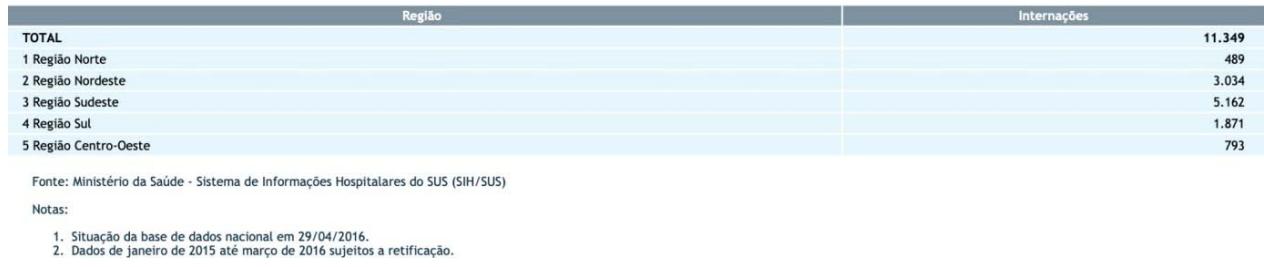 Figure 2: Epidemiological table of hospital morbidity by place of hospitalization for females
Figure 1 illustrates the impact of atherosclerotic disease by showing that there were 11,349 deaths in 5 months. In addition, it is worth mentioning and emphasizing the focus on the Southeast
Region, given the routine and life dynamics of most residents, as well as their lifestyle habits, which provide more risk factors for the development of atherosclerotic disease.
Internações segundo Região Lista Morb CID-10: Arteroesclerose Sexo: Fem Periode: Jan-Mai/2023
<table><tr><td>Região</td><td>Internações</td></tr><tr><td>TOTAL</td><td>4.949</td></tr><tr><td>1 Região Norte</td><td>232</td></tr><tr><td>2 Região Nordeste</td><td>1.417</td></tr><tr><td>3 Região Sudeste</td><td>2.227</td></tr><tr><td>4 Região Sul</td><td>740</td></tr><tr><td>5 Região Centro-Oeste</td><td>333</td></tr><tr><td colspan="2">Fonte: Ministério da Saüde - Sistema de Informações Hospitalares do SUS (SIH/SUS)</td></tr><tr><td colspan="2">Notas:</td></tr><tr><td colspan="2">1. Situação da base de dados nacional em 29/04/2016.</td></tr><tr><td colspan="2">2. Dados de janeiro de 2015 até-março de 2016 sujeitos a retitração.</td></tr></table>
Given that this is the chronic, non-communicable disease that kills the most people in the nation, it is crucial to comprehend and debate the effect that hospitalization rates have on public health. Figure 2 indicates that female patients account for a significant proportion of hospitalizations, and it should be understood that this is reflected in the images of myocardial revascularization.
According to the study, "Clinical profile of women undergoing revascularization surgery," patients undergoing coronary artery bypass grafting and valve replacement were predominantly female (33.8%) and elderly (60.89 years), which is a rare finding in the literature given that studies show that males and the elderly make up the majority of patients undergoing coronary artery bypass grafting surgeries (GUTIERRES, 2020).
On the other hand, according to (Choles FE, et al. 2015), diabetic women have more coronary lesions compared to non-diabetic women. There is evidence that women with diabetes mellitus have worse outcomes than men. In addition, diabetic women with atherosclerotic disease undergoing revascularization have a higher risk of restenosis due to pathophysiological changes at the vascular level, a decrease in the protective effect of estrogens after menopause, and the fact that the caliber of their arteries is smaller than that of non-diabetic women and smaller than that of men. In them, revascularization of the anterior descending artery with coronary artery bypass grafting is associated with a higher incidence of adverse outcomes in the short and medium term (MOTA, 2015).
## IV. FINAL CONSIDERATIONS
Thus, it is essential to understand this change in perspective since patients who needed myocardial revascularization were men, and this profile is constantly changing since there are several risk factors, mainly due to the physiological changes of aging. Finally, monitoring women's health since adulthood, with guidance for healthy lifestyle habits and specialized monitoring in the climacteric period, is essential to maintaining a better quality of life and reducing mortality rates related to atherosclerotic diseases and myocardial revascularization.
Generating HTML Viewer...
References
14 Cites in Article
Michel Cadore,João Guaragna,Justino Anacker,Luciano Albuquerque,Luiz Bodanese,Jacqueline Piccoli,João Petraco,Marco Goldani (2010). Proposição de um escore de risco cirúrgico em pacientes submetidos à cirurgia de revascularização miocárdica.
Evilin Gutierres,Laurelize Rocha,Aline Brum,Janaína Yasin,Deciane Carvalho,Raissa Brum (2020). PERFIL CLÍNICO DE MULHERES SUBMETIDAS À CIRURGIA DE REVASCULARIZAÇÃO DO MIOCÁRDIO E TROCA VALVAR.
Arthur Weber,Carpeggiani (2023). Efeito do exercício físico aeróbico sobre o risco cardiovascular e a saúde mental de mulheres pós-menopáusicas: revisão sistemática e metanálise. Promoção e proteção da saúde da mulher, ATM.
Marli Mamede,Líscia Silva,Bruna Oliveira (2019). Conhecimento e sentimentos das mulheres climatéricas sobre a doença coronariana.
Do,Thalia Mota (2020). Complicações da revascularização do miocárdio em pacientes com diabetes mellitus.
Raphael Rosan,Paris (null). Avaliação do risco de óbito intra-hospitalar em cirurgia de revascularização miocárdica isolada através do ERPO.
Bruna Rissardi,Roberta Soares,; Alessandra,Arlene Ayala,Monterrosa (2020). Fatores de risco da doença coronariana entre os pacientes submetidos à revascularização miocárdica (RM) em Joinville/SC.
Mariana Tavares,Gérlia Silveira,Gabriel Castro,Sarah Candido,Cynthia Bachur (2020). Prevalência dos fatores de risco da doença coronariana em paciente submetidos a revascularização do miocárdio.
I Romano,L Lenatti,N Franco,L Misuraca,N Morici,C Leuzzi (2016). Menopause, atherosclerosis and cardiovascular risk: a puzzle with too few pieces.
Helena Cristina Balthazar Guedes Borges,Marisa Coelho Adati,Danielle Copello Vigo,Valeria Furtado De Mendonça,Marlon Akio Issobe,Flavia Barreto Dos Santos,Helena Pereira Da Silva Zamith (2016). Avaliação dos testes rápidos para diagnóstico da dengue no Brasil.
C Versiani,A Freire,Gmm Dias,B Brito,Jsb Rocha,Vmcp Reis (2013). Avaliação do risco cardiovascular em mulheres climatéricas assistidas pelo Programa Saúde da Família.
Samar El Khoudary,Gail Greendale,Sybil Crawford,Nancy Avis,Maria Brooks,Rebecca Thurston,Carrie Karvonen-Gutierrez,L Waetjen,Karen Matthews (2019). The menopause transition and women's health at midlife: a progress report from the Study of Women's Health Across the Nation (SWAN).
Samar El Khoudary,Brooke Aggarwal,Theresa Beckie,Howard Hodis,Amber Johnson,Robert Langer,Marian Limacher,Joann Manson,Marcia Stefanick,Matthew Allison (2020). Menopause Transition and Cardiovascular Disease Risk: Implications for Timing of Early Prevention: A Scientific Statement From the American Heart Association.
Lady Akwa,Monday Moses,Abigael Emikpe,Biggie Baffour-Awuah,Benjamin Asamoah,Otchere Addai-Mensah,Max Annani-Akollor,Francis Osei,Eric Appiah (2017). Lipid profile, cardiorespiratory function and quality of life of postmenopausal women improves with aerobic exercise.
No ethics committee approval was required for this article type.
Data Availability
Not applicable for this article.
How to Cite This Article
Matheus Amorim Grigorio. 2026. \u201cMyocardial Revascularization in Women, An Epidemiological Analysis\u201d. Global Journal of Medical Research - F: Diseases GJMR-F Volume 23 (GJMR Volume 23 Issue F6): .
Explore published articles in an immersive Augmented Reality environment. Our platform converts research papers into interactive 3D books, allowing readers to view and interact with content using AR and VR compatible devices.
Your published article is automatically converted into a realistic 3D book. Flip through pages and read research papers in a more engaging and interactive format.
Our website is actively being updated, and changes may occur frequently. Please clear your browser cache if needed. For feedback or error reporting, please email [email protected]
Thank you for connecting with us. We will respond to you shortly.