


I. INTRODUCTION
Volar perilunate dislocation (VPLD) is a rare injury accounting for about 3% of perilunate dislocations which comprise of less than 10% of all wrist injuries. It generally occurs due to high-energy trauma and is frequently missed. Open reduction and internal fixation is the ideal treatment due to variable results with closed reduction. Patients presenting late are particularly difficult to manage due to soft tissue contractures and increased chances of 1) avascular necrosis of scaphoid and lunate, 2) tractional injury to neurovascular structures, 3) wrist stiffness, and 4) complex regional pain syndrome (CRPS).
We, through this case report, aim to highlight the problems faced in managing neglected VPLDs and importance of prompt restoration of intercarpal alignment in such injuries to prevent complications. We also state that early recognition and treatment improves patient outcomes in CRPS.
II. CASE PRESENTATION
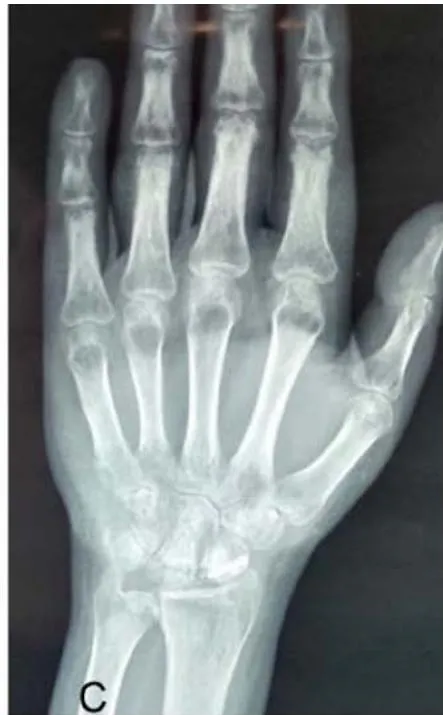
A 30-year-old man presented to us with pain in the right wrist and restricted movements. He had fell down from a height of around 15 feet on his palmar-flexed wrist a month back. He took the primary treatment from an osteopath where some kind of bandaging was done. He came to us when his symptoms hadn't subsided one month after the injury. On examination, there was diffuse tenderness and swelling over the right wrist with restriction of movements. The overlying skin was normal. There was no weakness or paresthesia in the right hand. X-rays suggested a trans-scaphoid volar perilunate dislocation. (Figure 1)
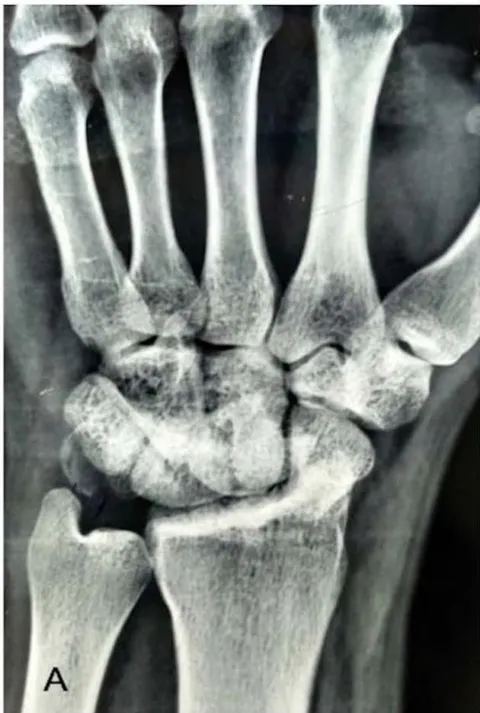
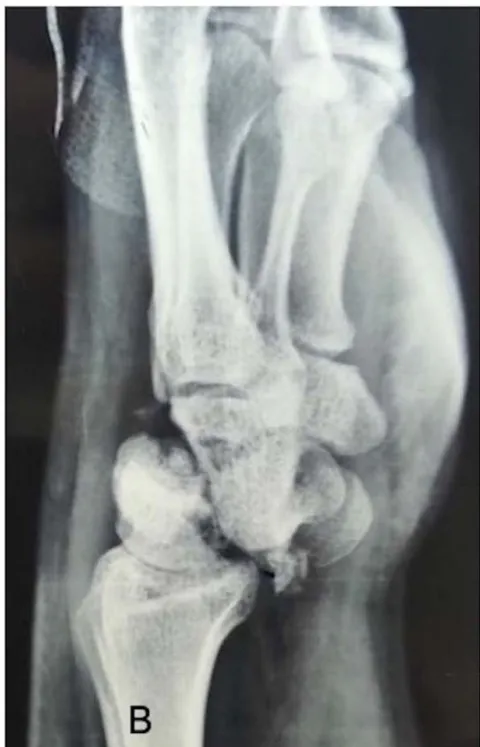
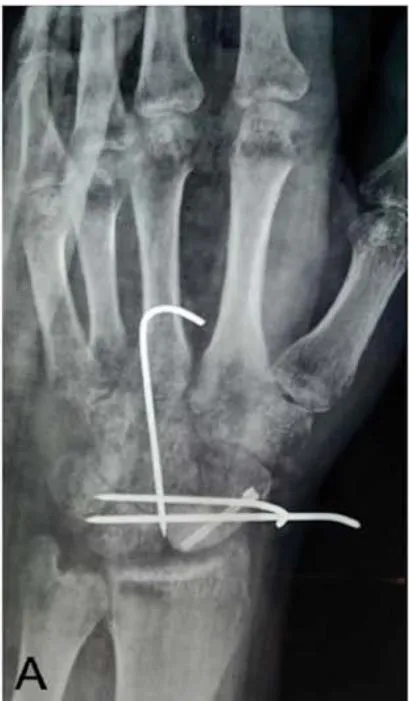
After taking an informed consent, we took the patient to the operating table. We used the volar approach to the scaphoid. Intra-operatively, we found a comminuted fracture of the scaphoid and gross intercarpal instability. We did open reduction and internal fixation with a headless screw for scaphoid fracture and scapho-lunate and capito-lunate K-wires for intercarpal instability.
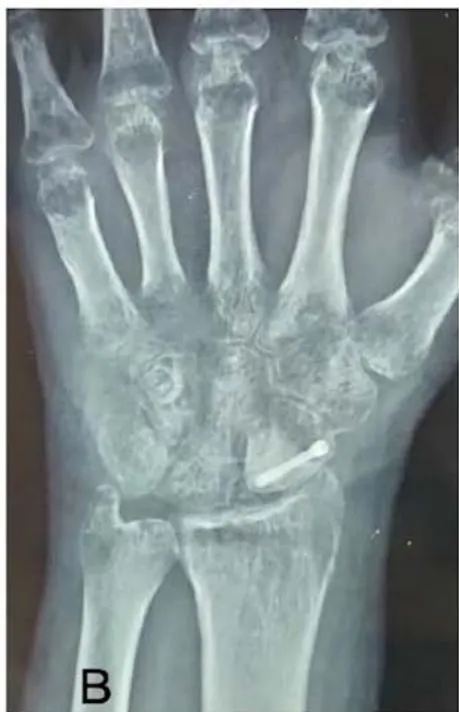
The patient was kept on a below-elbow plaster slab for 6 weeks, after which it was removed along with the K-wires and range of motion exercises were started. Unfortunately, the patient developed complex regional pain syndrome (CRPS) at this point, which was suggested by his complaints of severe burning pain and abnormally increased sweating in the affected area. X-rays showed severe patchy osteopenia around the wrist. Active and passive range of motion exercises and contrast bath were initiated and he was kept on low dose amitriptyline. Gradually CRPS resolved and at 6-month follow-up, the patient had a wrist dorsiflexion of 30° and palmar-flexion of 45°. (Figure 2)
NEGLECTED TRANS-SCAPHOID VOLAR PERILUNATE DISLOCATION WITH POST-OPERATIVE COMPLEX REGIONAL PAIN SYNDROME: A CASE REPORT
III. Discussion
Perilunate dislocation comprises volar or dorsal translation of the carpus secondary to ligamentous or bony disruption around the lunate. This was explained by Johnson as greater arc (associated with a fracture around lunate) and lesser arc (pure ligamentous disruption around lunate) injuries.
Trans-scaphoid volar perilunate dislocation (VPLD) is an extremely rare injury, generally caused by a fall on palmar-flexed and ulnar-deviated wrist. It is frequently missed and hence, can be neglected. Patients can present with persistent pain and stiffness of the wrist joint with signs of median nerve compression.
Prompt restoration of intercarpal alignment is necessary to prevent complications like median nerve injury, carpal instability, complex regional pain syndrome, avascular necrosis of lunate and scaphoid, and secondary osteoarthritis. The literature suggests that an open reduction is necessary and can be done till 2 months after the injury. In patients where open reduction is not successful or those presenting after 2 months, a reconstructive or salvage procedure is generally required.
Patients presenting late with VPLDs have more chances of developing complex regional pain syndrome (CRPS) in the post-operative period. CRPS occurs due to central and peripheral nociceptive sensitisation, altered sympathetic function, inflammatory and immune related factors, brain changes, and psychological factors. It is characterised by excessive burning pain, swelling, altered sweating pattern and warm or cold skin. Diagnosis is solely clinical. Early recognition and treatment is necessary. Various treatment modalities like drugs (corticosteroids, anti-convulsants, analgesic antidepressants), ganglion blocks, spinal cord stimulation and physical therapy have been documented.