This is a critical review on gender issue and its policies, to understand and to evaluate the impact of the gender state interventionism, with its costs, failures, paradoxes and other unwanted effects. This review uses the theoretical and methodological frameworks from neoinstitutional approach (Law & Economics, Public Choice, Constitutional Economic, etc.), to build bridges between Economy, Law and Politics, without confusion among the social spheres and under the principle of reality, which rejects economic thaumaturgy, political romanticism and state paternalism. There is a historical-comparative review on the development of coercive implementation based on gender perspective and its agenda, from a macro-view to a micro level, focusing the attention on the Spanish case. There is a final statement of its results, to clarify what kind of incentives have been given the gender bills and policies, the level of efficiency and institutional quality to solve social problems, the risks of an endless agenda and other unwanted effects, but foreseeable according to the principle of reality.
## I. INTRODUCTION
Is it possible to rationally analyze legislation and public policies that are increasingly more emotional and perceptual? Is it possible to criticize certain issues of imposed consensus? Are there unquestionable taboo concepts or bullet concepts capable of killing any discussion? Sapere aude (dare to think) was one of the great university mottos (Sánchez-Bayón, 2010a), which the Enlightenment appropriated, to bequeath us the logos (or modern individual technical rationality). However, it seems that Economy, Politics and Law today revolve around the same private issues of groups, converted into public ones and supported by pathos (or postmodern shared sentiment).[^5] Hence, one of the great challenges today is to know the logos and the pathos, facilitating communication between each other, without fear of external censorship (cancellation) or internal censorship (the spiral of silence).
One of the taboo concepts mentioned could well be the gender issue, referring to a great social problem with multiple aspects: it goes beyond the prevention and repression of machismo (also a lax concept: from abuse and feminicide to compliments).[^10] or quotas and specific aid), since a good part of the doctrine understands that it is the agenda to subvert the order given in the West, because it is based on discriminatory and oppressive hetero-patriarchal capitalist approaches (Johnson and Zubiaurre, 2012; Laje, 2022). Currently, it is even more confusing, when combined with another subversive agenda of the established order, such as climate change and degrowth (Mellor, 1992 and 1997; Koch, 2019; Fullbrook and Morgan, 2021; Keen, 2021), in addition to suffering a hermeneutical turn of $180^{\circ}$, going from cis-gender feminist postulates (cis) to trans-gender feminists (trans). Therefore, to better understand such a diffuse and controversial issue, defended from pathos (or shared sentiment), this study offers an opinion on the legal-economic effects of the gender issue, from neo-institutionalist approaches, to address via logos (or individual rationality), plus methodological individualism (which forces us to go deeper and reach the foundations and concrete agents involved). To facilitate the communication and transition from pathos to logos, two metaphors are used that allow us to understand the meaning and scope of the gender agenda, regulation and public policies, given public interventionism: a) cobra effect; b) boiled frog syndrome.
a) Cobra effect (Siebert, 2001)\[^1\]: Refers to the perverse incentives of that regulation and public policies that cause a greater evil. Perhaps they started from a good will, but given their normativism (confusing what should be with what is), along with their poor design and implementation, they can end up causing contrary and unwanted effects. This review alludes to the case of the undesired effects of the gender agenda (e.g. why gender regulation, justified for greater protection of women, can end up reducing sentences and releasing rapists, causing re-victimization, vid. epig. 4). This is not something anecdotal, but is related to: a) Campbell's law (1976), regarding the use and abuse of indicators of gender violence; b) the criticism of Lucas (1976), on the naivety of trying to predict the effects of a change via public policies based on relationships observed in historical data (maximum if they are aggregates, which in turn connects with Arrow's impossibility theorem, and the Austrian School with its human action, plus the Virginia School or Public Choice and its endless agenda, see next point); c) the theorems of Mises (1949) and Buchanan-Tullock (1962), according to which, the greater the state intervention to solve a specific problem, the greater the risk that said problem will become expansive and chronic (see section. 2).
b) Boiled frog syndrome (Quinn, 1996): If you put a frog in a boiling pot, it will jump with all its strength to get out immediately, but if you put it at a warm temperature and it progressively heats up, when you want to give it When she realizes the danger, she will not have the strength to escape and will be boiled. Applying the metaphor to society, if it has an interventionist government (from the neo-institutional perspective of the New Political Economy, see section 2), then this is how the induced progressive and programmatic changes occur2, ranging from the gender issue (socio-cultural construction) to cis-gender feminism (promotion of biologically heterosexual women) and trans-gender feminism (ditto, but transsexual women: anyone who feels and perceives themselves as a woman), the paradox studied here is consequently provoked:
a greater state gender intervention, less freedom for (heterosexual) women and greater lack of protection and dependency. Such a strategy of domination and loss of rights and freedoms is carried out in accordance with the strategy of the endless agenda (Anderson, 1986), the slippery slope (Volokh, 2003) and the Overton window (Russell, 2006; Benon, 2013): to include in the institutional agenda (which gives way to new regulation and public policies for its implementation), those issues that only interest interest and pressure groups, but not to society as a whole (because they are statistically negligible or without tradition or support any real institutional, counting only on constructed majorities, Buchanan and Tullock, 1962); then, progress is made programmatically, introducing gradual and conditioning changes in public opinion, until society accepts the proposed social engineering transformation (thus going from something private and publicly inconceivable to acceptable and institutionalized: like sex, turning it into a gender and counting with an official promotion body, eg Ministry and Secretariat of State for Equality and Institute of Women/Women in Spain, Ministre déleguée chargée de l'Égalité entre les femmes et les hommes in France, and similar in Luxembourg and Denmark – not so in Hungary, Poland and Romania). To achieve such a $180^{\circ}$ socio-political turn, according to cultural economics (and behavioral economics is especially so, between heterodox approaches and paradigmatic renewal, Sánchez-Bayón, 2020a, 2021a-by 2022a-c), it usually takes advantage of cognitive biases (Kahneman, 2011; Kahneman et al, 1982) and nudges (Thaler, 2015; Thaler et al, 2009). And according to Austrian Economics, the tedium of boom periods and their subsequent crises (due to bubbles caused) are also often used as an opportunity to accelerate social transformation (Huerta de Soto et al, 2021; Alonso et al, 2023).
Therefore, we insist on clarifying that this is not a study of taking a position, but rather a mere application of the resources offered by neo-institutional analysis. *Ergo*, a critical review is offered from the combination of *Comparative Political Economy*, *Comparative Law and Human Rights*, as they are connected disciplines, in which the development of social exchanges and their institutionalization are studied, establishing the advancement of culture as a common minimum. human rights and personal and social well-being, from multidisciplinary approaches (Sánchez-Bayón, 2010a, 2012 and 2014; Sánchez-Bayón and Pazos, 2013). The novelty of this review is that it is carried out from the neo-institutional approach, since it is the one that put an end to the romanticism of Politics (distrusting politicians and their own agendas, as well as state paternalism and the dependency trap), in addition of paying attention to the analysis of incentives, efficiency, institutional quality, Buchanan-Tullock theorems on the endless agenda and the politician's lack of incentives to solve problems, while at the same time intensifying them emotionally (thereby allowing the provision of more budget, positions, clientelist networks, etc., see section 2).
## II. THEORETICAL AND METHODOLOGICAL
### FRAMEWORKS: NEO-INSTITUTIONAL
#### REVIEW
Comparative Law and Comparative Political Economy share roots (Sánchez-Bayón, 2022a-d). Then, they share theoretical and methodological frameworks, such as analytical techniques of methodological individualism, such as the analysis of legality (legitimacy, validity and effectiveness) and legal qualification (exegesis, hermeneutics and heuristics), as well as techniques of institutional evolutionary analysis, such as a study. of cases or profiles (Peláez and Sánchez-Bayón, 2012; Sánchez-Bayón, 2015). These techniques have been received by the rest of the legal sciences and transferred to the economic sciences, as clarified in the first manuals of Principles of Political Economy (Sánchez-Bayón, 2020a-by 2021a), remaining in Comparative Political Economy and as You will see with the neoinstitutionalists (many of them being jurists, such as Coase –Nobel Prize winner in Economics-, Tullock, et al.). With respect to the collection of research techniques received from the Legal Sciences, and in defense of the same and its methodological differentiation with respect to the Natural Sciences and Engineering, it is worth highlighting the work of another heterodox approach (closely related to the neo-institutionalists), such as the Austrian School (Huerta de Soto, 2000), also with doctors in Law (from Menger, through Mises and Hayek –Nobel Prize in Economics-, to current exponents, such as Huerta de Soto) and cultivators of the economy based on action human (Menger, 1883; Mises, 1949; Huerta de Soto, 2009).
With respect to Human Rights, although its origin of positive Law is found in the natural rights of the Law of the Indies, promoted by the School of Salamanca (Clavero, 1992 and 2002; Sánchez-Bayón, 2010a and 2022d), however, the The current model is framed in the contemporary proposal of the United Nations (Sánchez-Bayón and Pazos, 2012). Regarding this last proposal, it has been supported by the main monotheistic religions (eg Jews, Christians and Muslims, Sánchez-Bayón, 2010b).
The aforementioned disciplines are reinterpreted here, to analyze the issue of the gender paradox, via the neo-institutionalist approach (remember that it is considered a heterodox approach - despite being mainline or fundamental, Boettke et al, 2016; Sánchez-Bayón, 2022a-b-, since unlike the mainstream or orthodoxy, it is one of the few lines of thought, together with the Austrian School, that is capable of putting an end to the romanticism of Politics and state paternalism - by revealing the hidden interests of its component actors) $^3$. It includes the following currents and approaches: a) Law & Economics -L&E or (Coase, 1937 and 1960; Posner, 1973 and 1979), which allows us to question the incentives, efficiency and institutional quality of regulation and public policies, as well as the costs on public goods and how to improve with reallocations of property rights;
b) Public Choice -PCh or Public Choice (Anderson, 1986; Buchanan and Tullock, 1962), serving to review how collective decisions are made (according to the maximization of interests of the economic agents that operate behind the State: bureaucrats, politicians and pressure and interest groups, above all), with their beneficiaries and those harmed (given the costs of consensus), taking into account hypotheses such as the endless agenda, clientelist networks, omnibus laws, the system of spoliation or distribution of the loot, nepotism, etc.;
c) Constitutional Economics -CE or Constitutional Economics (Brennan and Buchanan, 1985; Buchanan, 1987 and 1990), favors the reduction of excess regulation, advocating for shorter and clearer laws, that establish basic and acceptable rules, thus allowing more exchanges and fewer costs of consensus, information and opportunity (in addition to avoiding perverse second-round effects, such as increased informality, corruption, etc.).
## III. HISTORICAL-COMPARATIVE AND
### NARRATIVE RESULTS: FALLACIES
#### OF GENDER
The gender paradox took place in Anglo-Saxon countries during the cultural wars (in the hard years of the Cold War, 1960-80, Sánchez-Bayón, 2017 and 2019a-b), leading to their crisis of their welfare economics model. interventionist state (given its hyperregulation, plus its deficit and expansive debt), its reformulation being necessary since the 1980s (to avoid non-payment and state bankruptcy, Sánchez-Bayón, 2020c). The problem is that, with the boom of the 2000s and the return to interventionism (along with integral politicism and the syndrome of the satisfied gentleman, Ortega y Gasset, 1929), there has been a revival of the cultural wars (Laje, 2022) with Adm. Obama and the reinvigoration of destructive identity policies (Fukuyama, 2018; Lilla, 2017; Sánchez-Bayón, 2019b) $^4$, in addition to taking advantage of the subsequent crisis, to accelerate the implementation of the gender agenda (Trillo-Figueroa, 2009). In the Nordic countries, the paradox studied peaks with globalization (1990s – since before the Cold War they were quite poor in relation to Western Europe), leading their interventionist model to the same crisis of unsustainability (due to hyperregulation and hyper-indebtedness), requiring its review and reformulation in the 2000s, then following the Anglo-Saxon path, with a certain revitalization of the problem (but this time, adding green tints to the gender issue, eg ecofeminism: it opposes capitalist development, for its replacement by a reproductive socialist model, Mermelstein, 1970; Lindbeck, 1971; Mellor, 1992 and 1997; Sánchez-Bayón, 2022a-b). The big problem is that the Anglo-Saxon and Nordic experiences, decontextualized, have been transplanted since the 2000s (and intensifying with the Great Recession of 2008 and UN-Women, see below), both in the Mediterranean and Latin American worlds (without antibodies and with greater risk of systemic sociopolitical failure).
Transvaluation (Nietzsche, 1888) and integral politicism (Ortega y Gasset, 1929) $^5$ are studied next, focusing on what the fallacies of the genre have been (in the Anglo-Saxon and Nordic world), and how it has occurred in each context the paradox of gender. Finally, it is exposed and explained how the whitening of feminism and its development from the cis to trans modality has occurred, exacerbating the gender paradox today.
Regarding the fallacies of the genre, please start with the name itself, taking as one of the main starting points the case of the Justice of the Supreme Court of the United States of America (USA), Joan Ruth Bader Ginsburg. She studied law at Harvard, although she graduated from Columbia (where she also taught), and soon began collaborating with the American Civil Liberties Union- ACLU, leading the women's rights section (and gender equality – more later renamed as gender equality). While working as a professor at Rutgers, she founded the magazine Women's Rights Law Reporter in 1970, in addition to taking six cases of sexual discrimination before the Supreme Court (1973-76). In 1980 she was appointed by President Carter to the District of Columbia Court of Appeals and in 1993, President Clinton nominated her for the Supreme Court. The first case that brought Ginsburg notoriety and that marked the milestone of renaming equality of the sexes as gender equality was Moritz v. Commissioner in 1972: he was the defense of a single man who was denied a caregiver deduction for his elderly mother by the Treasury because of his sex. Out of modesty at the time and in order not to diminish the seriousness of the argument, Ginsburg preferred to replace the biological term "sex" with the grammatical "gender." Given his victory, this is how he was later used in the ACLU and in his classes, already in Columbia.
Thus, we went from talking about sexual equality or equal rights between the sexes (as movements such as the suffragette, the egalitarian, the women's movement, etc. had been doing), to considering gender equality (leaving the issue of sex to the homosexual cause), although it will be reconnected via cultural deconstruction and lesbian-feminism and the queer cause or self-perception of sexual identity: LGTB+ and destruction of the heteronormative order, De Lauretis, 1994 and 1996; Halperin, 1995; López, 2008; Soh, 2020, see below). In the end, we have ended up talking about gender inequality, which is the alternative use of Law according to author and activism (Millet, 1970; Valcárcel, 1991 and 2009; Johnson and Zubiàurre, 2012; MacKinnon, 2017): there is room for discrimination positive and quotas in favor of women, but not men (going back to 1972, when Ginsburg won her case), no longer being an issue to be resolved by judges (violating the legal principles of separation of powers, legal certainty, etc.), but is assumed by the
Administration (also transgressing the legal principle of prohibition of the arbitrariness of public powers, eg art. 9 Spanish Constitution of 1978-CE). And how was all this achieved? With the whitewashing of feminism and its fickle causes, with a moldable agenda (Figueroa-Trillo, 2009).
These approaches have been disseminated in the Anglo-Saxon world by Cultural Studies (eg Feminist & Gender Studies, Gay & Lesbian Studies, Queer Studies – there are even Men's Studies, Lauri and Hickey-Moody, 2015), and in the Nordic world, the public body called Nordisk Institut für Kunnskap om Kjonn-NIKK or Nordic Research Institute on Gender Issues (and its periodical NIKK magasin) was key. This organization began in 1995, based at the University of Oslo and financed by the Nordic Council, as the Nordic Institute for Research on Women and Gender, soon suffering from the feminist and gender hermeneutical turn (focused on inequality, abortion, pornography and prostitution), to the point – highly ideological and constructivist – in which it stopped being funded and was dissolved in 2011, to transfer its funds to finance other research programs in public policies more representative of reality. The University of Gothenburg and the Swedish Gender Research Secretariat won the tender, lasting from 2012 to 2015 and with a less conflictive tone. Finally, given that the real problem was not gender, but rather the drop in the birth rate and the lack of conciliation, public policies were focused on these issues.
Regarding feminism and its whitening[^8], it is worth remembering that: a) feminism has historically been socialist - at least in its mainstream or dominant current - (transferring the conflictive dialectic of employer-worker to man-woman, being one of its pioneers). Beauvoir, 1949) $^{9}$; b) feminism has had various expressions along its journey (from the sexual liberation movement, in which Bevoir participated in the 60s, to the gender movement, lesbianism and trans feminism of Butler and De Lauretis -Univ. California-, Lorde -City Univ. New York-, Wittig -Univ. Arizona-, Sedgwick -Univ. Duke and Boston-, et al., around the 90s; Lopez, 2008; Valcarcel, 2009; Johnson et al, 2012); c) feminism has been used to criticize the West $^{10}$ (accusing this civilization of being sexually repressed and even hetero-patriarchal oppressive through rape, pornography and prostitution, Millet, 1970; MacKinnon, 1989 and 1993 - in reality, it seeks control of power sexual). It is paradoxical, since the West has been the only civilization that has favored equal rights, something that does not happen in others (Huntington, 1993 and 1996); d) the reformulation of feminism has mutated according to the critical needs of each moment programmed to establish the new revolutionary subject - increasingly hybrid- $^{11}$ and advance on the slippery slope, with results such as the gender paradox.
At the end of the Cold War, socialism did not carry out its self-criticism (as its principles of historical-materialism and dialectical-materialism were refuted, Sánchez-Bayón et al., 2017), so it turned to relativism and with it multiculturalism (Boghossian, 2006; Kymlicka and Donaldson, 2014; Joppke, 2020; Butler et al, 2020) and intersectionality (Laclau and Mouffe, 1987; Butler, 2009; vine. below), looking for new dissatisfied and/or marginal groups, to nurture the new hybrid and directed revolutionary subject, which would replace the liberated worker, converted into a petty bourgeois capitalist or middle class. Then, unlike previous pro-women's rights movements (such as suffragism)[^12], socialism went from instrumentalizing women as part of the new revolutionary subject to constituting (under feminist approaches or perspectives), to reconnect them with other "oppressed minorities", especially (homo)sexual ones (again undoing the advances of the 70s). Such a strategy was the aforementioned intersectionality: it is a subversive plan for the integration of marginalized groups, to constitute a renewed major revolutionary subject, capable of assembling majorities, and thus accessing institutions, in addition to imposing its own agenda, via regulatory changes and public politics. To understand all this, the transition from traditional cis feminism to the emerging trans feminism is explained below (later attacking the trans to the cis, reclassifying him as a terf or hater, while the cis has renamed himself as radical: it is about the tension natural vs. cultural, see below).
Trans feminism, like all the assumptions coming from cultural socialism or the Fourth Socialist International (also called situationism, after the homonymous writings of Sartre, 1947-76), comes from the cultural wars, and is based on a criticism that would respond to the West. via pathos (shared feeling that mobilizes). It starts from the recognition of a group supposedly marginalized and violated at some nonspecific past moment, which must now be repaired through compensation in the form of privileges (eg quotas, preferences, remuneration). These are no longer rights common to all human beings due to their dignity (as human rights are), but rather we are facing a medieval legal regression, in which various regimes or statutes (iura propria) are given according to "belongs"13 to an estate, a guild or any other differentiating community (Sanchez-Bayon, 2019a-b). In this case, a minority assumption is addressed (the trans collective), which has become a majority thanks to the intersectionality strategy (Laclau and Mouffe, 1987; Butler et al, 2000 and 2016), initially managing to unite feminisms and LGTBQ+ expressions, to end up imposing queer radicalism -radical, because it is more transgressive and goes to the root of cultural criticism of the West-. This plot leap (from women's studies to gender - and reconnection with queer narrative-) is usually attributed to Butler (1990, 2004 and 2009)[^14], but it was already in Beauvoir and her hidden agenda[^15].
The imposition of trans feminism on cis feminism has meant: a) cis feminism has been renamed by trans people as terf (hater or transphobe), although cis feminism has sought to label itself as radical; b) the spaces, quotas and benefits reserved for cis women have been lost in favor of those who say they feel like a woman (eg entry into locker rooms, sports and women's competitions; entrance tests adapted for State security forces and bodies, firefighters, etc.);
c) Women's Studies (within Philosophy and Letters and/or Cultural Studies-in the Anglo-Saxon and Nordic world-) were surpassed by Feminist and Gender Studies (becoming academically independent) and whose current mainstream is trans feminism (which is the most critical of the West - because hetero-patriarchal cis); etc It is worth finishing this point with a reflection from an academic who was canceled (see figure 1): "universities should not be closed, but rather useless studies such as gender studies" (Prof. M. Adams, Univ. North Carolina, was accused of hate speech, suffering scratching or harassment, until he was fired and finally shot dead in his home). The problem, in cases like the Spanish one and according to the neo-institutionalists (see section 5), is that Feminist and Gender Studies are not limited to the university, but through pressure (such as a lobby or interest group), They have become a
- 14 This literature professor at the University of California and Columbia, has been very media and influential, not only for the hermeneutical turn from cis to trans, but for turning cis feminism into terf (hater or transphobe). As happened to Beauvoir (with her bisexuality and corruption of minors, see next note), Butler has also had her own queer agenda (as an androgynous lesbian reinterpreting herself as "fluid").
- 15 S. Beauvoir was a partner of Sartre, but also of other feminists (while she was writing The Second Sex – and Sartre was with Lena Zonina, a KGB agent), when she had to move, after the final conviction for the Sorokine case in 1943 (student hers, seduced to sleep with her and with Sartre, although there were dozens of cases, called "fresh meat" by Beauvoir herself in her memoirs – and some ended up with mental disorders due to the experiences they lived: Natalie Sorokin, Bianca Lamblin - born Bienenfeld -, Deirdre Beir, Olga Kosakiewicz, etc.; Lamblin, 1993, 1996 and 2004; Seymour-Jones, 2009; Bonnet, 2015), becoming disqualified from teaching (although some time later they would try to rehabilitate her – even make her a martyr of feminism). He reoffended and supported the pedophiles of the Marseille cases of 1969 (the literature professor, G. Russier corrupted, kidnapped and embezzled funds from minors) and the Versailles case of 1977 (of abuse of minors, achieving Beauvoir, Sartre, Foucault, Barthes, Derrida, etc.). Also, on his agenda was pro-abortion activism, eugenics, etc.
public service (charged from public sector budgets and with regulation and public policies that ensure their employability), to be required in: a) complementary training in schools and institutes; b) architectural studies; c) tenders with the Administration; d) labor inspection in companies, etc. Thus, the gender perspective is part of current bureaucracy.
## IV. DISCUSSION OF RESULTS
### a) Macro or global level: UN-Women and fifth generation of human rights
Traditionally, in the United Nations (UN) there were already specialized actions and organizations for the promotion of women (eg Division for the Advancement of Women in 1946, United Nations Development Fund for Women-UNIFEM in 1976, Institute international research and training for the advancement of women-INSTRAW in 1976, Office of the Special Adviser on Gender Issues and Advancement of Women-SOGI in 1997, etc.), in addition to the specialized system of women's rights (Declaration on the elimination of violence against women 1967, Convention and Committee on the elimination of all forms of discrimination against women-CEDAW 1979 -in force 1981-, Commission on the Legal and Social Status of Women-ECOSOC, etc.), since the desire was to guarantee equal rights and ensure their enforceability (it was not about generating new rights or privileges, but rather effectively realizing the existing ones for women)[^16]. However, in 2010 it was decided to bring together all actions under the umbrella of UN-Women, calling itself the "UN entity for Gender Equality and the Empowerment of Women"[^17]. There is thus an already underlying hermeneutical turn (eg in the World Health Organization and its campaigns for family planning and reproductive rights - a euphemism for abortion and population reduction in poor countries), imposing the vision of cis feminism (eg pro -abortion, anti-prostitution and pornography), and especially trans feminism (eg pro-sexual identity autonomy, anti-Western hetero-patriarchy - capitalist and Christian). At the time, it served as a springboard for the Chilean socialist Michelle Bachelet, who accepted the first appointment as Executive Director of UN-Women in 2010, to resign in 2013, when she ran for the presidential elections in her country (and won them thanks to such platform).
This distortion is not new, but it has intensified with UN-Women. The evolutionary example of International Women's Day (finally instituted on March 8 of each year) serves as an example. This celebration has two civil suffrage origins (not state, as the USSR and China attempted to hybridize in the 60s, by requiring manpower): a) Anglo-Saxon world: 3/8/1857 is remembered, for the fire in a textile factory in New York (123 women and 23 men died), as well as on 3/8/1908, with the great seamstresses' strike and its commemorative march (under the motto "Bread and roses");
b) Nordic world: 3/8/1915 is remembered, when women's protests took place, so that World War I would end and their husbands and children would return (under the motto "Bread and Peace"). These origins were taken into account by the UN to establish the official Day of Women's Rights and World Peace in 1975, and it has been celebrated every year since 1977. However, the issue changed with UN-Women and the marches. since 2011, reinterpreted in a socialist key (or rather Woke)[^18], with slogans of working women (hence the talk of a strike and not a citizen demonstration), proabortion (eliminating the genuine biological component of women), anti-prostitution (due to puritanism and control of sex), etc.
The previous example serves as a preliminary consideration, preparatory to the reflection regarding the cause promoted on the recognition of a fifth generation of human rights\[^19\]: ethno-cultural and gender rights. Remember that human rights (from the subjective dimension of law and its theories of the person and legal relationships), turn out to be legal guarantees in the synallagmatic relationship between the State and citizens (the right of one party is the obligation of the another), supported by human dignity and being individualizable in each case (in its exercise and its enforceability), enjoying characteristics such as its innate, inalienable, inalienable condition, etc. Therefore, they are not concessions granted by the State, but rather faculties that correspond to each human being from their conception (reaching the unborn or conceived unborn), protecting them in their relationship with public powers, against possible unjust and/or arbitrary actions, allowing thus the cessation of its violation, in addition to favoring its reparation and its better protection and promotion. Now, from state formalist positivism (Sánchez-Bayón, 2010c), a series of limitations to the exercise of human rights has been admitted, such as those related to the theory of Ordering (Romano, 1918). In principle, the limits established on the exercise of human rights are: public order, public security, public health and public morality, plus exceptional situations such as the state of emergency, etc. Another limit set is the peaceful exercise of rights or a withdrawal in this regard will be understood. Returning to the question of a fifth generation of human rights, it turns out that it does not fit into the traditional type related to human rights: they are not universal rights of every human being individualizable by reason of their human dignity, but
rather they seem like privileges of communities. (which require a legal representative for their exercise), based on the quality of life, in addition to being negotiable with each Government (and their regime may vary in space and time); They are not exclusive either (since their budget is not freedom or property, but rather state provision paid for by third parties). This supposed fifth generation comes into conflict with previous generations, especially with the first generation, since it limits freedom of expression, academic and scientific-academic freedom, etc., since it promotes (self-) censorship and the spiral from silence, for fear of reprisals, from scratches (or harassment) or cyberbullying to cancellation (erasing from public life, see figure below).
Teachers harassed and canceled in the US after COVID-19:
<table><tr><td>Teachers harassed and canceled in the US after COVID-19:</td></tr><tr><td>1.- Mike Adams (Prof. Criminology, Univ. North Carolina): accused of "hate speech" (for statements on social networks: "universities should not be closed, but useless studies such as gender studies"; "there is no change of sex, it is genital mutilation"). He was retired early, following harassment, and died from a gunshot wound.</td></tr><tr><td>2.- Peter Boghossian (Prof. CCSS, Portland State Univ.): ridiculed Cultural Studies magazines and introduced Woke criticism in class. He had to resign and move.</td></tr><tr><td>3.- Bruce Gilley (Prof. Hia., Portland State Univ.) He wrote about benefits of colonialism (reproducing A. Smith) and was accused of being a colonialist and white supremacist; His publications were withdrawn and his teaching was reduced to a minimum.</td></tr><tr><td>4.- Gregory Manco (Professor of Mathematics, St. Joseph University of Philadelphia): on Twitter, with an anonymous account, he criticized slavery reparations and racial sensitivity training. He was fired.</td></tr><tr><td>5.- John Staddon (P rof. Psychology and Neuroscience, Duke Univ. & APA): questioned trans feminism (with statements such as: "Hmm... Is the binary view of sex false? What is the evidence? Is there a Z chromosome?" He was removed from committees and from dealing with the public (including much of his teaching).</td></tr><tr><td>6.- Charles Negy (Professor of Psychology, Univ. Central Florida): criticized the idea of systemic racism and white privilege. He was fired despite being a professor.</td></tr><tr><td>7.- Leslie Neal-Boylan (Dean of Nursing, Univ. Massachusetts): sent an email after the Black lives matter riots during lockdowns (said: "all lives matter"). She was fired.</td></tr><tr><td>8.- Maitland Jones (Professor of Chemistry, Princeton & NYU): there was a complaint from students about his difficult classes and low grades (students "felt humiliated and without the right to a good grade", criticizing him as "repressive hetero-patriarchal"). He was fired.</td></tr><tr><td>9.- Et al.</td></tr><tr><td>Teachers harassed and canceled in Spain:</td></tr><tr><td>1.- University Education: books such as Nobody is born in a wrong body by J. Errasti and M. Pérez, The Labyrinth of Sex by P. de Lora, have been labeled as transphobic, removed from libraries and vandalized (eg Biblioteca de la Ftad CC. Policies of the UCM). These professors saw their respective conferences and book presentations cancelled, under threats from the Trans-MariBiBollo-RQTR student association.</td></tr><tr><td>2.- Basic Education and Baccalaureate: JL Barrón (Prof. Biology, Complutense Public Institute of Alcalá): suspended from employment and salary for stating that there are only two sexes.</td></tr><tr><td>3.- Et al.</td></tr></table>
### b) Micro or local level: evaluation of the recent Spanish regulation and its effects
Given the Anglo-Saxon and Nordic origins (both of socialism and feminism and of the gender issue and the queer vision), attention is now focused on the Spanish case, as an illustration of the effects of its cultural transplant like this. First, some notes are offered on the reception and development of the subject. The presentation of the main milestones of the legal and institutional framework continues. Finally, we proceed with the analysis of legality (legitimacy, validity and effectiveness) and the economic analysis of the law (incentives, efficiency and institutional quality), as well as the opinion of public choice (review of the Buchanan-
Tullock theorems, evaluation of the costs of consensus for the public service, with its winners and losers, and what the alternatives are).
Regarding the reception of the matter, the first transplants began with Adm. González (1982-96, PSOE), introducing regulations favoring positive discrimination (eg Equality Plans since 1983, Women's Institute via Law 16/1983, of October 24, creation of the autonomous body of the Women's Institute). Organic Law 9/1985, of July 5, reforming art. 417 bis of the Penal Code (for the decriminalization of abortion)[^20]. With Adm. Rodríguez Zapatero (2004-11, PSOE), inclusive language is incorporated (due to the influence of Lendakari or President of the Basque Government Ibarretxe, PNV) and cis feminism is promoted, with its pro-abortion, anti-prostitution agenda., etc. The Ministry of Equality was created in 2008 (subordinating the Women's Institute, the Secretary of State for Equality in 2010, etc.). Organic Law 1/2004, of December 28, on comprehensive protection measures against gender violence is also approved (thus implementing gender violence courts), together with Organic Law 3/2007, of March 22, for the effective equality of women and men[^21], and Organic Law 2/2010, of March 3, on sexual and reproductive health and voluntary interruption of pregnancy[^22]. With the current Adm. Sánchez (2018-2023), the Ministry of Equality is recovered in 2020, together with the General Directorate of Sexual Diversity and LGTBI Rights (giving the Rainbow Recognitions, with their corresponding gratification). The following regulatory package is approved\[^23\]: a) Yes is Yes Law (Organic Law 10/2022, of September 6, on the comprehensive guarantee of sexual freedom-with correction of errors on 10/5/22 and modified in April 2023)[^24], eliminated the need for medical proof and the crime of sexual abuse, becoming all sexual assault, with an administrative declaration being sufficient to have said condition and access aid and benefits;
b) New abortion law (Organic Law 1/2023, of February 28, which modifies Organic Law 2/2010) $^{25}$, reinforced the performance of abortions in public health, eliminated the requirement for parental authorization for minors from 16 years, restricted the conscientious objection of health personnel, in addition to introducing sick leave due to disabling menstruation and free contraceptive pills;
c) Trans Law (Law 4/2023, of February 28, for the real and effective equality of trans people and for the guarantee of the rights of LGTBI people) $^{26}$, typified the so-called fifth generation rights - but without complying with the reserve of organic law to develop rights -, eliminating any requirement to request a change of sex in the Civil Registry (minors can do so freely from the age of 16 and with judicial authorization from the age of 12), in addition to giving access to assisted reproduction and promote awareness in educational and health fields, etc.
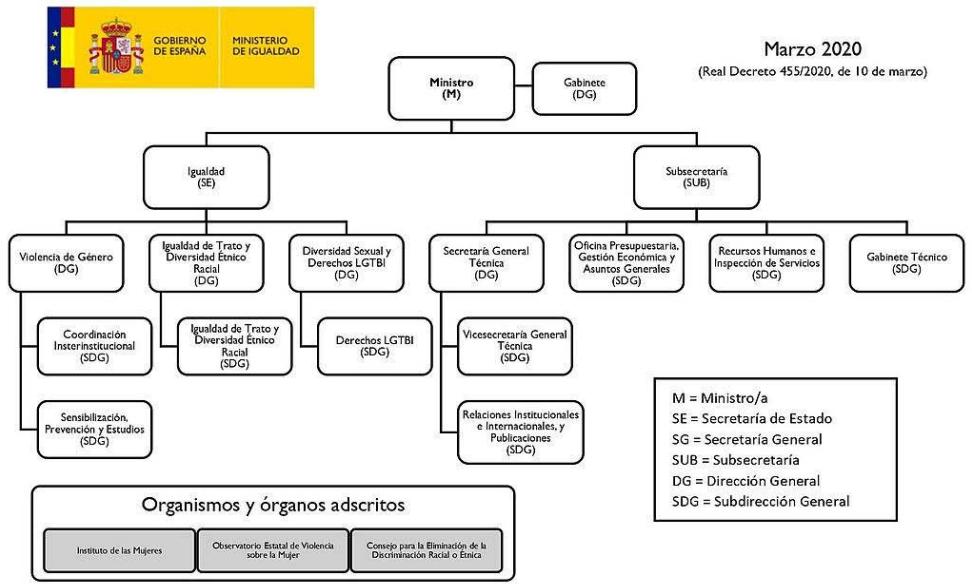 Figure 2: Organization chart of the Spanish Ministry of Equality (March 2020).
Source: Ministry of Equality (2020)27.
The legal analysis, the economic analysis of the law and the public choice opinion are then carried out:
### a) Legality analysis
- Legitimacy: Does not correspond, keeping only appearance. There is no generalized conviction that one is dealing with the law, only mere legality. There is a legal appearance, but in collision with fundamental rights, general principles of law, Natural Law and conscientious objection (Hayek, 1973-79).
- Validity: Does not correspond, neither by competent power, nor by instrument handled, nor by respect for the procedure (Sánchez-Bayón, 2019a; Sánchez-Bayón and Peña-Ramos, 2021). If it is the Government that promotes the initiative, it is a bill, which requires prior institutional reports for its registration in the Congress Board (having been omitted, due to unfavorability, eg Council of State, CGPJ), thus passing to the Commissions (submitting to votes and amendments) and from there to the Senate (with similar procedures and the possibility of veto, reverting to Congress). Finally, to avoid the initial requirements, it was processed as a legislative initiative of the Government's parliamentary group and through urgency to avoid amendments; However, within a month errors had to be corrected and within half a year the substance and procedure had to be modified.
- Efficiency: Not observed, given its temporality (with the need to correct errors within a month, and modify the substance and procedure within half a year, in addition to requiring constant review of sentences and on a case-by-case basis by the judiciary –vid.figure 3). Its so-called perverse effects could not have been avoided with a mere transitional provision, since art would have been violated. 2 of the Penal Code of Spain of 1995-CP and art. 9, 17 and 25 of the Spanish Constitution of 1978-CE. Added to the above is the risk of rectification via unconstitutionality and amparo appeals or unconstitutionality issues before the Constitutional Court, due to possible violation of arts. 14, 17, 24 and 25 CE (regarding legal equality, legal certainty, presumption of innocence, police and judicial guarantees, etc.). To complete the question, we refer to the economic analysis of law (especially with regard to perverse incentives and institutional quality, such as the relativistic incentive), and to the opinion of public choice (with regard to the costs of consensus, especially to hidden costs and winner-loser ratio).
<table><tr><td>Órgano</td><td>Reducciones condena*</td><td>Excarcelaciones*</td></tr><tr><td>Tribunal Supremo</td><td>20</td><td>No aplica</td></tr><tr><td>Audienda Nacional</td><td>1</td><td>0</td></tr><tr><td>T.S.J.</td><td>118</td><td>5</td></tr><tr><td>Audienda Provincial</td><td>940</td><td>103</td></tr><tr><td>TOTAL</td><td>1.079</td><td>108</td></tr><tr><td colspan="3">*Resoluciones confirmadas a 01-V-2023</td></tr></table>
<table><tr><td>Órgano</td><td>Porcentaje de revisiones que implican reducción de condena*</td></tr><tr><td>Tribunal Supremo</td><td>42,6%</td></tr><tr><td>Audienda Nacional</td><td>14,3%</td></tr><tr><td>T.S.J.</td><td>27,7%</td></tr><tr><td>Audienda Provincial</td><td>30,8%</td></tr><tr><td>TOTAL</td><td>30,9%</td></tr><tr><td colspan="2">*Solo computations aquellos Órganos que han informado del total de revisiones efectuadas</td></tr></table>
Figure 3: Perverse effects of the Law of Yes Means Yes (sentence reductions and releases until May 2023)
### b) Economic analysis of the law
- Incentives: Toughening a penalty does not always imply its deterrence or prevention, but rather when faced with the risk-benefit equation, one ends up opting for a transgression that compensates for the risk assumed. Then, if the crime of sexual abuse is suppressed (relative to those behaviors without violence or threat to sexual autonomy) and everything becomes sexual assault, then any behavior could be, so that a perverse incentive of relativism is produced, according to which, if any sexual relationship that violates personal autonomy can be condemned as aggression, then violence or threats could be acted upon, given the risk of condemnation in this regard (eg "packs" are not discouraged - in relation to the case that gave rise to the law of yes is yes-, but rather they stimulate the same or more perverse behaviors, according to the risk-benefit equation, García-Pablos, 1991 and 2011). The relativistic incentive is intensified with related regulation, such as the trans law, since according to Secretary of State Rodríguez "Pam", if the rape occurs between a cis woman and another trans woman, then there is no rape (because it is intra-gender and missing the male subject - in accordance with the socialist approaches of authorial crime and alternative use of the law). The perverse effects of such a relativistic incentive are aggravated by inmates' requests to change prisons[^29].
Efficiency: Legal efficiency (relative to the improvement of legislative technique and guarantees), requires that, due to the principle of proportionality (among others), if a current crime happens to be subsumed into another, the criminal range must adjust, hence the reduction of sentences and releases. Then, of the 3,900 prisoners for crimes against sexual freedom, as of May 1, 2023 (in six months since the rule came into force), there have already been 1,079 sentence reductions and 108 releases (see previous figure). This represents an impact of 1/3 of prisoners (1 in 3 rapists) have benefited from the approved regulation (the number of which will increase, until $100\%$ is reviewed, in addition to beginning other types of benefits - and hidden costs of the regulation for society- in relation to the trans law, see previous and next section). Then, legal efficiency is failing, not only because revisions are required (shortly after processing) for typographical errors, grammatical errors, etc., but also because of conceptual and legal theory failures (violating basic legal principles),[^28] which has caused greater insecurity (for the reasons given, eg reduction of sentences and releases). Even in forensic practice, distortions of the procedure and its interpretation are occurring (e.g. with the application of the yes law, not only are sentence reductions given, but the interpretation of a continuing crime is also favored, the impossibility of alleging aggravating circumstances, etc.).
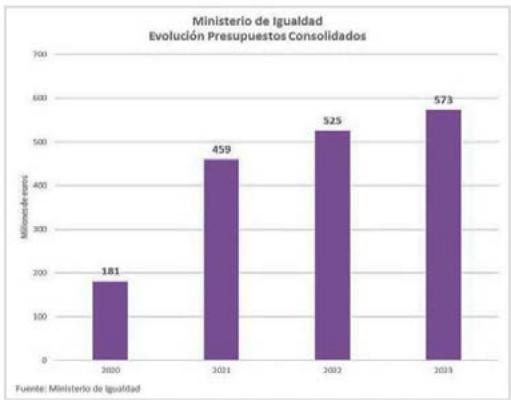
increase); In 2019, when the independence of the Ministry of Equality was restored, its budget became 181 million, counting both direct and indirect victims, while the number of female victims of gender violence decreased (see figures below); and in 2023, the budget was increased by $500\%$, with an amount of 592.1 million euros. Then, with the current institutional architecture and its regulation and public policies, not only real costs increase, but also processing costs, information costs, opportunity costs, etc. (see public election opinion), when paradoxically the number of advisors and members of the Ministry of Equality has increased, along with its budget items.
 Source: La Moncloa-Government of Spain (2023) $^{31}$
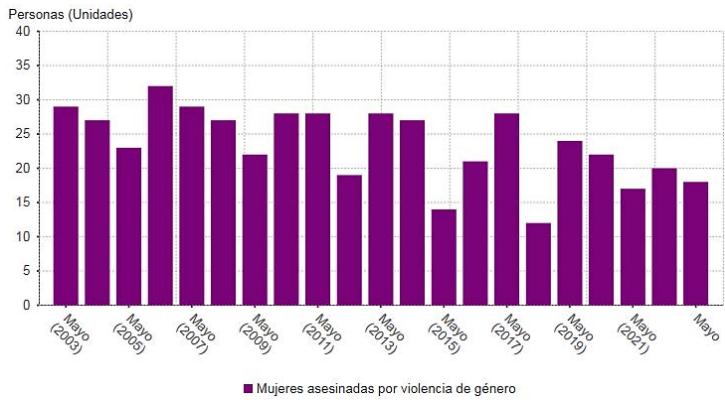 Figure 4: Evolution of the budget of the Ministry of Equality (2020-23) Source: Ministry of Equality and Epdata (2023) $^{32}$. Figure 5: Trend of death of women due to gender violence (2003-21).
#### Victimas y personas denounced en violencia deLEE y violencia domestica segun sexo. Serie 2015-2019
Valores absolutos y tasas de variación (%)
<table><tr><td>Violencia de@genero</td><td>Año 2015</td><td>Año 2016</td><td>Año 2017</td><td>Año 2018</td><td>Año 2019</td><td>Tasa devariación2019/2018</td></tr><tr><td>Victimas (mujeres)</td><td>27.624</td><td>28.281</td><td>29.008</td><td>31.286</td><td>31.911</td><td>2,0</td></tr><tr><td>Personas denunciadas (hombres)</td><td>27.562</td><td>28.201</td><td>28.987</td><td>31.250</td><td>31.805</td><td>1,8</td></tr><tr><td colspan="7">Violenciadomestica</td></tr><tr><td>Victimas</td><td>7.229</td><td>6.863</td><td>6.909</td><td>7.388</td><td>7.654</td><td>3,6</td></tr><tr><td>Hombres</td><td>2.677</td><td>2.574</td><td>2.596</td><td>2.792</td><td>2.906</td><td>4,1</td></tr><tr><td>Mujeres</td><td>4.552</td><td>4.289</td><td>4.313</td><td>4.596</td><td>4.748</td><td>3,3</td></tr><tr><td>Personas denunciadas</td><td>4.981</td><td>4.643</td><td>4.908</td><td>5.093</td><td>5.395</td><td>5,9</td></tr><tr><td>Hombres</td><td>3.736</td><td>3.342</td><td>3.590</td><td>3.696</td><td>3.885</td><td>5,1</td></tr><tr><td>Mujeres</td><td>1.245</td><td>1.301</td><td>1.318</td><td>1.397</td><td>1.510</td><td>8,1</td></tr><tr><td>Personas denunciadas y victimas ala vez</td><td>259</td><td>187</td><td>217</td><td>221</td><td>192</td><td>-13,1</td></tr><tr><td>Hombres</td><td>151</td><td>119</td><td>146</td><td>134</td><td>106</td><td>-20,9</td></tr><tr><td>Mujeres</td><td>108</td><td>68</td><td>71</td><td>87</td><td>86</td><td>-1,1</td></tr></table>
Figure 6: Statistical data on gender and domestic violence
The previous graphs show that more is not being done with less (there is economic inefficiency – there is even a risk of corruption and waste). It turns out that, at the same time as budgets increase, new beneficiaries are sought (clientele networks, according to neo-institutionalists), allowing the justification of said increase, although the problem remains unresolved (rather it may seem that it increases as social problem, so that the budget is increased for more positions and subsidies – again, according to the suspicion of the neo-institutionalists and their theorem about the never-ending agenda, Anderson, 1986). In this sense, Campbell's law and Luke's criticism seem to be fulfilled in the same way (see section 1).
- Institutional quality: It cannot be argued that this is the first regulation that addresses the autonomy of the will - as has been done in the yes means yes law itself and in its interpretation by the Secretary of State for Equality and the Delegate of the Government for Equality -, since that is the cornerstone of the codification of private law (it is enough to consult traditional manuals - from the Faculties of Jurisprudence, Sánchez-Bayón, 2010a - and their updaters - in the Faculties of Law - such as Prof. Albaladejo, Lasarte, Lacruz, Díez-Picazo). Regarding its application to sexual relations in Spanish Law, the requirement of consent has its roots in Roman Law and Canon Law (as a cause of marital annulment and sexual crime), with an idiosyncratic manifestation, which arises with the ius commune of Castile on the breach of a marriage promise (the reason why a maiden agreed to maintain relations under said promise and if it was breached, a prison sentence was possible; currently, in a good part of the civil law family the matter is maintained matrimonial). Therefore, there is nothing original about the new regulation, except
for the effects of weakening, disaffection and deinstitutionalization (due to veils of confusion such as double-think and neo-speak, or weasel concepts and polylogisms, see note 8), promoting exactly the opposite of what was announced, generating greater legal insecurity and blurring of institutions and their relationships (eg risk of false complaints, as retaliation for breakups, or undue advantage in divorce proceedings, etc.).
c) Public choice opinion: Given the premise of suspicion of politics and politicians (by approaching the matter realistically, without any romanticism), Buchanan's theorems are fulfilled in the case of the gender issue and its agenda. Tullock on the cost of consensus and its effects in the form of a loot-sharing system, dependency and clientelist networks, omnibus or take-all laws, etc. Thus it has been shown that with the yes means yes law (in combination with the trans law), the CP, the Criminal Procedure Law, the Gender Violence Law, etc., have also been expressly modified, and tacitly (and invalid, for not following due procedure), the Civil Procedure Law, CE, etc. Regarding the evaluation of the costs of the consensus for the public service[^34], keep in mind that this is a regulation by minorities for minorities\[^35\]: in 2019, 47 million inhabitants lived in Spain and yet regulations were prepared for less than 50 cases. of deaths of women due to gender violence (judicially declared, only 24), and less than 400 cases of medically diagnosed gender dysphoria. This means regulating for less than $0.00005\%$ of the population (in cases of death of women due to gender violence declared judicially) and $0.0008\%$ (in cases of gender dysphoria diagnosed medically. In statistical terms, it would be considered an "irrelevant and negligible" figure (not for reasons of human dignity, since each life is an incalculable treasure). Perhaps it would have been more convenient (at least in statistical terms), to regulate mortality due to work accidents (721 cases in 2019), in traffic accidents (1,755 cases in 2019), or suicides (3,539 cases in 2019), where the majority of cases are men, so they may be in greater danger than women (but these data would dismantle the social alarm established by the gender discourse.) In any case, all the assumptions raised continue to be minority, since the legislation must be general and for all citizens, not ad hoc or ad hominem (except that it is an alternative use of the right and according to author crimes).
Those most harmed by the proposed gender regulatory package are: a) directly, cis women and children (given the reduction in sentences and release of sexual offenders - which makes sense with the hidden agenda, as noted with Beauvoir); b) indirectly, the citizens, who have endured the growing waste of public funds in a minority cause and managed to exalt the problem and not to resolve it (if the problem ended, so would the positions, the budget allocations, with their subsidies and subsidies, etc.)[^36]; c) society as a whole
- attention has to be paid to them, attention is not being devoted – again – to what is urgent and essential, so it is increasingly worth it and risks appear such as informality, corruption, etc.); d) satisfaction and overexploitation of resources (by having to reach consensus and finance together, you end up consuming what you don't want, but that's how you do it, because others consume and you don't want to lose, eg you don't consume the same in a restaurant where everyone pays their own, which is paid at a low price); e) political inanity (politicians usually lack their own discourse, imposing what they consider to be the majority in political opinion, thus normally adopting the loudest, that is, the most extreme; hence they are not willing to assume the cost of dismantling established discourses and agendas); f) etc.
- 35 2019 from the Ministry of Labor, Social Security and INE are used (URL: Spain in figures 2019 (ine.es); INSST: Analysis of mortality due to work accidents in Spain. 2017-2019 (insst.es); DGT: In 2019, 1,755 people died in traffic accidents (dgt.es); National Statistics Institute (ine.es), etc.).
- 36 Within the Co-Responsible Plan, million-dollar campaigns have been carried out such as "the soft man" (URL: Igualdad. 09/08/2022. 'The soft man' campaign [Communication/Campaigns]); Awareness Campaigns (URL: Awareness campaigns and materials - Government Delegation against Gender Violence (igualdad.gob.es)): "#ThenWho" (URL: #ThenWho - Government Delegation against Gender Violence (equality. gob.es)); "Now that you see us" (URL: Igualdad.
(including humanity), since its well-being is reduced, by not dedicating efforts to specific problems that can be solved (eg in the UN Sustainable Development Goals, zero hunger comes first, more health and education, and then there is the gender issue). Furthermore, in the case of the gender issue, the displacement effect of the Peacok and Wiseman hypothesis (1961 and 1979) is observed: the researchers observed that public spending does not grow linearly, but rather exponentially, taking advantage of periods of crisis or alarm situations; In this sense, it has been confirmed in periods of war or threats such as COVID-19 (Bagus et al, 2021 and 2022), but also with alerts such as climate alerts or femicides due to sexist violence.
## V. CONCLUSIONS
As presented at the beginning, the bullet concepts, the Anglo-Australian economist Colin Clark, despite being one of the fathers of current econometrics, stated that some words have the emotional impact of a bullet, with the power of kill any rational discussion: the question of gender and queer (today hybridized), could well be high-caliber projectiles. Because? Without entering into its ontology and epistemology (based on anti-thesis or contestation against another - ergo inauthentic), it is enough to attend to its opposition to any objective element (by rejecting biological and genetic foundations, among others), and its defense of a constructivist basis and subjective perception (according to the appreciation and feeling of each person at any given moment), this leads to a relativism and indeterminacy that is difficult to manage – of course, fertile ground for ideologization and polarization. Then, in the face of emotional bullets, a bulletproof vest is offered, with a rational construction, such as that coming from neo-institutional approaches and their methodological individualism, plus their reality principle, thus allowing us to detect foundations and intervening agents (without romanticism or constructions). illusory or wishful-thinking), breaking down costs, failures, paradoxes and other unwanted effects (and, however, implicit and expected, given interventionism or inspiring social engineering).
Among the fallacies of gender, increased by state interventionism in this regard and its management failures, the gender paradox stands out. As we have seen, it consists of the fact that the more state intervention in gender matters (now led by *trans feminism*) advances, then the greater the loss of sexual autonomy of cis women (those who are genetically and biologically coincident), with their gender), as well as the greater their political-legal lack of protection and their dependence on state protection. This paradox is being confirmed in the Anglo-Saxon and Nordic world, where it began, but it has also been transplanted to the Mediterranean and Latin American world, with serious damage and high costs, as has been confirmed with the study of the Spanish case (confirming the cobra effect, Campbell's Law or Lucas's Criticism). As a result of the increase in positions and advisors of the Ministry of Equality and its associated budget (going from 43 million euros in 2008 to 5,92.1 million in 2023), to implement its regulatory package (such as the yes is yes law, the trans law, etc.) and their corresponding public policies (eg "the soft man", "the diverse bodies", "#SoWho", "App for registering the distribution of household chores"). As has been seen with the neo-institutional analysis (which starts from the premise of distrust of power, rejecting romanticism in politics and state paternalism, in addition to assuming the realistic vision of the hidden and endless agenda of the agents that make up the State)), it is evident that the gender issue is more a stimulus to the social problem, with perverse incentives such as the exacerbation of rapists, instead of seeking an effective resolution of the problem. According to the Public Election, the politician, together with the pressure group and the established clientele network, lack incentives to solve the reported problem, because then the budget in this regard would not be increased, but rather the continuity of the number of positions and advisors, grants and subsidies, etc. In short, there should be a higher level of public intervention, based on the intensification of alarm due to the rise of the problem (given the increase in indicators, such as that of victims of gender violence - being corrupted according to Campbell's law), this It ends up putting women in a position of greater dependence, at the expense of state action - as has been confirmed.
this case, via intersectionality, the cis woman has gone from trans to trans), when in reality, the hybridization of subjects is used to achieve power, and once the socialist leadership is established, all the others must to form a collective submissive to the coercive centralized planning agenda (as Mises denounced, above all). In this sense, thanks to its heterodox condition, the theoretical and methodological frameworks not only of the neo-institutionalists, but also of the Austrian school of economics, the anarcho-capitalists, the culturalists, etc. are interesting and useful.
As future lines of research, the empirical part will be delved into, studying more comparative cases of implementation of the gender issue in the Mediterranean and Latin American world, so that it can be confirmed or not, whether the paradox can be elevated to a general principle or is only a mere empirical observation.
It ends with a corollary, such as the Nordic paradox. Remember NIKK (Nordic Institute for Research on Gender Issues), and that one of the reasons for its dissolution was its denial of the biological component (exacerbating the gender issue), evident in its reports and, above all, in the document. *Brainwashing* drama. The public debate that followed was about the aforementioned Nordic paradox: in developed and egalitarian societies (such as the Nordic ones), women tend to freely choose studies and professions related to dealing with others and multi-tasking (eg education, health, social work), while men do it on manipulative issues of things (eg natural sciences and engineering, transportation, construction). Only in developing countries do women tend to choose STEM careers, to secure a job later, but not because of personal preference. Therefore it is not a constructivist question of discrimination, but rather a biological one and freedom of choice. In accordance with this Nordic paradox, then, it made more sense to finance public policies aimed at promoting birth rates and conciliation – as has already been pointed out previously.
[^1]: In colonial India, to end the danger of cobras, the British offered a reward for each specimen captured, which led to the lucrative business of breeding these venomous snakes. Upon realizing the unwanted effects, the British withdrew public aid and cobra breeders got rid of them by releasing them, which caused an even greater plague of cobras (Siebert, 2001; González and Sánchez-Bayón, 2021). A similar story is told about Indochina with the rats and French colonial mismanagement (Vann, 2003). _(p.2)_
[^8]: Via type resources: a) weasel concepts (Hayek, 1952a-b): like the vermin, which slurps the egg and leaves the shell, since socialism the name of concepts and institutions is maintained, but they have previously been emptied, to let them mean what they want at any given moment; b) polylogisms (Mises, 1957): socialism tries to make people believe that each group has its own logic and only by belonging to it can it be understood from its perspective – something curious, because the majority of socialist leaders have never come from the proletariat. and if someone criticizes, then the ad hominem attack will be carried out until their social discredit; c) veils of confusion (Sánchez-Bayón, 2015 and 2017): a concept of counter-intelligence from the Cold War is alluded to, to refer to the concealment of the truth through discursive distortions (which requires an exercise of revelations or removal of veils of confusion; among the veils it is worth highlighting: memory and post-truth, Newspeak and double-think, etc.); d) transvaluation (Nietzsche, 1888): investing bad into good and vice versa (as well as private into public – as neo- and post-Keynesians claim); e) integral politicism (Ortega y Gasset, 1929): expanding politics to all social spheres. _(p.5)_
[^12]: In Spain, it was the representative Campoamor who achieved the recognition of full women's suffrage (since since the Dictatorship of Primo de Rivera women could vote in municipal elections and be elected deputies for Cortes, eg Teresa Aspiazu, councilor of Malaga since 1924). Of course, with the very hostile opposition from the left (the PSOE commissioned Victoria Kent and Margarita Nelken to attack Campoamor and its proposal for full female suffrage, believing that it would benefit the right, given the influence of the Church on women); On the other hand, it was with the support of the right that the change was made (Campoamor published in La Tribuna, where she met her mentor, the versatile Carmen de Burgos Segui, from the Generation of '98, who in turn drank from the literary and intellectuals Emilia Pardo Bazán and Concepción Arenal, who already had university training in the 19th century). Another pro-women's rights movement in Spain was that of the teachers (organized from the Society of San Vicente de Paul or via Father Poveda), who found the Free Institution of Education as a brake on their job promotion (as happened to them to Concepción Arenal, who did not go beyond mere collaborator). _(p.6)_
[^16]: The special humanist regime for women is part of a specific adapted treatment, beyond the common rules of the general framework, justified because there are certain people who can be grouped together, who have a greater disposition to vulnerability (due to noncompliance with interpositio legislationis and ultra vires activism. in the form of letters granted): historically they have been discriminated against or have not been able to directly claim their rights (eg women, children, indigenous peoples, the elderly, people with disabilities). The main problem that this special regime presents is the risk of judicial activism, alternative use of the Law, legal uncertainty, administrative interdiction, positive discrimination, etc. _(p.7)_
[^17]: UNWomen: http://www.unwomen.org/ _(p.7)_
[^18]: Remember the Woke hybridization and its hyper-morality of socialist remnants, puritanism and queer pride. _(p.7)_
[^19]: Traditionally, the doctrine has recognized up to four generations of human rights: a) 1st gen. civil and political rights, developed since the liberal bourgeois revolutions of the late 20th century. XVIII; b) 2nd gen. economic and social rights, promoted since the end of the 20th century. XIX, as a result of the demographic transition and the consolidation of the nation-state; c) 3rd gen. cultural and environmental rights, postulated since the 60s; d) 4th gen. technological and bioethical rights, extended since the 70s (in reality, revisiting previous generations from the technological impact); e) 5th gen. ethno-cultural and gender rights, emerged in the 2000s (and intensified since 2010, with UN-Women) and whose legal foundations do not fit with traditional theories of human rights: they are not articulated from the logos, equality juridical and universality, but from pathos, equity and community particularity. _(p.7)_
[^20]: Official State Gazette-BOE: BOE-A-1985-14138 Organic Law 9/1985, of July 5, reforming article 417 bis of the Penal Code. _(p.9)_
[^21]: BOE: BOE-A-2007-6115 Organic Law 3/2007, of March 22, for the effective equality of women and men. _(p.9)_
[^22]: BOE: BOE-A-2023-5364 Organic Law 1/2023, of February 28, which modifies Organic Law 2/2010, of March 3, on sexual and reproductive health and voluntary interruption of pregnancy. _(p.9)_
[^23]: Ángela Rodríguez (Martínez) "Pam", Secretary of Equality, declared on the Cadena Ser program Buenismo Bien (3/8/2022): "We have legislative diarrhea. We don't know how long we are going to be in the Government" (...)"people like me are not in the Government" (...)"being in the Government is an anomaly"(...) Precisely, because we know that we are not going to be For a long time, we have the legislative diarrhea that we have. We are trying to do many things all the time, lest it end tomorrow" (URL: Cadena SER: Listen to Buenismo bien; Inés Arrimadas on Twitter: "-We know that being in the government is an anomaly" - "The people since I am not in the government" - "And that is why we have the legislative diarrhea that we have, lest it end tomorrow" Ángela Rodríguez, Secretary of State for 'Equality'. There is no need to add anything else $\square \square \uparrow$ https://t.co/ avM9dKq3xc" /Twitter). _(p.9)_
[^24]: BOE: BOE-A-2022-14630 Organic Law 10/2022, of September 6, on the comprehensive guarantee of sexual freedom. _(p.9)_
[^29]: Cases that are already beginning to occur in Spanish prisons and are denounced by the Association of Penitentiary Administration Technicians: a) self-declared rapists of trans women demand to be transferred to women's prisons, increasing the risk of rape (as has already happened in Scotland with this type of regulation); b) cis women request to be trans, to enter male modules, where they exchange sex for compensation (then prostitution is favored). _(p.11)_
[^28]: CGPJ: https://www.poderjudicial.es/cgijs/es/Poder-Judicial/Consejo-General-del-Poder-Judicial/En-Portada/Los-tribunales-han-acordado1 _(p.11)_
[^34]: The more consensus is required (especially with the yes means yes law and the trans law, since they affect fundamental rights and therefore have a reserve of organic law, art. _(p.13)_
[^2]: Changes induced from an artificially expansive institutional agenda, via pressure group interests or political programs based on unsolvable but threatening problems (Anderson, 1986). _(p.2)_
[^3]: The great modeler of the state welfare economy and Nobel Prize winner in Economics, Hicks, refused to enter the "black box" that is the State, while the neoinstitutionalists, starting from reasonable doubt (why the same subject participating in the public sector is angelic and good-natured, but when it does so in the private sector it is evil and selfish), and via methodological individualism, it was discovered that within the State the following actors/agents acted with their own agendas: a) bureaucrats (their profit maximization involves increasing the budget and more subordinates); b) politicians (its maximization involves increasing the vote, creating clientelist networks for this); c) lobbies or pressure groups (their maximization involves seeking public rents or making their goods or services public, charged to budgets). _(p.3)_
[^4]: The progressive-liberticidal plan has had the following milestones in the US (to move from citizen normalization, based on freedom and legal equality - as typified by the 14th Amendment of the US Constitution -, to move to exaltation of the community differential fact, demanding compensation for alleged violation, with identity privileges): a) affirmative action or positive discrimination, via protests in favor of minorities in the 60s, which ended the traditional American way of life (it is the age of loss of innocence); b) reserve action or quota policies, to promote minorities during the culture wars and until the 2000s, when it was stopped by Justice O'Connor; c) reverse action or investment policies, to rebalance power relations, preventing the promotion of white heterosexual men (for having benefited from enlightened rationality and its social construction), in addition to promoting political correctness and inclusive language (intensifying since the 1990s, due to federal aid from Adm. Clinton); d) identity politics or identity policies, based on the alternative use of the Law, where it is no longer about freedom and equality, but about equity à la carte (leading to the design of author crimes, hate crimes, memory crimes, etc.). Among the latest liberticidal manifestations of identity politics (exported to the rest of the world), it is worth mentioning movements such as me too, black lives matter, green new deal, etc. (Sánchez-Bayón, 2019b). _(p.4)_
[^5]: Which means turning the private into public (such as sex, family relationships, etc.) and increasing state intervention in all social spheres. _(p.4)_
[^6]: Traditionally, grammatical gender comprised 6 categories: masculine, feminine, neuter, common, epicene and ambiguous. However, due to the influence of the LGTBQ+ movement and trans feminism, the UN has gone from recognizing 5 categories (male, female, homosexual, transsexual and queer) to more than 100 (examples of non-binary: 3rd gender, trigender, pangender, fluid, agender, etc.); Big-Tech, like Meta (Facebook), offer more than 50 options. _(p.4)_
[^7]: The controversy reached its peak with the broadcast on Norwegian public television of the seven-episode docu-drama called Hjernevask (brainwashing). It was the subject of debate in parliament and shortly afterwards it was decided to dissolve the body. _(p.5)_
[^9]: Just as Sartre, his partner, compulsively wrote his *Being and Nothingness* (1943) and *Existentialism* is a *Humanism* (1946), Beauvoir (1963) recognizes the influence (with details of conversations - although both in reality badly copy Erasmus, who in turn based himself on Tertullian's Apologetics: fiunt, non nascuntur christiani), also imitating the free and careless essay style (regarding incorrect citations, the order of the text, the relationship between arguments and their verisimilitude and coherence): the dialectical relationship of employer-worker oppression (that is, the Hegelian master-slave relationship that Marx and Engels appropriated), Beauvoir extended it to man-woman relationships (one-the-other), comparing them with the relationship between Nazi and white slaveholder (the man) vs. Jew and black slave (woman). In his argument he confuses times and contexts, abounding in anachronisms and transvaluations. There is a key contradiction in defining women from the biological component of being with a uterus, while at the same time affirming that a woman is not born, but rather made (due to the cultural construction of assignment of given roles: daughter, wife, mother, etc. -all of them rejected, due to their own lesbian, pedophile, etc. agenda, see below). _(p.5)_
[^10]: Criticism or deconstruction (Derrida, 1967; Rorty, 2003); even resignification (Halperin, 1995). _(p.5)_
[^11]: Remember that, in the secular Western (Greco-Roman) tradition, hubris was the punishment of confusion and madness that the Olympian divinities applied to humans who claimed to be like them. It also occurred in the sacred or Judeo-Christian tradition (eg Tower of Babel). Currently, hybridization consists of remnants of socialism (from any of its Internationals), puritanism and queer vision, plus climate alarm and racial issues, which defines the current Woke or awake ideology - due to supposed awareness - (they classify themselves as social justice warriors - although given their vital attitude, they are described as the offended ones of the crystal generation, seeming to coincide more with the satisfied young man of Ortega y Gasset, 1929). _(p.5)_
[^13]: and 2012). _(p.6)_
[^25]: BOE: BOE-A-2023-5364 Organic Law 1/2023, of February 28, which modifies Organic Law 2/2010, of March 3, on sexual and reproductive health and voluntary interruption of pregnancy. _(p.9)_
[^26]: BOE: BOE-A-2023-5366 Law 4/2023, of February 28, for the real and effective equality of trans people and for the guarantee of the rights of LGTBI people. _(p.9)_
[^30]: Given the tendency towards an alternative use of the law and the promotion of author crimes (eg if you are a man, you are predisposed to sexual assault), with the aforementioned regulation (eg gender violence law, yes means yes law, trans law), increases the risk of violation of equality and legal security, the presumption of innocence, objectivity and burden of proof, etc. Other universal principles violated are agere licere et ultra vires, horror vacui, etc. _(p.11)_
[^31]: La Moncloa-Government of Spain: La Moncloa. 10/07/2022. The Equality budget for 2023 increases by $9\%$, reaching the historic figure of 573 million [Press/News/Equality] This is a downward revision of the true budgets, since freely available funds are not computed (see. note 27) – which negatively affects transparency and accountability, institutional trust, etc. _(p.12)_
[^32]: Epdata: Gender violence - data and statistics (epdata.es) _(p.12)_
[^33]: INE: Domestic Violence and Gender Violence Statistics (EVDVG). (ine.es); The aforementioned Campbell's law and Lucas's criticism seem to be fulfilled here, as well as the suspicion of the endless agenda, etc. _(p.13)_
[^81]: CE), the greater the costs (the more will have to be given and the less will satisfy the result). Among the costs to consider: a) opportunity cost (funds are dedicated to what is prioritized on the agenda, for ideological or fashionable reasons, taking them away from what is urgent and essential); b) hidden costs (undesired effects, such as perverse incentives that affect institutional quality and trust in the system); c) cost of information (as more requirements are demanded and _(p.13)_
Generating HTML Viewer...
References
104 Cites in Article
M Anderson (1986). The Unfinished Agenda: Essays on the Political Economy of Government Policy in Honor of Arthur Seldon.
Philipp Bagus,José Peña-Ramos,Antonio Sánchez-Bayón (2021). COVID-19 and the Political Economy of Mass Hysteria.
Philipp Bagus,José Peña‐ramos,Antonio Sánchez‐bayón (2022). Capitalism, <scp>COVID</scp>‐19 and lockdowns.
S Beauvoir (1949). Le deuxième sexe.
Benon Zbigniew Szałek (2013). Some Praxiological Reflections on the So-Called ‘Overton Window of Political Possibilities’,‘Framing’ and Related Problems.
P Boettke,S Haeffele-Balch,Storr (2016). Mainline Economics.
P Boghossian (2006). Fear of Knowledge: Against Relativism and Constructivism.
M Bonnet (2015). Simone de Beauvoir et les femmes aujourd’hui.
G Brennan,J Buchanan (1985). Constitutional Political Economy.
J Buchanan (1987). Constitutional Economics.
J Buchanan (1990). The Domain of Constitutional Economics.
J Buchanan,G Tullock (1962). The Calculus of Consent: Logical Foundations of Constitutional Democracy.
J Butler (1990). Gender trouble: feminism and the subversion of identity.
J Butler (2004). Undoing gender.
J Butler (2009). Frames of War: When is Life Grievable? (review).
J Butler,E Laclau,S Zizek (2000). Contingency, hegemony, universality: contemporary dialogues on the Left.
J Butler,Z Gambetti (2016). Vulnerability in Resistance.
Donald Campbell (1976). Assessing the Impact of Planned Social Change*.
B Clavero (1992). Historical institution of law.
B Clavero (2002). Indigenous history and law.
R Coase (1937). The Nature of the Firm.
R Coase (1960). The problem of social cost.
De Lauretis,T (1994). Book Reviews : Exploring the Excess: the Desiring Phantasy of a Female Body.
De Lauretis,T (1996). Sui generis: scritti di teoria femminista (preface by Giovanna Grignaffini).
J Derrida (1967). On grammatologie.
F Fukuyama (2018). Identity: Contemporary Identity Politics and the Struggle for Recognition.
E Fullbrook,Morgan (2021). Post-Neoliberal Economics.
A García-Pablos (1991). Crime prevention in a social and democratic state of law.
A García-Pablos (2011). Crime prevention and the main centers of interest of modern criminology.
E González,A Sánchez-Bayón (2021). Rescue and transformation of the Spanish tourism sector via European funds Nex Gen EU.
M Halperin (1995). Saint Foucault: Towards a Gay Hagiography.
F Hayek (1952). The sensory order.
F Hayek (1952). The counter-revolution of science: Studies on the Abuse of Reason.
F Hayek (1973). Law, Legislation, and Liberty.
J Huerta De Soto (2000). Austrian School.
Jesús Huerta De Soto (2009). The Theory of Dynamic Efficiency.
Jesús Huerta De Soto,Antonio Sánchez-Bayón,Philipp Bagus (2021). Principles of Monetary & Financial Sustainability and Wellbeing in a Post-COVID-19 World: The Crisis and Its Management.
S Huntington (1993). The clash of civilizations?.
S Huntington (1996). The Clash of Civilizations and the Remaking of World Order.
R Johnson,M Zubiaurre (2012). Anthology of Spanish feminist thought.
Christian Joppke (2020). Multiculturalism.
D Kahneman (2011). Thinking, fast and slow.
D Kahneman,P Slovic,A Tversky (1982). Judgment Under Uncertainty: Heuristics and Biases.
S Keen (2021). The New Economics. A Manifesto.
Max Koch,Hubert Buch-Hansen (2019). Open Access: In search of a political economy of the postgrowth era.
W Kymlicka,S Donaldson (2014). Animal rights, multiculturalism, and the Left.
E Laclau,C Mouffe (1987). Towards a radicalization of democracy.
A Laje (2022). The cultural battle.
B Lamblin (1993). Mémoires d'une jeune fille dérangée.
Bianca Lamblin (1996). A Disgraceful Triangle.
B Lamblin,N Rodgers,M Thompson (2004). Philosophers behaving badly.
T Laurie,A Hickey-Moody (2015). Geophilosophies of Masculinity: remapping gender, aesthetics knowledge.
M Lilla (2017). Once and Future Liberal: After Identity Politics.
A Lindbeck (1971). A. Lindbeck. The Political Economy of the New Left. An Outsider's View. New York, Harper & Row, Publishers, Inc., 1971, XXI p. 102 p..
S López (2008). The queer labyrinth.
Robert Lucas (1976). Econometric policy evaluation: A critique.
C Mackinnon (1989). Towards a feminist theory of State.
C Mackinnon (1993). Only Words.
C Mackinnon (2017). Butterfly Politics.
M Mellor (1992). Breaking the Boundaries: Towards a Feminist Green Socialism.
M Mellor (1997). Feminism and Ecology.
C Menger (1883). Untersuchungen uber die Methode der Socialwissenschaften und der Politischen Oekonomie Insbesondere.
D Mermelstein (1970). Economics: mainstream readings and radical critiques.
M Millet (1970). Sexual Politics.
L Mises (1949). Human Action: A Treatise on Economics.
F Nietzsche (1888). Ecce homo.
J Ortega Y Gasset (1929). The rebellion of the masses.
A Peacock,J Wiseman (1961). The growth of public expenditure in the United Kingdom.
Alan Peacock,Jack Wiseman (1979). Approaches To the Analysis of Government Expenditure Growth.
M Peláez,A Sánchez-Bayón (2012). Dictionary of European and American Canonists and Ecclesiasticalists.
R Posner (1973). Economic Analysis of Law.
Richard Posner (1979). Utilitarianism, Economics, and Legal Theory.
S Romano (1918). L'ordinamento giuridico.
Richard Rorty (2003). Feminism, Ideology, and Deconstruction: A Pragmatist View.
Benon Zbigniew Szałek (2006). Some Praxiological Reflections on the So-Called ‘Overton Window of Political Possibilities’,‘Framing’ and Related Problems.
R Sánchez (1995). Study on freedoms.
A Sánchez-Bayón (2010). Studies of political-legal culture.
A Sánchez-Bayón (2010). Legal transplants of globalization: the relationships between human rights and confessional ordinances.
A Sánchez-Bayón (2010). Au revoir, loi de l'État: the end of state welfare law.
A Sánchez-Bayón (2012). Comparative and Global Law System.
A Sánchez-Bayón (2014). Fundamentos de derecho comparado y global: ¿Cabe un orden común en la globalización?.
A Sánchez-Bayón (2015). University, science and religion in the United States of America.
A Sánchez-Bayón (2017). Conceptual and linguistic revelations of post-globalization.
A Sánchez-Bayón (2019). Democratic culture on trial in post-globalization.
A Sánchez-Bayón (2019). Sociology of American identity.
A Sánchez-Bayón (2020). Renewal of economicbusiness thinking after globalization.
A Sánchez-Bayón (2020). An epistemological history of studies in legal and economic sciences.
A Sánchez-Bayón (2020). Two or three waves of welfare state transformation?.
A Sánchez-Bayón (2021). Urgencia de una filosofía económica para la transición digital.
A Sánchez-Bayon (2022). Economic crisis or economy in crisis? Orthodoxy-heterodoxy relationships in the digital transition.
A Sánchez-Bayón (2022). From Neoclassical synthesis to Heterodox synthesis in the digital economy.
A Sánchez-Bayón (2022). The Spanish economic school. Contribution of the Salamanca school to Political Economy and Public Finance.
A Sánchez-Bayón,M Pazos (2013). Theory and praxis of human rights. Guide for its enforceability.
A Sánchez-Bayón,G Campos,C Fuente (2017). Decline of the state and its institutional and protocol relations? Porto: Synderesis.
A Sánchez-Bayón,J Peña-Ramos (2021). Public institutions under debate.
J Sartre (1947). Situations.
Seymour-Jones C (2009). A dangerous liaison: a revelatory new biography of Simone de Beauvoir and Jean-Paul Sartre.
H Siebert (2001). Der Kobra-Effekt. Wie man Irrwege der Wirtschaftspolitik vermeidet.
D Soh (2020). The end of gender: debunking the myths about sex and identity in our society.
R Thaler,C Sunstein (2009). Nudge: improving decisions about health, wealth and happiness.
R Thaler (2015). Misbehaving: the making of behavioral economics.
D ; M Quinn (1991). Of Rats, Rice, and Race: The Great Hanoi Rat Massacre, an Episode in French Colonial History.
Eugene Volokh (2003). The Mechanisms of the Slippery Slope.
Explore published articles in an immersive Augmented Reality environment. Our platform converts research papers into interactive 3D books, allowing readers to view and interact with content using AR and VR compatible devices.
Your published article is automatically converted into a realistic 3D book. Flip through pages and read research papers in a more engaging and interactive format.
This is a critical review on gender issue and its policies, to understand and to evaluate the impact of the gender state interventionism, with its costs, failures, paradoxes and other unwanted effects. This review uses the theoretical and methodological frameworks from neoinstitutional approach (Law & Economics, Public Choice, Constitutional Economic, etc.), to build bridges between Economy, Law and Politics, without confusion among the social spheres and under the principle of reality, which rejects economic thaumaturgy, political romanticism and state paternalism. There is a historical-comparative review on the development of coercive implementation based on gender perspective and its agenda, from a macro-view to a micro level, focusing the attention on the Spanish case. There is a final statement of its results, to clarify what kind of incentives have been given the gender bills and policies, the level of efficiency and institutional quality to solve social problems, the risks of an endless agenda and other unwanted effects, but foreseeable according to the principle of reality.
Our website is actively being updated, and changes may occur frequently. Please clear your browser cache if needed. For feedback or error reporting, please email [email protected]
Thank you for connecting with us. We will respond to you shortly.