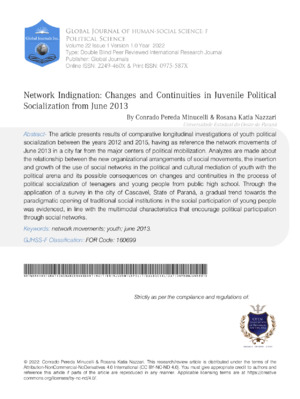
Network Indignation: Changes and Continuities in Juvenile Political Socialization From June 2013

α
Conrado Pereda Minucelli
σ
Rosana Katia Nazzari

Send Message

To: Author

Network Indignation: Changes and Continuities in Juvenile Political Socialization  From June 2013

Article Fingerprint

ReserarchID

5A5QY

Network Indignation: Changes and Continuities in Juvenile Political Socialization  From June 2013 Banner

AI TAKEAWAY

Connecting with the Eternal Ground
  • English
  • Afrikaans
  • Albanian
  • Amharic
  • Arabic
  • Armenian
  • Azerbaijani
  • Basque
  • Belarusian
  • Bengali
  • Bosnian
  • Bulgarian
  • Catalan
  • Cebuano
  • Chichewa
  • Chinese (Simplified)
  • Chinese (Traditional)
  • Corsican
  • Croatian
  • Czech
  • Danish
  • Dutch
  • Esperanto
  • Estonian
  • Filipino
  • Finnish
  • French
  • Frisian
  • Galician
  • Georgian
  • German
  • Greek
  • Gujarati
  • Haitian Creole
  • Hausa
  • Hawaiian
  • Hebrew
  • Hindi
  • Hmong
  • Hungarian
  • Icelandic
  • Igbo
  • Indonesian
  • Irish
  • Italian
  • Japanese
  • Javanese
  • Kannada
  • Kazakh
  • Khmer
  • Korean
  • Kurdish (Kurmanji)
  • Kyrgyz
  • Lao
  • Latin
  • Latvian
  • Lithuanian
  • Luxembourgish
  • Macedonian
  • Malagasy
  • Malay
  • Malayalam
  • Maltese
  • Maori
  • Marathi
  • Mongolian
  • Myanmar (Burmese)
  • Nepali
  • Norwegian
  • Pashto
  • Persian
  • Polish
  • Portuguese
  • Punjabi
  • Romanian
  • Russian
  • Samoan
  • Scots Gaelic
  • Serbian
  • Sesotho
  • Shona
  • Sindhi
  • Sinhala
  • Slovak
  • Slovenian
  • Somali
  • Spanish
  • Sundanese
  • Swahili
  • Swedish
  • Tajik
  • Tamil
  • Telugu
  • Thai
  • Turkish
  • Ukrainian
  • Urdu
  • Uzbek
  • Vietnamese
  • Welsh
  • Xhosa
  • Yiddish
  • Yoruba
  • Zulu

Abstract

The article presents results of comparative longitudinal investigations of youth political socialization between the years 2012 and 2015, having as reference the network movements of June 2013 in a city far from the major centers of political mobilization. Analyzes are made about the relationship between the new organizational arrangements of social movements, the insertion and growth of the use of social networks in the political and cultural mediation of youth with the political arena and its possible consequences on changes and continuities in the process of political socialization of teenagers and young people from public high school. Through the application of a survey in the city of Cascavel, State of Paraná, a gradual trend towards the paradigmatic opening of traditional social institutions in the social participation of young people was evidenced, in line with the multimodal characteristics that encourage political participation through social networks.

References

21 Cites in Article
  1. Referências Bibliográficas (null). REFERÊNCIAS BIBLIOGRÁFICAS.
  2. Gabriel Almond,Sidney Verba (1965). The Civic Culture.
  3. Powell ___________,G Jr (1972). Uma teoria de política comparada.
  4. M Baquero,I Keil (2004). Democracia, juventude e capital social no Brasil.
  5. P Barbetta (2002). Estatística aplicada às Ciências Sociais.
  6. M Castells (2013). Redes de indignação e esperança: movimentos sociais na era da internet.
  7. (1999). A sociedade em rede.
  8. Latinobarómetro (2014). Banco de dados do Latinobarômetro.
  9. P Lévy,Cibercultura (1999). Unknown Title.
  10. C Minucelli,Participação (2015). cultura e socialização política juvenil em Cascavel/PR: um estudo a partir dos movimentos em rede.
  11. B Misztal (1998). Trust in modern societies: the search for the bases of social order.
  12. J Moisés (2010). Democracia e Confiança -Por que os Cidadãos Desconfiam das Instituições Públicas?.
  13. R Nazzari (2006). Juventude brasileira: capital social, cultura e socialização política.
  14. Vanderlei Verdolin (2006). Família e escola: os desafios da comunicação nas relações do cotidiano.
  15. N Postman (1999). O desaparecimento da infância.
  16. R Putnam (2006). Comunidade e Democracia: a experiência da Itália moderna.
  17. G Sartori (1994). Comparación y método comparativo.
  18. Ilse Scherer-Warren (2014). Dos movimentos sociais às manifestações de rua: o ativismo brasileiro no século XXI.
  19. Eduardo Veras,Diego Hasse (2000). Salta d’água: pesquisa, crítica política e distintas temporalidades em exposição.
  20. Luciana Tatagiba (1984). 1984, 1992 e 2013. Sobre ciclos de protestos e democracia no Brasil.
  21. T Thomazini,Câmara Programa,Jovem (2012). limites e possibilidades de um processo de socialização política. Dissertação. Programa de Pós-Graduação Stricto Sensu em Ciências Sociais.

Funding

No external funding was declared for this work.

Conflict of Interest

The authors declare no conflict of interest.

Ethical Approval

No ethics committee approval was required for this article type.

Data Availability

Not applicable for this article.

How to Cite This Article

Conrado Pereda Minucelli. 2026. \u201cNetwork Indignation: Changes and Continuities in Juvenile Political Socialization From June 2013\u201d. Global Journal of Human-Social Science - F: Political Science GJHSS-F Volume 22 (GJHSS Volume 22 Issue F1): .

Download Citation

Analyzing political socialization and network impacts on juvenile political participation and activism.
Issue Cover
GJHSS Volume 22 Issue F1
Pg. 23- 34
Journal Specifications

Crossref Journal DOI 10.17406/GJHSS

Print ISSN 0975-587X

e-ISSN 2249-460X

Keywords
Classification
GJHSS-F Classification: FOR Code: 160699
Version of record

v1.2

Issue date

February 2, 2022

Language
pt
Experiance in AR

Explore published articles in an immersive Augmented Reality environment. Our platform converts research papers into interactive 3D books, allowing readers to view and interact with content using AR and VR compatible devices.

Read in 3D

Your published article is automatically converted into a realistic 3D book. Flip through pages and read research papers in a more engaging and interactive format.

Article Matrices
Total Views: 1965
Total Downloads: 61
2026 Trends
Related Research

Published Article

The article presents results of comparative longitudinal investigations of youth political socialization between the years 2012 and 2015, having as reference the network movements of June 2013 in a city far from the major centers of political mobilization. Analyzes are made about the relationship between the new organizational arrangements of social movements, the insertion and growth of the use of social networks in the political and cultural mediation of youth with the political arena and its possible consequences on changes and continuities in the process of political socialization of teenagers and young people from public high school. Through the application of a survey in the city of Cascavel, State of Paraná, a gradual trend towards the paradigmatic opening of traditional social institutions in the social participation of young people was evidenced, in line with the multimodal characteristics that encourage political participation through social networks.

Our website is actively being updated, and changes may occur frequently. Please clear your browser cache if needed. For feedback or error reporting, please email [email protected]

Request Access

Please fill out the form below to request access to this research paper. Your request will be reviewed by the editorial or author team.
X

Quote and Order Details

Contact Person

Invoice Address

Notes or Comments

This is the heading

Lorem ipsum dolor sit amet, consectetur adipiscing elit. Ut elit tellus, luctus nec ullamcorper mattis, pulvinar dapibus leo.

High-quality academic research articles on global topics and journals.

Network Indignation: Changes and Continuities in Juvenile Political Socialization From June 2013

Conrado Pereda Minucelli
Rosana Katia Nazzari

Research Journals