Employee innovative work behaviour is a key factor in an organization’s survival and competitiveness in the global economy. However, only a few studies examined the impact of antecedents of employee innovative work behavior. Hence, aims to investigate the impact of idiosyncratic deals on employee innovative behavior and the perceived coworker distributive justice’s role in this relationship. The conceptual model was empirically tested by collecting data from 113 insurance agents in the Gampaha district in Sri Lanka. The Partial Least Squares technique (PLS), a third-generation structural equation modeling technique (SEM), was used to analyze data in this study. The study’s findings revealed a significant impact of idiosyncratic deals on employee innovative work behavior. Perceived coworker distributive justice significantly moderates the impact of idiosyncratic deals on employee innovative work behavior. Hence, this study broadened the theoretical understanding of i-deals, innovative work behaviour, and coworkers’ reactions to the organizations.
## I. INTRODUCTION
Researchers generally agree that creativity and innovation are based on ideas, which are then developed, supported, and implemented by people (Khaola & Musiwa, 2021). Recently many scholars highly focused on employee innovative working behavior (IWB) and its antecedents as its increasing organizational competitiveness and survival (Yuan & Woodman, 2010) as it is considered as a key for an organization to survive in the highly volatile market (Bos-Nehles & Veenendaal, 2017).
Many researchers have posited that creativity and innovation are two different concepts (Pieterse, Van Knippenberg, Schippers, & Stam, 2009; Woods, Mustafa, Anderson, & Sayer, 2018). The IWB of an employee is the ability to promote and seek new ideas and attempt to build support for the implementation of these ideas (Singh & Sarkar, 2012). Hence, the IWB of employees is essential for the success of an organization because the organization cannot be innovative without its employees, and innovative behavior is essential for the organization's success in a fast-changing business environment (Abstein & Spieth, 2014).
Even though innovation and innovative working behavior of employees are very important for a particular organization or the whole country, there is a question of whether we pay considerable attention to the employees' innovative working behavior or the country's innovation rate. According to the Global Innovation Index (2022), Sri Lanka is in the 85th position. Even though the country has risen 10 places from 95th last year (2021) to 95th this year and from 101st the year before (2020), this is not where Sri Lanka should be, and our country is underperforming. Moreover, Patents by origin were 353.0 in 2020, down 1 percentage point from the previous year and equivalent to an indicator rank of 60, and in 2021, the global brand value was equal to 1.0 billion USD, a 22 percentage point decrease from the previous year, and corresponded to an indicator rank of 56 (Global Innovation Index, 2022). Further according to the latest Global Competitiveness Report, Germany has attained the status of the world's most innovative economy. US and Switzerland were ranked second and third, respectively. Sri Lanka is ranked 85th (WEF, 2019). Both innovation inputs and outputs were measured by the index. Government fiscal policy, educational policy, and innovation participants were among the innovation inputs. Patents, technology transfers, other R & D rates, and various performances were among the outputs. According to the report, Sri Lanka is falling behind its neighboring countries such as India, Indonesia, and Thailand (WEF, 2019).
Another issue is that $75\%$ of the research was qualitative and conclusive, and they were not focused on determining the current state of employee innovative behavior (Ariyarathna, 2018). In the Sri Lankan context, no research addressing employee innovative behavior in insurance companies has been published. The theoretical justification for the causal relationship between I-deals and IWB is hardly ever provided in the body of existing literature. As a result, a thorough investigation of this research topic is required. On the other hand, most companies, including insurance companies, are evolving rapidly, and those organizations need to identify strategies that can enhance innovation.
According to Blau (1964), social exchange theory explains that "anyone who renders rewarding services to another is obligated to discharge this obligation; the second must furnish benefits to the first in turn" (p. 89). The core of social exchange theory is the idea of "reciprocity." Exchanging concepts or items under mutually agreeable terms is referred to as "reciprocity." The recipient of a valuable thing from the other party in this relationship feels obligated to return the favor by giving another valuable thing. Moreover, researchers use distributive justice theory to understand the coworker's reaction, which suggests that people judge the fairness of allocation outcomes depending on the type of resources involved (Bal & Rousseau, 2016). Distributive justice theory argues that organizations must strive toward the equitable or fair distribution of resources.
Balu (1964) stated that I-deals are important for social exchange relationships and reciprocations between employers and employees, and Bal and Rousseau (2016) stated that it is important to study coworkers' reactions to i-deals. Hence, in this study, researchers try to identify the impact of i-deals on IWB and the role of coworkers' support on i-deals and IWB.
Even though most publications have focused on the antecedents of IWB (Luu, 2021; Venketsamy & Lew, 2022; Saether, 2019; Namono et al., 2021; Mubarak et al., 2021; Zuberi & Khattak, 2021), little empirical evidence has been collected about the effects of i-deals on employee innovative work behavior. Except for the study done by Spieglare, Guy, and Geert (2014), which examined the employment relationship which constructs close to i-deals and innovative work behavior, and the study done by Kimwolo (2018), no other known studies available in the current literature. Further current literature on I-deals also focused on i-deals (Hornung, Rousseau & Glaser, 2009; Rousseau, Hornung & Kim, 2009) and employee perception of i-deals by asking employees the type of i-deals they have negotiated with their employer. Moreover, Coworkers are an important group of stakeholders in workplace accommodation situations, especially when accommodations can influence everyone's rewards (Colella, 2001). Even though it has been mentioned coworkers play an important role in i-deals (Rousseau, 2005), there is little research on how coworkers react to them (Lai, Rousseau, & Chang, 2009). More importantly, no study has been conducted on the Insurance sector in Sri Lanka to examine the influence of I-deals on IWB moderated by co-worker distributive justice. Hence, this research aims to identify the impact of i-deals on IWB and the role of coworkers' support on i-deals and IWB.
At the outset of the paper, the researchers introduce the study under section one. Then focused on the literature review in section two. Section three is mainly concerned with hypotheses and conceptual framework. Section four focuses on research methodology. Findings, discussion, and conclusion give in section four. Then, the paper presents the theoretical and practical contribution and finally presents the limitation and direction for future researchers.
## II. STATEMENT OF THE PROBLEM
The question is whether employers or the necessary authorities give more attention to the employees' innovative working behavior or the country's innovation rate, even though innovation and innovative working behavior of employees are very important for a specific organization or the entire country. Sri Lanka is ranked 85th on the Global Innovation Index for 2022. Despite moving up 10 spots from 95th place last year (2021) to 95th place this year and from 101st place the year before (2020), Sri Lanka is still performing below expectations at this level. The most recent Global Competitiveness Report indicates that Germany has become the most innovative economy in the world. Switzerland and the United States came in second and third, respectively. Sri Lanka is positioned 85th (WEF, 2019).
Further, the insurance industry in Sri Lanka is a significant economic contributor as it collected Rs. 209 billion in premiums in 2020, and Rs. 796 billion in assets listed on their balance sheets, and, more importantly, the fundamental social and economic function it serves by assuming the risk of individuals and businesses. Even though insurance penetration increased slightly from the $1.31\%$ recorded in 2019 to $1.41\%$ in 2020, insurance penetration is still low compared to other Asian countries (KPMG, 2021).
Further, little empirical data is available regarding how i-deals affect employees' innovative work behavior. There are currently no other known studies in the literature except those by Spieglare, Guy, and Geert (2014) and Kimwolo (2018), which looked at employment relationships and innovative work behavior. Most publications (Hornung, Rousseau & Glaser, 2009; Rousseau, Hornung & Kim, 2009) have concentrated on the causes and effects of i-deals and employee perception of i-deals.
Moreover, most of the existing research was qualitative and did not aim to assess the state of employee innovation behavior (Ariyarathna, 2018). Nevertheless, as per the best understanding of the researchers no research study has been done to analyze the impact of i-deals on the IWB of the employees moderated by the co-workers' distributive justice in the insurance sector in Sri Lanka. On the other hand, most businesses, including insurance companies, are evolving quickly, and those businesses need to find ways to foster innovation.
Hence, the problem addressed through this study was "whether there is an impact of I-deals on employee IWB and how the Perceived Coworkers' Distributive Justice impacts the relationship between I- deals and IWB."
## III. RESEARCH QUESTIONS
1. Is there any impact of I-deals on employee IWB?
2. How does the Perceived Coworkers' Distributive Justice impact the relationship between I-deals and IWB?
## IV. RESEARCH OBJECTIVES
The general objective of this research study is to identify the impact of I-deals on IWB of the insurance agents in the Gampaha district in Sri Lanka.
a) Specific Objectives
- To examine the moderating effect of Co-worker distributive justice on the impact of I-deals on IWB of the insurance agents in the Gampaha district in Sri Lanka.
## V. LITERATURE REVIEW
### a) Innovative Work Behavior (IWB)
Developing, disseminating, and applying innovative ideas are all components of innovative work behavior, a multistage, interrelated behavioral process (Saether, 2019). Creativity and innovativeness have been identified as important factors for organizational success and performance (Janssen, van de Vliert & West, 2004). Employee IWB is a unique asset that leads the organization to its pinnacle (Sartori, Favretto, & Ceschi, 2013; Wojtczuk Turek & Turek, 2005). Hence, employee IWB is indispensable in daily activities (Herrmann & Felfe, 2013).
Innovative or creative behavior is a research topic that has only received a little scholarly attention (Ali et al., 2019). According to the existing literature, there is an impact on the IWB of employees through several factors such as problem-solving skills, motivation factors, leadership, team relationships (Young, 2012; Janssen, 2004), self-efficacy (Axtell, Holman & Wall, 2006), LMX (Jaussi & Dionne, 2003), climate for innovation (Scott & Bruce, 1994), proactive personality and leader-member exchange (Zuberi & Khattak, 2021), human resource flexibility (Luu, 2021), hope (Namono et al., 2021). Moreover, according to Slåtten, Svensson, and Sværi (2011), organizations should try to promote IWB as organizations want to succeed in the dynamic environment. New ideas and employee ability to take the initiative to generate a competitive advantage via differentiation.
According to de Jong and den Hartog (2010) and Noori, Mazrui and Intan (2017), IWB is employee behavior that leads to increased organizational performance via idea creation and application in producing products, procedures, and processes. Kimwolo (2017) stated that IWB consists of idea generation, promotion, and realization. Idea generation refers to the stage where employees produce new ideas and find friends and assistance surrounding the idea, referred to as idea promoting (Janssen, 2000). Moreover, according to Janssen, idea realization is the development of a prototype that enables individuals and groups to experiment. Further, de Jong and den Hartog (2010) included idea implementation as the final stage of IWB. In idea implementation, employees translate creative ideas into innovative ones. de Jong and den Hartog (2010) argued that the IWB construct is theoretically multi-dimensional and developed a four-factor IWB scale with dimensions: idea exploration, idea generation, idea championing, and implementation of ideas.
Idea exploration includes thinking of new or different ways to look at existing products, services, or processes (Basadur, 2004). Ideas may be generated for new goods, services, or procedures, for entering new markets, for enhancing current work procedures, or, more generally, for finding solutions to problems that have been identified, and this is referred to as idea generation. Idea championship focuses on individuals in informal roles who help realize innovative ideas and push creative concepts beyond organizational barriers (de Jong & den Hartog, 2010). Further idea implementation includes making innovation a part of the day today work processes and modifying them regularly (de Jong & den Hartog, 2010).
### b) Idiosyncratic Deals (I-Deals)
## i. Ideals Refer to
"Voluntary, personalized agreements of a non-standardized nature, negotiated between an individual employee and their employers regarding terms that benefit each party."
(Rousseau et al., 2006, p. 978)
According to Rousseau (2006), i-deals are special employment conditions that employees are bargained for, such as customized duties and individual career opportunities. I-deals are individually negotiated arrangements unique to one employee called an "i-dealer". Rosen et al. (2013) posited that i-deals include special training opportunities and tailored compensation packages. I-deals consist of development, work flexibility (arrangements relevant to working hours), task and work responsibility, arrangements relevant to education, task, and promotions, and financial incentives, which consist of arrangements relevant to salary and promotions (Liao et al., 2014). Intrinsically motivating i-deals consist of tasks, responsibilities, and flexibility that strongly relate to attitudinal and behavioral outcomes (Rosen et al., 2013). Hence, they are emotionally attached to the organization (Liao et al., 2014). I-deals are related to organizational commitment, job satisfaction, and voice behavior (Ng & Feldman, 2010; Liao et al., 2014).
"Ex-ante" and "ex-post" are the two forms of i-deals, and they were formed depending on the time they were arranged. 'Ex-ante' refers to i-deals arranged during the recruitment, and ex-post refers to the i-deals arranged in the ongoing employment relationship (Rousseau, 2006).
I-deals differ from other employment relationships in terms of four features. They are heterogeneous, individually negotiated, mutually beneficial, and vary in scope (Rousseau & Kim, 2006). I-deals are heterogeneous even though employees perform similar organizational activities (Arthur & Rousseau, 2001). Hence, they are individually negotiated, as not all employees' requirements are similar. Further, both parties should enjoy the benefit of having i-deals (Horung et al., 2009), and multiple items in the employment contract may be negotiated; hence, ideals vary in scope (Anand et al., 2010).
Further, i-deals benefit employees and the organization (Hornung et al., 2008; Laulie et al., 2019; Taser et al., 2021). For employees, i-deals fulfill the need for customized work arrangements that may facilitate motivation and productivity, while i-deals assist employers in attracting, retaining, or motivating valuable employees, and it facilitates employees to balance work and non-work to obtain more energy to perform (Ryan & Deci, 2000).
## ii. Task and Work Responsibilities
According to Rosen et al. (2013), task and work responsibilities i-deals refer to employment arrangements negotiated between employee and employer for extra tasks and responsibilities of the job, a task which develops skills, fits the personality, and a position that requires unique abilities brought to the job. This type of i-deals consists of tasks that develop skills that fit with the personality (Rosen et al., 2013); reduce workload i-deals such as shorter workdays and customized work tasks that depend on employee abilities and circumstances (Hornung et al., 2010). These i-deals have exhibited a positive relationship with performance-related attitudes such as affective commitment and job satisfaction (Hornung et al., 2010; Rosen et al., 2013).
## iii. Schedule Flexibility
Flexibility i-deals refer to employee arrangements when employees negotiate their work schedules, an allowance to attend non-work-related duties outside normal leaves, completion of work outside the main office, and flexible work times (Rosen et al., 2013). Moreover, Kimwolo (2018) stated that these i-deals allow employees to complete the work in progress from the outside of the office (at home) and customize work time. Therefore, flexibility in i-deals reduces work-family conflict as the employees can arrange to finish both work-family matters (Hornung et al., 2010).
## iv. Location Flexibility
Location flexibility means an arrangement relating to the location. The ability to combine caring responsibilities is ensured by location flexibility (Oostrom & Pennings, 2015). Location flexibility could indicate a lack of work motivation, which could have a negative impact on performance and employability (Rousseau, 2005). For location flexibility i-deals, such an arrangement indicates the employee's willingness to conduct (part of) work outside the office (such as working from home). Having location flexibility i-deals indicates an employee's willingness to engage in efforts outside of regular working hours and locations, which will be reflected in the employee's willingness to be flexible (Kelliher & Anderson, 2010). This flexibility will be transferred to potential other employers, indicating a willingness to conduct work flexibly, which organizations will value. However, it is surprising that location flexibility received less attention as it assists in work-life balance (Rosen et al., 2013).
## v. Financial Incentives
Financial i-deals consist of financial incentives that meet the employee's needs, compensation arrangements customized for each employee, compensation arrangements tailored for the employee's inherent set of skills, etc. According to Anand et al. (2011), financial i-deals have been associated with employee outcomes such as organizational citizenship behavior. Furthermore, Liao et al. (2014) categorized financial i-deals as things that increase the extrinsic motivation of employees, as they are more economical than social exchange relationships. Previous studies have found that financial i-deals predict employee outcomes positively (Vidyarthi et al., 2014; Spieglare et al., 2014). It was found that financial incentives i-deals were the most significant predictor of innovative work behavior (Kimwolo & Kimosop, 2017).
### c) Coworkers' Perception of Distributive Justice
Distributive justice is the perceived fairness of outcomes received (Adams, 1965). Hence, coworkers' perception of distributive justice means the perception of the coworker on the fairness of outcomes received by their workmates. Distributive justice theory argues that organizations should distribute their resources equitably and fairly. According to Lai et al. (2009), i-deals also create inequalities at work by granting different levels of outcomes to or coworker that he or she does not.
Hence, i-deals consider coworkers as key stakeholders likely to develop judgments on i-deals (Lai et al., 2009; Rousseau, 2005).
According to Adams(1965), equity theory implies that employees have a natural tendency to compare their inputs, such as workload, effort, work hours, and performance, with their work outputs, such as financial and non-financial rewards. Moreover, to ensure that their employer equitably and fairly treats them, employees compare their inputs and outputs with those of their coworkers(Carrell & Ditrich, 1978). Rousseau(2005)stated that an i-deal could show this equity balance in the eye of a coworker as it assists in changing the employee's work inputs and/or outputs.
When employees feel that their employers unfairly treat them, they will take activities to restore equity by justifying the inequity psychologically or cognitively or by attempting to alter their inputs and outputs and/or those of others (Skiba & Rosenberg, 2011). For instance, employees can try to decrease their coworker's output by complaining to management or decrease their input by reducing work effort.
### d) Theoretical Underpinning Theories
One of the most influential conceptual paradigms for comprehending workplace behavior is social exchange theory (SET). The social exchange process starts when an organizational actor or perpetrator, typically a manager or coworker, treats a target person favorably or unfavorably (Eisenberger, Lynch, Aselage, & Rohdieck, 2004). The target, who is frequently a subordinate or coworker, may respond to the initiating action by engaging in similar behavior, whether good or bad (Eisenberger, Cotterell, & Marvel, 1987). According to social exchange theory, when targets take positive initiating actions, they will typically respond in kind by making more positive or fewer negative responses. Hence, based on the social exchange theory, researchers of this study try to identify the impact of I-deals and innovative work behaviour.
The fairness of outcomes, such as pay and promotion, concerns distributive justice (Colquitt et al., 2001). It exists when results are distributed fairly based on the abilities and contributions of employees (Ozen, 2003). Employees gauge the distribution of an outcome's fairness by contrasting their input-output ratio with that of others. Hence, based on the distributive justice theory, researchers are trying to identify the impact of coworkers' perception of distributive justice on the impact of l-deals on employee innovative work behaviour.
## VI. HYPOTHESES AND CONCEPTUAL
### FRAMEWORK
### a) I-deals and Innovative Working Behaviour
IWB is one-way employees contribute to the organization to enhance organizational performance by exploring new ideas, introducing new production methods and delivering services, etc. (Kimwolo, 2018). Employees require motivation to exhibit innovative working behavior, and several ways can use to motivate employees. Extrinsic motivations take the form of development and financial i-deals, and intrinsic motivation may take the form of task and work responsibilities and flexibility i-deals. Task and work responsibilities i-deals positively influence innovative behavior as task and work responsibilities i-deals are intended to develop employees' knowledge, skills, and abilities, leading to creative ideas. Further, task and work responsibilities indicate that the organization recognizes the employee's ability and value (Ho & Kong, 2015). It boosts the employee's confidence in finishing the work and encourages them to put more effort into their work and achieve more innovative results.
Moreover, flexibility i-deals are intended to avoid conflicts in employees' time resources, relieve any role conflicts, arrange their work schedules according to employees' needs, achieve work-family balance, and maximize their work efficiency (Wang et al., 2019). Individuals who devote their energy to resolving work-family conflict may not have time to work and may be unable to put their hearts into creative work (Huang & Chen, 2020). Flexibility i-deals can assist employees in resolving the problem of work-family conflict, relieving the stress of worrying about non-work issues during working hours, transferring limited resources such as time, attention, and energy to the work field, and improving their role performance at work (Kelly et al., 2020) and this creates the atmosphere for innovations.
There is little research on i-deals and innovative work behavior, and these employment arrangements have been studied with other employee outcomes such as organizational citizenship behavior, organizational commitment, etc. According to Spieglare et al. (2014), the relationship between IWB and I-deals has been previously tested in Europe, and customized employment arrangements are visible in those countries. In a few empirical studies on i-deals, researchers have found that employees respond positively when employers offer special arrangements (Horung et al., 2009; Ng & Feldman, 2010; Rosen et al., 2011).
The following hypothesis (H1) is proposed based on the above justification.
H1: There is a significant impact of i-deals on employee innovative working behavior.
### b) Moderating Role of Coworker's Perception of Distributive Justice
According to the theory of equity (Adams, 1965), employees have a natural tendency to participate in social comparison by comparing their labor contributions (for example, workload, effort, hours of work, and performance) with their labor results (for example, financial and non-financial rewards). To assess whether their employer treats them fairly, employees then compare this entry/exit relationship with their benchmark coworkers (Carrell & Ditrich, 1978).
Coworker's side of i-deals has been extensively investigated in both the domain of organizational behavior (Holtz & Harold, 2013) and in business ethics (Shin et al., 2014) by using a distributive justice perspective (Lai et al., 2009). I-deals also create inequalities at work by giving an employee a certain result that their coworkers do not have (Lai et al., 2009). Therefore, agreements of i-deals also involve coworkers as key actors who are likely to develop judgments about the agreement and react accordingly (Lai et al., 2009; Rousseau, 2005).
Furthermore, coworkers' inputs and outputs can be affected when i-deal burdens them with extra work or reduces their chances of achieving desirable results (Greenberg et al., 2004). Consequently, Lai et al. (2009) argued that the more favorable perceptions of fairness could explain why a bond of friendship between the i-dealer and the coworker, as well as a coworker's belief in having the opportunity to obtain a similar agreement in the future, increases the acceptance of an i-deal.
The following hypothesis (H2) is proposed based on the above justification.
H2: Coworkers' perception of distributive justice significantly moderates the impact of idiosyncratic deals on innovative working behavior.
According to the literature review, it was clear that there is an impact of idiosyncratic deals on innovative employee behavior, and coworkers' perception of distributive justice affects the relationship between idiosyncratic deals and employee innovative working behavior. Therefore, the conceptual framework for this study was developed based on the literature (see Figure 3.1).
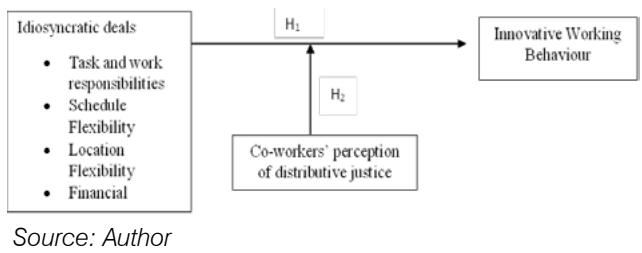 Figure 1: Conceptual Framework
## VII. METHODOLOGY
This study was quantitative research based on a positivistic paradigm and followed the deductive approach. This study belongs to the survey strategy as the data is collected using a questionnaire. Further, this was a cross-sectional study since the data was collected and analyzed at one point in a time.
### a) Participants and Procedure
The populationincluded190 insurance agents in the Gampaha district, Western Province, Sri Lanka. A simple random sampling method was used to gather the primary data for the study. Further, according to Kreicie and Morgan's table, this study focused on collecting data from a sample size of 130. For analysis, 130 self-administrated questionnaires were distributed among insurance agents in the Gampaha district, and the researcher collected 113 responses. Hence, the response rate is $87\%$.
### b) Measures
The study focused on three constructs: idiosyncratic deals, coworkers' perception of distributive justice, and innovative working behavior. Already validated questionnaires were to measure these constructs (de Jong & den Hartog, 2010; Rosen et al., 2013; Niehoff & Moorman, 1993). The questionnaire for measuring task and work responsibility $(\alpha =.83)$, schedule flexibility ( $\alpha =.78$ ), location flexibility ( $\alpha =.89$ ), and financial ( $\alpha =.86$ ) was a standard one that was originally developed by Rosen et al. (2013). It consisted of 16 items. The questionnaire for measuring IWB was originally developed by de Jong and den Hartog (2010). It consisted of 09 items. Coworkers' perception of distributive justice was measured using a scale developed by Niehoff and Moorman (1993). It consists of five items that assess the fairness of different work outcomes, such as pay level, work schedule, workload, and job responsibility. The questionnaire was divided into four parts and used a 7-point Likert scale ( $1 =$ strongly disagree, $7 =$ strongly agree) for all sections except the demographic section.
### c) Analytical Strategy
The Partial Least Squares technique (PLS), a third-generation structural equation modeling technique (SEM), was used to analyze data in this study. The demographic data of the respondents was described using SPSS version 26. Smart PLS was used to test the measurement and structural models.
Data were screened for appropriateness for use in the main analysis prior to statistical analysis. This was accomplished by looking for data entry errors, missing data, and outliers and identifying that data were appropriate for the main analysis.
### d) Pilot Study
The researchers carried out a pilot study using 30 responses before distributing the questionnaire to the sample to validate the measurement scale of the study, and the findings of the pilot study revealed that all the Composite Reliability and Cronbach's Alpha values were greater than the threshold level.
## VIII. ANALYSIS OF THE MEASUREMENT MODEL
### a) Internal Consistency Reliability
Reliability in SMART PLS is assessed through Cronbach's Alpha, Composite Reliability and validity measures through convergent and discriminant validity. Cronbach's Alpha, Composite Reliability, and AVE are shown in Table 1. All the Composite Reliability and Cronbach's Alpha values were greater than the threshold level, indicating an acceptable level of convergent validity and internal consistency reliability for all constructs.
Table 1: Internal Consistency Reliability and Convergent Validity
<table><tr><td></td><td>Cronbach's Alpha</td><td>Composite Reliability</td><td>Average Variance Extracted (AVE)</td></tr><tr><td>CPDJ</td><td>0.859</td><td>0.9</td><td>0.648</td></tr><tr><td>IDSD</td><td>0.938</td><td>0.945</td><td>0.518</td></tr><tr><td>IWB</td><td>0.965</td><td>0.97</td><td>0.782</td></tr></table>
Cronbach's alpha and composite reliability are the most commonly used methods for estimating internal consistency reliability in SEM (Hair et al., 2011), and the cut-off value of both Cronbach's alpha and composite reliability is 0.70. (Salkind, 2010). According to table 01, Cronbach's Alpha value of co-workers' perception of distributive justice is 0.859, idiosyncratic deals is 0.938, and Innovative wording beaviour is 0.965. On the other hand, the composite reliability of the constructs of Co-workers' perception of distributive justice, Idiosyncratic deals, and Innovative wording beaviour is 0.9, 0.945, and 0.97, respectively. Accordingly, all three constructs satisfied Cronbach's alpha and composite reliability threshold.
### b) Convergent Validity
When items in a specific measure converge to represent the underlying construct, convergent validity is established. The mean squared loadings of each indicator associated with a construct are used to calculate the AVE. Convergent validity is established statistically when the Average Variance Extracted (AVE) is greater than 0.50 (Hair et al., 2011). According to table 01, the AVE values of all three constructs are higher than the threshold value of 0.5 and satisfy the required condition of convergent validity.
### c) Discriminant Validity
The Fornell and Larcker Criterion states that discriminant validity is established if the Sq. The root of AVE for a specific construct exceeds its correlation with all other constructs (Hair et al., 2016). The discriminant validity (Fornell and Larcker) results for the model constructs are shown in Table 2. The correlation values were higher than the square root of AVE. As a result, the results met the criteria for discriminant validity.
Table 2: Discriminant Validity (Fornell and Larcker Criterion)
<table><tr><td></td><td>CPDJ</td><td>IDSD</td><td>IWB</td></tr><tr><td>CPDJ</td><td>0.805</td><td></td><td></td></tr><tr><td>IDSD</td><td>0.785</td><td>0.72</td><td></td></tr><tr><td>IWB</td><td>0.643</td><td>0.652</td><td>0.884</td></tr></table>
Heterotrait-Monotrait (HTMT) Ratio is also used to test the discriminant validity. Henseler et al. (2015) propose a threshold value of 0.90, and HTMT value greater than 0.90 indicates a lack of discriminant validity. According to table 3, all the values are below 0.9, satisfying the HTMT criteria.
Table 3: Discriminant Validity (HTMT)
<table><tr><td></td><td>CPDJ</td><td>IDSD</td><td>IWB</td></tr><tr><td>CPDJ</td><td></td><td></td><td></td></tr><tr><td>IDSD</td><td>0.851</td><td></td><td></td></tr><tr><td>IWB</td><td>0.687</td><td>0.651</td><td></td></tr></table>
Cross loadings is another technique used to measure discriminant validity, and it states that a specific item should have higher loadings on its parent construct than other constructs in the study (Sarstedt, Ringle & Hair, 2021). The data of this study ensures discriminant validity as items have higher loadings on their parent constructs than others.
### d) Analysis of The Structural Model
The structural model was used to test the hypotheses and assess the model's explanatory power. The model's explanatory power could be assessed using the coefficient of determination (R2) and the level of significance in the path coefficients. According to the data analysis, the $R^2$ value of IWB was 0.549 (55%), which means that a 55% change in idiosyncratic deals can be attributed to innovative working behavior.
Endogenous latent variable R2 values of 0.75, 0.50, or 0.25 in structural models can be described as substantial, moderate, or weak, respectively (Hair et al., 2011). Hence, the $R^2$ value of IWB was at a moderate level.
### e) Assessment of Direct Relationships
The first and second hypotheses were tested using bootstrapping, and the researcher used a structured bootstrap procedure to assess the significance of the paths (Hair et al., 2011). Accordingly, a complete bootstrapping was done in a 500-subsample setting. It was a two-tailed test done at the ninety-five percent (95%) $(p < 0.05)$ confidence level. The result of the direct relationship is depicted in table 4. Figure 2 shows the results of the PLS algorithm.
Table 4: Hypotheses Testing - Direct Relationships
<table><tr><td>Hypotheses</td><td>Path coefficient (β)</td><td>T Statistics</td><td>p-value</td><td>Decision</td></tr><tr><td>H1 -IDSD -> IWB</td><td>0.245</td><td>2.302</td><td>0.022</td><td>Supported</td></tr></table>
According to the data analysis, idiosyncratic deals significantly impactemployees' innovative working behavior with a weak effect size $(\beta = 0.245)$. Hence, $H_{1}$ is supported.
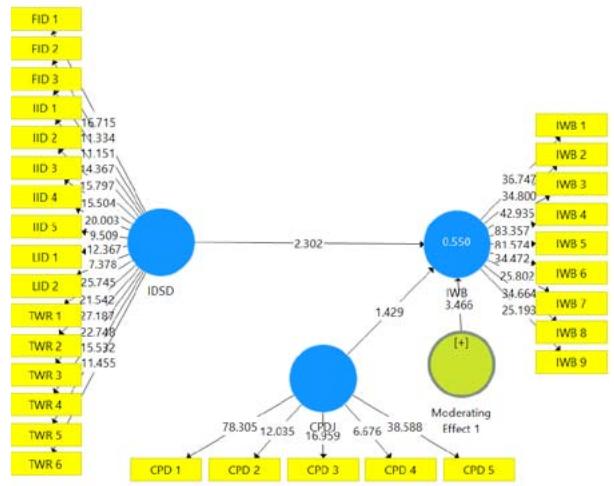 Figure 2: Final Measurement Model
### f) Assessment of the Indirect Relationship
The results of the moderating effect of the coworkers' perception of distributive justice on the impact of idiosyncratic deals and innovative working behaviour are outlined in table 5.
Table 5: Hypothesis Testing – Indirect Relationship
<table><tr><td>Hypotheses</td><td>Path coefficient (β)</td><td>T Statistics</td><td>p-value</td><td>Decision</td></tr><tr><td>H2 - IDSD*CPDJ -> IWB</td><td>-0.351</td><td>3.466</td><td>0.001</td><td>Supported</td></tr></table>
Table 5 shows a significant moderating effect at a ninety-five percent (95%) $(p < 0.05)$ confidence level on the relationship between idiosyncratic deals and employee innovative working behavior. Therefore, hypothesis 2 $(\mathsf{H}_2)$ is accepted.
## IX. DISCUSSION OF FINDINGS AND CONCLUSION
The main purpose of this study is to identify the impact of i-deals on IWB and the role of coworkers' support on i-deals and IWB. According to Kimwolo (2018), IWB is one way to enhance organizational performance. To enhance the innovative working behavior of the employees, they need to be motivated. Extrinsic motivations take the form of development and financial i-deals, and intrinsic motivation may take the form of task and work responsibilities and flexibility i-deals. According to studies done by Spieglare et al. (2014); Horung et al. (2009); Ng and Feldman (2010), and Rosen et al. (2011) identified that employees responded positively when employers offered special employment arrangements. Moreover, as per Casper and Buffardi (2004) and Eisenberger et al. (2001), employees try to pay back the employer for their valuable contributions to the employees, which strengthens their relationship. Further, Kimwolo (2017) stated that there is a significant relationship between i-deals and IWB. The current study's findings also revealed a significant impact of i-deals on employee innovative working behavior ( $\beta = 0.245$, $p = 0.028$ ), supporting H1, and the study's findings resonate with the existing literature.
According to the study findings, coworkers' perception of distributive justice significantly moderates the impact of idiosyncratic deals on innovative working behavior ( $\beta = -0.351$, $p = 0.001$ ). This indicates that coworkers' perception of distributive justice negatively impacts the relationship between idiosyncratic deals and innovative working behavior. The finding coincided with the existing literature. According to Holtz and Harold (2013) and Shin et al. (2014), the coworker's side of i-deals has been extensively investigated using a distributive justice perspective in organizational behavior and business ethics. Furthermore, coworkers' inputs and outputs can be affected when i-deal burdens them with extra work or reduces their chances of achieving desirable results (Greenberg et al., 2004).
Hence, employers must pay close attention to how to improve the employment contracts between the employee and employer for additional tasks and responsibilities of the job, a task that develops skills that fits the personality, and a position that calls for special abilities brought to the job. Further, organizations need to encourage employees' flexible work schedules, an allowance to attend non-work-related duties outside normal leaves, completion of work outside the main office, and flexible work times. More importantly, employers should focus on financial incentives that meet the employee's needs and customize compensation arrangements tailored to the employee's inherent skills, as these enhance the innovative work behaviour of the organization's employees.
## X. THEORETICAL AND MANAGERIAL IMPLICATIONS
This study is important on theoretical grounds as a dearth of research deals with i-deals and IWB in both the Sri Lankan and global contexts. Researchers have used social exchange theory to study the relationship between ideals and employee innovative work behavior and distributive justice theory to understand coworkers' reactions to i-deals. Hence, this study broadened the theoretical understanding of i-deals, IWB, and coworkers' reactions to the organizations. Therefore, the findings assist in getting an understanding for the managers of the organizations about coworkers' reactions to i-deals and the strategies that can use to enhance the i-deals and IWB of the employees. And employees can get an idea of how much their coworker's perception of distributive justice is important for their performance.
Except for the study done by Spieglare et al. (2014), which examined the employment relationship which constructs close to i-deals and innovative work behavior, and the study done by Kimwolo (2018), no other known studies are available in the current literature. Most publications have focused on the antecedents and consequences of i-deals (Hornung et al., 2009; Rousseau et al., 2009). Moreover, it has been mentioned coworkers play an important role in i-deals (Rousseau, 2005). There is little research on how coworkers react to them (Lai et al., 2009). Hence this study is important as the findings fill the existing literature gap to a certain extent. The study findings have identified a significant moderation effect of coworkers' perception of distributive justice on the impact of I-deals and IWB. However, this moderation effect is negative, and it indicates that the impact of I-deals on IWB weaken by the coworker's perception of distributive justice. Hence it gives a clue to the employers in the organizations that they need to handle I-deals for each employee depending on their contribution to the organization. Therefore, the managers in insurance sector organizations can take necessary steps to enhance the IWB of the employees and the performance of the whole organization. And this opens a door for future researchers to test the antecedents and decedents of the coworker's perception of distributive justice.
## XI. LIMITATIONS AND DIRECTIONS FOR FUTURE RESEARCH
Researchers have identified several limitations in this study. The generalization of the results in this study is questionable as this study is limited only to the insurance agents in the Gampaha district, Sri Lanka. Hence, the results may not be exactly applicable to other industries. Further, future researchers can conduct a cross-national research study as it can provide more generalized findings in this area. However, future researchers can examine this conceptual model in another industry to have more generalized findings. The study's cross-sectional nature is another limitation, as the results can be changed over time. Hence, future researchers can focus on a longitudinal study to observe and identify the behavioral changes of the employees of the organizations.
Moreover, this study reveals that coworkers' perception of distributive justice negatively moderates the impact of l-deals on innovative work behaviour. Hence, future researchers can examine antecedents for this kind of relationship. Finally, since there are few studies on i-deals, future researchers can examine the effect of i-deals on different employee outcomes.
Generating HTML Viewer...
References
82 Cites in Article
Faizan Ali,Eunhye Park,Junehee Kwon,Bongsug Chae (2019). 30 years of contemporary hospitality management.
Adriana Abstein,Patrick Spieth (2014). Exploring <scp>HRM</scp> Meta‐Features that Foster Employees' Innovative Work Behaviour in Times of Increasing Work–Life Conflict.
J Adams (1965). Inequity In Social Exchange.
Smriti Anand,Prajya Vidyarthi,Robert Liden,Denise Rousseau (2010). Good Citizens in Poor-Quality Relationships: Idiosyncratic Deals as a Substitute for Relationship Quality.
Smriti Anand,Jia Hu,Prajya Vidyarthi,Robert Liden (2011). Leader-member exchange as a linking pin in the idiosyncratic deals - Performance relationship in workgroups.
Isuri Liyanage,Githendri Siriwardhana,Anjana Abeyrathne,Asela Pallewela,Kanchana Wijesinghe (2018). DETERMINATION OF LUNG SOUND AS NORMAL OR ABNORMAL, USING A STATISTICAL TECHNIQUE.
Michael Arthur,Denise Rousseau (2001). Introduction: The Boundaryless Career A New Employment Principle for a New Organizational Era.
C Axtell,D Holman,T Wall (2006). Promoting innovation: A change study.
P Blau (1964). Exchange and Power in Social Life.
A Bos-Nehles,A Veenendaal (2017). Perceptions of HR practices and innovative work behavior: The moderating effect of an innovative climate.
Michael Carrell,John Dittrich (1978). Equity Theory: The Recent Literature, Methodological Considerations, and New Directions.
Wendy Casper,Louis Buffardi (2004). Work-life benefits and job pursuit intentions: The role of anticipated organizational support.
Jason Colquitt,Donald Conlon,Michael Wesson,Christopher Porter,K Ng (2001). Justice at the millennium: A meta-analytic review of 25 years of organizational justice research..
Adrienne Colella (2001). Coworker Distributive Fairness Judgments of the Workplace Accommodation of Employees with Disabilities.
Jong De,J Den Hartog,D (2010). Measuring Innovative Work Behaviour.
Robert Eisenberger,Stephen Armeli,Barbara Rexwinkel,Patrick Lynch,Linda Rhoades (2001). Reciprocation of perceived organizational support..
Robert Eisenberger,Norman Cotterell,Joan Marvel (1987). Reciprocation ideology..
Robert Eisenberger,Patrick Lynch,Justin Aselage,Stephanie Rohdieck (2004). Who Takes the most Revenge? Individual Differences in Negative Reciprocity Norm Endorsement.
(2022). what is the future of innovation-driven growth? Geneva.
Jerald Greenberg,Marie-Élène Roberge,Violet Ho,Denise Rousseau (2004). FAIRNESS IN IDIOSYNCRATIC WORK ARRANGEMENTS: JUSTICE AS AN I-DEAL.
Joe Hair,Marko Sarstedt,Christian Ringle,Jeannette Mena (2011). An assessment of the use of partial least squares structural equation modeling in marketing research.
J Hair,M Sarstedt,L Matthews,C Ringle (2016). Identifying and treating unobserved heterogeneity with FIMIX-PLS: part Imethod.
Daniel Herrmann,Jörg Felfe (2013). Moderators of the Relationship Between Leadership Style and Employee Creativity: The Role of Task Novelty and Personal Initiative.
J Henseler,C Ringle,M Sarstedt (2015). A new criterion for assessing discriminant validity in variance-based structural equation modeling.
Brian Holtz,Crystal Harold (2013). Effects of leadership consideration and structure on employee perceptions of justice and counterproductive work behavior.
Severin Hornung,Denise Rousseau,Jürgen Glaser (2009). Why supervisors make idiosyncratic deals: antecedents and outcomes of i‐deals from a managerial perspective.
Severin Hornung,Denise Rousseau,Jürgen Glaser (2008). Creating flexible work arrangements through idiosyncratic deals..
Severin Hornung,Denise Rousseau,Jürgen Glaser,Peter Angerer,Matthias Weigl (2010). Beyond top‐down and bottom‐up work redesign: Customizing job content through idiosyncratic deals.
Violet Ho,Dejun Kong (2015). Exploring the signaling function of idiosyncratic deals and their interaction.
Yufang Huang,Xin Chen (2021). A moderated mediation model of idiosyncratic deals and innovative performance of R&D employees: roles of vitality.
Onne Janssen (2000). Job demands, perceptions of effort‐reward fairness and innovative work behaviour.
Onne Janssen (2004). How fairness perceptions make innovative behavior more or less stressful.
Onne Janssen,Evert Van De Vliert,Michael West (2004). The bright and dark sides of individual and group innovation: a Special Issue introduction.
Kimberly Jaussi,Shelley Dionne (2003). Leading for creativity: The role of unconventional leader behavior.
Clare Kelliher,Deirdre Anderson (2010). Doing more with less? Flexible working practices and the intensification of work.
Ciara Kelly,Yasin Rofcanin,Mireia Las Heras,Chidiebere Ogbonnaya,Elise Marescaux,María Bosch (2020). Seeking an “i-deal” balance: Schedule-flexibility i-deals as mediating mechanisms between supervisor emotional support and employee work and home performance.
Peter Khaola,Douglas Musiiwa (2021). Bolstering innovative work behaviours through leadership, affective commitment and organisational justice: a three-way interaction analysis.
Andrew Kimwolo,Thomas Cheruiyot (2017). Intrinsically motivating idiosyncratic deals and innovative work behaviour.
Andrew Kimwolo,Thomas Cheruiyot (2018). Intrinsically motivating idiosyncratic deals and innovative work behaviour.
Andrew Kimwolo,Thomas Cheruiyot (2017). Intrinsically motivating idiosyncratic deals and innovative work behaviour.
Michael Stanczyk (2021). „Versicherer stellen Kunden und ihre Bedürfnisse stärker in den Mittelpunkt“.
Lyonel Laulié,Amanuel Tekleab,Junghyun Lee (2019). Why Grant I-Deals? Supervisors’ Prior I-Deals, Exchange Ideology, and Justice Sensitivity.
Lei Lai,Denise Rousseau,Klarissa Chang (2009). Idiosyncratic deals: Coworkers as interested third parties..
Chenwei Liao,Sandy Wayne,Denise Rousseau (2014). Idiosyncratic deals in contemporary organizations: A qualitative and meta‐analytical review.
Jun Liu,Cynthia Lee,Chun Hui,Ho Kwan,Long-Zeng Wu (2013). Idiosyncratic deals and employee outcomes: The mediating roles of social exchange and self-enhancement and the moderating role of individualism..
Tuan Luu (2021). Can human resource flexibility disentangle innovative work behavior among hospitality employees? The roles of harmonious passion and regulatory foci.
Namra Mubarak,Jabran Khan,Robina Yasmin,Atasya Osmadi (2021). The impact of a proactive personality on innovative work behavior: the role of work engagement and transformational leadership.
Rehema Namono,Ambrose Kemboi,Joel Chepkwony (2021). Enhancing innovative work behaviour in higher institutions of learning: the role of hope.
Thomas Ng,Daniel Feldman (2010). Idiosyncratic deals and organizational commitment.
B Niehoff,R Moorman (1993). JUSTICE AS A MEDIATOR OF THE RELATIONSHIP BETWEEN METHODS OF MONITORING AND ORGANIZATIONAL CITIZENSHIP BEHAVIOR..
Pauline Leong (2017). Malaysian Politics in the Age of Media-tion.
Janneke Oostrom,Martine Pennings,P Bal (2016). How do idiosyncratic deals contribute to the employability of older workers?.
J Ozen (2003). Organizational justice as the key to trust in organization.
Anne Pieterse,Daan Van Knippenberg,Michaéla Schippers,Daan Stam (2009). Transformational and transactional leadership and innovative behavior: The moderating role of psychological empowerment.
Christopher Rosen,Daniel Slater,Chu-Hsiang (daisy) Chang,Russell Johnson (2013). Let’s Make a Deal.
Denise Rousseau (2005). I-deals: Idiosyncratic Deals Employees Bargain for Themselves.
D Rousseau (2006). Interpreting Employment Contracts : Judges, Employers and Workers.
(2008). The New American Workplace by James O'Toole and Edward E. Lawler, III America at Work: Choices and Challenges edited by Edward E. Lawler, III and James O'Toole.
Denise Rousseau,Severin Hornung,Tai Kim (2009). Idiosyncratic deals: Testing propositions on timing, content, and the employment relationship.
Denise Rousseau,T Kim (2006). I-deals: Idiosyncratic Deals Employees Bargain for Themselves.
Christopher Rosen,Daniel Slater,Chu-Hsiang (daisy) Chang,Russell Johnson (2011). Let’s Make a Deal.
Richard Ryan,Edward Deci (2000). Self-determination theory and the facilitation of intrinsic motivation, social development, and well-being..
Erik Saether (2019). Motivational antecedents to high-tech R&D employees' innovative work behavior: Self-determined motivation, person-organization fit, organization support of creativity, and pay justice.
Marko Sarstedt,Christian Ringle,Joseph Hair (2021). Partial Least Squares Structural Equation Modeling.
Neil Salkind (2010). Encyclopedia of Research Design.
Riccardo Sartori,Arianna Costantini,Andrea Ceschi,Francesco Tommasi (2013). How Do You Manage Change in Organizations? Training, Development, Innovation, and Their Relationships.
S Scott,R Bruce (1994). DETERMINANTS OF INNOVATIVE BEHAVIOR: A PATH MODEL OF INDIVIDUAL INNOVATION IN THE WORKPLACE..
Yuhyung Shin,Sun Sung,Jin Choi,Min Kim (2014). Top Management Ethical Leadership and Firm Performance: Mediating Role of Ethical and Procedural Justice Climate.
Manjari Singh,Anita Sarkar (2012). The Relationship Between Psychological Empowerment and Innovative Behavior.
M Skiba,S Rosenberg (2011). The disutility of equity theory in contemporary management practice.
Terje Slåtten,Göran Svensson,Sander Sværi (2011). Empowering leadership and the influence of a humorous work climate on service employees' creativity and innovative behaviour in frontline service jobs.
D Spieglare,V Guy,V Geert (2014). Labour Flexibility and Innovation: Complementary or Concurrent Strategies? A Review of Literature.
Didem Taser,Yasin Rofcanin,Mireia Las Heras,Maria Bosch (2021). Flexibility I-deals and prosocial motives: a trickle-down perspective.
P Vidyarthi,S Anand,R Liden (2014). Do emotionally perceptive leaders motivate higher employee performance? The moderating role of task interdependence and power distance.
Aveshan Venketsamy,Charlene Lew (2022). Intrinsic and extrinsic reward synergies for innovative work behavior among South African knowledge workers.
Peng Wang,Shuhong Wang,Xiang Yao,I‐chieh Hsu,John Lawler (2019). Idiosyncratic deals and work‐to‐family conflict and enrichment: The mediating roles of fit perceptions and efficacy beliefs.
Agnieszka Wojtczuk-Turek,Dariusz Turek (2015). Innovative behaviour in the workplace.
Stephen Woods,Michael Mustafa,Neil Anderson,Benjamin Sayer (2018). Innovative work behavior and personality traits.
Linn Young (2012). How to Promote Innovative Behavior at Work? The Role of Justice and Support Within Organizations.
Feirong Yuan,Richard Woodman (2010). Innovative Behavior in the Workplace: The Role of Performance and Image Outcome Expectations.
Marium Zuberi,Arif Khattak (2021). Impact of proactive personality and leader member exchange on innovative work behavior: a job design perspective.
No ethics committee approval was required for this article type.
Data Availability
Not applicable for this article.
How to Cite This Article
Vimansha Rangani Ranasinghe. 2026. \u201cNexus between Idiosyncratic Deals and Employee Innovative Work Behavior: A Moderated Model of Perceived Coworkers Distributive Justice\u201d. Global Journal of Management and Business Research - A: Administration & Management GJMBR-A Volume 23 (GJMBR Volume 23 Issue A6): .
Explore published articles in an immersive Augmented Reality environment. Our platform converts research papers into interactive 3D books, allowing readers to view and interact with content using AR and VR compatible devices.
Your published article is automatically converted into a realistic 3D book. Flip through pages and read research papers in a more engaging and interactive format.
Employee innovative work behaviour is a key factor in an organization’s survival and competitiveness in the global economy. However, only a few studies examined the impact of antecedents of employee innovative work behavior. Hence, aims to investigate the impact of idiosyncratic deals on employee innovative behavior and the perceived coworker distributive justice’s role in this relationship. The conceptual model was empirically tested by collecting data from 113 insurance agents in the Gampaha district in Sri Lanka. The Partial Least Squares technique (PLS), a third-generation structural equation modeling technique (SEM), was used to analyze data in this study. The study’s findings revealed a significant impact of idiosyncratic deals on employee innovative work behavior. Perceived coworker distributive justice significantly moderates the impact of idiosyncratic deals on employee innovative work behavior. Hence, this study broadened the theoretical understanding of i-deals, innovative work behaviour, and coworkers’ reactions to the organizations.
Our website is actively being updated, and changes may occur frequently. Please clear your browser cache if needed. For feedback or error reporting, please email [email protected]
Thank you for connecting with us. We will respond to you shortly.