
Azeez Olarewaju Ahmed
I. INTRODUCTION
The link between monetary policy and bank lending is crucial because monetary policy involves deliberate actions of the monetary authorities mostly central bank to change the quantity, availability or cost of money in an economy to achieve low unemployment, high output growth rate, price stability and stable exchange rate through monetary policy rate, open market operation, reserve requirement, credit control and moral suasion (CBN, 2016). In Nigeria as well as other developing countries, it has been observed that prudent monetary policies are the key stone to effective regulations as well as supervision for the growth of any country's banking Industry. By effective manipulation of monetary policy variables, the Central bank seek to influence the growth rate of money supply in an economy, interest rate level, liquidity and the availability of credit from the banking sector (Ehimare, Emena and Niyan, 2015).
Monetary policy has an interdependent relationship with commercial banks in the economy. This is based on the fact that they are the main agents of monetary policy implementation within any economy (Krause & Rioja, 2006). Apart from the traditional roles of savings, banking system played fundamental roles in the growth of an economy through their intermediation role. They perform these roles by mobilizing resources (savings) from the surplus units and channeling them to the deficit units for productive activities within an economy (Schumpeter, 1934). Banks through their credit policy act as lubricants and promote growth in different sectors of the economy. In making credit available, banks are rendering a great deal of social service and through their action, production is increased, capital investments are expanded and a higher standard of living is realized (Eta and Oghoghomeh, 2015).
Although, the empirical link between monetary policy and bank credit has been intensively examined. Nevertheless, such empirical evidences appear to be inconclusive unsettled. For instance, Anyanwu and Kalu (2017), Enyioku (2017), Kalu (2017), Akanni and Imegi (2017); and Meshack and Nyamute (2016) found that monetary policy enhances bank lending whereas Onaolapo and Shomade (2017), Jegede (2016) Agbonkhese and Asekome (2016); Akannbi and Ajagbe (2016); Muhammed (2015); and Ekpung et al (2015) found that monetary policy inhibits bank credit. Given the lack of inconclusiveness from the previous research work could therefore indicate it as an area that requires further probe. Thus, this study seeks to fill the gap in economic literature by exploring the linkbetween monetary policy and bank credit in the case of Nigeria over the period of 2001 to 2017 using Autoregressive Distributed Lag (ARDL) model. The rest of the paper is organized as follows: Section 2 provides an overview of the relevant empirical literature between monetary policy and bank credit; Section 3 is the methodology section while Section 4 contains the results and discussion. Finally, Section 5 deals the conclusion and policy recommendations.
II. REVIEW OF RELEVANT LITERATURE
The empirical nexus between monetary policy and bank credit has been extensively examined in the past years. However, such empirical evidences appear to be unsettled. For instance, Anyanwu and Kalu (2017) employed Ordinary Least Square (OLS) technique in investigating the role of monetary management on commercial bank loan and advances and output in Nigeria spanning 1994 and 2015, and found that money supply enhances bank loan and advances. In a related study, Onaolapo and Shomade (2017) employed Error Correction Model to explore the role of monetary policies (proxied by volume of deposits, interest rate and cash reserve requirement) on commercial bank lending behavior (proxied by commercial loan and advances to customers) in Nigeria covering the period of 1980 and 2014. The result disclosed that volume of deposit enhances commercial bank loan and advances to customers while monetary policy rate (short-term interest rate) and cash reserve ratio retards commercial bank loan and advances to customers.
Using Vector Error Correction Model, Jegede (2016) assessed the role of monetary policy (proxied by money supply, interest rate and liquidity ratio) on commercial bank lending activities in Nigeria during the period of 1998-2013. The study found that money supply and liquidity ratio reduce commercial loan and advances to customers while interest rate increases commercial loan and advances to customers in Nigeria. Likewise, Agbonkhese and Asekome (2016) analyzed the impact of monetary policy on bank credit creation in Nigeria from 1980 and 2010 using OLS technique. The results of the study showed that total deposits and treasury bills rate boost credit creation while reserve requirement ratio and interest rate had a negative relationship with total credit creation. In another study by Agbonkhese and Asekome (2017) examined the role of macroeconomic indicators (real GDP, money supply, exchange rate, lending interest rate and inflation) on commercial bank risk assets creation in Nigeria over the period of 1980 to 2014. The study employed OLS methodology and the result showed that money supply, lending interest rate exert a significant positive impact on commercial bank risk asset creation while inflation rate retards it.
With the aid of annual data and OLS technique, Enyioko (2017) examined the role of monetary policy (proxied by interest rate) on the overall performance of commercial banks in Nigeria from 2005 to 2012. The study showed that monetary policies have insignificant impact on commercial bank performance in Nigeria. Akanbi and Ajagbe (2016) investigated the importance of monetary policy on commercial banks operation in Nigeria spanning 1990 to 2015. The result revealed that monetary policy retard commercial bank performance in Nigeria within the study period. In addition, Kalu (2017) analyzed the link between monetary policy and private sector credit in Nigeria January 2000 to May 2013. The result of the error correction model (ECM) disclosed that variations in credit have enhance changes in monetary policy and credit granger cause monetary policy.
Furthermore, Matousek and Solomon (2017) investigates the bank lending channel in Nigeria using GMM technique with annual data from 2002 to 2008. They found that consolidation and restructuring policies of Central Bank of Nigeria's (CBN) enhance bank lending channel and loan growth response sensitive to changes in bank size and capitalization. Recently, Ezeaku et al (2018) utilized error correction technique to probe the role of monetary policy transmission mechanism on industrial development spanning 1981 and 2014. The result of the study indicates that Monetary policy transmission mechanism (interest rate, credit and exchange rate) retard real output growth in Nigeria. Focusing on the effect of monetary policy on liquidity of capital market in Nigeria spanning 1981 and 2016, Akanni and Imegi (2017) employed Error Correction Model (ECM) and established that monetary policy stimulates liquidity of capital market.
Lawal et al (2018) explored the nexus between monetary policies and stock market behavior from 1985 and 2015. The result of the ARDL technique showed stock market behavior is influenced directly by interest rate and indirect by bank credit and exchange rate. Using the Vector Auto-regressive Method and annual data spanning 1986 and 2009, Nwosa and Saibu (2016) explored the importance of transmission channels of monetary policy on sectoral output growth in Nigeria. The result indicates that interest rate and exchange rate channels enhance sectoral output growth in Nigeria. Conversely, Owolabi and Adegbite (2017) found that rediscount rate and deposit enhance industrial output whereas treasury bills inhibit industrial output when evaluating the nexus between monetary policy and industrial growth spanning 1970 and 2010.
In investigating the role of monetary policy (proxied by deposit interest rate, minimum discount rate and exchange rate) on commercial bank performance (proxied by deposit liabilities) in Nigeria from 1970 to 2013, Ekpung et al (2015) employed OLS methodology and found that deposit interest rate and minimum discount rate negatively influence commercial bank performance whereas exchange rate has a significant positive impact on commercial bank performance in Nigeria. In addition, Ehimare et al (2015) employed VECM methodology to assessed the impact of monetary policy (proxied by monetary policy rate) on loan risk exposure of commercial banks (proxied by loan and advance) in Nigeria over the period of 1981 and 2013. The result disclose that monetary policy rate enhances commercial bank loan and advances in Nigeria. In the case of Kenya, Meshack and Nyamute (2016) evaluate the nexus between monetary policy and commercial bank performance in Kenya over the period of 2005 and 2015. They found that monetary policy (proxied by open market operation) exert a significant positive impact on commercial bank performance in Kenya within the study period.
Conversely, Ajudua et al (2015) examined the impact of monetary policy (monetary policy rate, money supply, lending interest rate and inflation rate) on the agricultural sector output in Nigeria from 1986 – 2013. Employing the ordinary least square (OLS) regression method, the study found that money supply and inflation stimulate agricultural sector output whereas lending interest rate and monetary policy rate discourages agricultural sector output in Nigeria. In a panel study, Odour et al (2017) utilized annual data from 167 banks in 37 African countries over the period of 2000–2011 as well as for the period 2007–2013 for 145 banks across 23 African countries to analyze the role of capital requirement on bank competition and stability. The result of the study indicates that higher capital requirements increases financial stability in Africa. However, in South Africa, Matemilola et al (2015) examined the effect of monetary policy (long run interest rate) on commercial bank lending rate in South Africa using monthly data from January 1978 to December 2012. The result of the Momentum Threshold Autoregressive and Asymmetric Error Correction Model disclosed that commercial bank lending rate adjusts to a decrease in the money market rate in South Africa.
Using a sample of 12 banks in Germany, 22 in Switzerland, and 10 in Thailand over the period of 1990 and 2013, Vithessonthi et al (2017) evaluate the relationship between the monetary policy (monetary policy rate), the loan policy of commercial banks, and the investment behavior of firms. The result of the POLS technique showed that monetary policy positively influences the commercial banks' lending rate in the short run in Germany and Thailand. However, monetary policy is ineffective in influencing the commercial banks' lending rate in Switzerland. In Chicago, Chang and Jansen (2016) investigate whether contractionary and expansionary policies have asymmetric impacts on bank loans and output spanning 2000 and 2014. Employing logistic smooth transition vector error correction model, they found that big bank loan growth has a much greater response to monetary policy, compared to that of small banks and asymmetry in the response of bank lending to monetary policy is not a substantially contributing factor in explaining the different responses of output to contractionary and expansionary policy.
Focusing on Ghana, Muhammad (2016) examined the link between monetary policy (proxied by prime lending rate and money supply) and bank lending behavior (loan and advances) for the period of 2005 to 2014. The study revealed that decrease in money supply leads to decrease in commercial bank loan and advances to customers' while prime lending rate and inflation also retard commercial bank lending behavior. Utilizing 108 large international banks spanning 1995 to 2014, Gambacorta (2017) explore the efficiency of monetary policy on bank lending. The result of the GMM technique disclosed that monetary policy is ineffective in encouraging bank lending growth at low level of interest rates. In a regional study, Brana, Campmas and Lapteacru (2018) investigates the role of monetary policy on bank risk behavior from 126 banks in 20 European countries spanning 2000 to 2015. The result of the dynamic panel threshold model showed that relaxing monetary policy (rising central banks' liquidity and low interest rates) has a detrimental influence on banks' risk. Similarly, Chen et al (2017) employed fixed effect and GMM technique to evaluate the impact of monetary policy on banks' risk-taking for 1000 banks from 29 emerging economies between 2000-2012, the study found that monetary policy reduces banks' riskiness. In summary, the empirical literature survey above, the relationship between monetary policy and bank lending is best characterized as mixed. The variation in the result is with regard to the type of data (aggregate data, sectorial data, etc.), the choice of sample period (monthly, quarterly, yearly, etc.), proxies for measuring monetary policy (monetary policy rate, cash reserve ratio, liquidity ratio, treasury bill rate) and estimation techniques (OLS, ECM, VECM etc). In the light of this observation, this study intends to fill the gap in the literature by examining the nexus between monetary policy and bank credit in Nigeria over the period of 2001 to 2017 using Autoregressive Distributed Lag (ARDL) Model.
III. METHODOLOGY
In line with Agbonkhese and Asekome (2016), the empirical model to examine the impact of monetary policy on commercial bank credit creation is written as:
Where BC denote Bank credit (proxied by commercial bank credit to private sector and small scale enterprises) and MP is Central bank monetary policy. In order to examine the role of various monetary policy instrument on bank credit creation, the variable MP is decompose into monetary policy rate (MPR) which indicate the cost of short-term borrowing or monetary base, liquidity ratio (LIQR) indicates the minimum percentage of commercial bank net demand and time liabilities with the central bank and money supply (MS) which indicates total amount of money in circulation. So equation (3.1) becomes:
Where BC is Bank Credit (proxied by bank credit to private sector and small scale enterprises), MPR denotes monetary policy rate, (LIQR) is liquidity ratio and (MS) is money supply at time t.
The log-linear form of equation (3.2) is expressed in the model below:
In order to examine the role of monetary policy on commercial bank credit in Nigeria. This study employs Autoregressive Distributed Lag (ARDL) approach to co integration developed by (Pesaran, Shin,
& Smith, 2001). This technique is applied because it can accommodate different orders of integration I(0), I(1) or I(0)/I(1). Furthermore, the ARDL approach integrates the short run dynamics with the long run equilibrium without losing any extended run information. Also, the ARDL approach provides better results for small sample data set compared to other traditional methods to co integration (Engle & Granger, 1987); (Johansen & Juselius, 1990); and (Phillips & Hansen, 1990). Lastly,
ARDL approach gets rid of endogeneity problem due to the selection of appropriate lag selection. Hence, residual correlation. The general ARDL representation of Eq (3.3) formulated as:
Where represents first difference operator, are the long-run multipliers, and and are the short-run dynamic coefficients, is white noise errors, is an example of drift term, p and q are the optimal lag lengths for the dependent and independent variables respectively. The existence of long-run relationships ascertained by conducting an F-test for the joint significance of the coefficients of the lagged values of the variables taking into account the null hypothesis of no co integration, , against the alternative where f=1,2.....4. The Wald test is applied in cases where there is more than one short-run coefficient of the same variable. The F-statistics compared with the upper and lower bounds critical values. If the F-statistic exceeds the high significant value, we conclude in favour of a long run relationship or otherwise. However, if the F-statistic lies between the lower and upper critical bounds, the inference would be inconclusive.
a) Data
This study makes use of quarterly time series data from 2001-2017 on bank credit (proxy by commercial bank credit to private sector and small scale enterprises), monetary policy rate, liquidity ratio and money supply sourced from Central Bank of Nigeria Statistical Bulletin, 2017 edition.
IV. RESULTS AND DISCUSSION
a) Preliminary Analyses
i. Descriptive statistic
Prior to estimation of the ARDL model to examine the impact of monetary policy on bank credit, we conduct preliminary analyses on the data. These involve the descriptive statistics to reveal the salient characteristics of the series (i.e. mean, standard deviation, maximum and minimum) and the stationarity tests (Augmented Dickey-Fuller and Phillips-Perron) to show time series properties of the variables. Deductible from Table 1, the average of bank credit to private sector and small and medium scale enterprises is ₦9744Band it ranges between ₦22290B and ₦764B while the average of money supply is ₦10581B and ranges between ₦24140B and ₦1269B. In addition, monetary policy rate is 12.5 on average with maximum of 20.5 while the average of liquidity ratio is 46.62 which is low.
| BC | MPR | LIQR | MS | |
| Mean | 9744.706 | 12.5000 | 46.6241 | 10581.71 |
| Maximum | 22290.66 | 20.5000 | 63.2050 | 24140.63 |
| Minimum | 764.9615 | 6.0000 | 30.4250 | 1269.322 |
| Std. Dev. | 7960.067 | 3.5233 | 8.4982 | 8026.048 |
ii. Unit root test
In an attempt to check the order of integration of each variable, this study employed the Augmented Dickey-Fuller (ADF) and Phillip-Peron (PP) unit root tests (see Table 2). ADF and PP tests for which the null hypothesis is non-stationarity and the alternative hypothesis is that variables are stationary. The results of the ADF and P Ptests indicate that Bank credit (LBC), Monetary policy rate (MPR) and Money supply (LMS), are stationary at first difference except liquidity ratio (LIQR) that is stationary at level. These two test sensure that none of the variables is integrated with an upper or derthan1which conforms with the assumptions of the ARDL bounds testing approach to co integration.
| ADF Test | PP Test | |||||
| Variables | Level | First Diff | Level | First Diff | ||
| LBC | -1.1150 | -4.7664*** | -0.5853 | -4.8869*** | ||
| MPR | -2.5142 | -4.8814*** | -1.8767 | -5.0285*** | ||
| LIQR | -3.8524** | -5.3171*** | -2.9909** | -5.2818*** | ||
| LMS | -1.2604 | -6.2438*** | -0.9501 | -6.2144*** | ||
iv. Co integration Test
Furthermore, the long-run relationship between the variables under consideration is examined. To this end, this study employed the ARDL bounds test approach for co integration by Pesaran et al. (2001). The result in Table 3 showed that the lower bound is 3.23 and the upper bound is 4.35 while the F-statistic is 5.1883. Since the F-statistics results is greater than the upper critical bound at 5 percent significance level, this implies the existence of a long-run relationship among monetary policy and bank credit in Nigeria.
| Variables | F-Statistics | Co integration | |
| 5.1883 | Co integration | ||
| Critical Value | Lower Bound | Upper Bound | |
| 1% | 4.29 | 3.77 | |
| 5% | 3.23 | 4.35 | |
| 10% | 2.72 | 3.77 |
b) Estimation Result
In order to examine the short and long run impact of monetary policy on bank credit in Nigeria, we estimate the ARDL method. The result of the short and long run estimates are reported in Table 4. The results indicate that monetary policy (proxied by monetary policy rate) has a significant negative impact on bank credit both in the short and long run. This result suggests that monetary policy rate retards bank credit to private sector and small and medium scale enterprises in Nigeria because increase in monetary policy causes a general rise in lending interest rate or cost of holding money. This result has been confirmed by many scholars in the economic literature who found that monetary policy rate retards bank credit (Akanbi and Ajagbe, 2016; Muhammad, 2016; and Onaolapo and Shomade, 2017). Further, results indicate that monetary policy (proxied by liquidity ratio (LIQR)) has a significant negative effect on bank credit in Nigeria in the short run but exert a significant positive impact in the long run. This may be as a result of insufficient government investment in infrastructural development. This outcome supports the findings of Jegede (2016) who finds that liquidity ratio reduces bank loan and advances to customers. In addition, money supply has a positive impact on bank credit both in the short and long run. This outcome conforms with the finding of Anyanwu and Kalu (2017) who found that money supply enhances bank credit.
The estimate of the lagged error term (ECT) is negative (-0.1582), and it is statistically significant at the 5% level. This implies that the adjustment from the short-run to the long-run equilibrium path is 15.8%. Furthermore, the that measures the degree at which the explanatory variables explained bank credit is high at 92.87%. Also, F-statistics (F=4351.00) which measures overall significance of the model indicates that all the estimated regression coefficients are highly statistically significantly different from zero. Lastly, it is traditional to check the robustness of a model by examining few diagnostic tests. The lower part of Table 4 show that serial correlation is not a problem in the estimation as shown by the Obs*R-squared values of 2.1274 while its corresponding p-value has a value of 0.1770. Since the probability value is greater than 5 percent, we accept the null hypothesis, meaning that there is no evidence of serial correlation in the model.
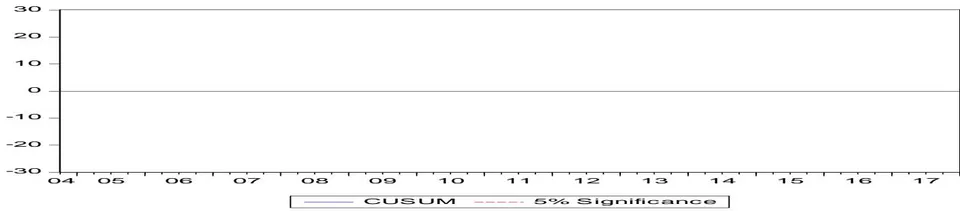
In addition, to test for the presence of homoscedasticity in the model, the study chooses the Arch Test. The ARCH test for heteroskedacity in the residual shows the probability value of 0.3239 at the 5% significance level. We thus accept the null hypothesis of homoscedasticity and reject the alternative hypothesis of presence of heteroskedasticity. The model also satisfies the Jarque-Bera normality test, indicating that the errors are normally distributed since the probability value of the Jarque-Bera (JB) statistics of 0.6013 is greater than 5 percent. Also in order to test the stability of the model, this study applied Cumulative Sum of Square (CUSUMsq) (see Figs. 1). Since the graph of the CUSUMsq test lies within the critical bounds at 5% level of significance, which implies that the ARDL parameters are efficient and stable.
| Dep. Var: LBC | Coefficient | Std. Error | t-Statistic | Prob. |
| Long run Estimate | ||||
| LMPR | -0.7055 | 0.2143 | -3.2917 | 0.0018*** |
| LLIQR | 0.6531 | 0.3830 | 1.7050 | 0.0939* |
| LMS | 0.9176 | 0.0464 | 19.7655 | 0.0000*** |
| C | 0.3297 | 1.0342 | 0.3188 | 0.7511 |
| Short run Estimate | ||||
| Δ LMPR | -0.1472 | 0.0721 | -2.0397 | 0.0463** |
| Δ LLIQR | -0.2390 | 0.0665 | -3.5937 | 0.0007*** |
| Δ LMS | 0.1451 | 0.0598 | 2.4245 | 0.0187** |
| ECT(-1) | -0.1582 | 0.0599 | -2.6370 | 0.0109** |
| 0.9287 | ||||
| F - Stat | 4351.00 | 0.0000*** | ||
| Diagnostic Tests | ||||
| Test | Test | Value | ||
| Normal | 1.0171 | 0.6013 | ||
| Serial | 2.1274 | 0.1770 | ||
| ARCH | 0.9731 | 0.3239 |
V. CONCLUSION AND POLICY RECOMMENDATION
This research work provides empirical evidence on the nexus between monetary policy and bank credit in Nigeria over the period of 1991 and 2017 with the aid of ARDL technique. The result of the ARDL bounds testing indicates a long run relationship between monetary policy (proxied by monetary policy rate, liquidity ratio and money supply) and bank credit. Further, our findings disclose that monetary policy rate and liquidity ratio retards commercial bank credit to private sector and small and medium scale enterprises in Nigeria. Based on this result, this study therefore concludes that monetary policy inhibits bank credit to private sector and small and medium scale enterprises in Nigeria. The policy implications of this empirical result is that high monetary policy rate and liquidity ratio reduces bank credit to private sector and small and medium scale enterprises. Hence, this study therefore recommends that monetary authorities should reduce monetary policy rate so as to reduce cost of borrowing in order to increase domestic credit to private sectors so as to boost investments and outputs.