
I. INTRODUCTION
Nowadays, with advances in technology, internet-related crimes have increased at an alarming rate [1]. Among these crimes, phishing is one of the most popular cyber-attack vectors, which is a serious threat to information security and especially to the global economy. In phishing attacks, attacker develops web pages mimicking original websites and sends out fake emails, impersonating as a trusted entity such as popular brands or organizations, asking for sensitive information such as username, password, phone number, credit card details and other personal information. Internet users should be aware of phishing attacks as it has been in the cyber domain for years. However, many people still tend to fall victim and leak confidential information through suspicious web pages.
II. RELATED WORK
Phishing is a major security issue that needs to be addressed. Internet users should be aware of phishing attacks because this has been around for years. However, many domestic users still tend to get tricked by these phishing attempts. Therefore, everyone needed a good software-based solution to overcome this human error. In recent years, industry and academia have proposed several anti-phishing solutions to counter the phishing threat. Some of the important methods are discussed below.
a) Document Object Format
Document Object Format (DOM) is a language-independent and cross-platform programming interface for XML, XHTML, and HTML documents [7]. The DOM is an object-oriented representation of the web page. The DOM-based phishing detection solutions use the similarity of a DOM tree on a suspicious web page and a legitimate web page to detect phishing. Since attackers always imitate a legitimate web page and create phishing web pages, the layout of the page is expected to be the same. Rosiello et al. have proposed a solution that alerts users when they use the same information on different websites, such as the same username and password [7].

b) Content-based comparison
Content-based comparison often attempts to compare the text of a web page through machine learning. Using the TF-IDF, the most used algorithm for extracting text and information from the web page, al. Zhang developed a content-based system to identify phishing websites . Basnett et al. Evaluate their performance using various machine learning techniques, including neural networks, SVM (Support Vector Machine), and SOM (Self-Organizing feature Map) .
c) Signature-based technique
Huang proposed a unique signature-based method to identify legitimate websites using text keywords and images on the website . The system compares the signature of the currently open website with the signature database when a user tries to log in to a new website. If the domain name is changed but the signature matches, the web page will be declared as phishing. When a user visits a website for the first time, the system generates the signature and saves it to the database. Therefore this detection only works for the previously visited website sites, and it cannot detect zero-hour phishing attacks.
d) Phish Zoo
Afros and Greens tad have proposed a phishing detection solution called "Phish Zoo" that creates a unique profile for a website using URL, images, text content, secure connection layer (SSL) certification, and script . When a user visits a website, Phish Zoo matches the current site profile with a list of legitimate sites and profiles stored in the database. As a first step, the URL and SSL certificate is compared with the stored profile. If it matches, the website is considered legitimate by Phish Zoo. Otherwise, the site's contents will be matched against appearance profiles to detect phishing attempts.
III. PROPOSED SOLUTION
In this section, the proposed phishing detection approach is explained. Phishing attacks have evolved a lot in past years such that even experienced users sometimes cannot be able to distinguish between phishing and legitimate pages. The proposed solution uses a level-based detection mechanism to identify phishing attacks in order to reduce the computational power and time consumption. Therefore it increases the performance and accuracy of the overall product than existing systems. Further, it provides protection against phishing attacks on trusted and untrusted internet connection. If the user is using an untrusted internet connection such as public WiFi, then the system checks the trustworthiness of the DNS servers . Otherwise, it will be forwarded to the usual phishing detection mechanism. The system architecture is proposed under six main components. They are namely:
Browser Extension
URL Analysis
Image Processing
DNS Phishing
Feedback Mechanism
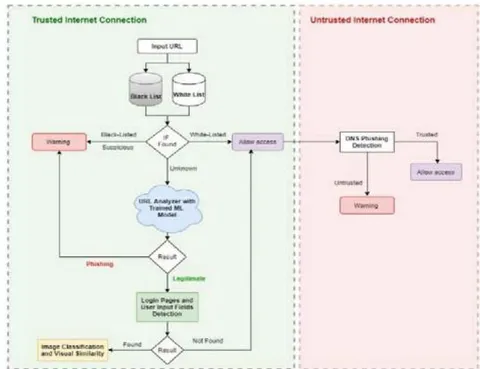
NoFish uses a level-based security mechanism to detect phishing attacks. Researches have designed it in such a manner to reduce the computational power, reduce the time consumption of the NoFish clients, and to increase the performance and accuracy of the overall product. Figure 1 depicts the flow chart of the proposed system. As a first step URL will be matched with the white-list and black-list databases. The system uses this approach to identify known phishing sites, and if it is a white-listed URL, the system allows the user to visit the website. If the URL does not exist in those databases, it will be sent to the URL analyzer. Then the URL analyzer will be predicted as a legitimate or phishing URL. Based on the prediction, the system will deny the website or moves to the webpage similarity comparison stage.
IV. BROWSER EXTENTION
The system has a browser extension for the Chrome web browser that must be downloaded by the user. This plays a major role in system performance, which is explained below
a) Customized Whitelist and Blacklist
Users can categorize websites into a white list or black-list through the extension, and it will be saved in the extension. When the user is bookmarking a website, it will automatically be added to the user-customized white-list within the extension once the phishing detection is completed. Consequently, the extension itself can allow or deny accessing a website without check with the server-side.
b) Extracting the URL
Extracting URL from the website the user is trying to visit is done by the extension and then it is forwarded to the NoFish server for further analysis.
c) Capturing Image of the Current Website
The extension takes a screenshot of the current web site and redirects it to the NoFish server. The current web page image is required for log detection and web page similarity comparison; hence the screenshot is forwarded to the analysis.
V. URL ANALYSIS
Many systems have been implemented to detect URL phishing attacks, and some of them have been focused mainly on email-based URL attacks only. However, phishing URLs can reach the victim in various ways. Nowadays, social media has become a major vector for phishing links. Very few of the existing solutions are still based on the old method, which is based on black-listing, and there are only a few existing systems that can-do real-time URL analysis to detect phishing attacks . However, they depend on language and algorithms that have been used to implement the system. The main purpose of implementing a URL analysis system such as NoFish is to detect any kind of phishing URL and secure the end-users as well as the organizations from phishing attacks better than prevailing solutions.
a) NoFish URL Analyzer
NoFish users can manage their own customized URL database in the extension. Therefore NoFish URL analyzer will not check URLs, which are in customized white-list and black-list available in the user browser extension, and it gives direct access to those sites. When a user browses a URL, which is not in customized data storage, the system request from the server to check it with a white-listed and a black-listed database. NoFish is not storing these databases, and it directly connects with the "Alexa" database and "PhishTank" database, and it uses their APIs to check the status of the URL. Alexa (Legitimate URLs) and Phish Tank (Phishing URLs) already maintain large databases orderly and authors believe it gives a better result and reduces the time to check compared to maintaining our own databases. However, according to user feedback, NoFish is maintaining its own white-listed and blacklisted database to personalize the service. The database is automatically updated according to user feedback. If that URL is not belonging to one of them, that means it is a newly identified URL from the analyzer. That URL goes through the trained machine learning model and give predictions whether it is phishing or legitimate. The system shows a warning to the user if the URL is phishing. Users can acknowledge and not continue or ignore the warning. If the model gives it as a legitimate URL, it is then immediately moved to the image classification and computer vision process.
b) Algorithms and Model
URL analysis is a common subject in the information security domain. There are so many existing projects on phishing detection on URL analysis and have used deep neural networks. However, NoFish has simply created its analyzer using Machine Learning (ML) approach after extensive research on several existing URL analyzers. It consists of Machine Learning algorithms and Natural Language Processing (NLP) [4] [14]. For measuring the performance of the system, a new dataset of phishing and legitimate URLs was constructed, and the experimental results were tested on them. NoFish have used Random Forest Classifier, Decision Tree Classifier, Logistic Regression Classifier, Support Vector Machine (SVM), and Naive Bayes algorithm with NLP feature and have done modifications and fine-tuning to create a higher accuracy model [16]. NoFish uses 13 features of URLs for identifying phishing patterns of a URL such as protocol, domain, path, having IP, long URL, short URL, redirection, prefix_suffix-separation, sub domain, google index, DNS records, and https token. Test results are discussed in the test results section.
VI. COMPUTER VISION FOR PHISHING DETECTION
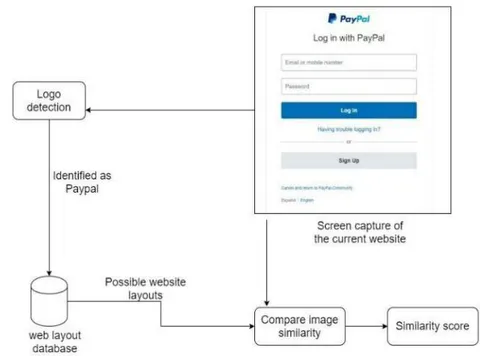
This is one of the most important stages in the system, and the goal is to categorize websites to make it easier to compare with the legitimate website layouts . Figure 2 depicts how the system uses computer vision to identify the current website.
a) Logo Detection
For this prototype, the logo detector can identify 20 image classes, including the most popular banks in Sri Lanka, and mostly used international websites. The logo detection model was trained using the Tensor Flow software library on Google Colab. NoFish team trained several Tensor Flow object detection models [16] with our own dataset, and in every case, it returned the same accuracy levels. Those models are mentioned in the test results section, along with the accuracy rates obtained.
Since the website login pages are not very complex images, the model can classify the logos with high accuracy. Therefore, we selected faster_rcnn_inception_v2_coco as our logo detection model and train with our own dataset to identify 20 different logos with high accuracy.
d) Compare Web Page Similarity
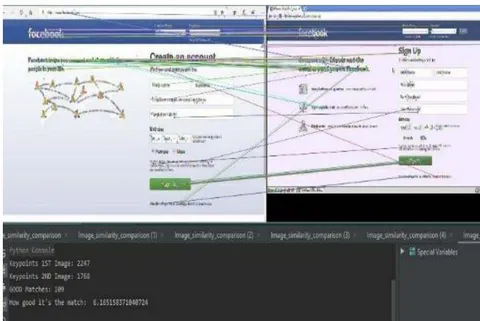
NoFish has developed this algorithm using the OpenCV python library to identify the similarity between the current website and the legitimate website. First, the algorithm identifies key points in both images and compares them to identify matching key points. Then defines a rating of similarity from 0 to 10, where 0 means they are completely different and 10 means they are perfectly matched. Based on the score, the system defines security levels. If the score is greater than 5 it defines as a high possibility, and if the score is greater than 3 and lower than 5 it will define as low possibility. Then the system returns a warning to the user accordingly, as depicted in Figure 3.
VII. EMAIL PHISHING DETECTION
a) Proposed Model for Email Phishing Detection
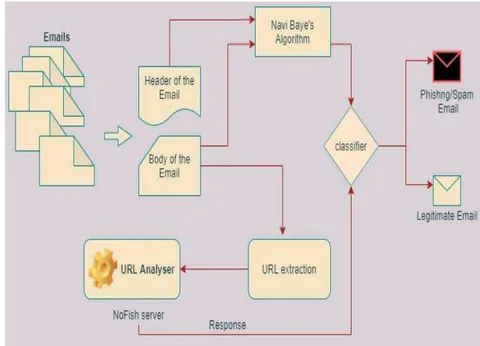
b) Detect spam emails
Our team has tested both the Naïve Bayes Algorithm (20) and Support Vector Machine (SVM) algorithms to detect spam emails. According to the test results, the Naïve Bayes Algorithm was used to detect spam emails. Test results are discussed in the section test results.
2) Detect phishing URLs in emails
VIII. INTERACTIVE DASHBOARD
NoFish system provides a user interactive dashboard to enhance the user experience. Users may use the interactive dashboard through the official site. It provides features for the user to explore more services that are provided by NoFish systems, such as feedback mechanism. Users can vote for black-listed URLs to verify it as a phishing or malicious website. This may be used after installing NoFish extension to the web browser.
IX. DETECTING DNS BASED ATTACKS
When the user is connecting to a WiFi network first, the system checks whether it was saved in the user's computer. If it is a saved WiFi system, assume that it is a trusted connection. When the user is connecting to a new WiFi network, then the system checks whether the WiFi connection requires a WPA or
WPA2 password. If not it is probably not secure. Further, to identify accurately, the system will ask the user whether it is public WiFi or trusted WiFi. If the WiFi is identified as untrusted, then the system will check for DNS related phishing attacks . To identifying a fake DNS author , proposed a solution that gives the IP address of the domain name of the current website using the IP Lookup API. Then using that IP address, the system can do a reverse IP lookup from the server-side and get the domain name, and by that, the system will define the DNS server is malicious or not .
X. TEST RESULTS
In order to choose a model for logo detection our team trained several pertained models chosen from Tensor Flow object detection API with our own data set. Those models are mentioned below, along with the accuracy rates obtained.
Faster_rcnn_inception_v2_coco model has a running time of 58ms per 600x600 image with mAP [1] measure of 28 – over 95% accuracy.
Ssd_mobilenet_v2_coco model has a running time of 31ms per 600x600 image with mAP [1] measure of 22 – over 95% accuracy.
Faster_rcnn_inception_resnet_v2_atrous_coco model has a running time of 620ms per 600x600 image with mAP [1] measure of 37 – over 95% accuracy.
When evaluating the URL analyzer, all the algorithms were tested separately with large phishing and legitimate data sets and Random Forest Classifier returned 96.257%, Decision Tree Classifier returned 84.119%, Logistic Regression Classifier returned 91.037%, Support Vector Machine returned 91.002%, and Navy Bayes returned 94.128% accuracies respectively. Consequently, in order to obtain a better accuracy level, NoFish has ensemble all four algorithms together and created a finalized model combining NLP based features in it. NoFish uses 16 features of URLs for identifying phishing patterns of a URL. It gives nearly the best performance with a 94% model accuracy rate for the detection of phishing URLs.
XI. CONCLUSION AND RECOMMENDATIONS
In order to prevent phishing, business and consumers need to educate themselves about phishing and anti-phishing techniques. They should use current protection methods and report suspicious activities. By doing so, they can reduce their exposure to fraud and identity theft and protect their privacy. The most effective solution for phishing is to train users not to blindly follow links to websites that need to include sensitive information such as passwords. The ultimate technological solution to phishing is the significant infrastructure changes on the Internet that exceed the ability of any organization to deploy. However, there are steps that can now be taken to reduce the consumer's risk of phishing attacks. Some of those steps are:
For Corporations
Stronger authentication on websites and emails.
Implement a good quality anti-virus, anti-spam, and content filtering solutions at the internet gateway.
For Consumers
Be suspicious.
Automatically detect and block malicious emails, websites, URLs, and DNS servers.
Automatically block sensitive information from leaking to malicious parties.