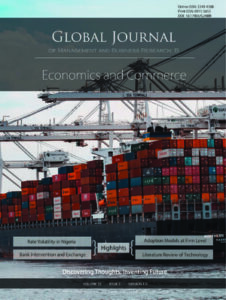
Non-Linear Causal Link between Central Bank Intervention and Exchange Rate Volatility in Nigeria

α
Ali Umar Ahmad
Ali Umar Ahmad
σ
Suraya Ismail
Suraya Ismail
ρ
Siba Dayyabu
Siba Dayyabu
Ѡ
Ahmad Azrin Adnan
Ahmad Azrin Adnan
¥
Ibrahim Sambo Farouq
§
Aminu Hassan Jakada
Aminu Hassan Jakada
χ
Umar Aliyu Mustapha
Umar Aliyu Mustapha

Send Message

To: Author

Non-Linear Causal Link between Central Bank Intervention and Exchange Rate  Volatility in Nigeria

Article Fingerprint

ReserarchID

X3M6J

Non-Linear Causal Link between Central Bank Intervention and Exchange Rate  Volatility in Nigeria Banner

AI TAKEAWAY

Connecting with the Eternal Ground
  • English
  • Afrikaans

  • Albanian
  • Amharic
  • Arabic
  • Armenian
  • Azerbaijani
  • Basque
  • Belarusian
  • Bengali
  • Bosnian
  • Bulgarian
  • Catalan
  • Cebuano
  • Chichewa
  • Chinese (Simplified)
  • Chinese (Traditional)
  • Corsican
  • Croatian
  • Czech
  • Danish
  • Dutch
  • Esperanto
  • Estonian
  • Filipino
  • Finnish
  • French
  • Frisian
  • Galician
  • Georgian
  • German
  • Greek
  • Gujarati
  • Haitian Creole
  • Hausa
  • Hawaiian
  • Hebrew
  • Hindi
  • Hmong
  • Hungarian
  • Icelandic
  • Igbo
  • Indonesian
  • Irish
  • Italian
  • Japanese
  • Javanese
  • Kannada
  • Kazakh
  • Khmer
  • Korean
  • Kurdish (Kurmanji)
  • Kyrgyz
  • Lao
  • Latin
  • Latvian
  • Lithuanian
  • Luxembourgish
  • Macedonian
  • Malagasy
  • Malay
  • Malayalam
  • Maltese
  • Maori
  • Marathi
  • Mongolian
  • Myanmar (Burmese)
  • Nepali
  • Norwegian
  • Pashto
  • Persian
  • Polish
  • Portuguese
  • Punjabi
  • Romanian
  • Russian
  • Samoan
  • Scots Gaelic
  • Serbian
  • Sesotho
  • Shona
  • Sindhi
  • Sinhala
  • Slovak
  • Slovenian
  • Somali
  • Spanish
  • Sundanese
  • Swahili
  • Swedish
  • Tajik
  • Tamil
  • Telugu
  • Thai
  • Turkish
  • Ukrainian
  • Urdu
  • Uzbek
  • Vietnamese
  • Welsh
  • Xhosa
  • Yiddish
  • Yoruba
  • Zulu

Abstract

The continued volatility of the Naira / USD exchange rate has attracted the attention of Nigeria’s Central Bank (CBN) to engage in the foreign exchange market. This study aims to examine the long-run relationship between interventions on the foreign exchange market and the Naira / USD exchange rate. Regarding four variables, the analysis uses annual data, namely the: Naira / USD exchange rate, money supply, net foreign assets, and interest rates from 1980-2018. This research also used non-linear unit root, cointegration and causality testing approach. The non-linear unit root tests for stationarity by KSS and Breitung showed that the variables employed were stationary at the first difference. Besides, nonlinear Breitung cointegration tests showed the existence of the long-term relationship between foreign market interventions and the Naira / USD exchange rate.

References

69 Cites in Article
  1. M Adebiyi (1986). Unknown Title.
  2. Özge Akinci,Olcay Çulha,Ümit Özlale,Gülbin Şahinbeyoğlu (2005). The effectiveness of foreign exchange interventions under a floating exchange rate regime for the Turkish economy: a post-crisis period analysis.
  3. A Alawiye (2013). CBN Defend Naira with $18.7bn.
  4. Shehu Aliyu (2009). Exchange Rate Volatility and Export Trade in Nigeria: An Empirical Investigation.
  5. K Ardalan (2004). The Monetary Approach to Balance of Payments: A Review of the Seminal Long-Run Empirical Research.
  6. N Balke,T Fomby (1997). Threshold Cointegration.
  7. K Basu,A Varoudakis (2013). How to move the exchange rate if you must: The diverse practice of foreign exchange intervention by central banks and a proposal for doing it better.
  8. H Behera,M Beine,J Lahaye,S Laurent,C Neely,F Palm (2007). Central Bank Intervention and Exchange Rate Volatility, It is Continuous and Jumps Components.
  9. Catherine Bonser‐neal,V Roley,Gordon Sellon, Jr. (1998). Monetary Policy Actions, Intervention, and Exchange Rates: A Reexamination of the Empirical Relationships Using Federal Funds Rate Target Data.
  10. Jörg Breitung (2002). Nonparametric tests for unit roots and cointegration.
  11. John Campbell,Pierre Perron (1991). Pitfalls and Opportunities: What Macroeconomists Should Know about Unit Roots.
  12. Calebe De Roure,Steven Furnagiev,Stefan Reitz (2015). The microstructure of exchange rate management: FX intervention and capital controls in Brazil.
  13. David Dejong,John Nankervis,N Savin,Charles Whiteman (1992). The power problems of unit root test in time series with autoregressive errors.
  14. Cees Diks,Valentyn Panchenko (2006). A new statistic and practical guidelines for nonparametric Granger causality testing.
  15. Piti Disyatat,Gabriele Galati (2007). The effectiveness of foreign exchange intervention in emerging market countries: Evidence from the Czech koruna.
  16. I Domaç,A Mendoza (2004). Is There Room for Foreign Exchange Interventions under an Inflation Targeting Framework? Evidence from Mexico and Turkey. Evidence from Mexico and Turkey.
  17. Kathryn Dominguez (1998). Central bank intervention and exchange rate volatility.
  18. Kathryn Dominguez (2003). The market microstructure of central bank intervention.
  19. J Edison (1993). New Proposals for the International Finance of Development, par N. F. WANG. Une brochure, 6 po. x 9, 27 pages. — INTERNATIONAL FINANCE SECTION, DEPARTMENT OF ECONOMICS, PRINCETON UNIVERSITY, Princeton, New Jersey, 1967..
  20. Walter Enders,Pierre Siklos (2001). Cointegration and Threshold Adjustment.
  21. Robert Engle,C Granger (1987). Co-Integration and Error Correction: Representation, Estimation, and Testing.
  22. Rasmus Fatum,Michael Hutchison (2009). Effectiveness of Official Daily Foreign Exchange Market Intervention Operations in Japan.
  23. Rasmus Fatum,Michael Hutchison (2006). Effectiveness of official daily foreign exchange market intervention operations in Japan.
  24. Jeffrey Frankel (1984). MONETARY AND PORTFOLIO-BALANCE MODELS OF EXCHANGE RATE DETERMINATION.
  25. M Frenkel,C Pierdzioch,G Stadtmann (2005). The effects of Japanese foreign exchange market interventions on the yen/US dollar exchange rate volatility.
  26. Renée Fry-Mckibbin,Sumila Wanaguru (2013). Currency intervention: A case study of an emerging market.
  27. Roberto Guimaraes,Cem Karacadag (2004). The Empirics of Foreign Exchange Intervention in Emerging Market Countries: the Cases of Mexico and Turkey.
  28. Søren Johansen (1988). Statistical analysis of cointegration vectors.
  29. Soren Johansen (1991). Estimation and Hypothesis Testing of Cointegration Vectors in Gaussian Vector Autoregressive Models.
  30. Søren Johansen,Katarina Juselius (1990). MAXIMUM LIKELIHOOD ESTIMATION AND INFERENCE ON COINTEGRATION — WITH APPLICATIONS TO THE DEMAND FOR MONEY.
  31. G Kaminsky,K Lewis (1996). Does foreign exchange intervention signal future monetary policy.
  32. E Kohlscheen (2013). Long-Run Determinants of the Brazilian Real: A Closer Look at Commodities.
  33. B Komolafe (2015). Nigeria central bank will struggle to defend the naira.
  34. Y Kurihara (2011). Official intervention in the foreign exchange market.
  35. E Lahura,M Vega (2013). Asymmetric effects of FOREX intervention using intraday data: evidence from Peru.
  36. V Liew (2004). Which lag length selection criteria should we employ?.
  37. M Mehdi,W Iqbal,J Sheikh,S Ul Deen (2012). Central Bank Intervention in the Foreign Exchange Market and Exchange Rate Volatility: Evidence from Pakistan.
  38. K Miyajima,C Montoro (2013). Impact of Foreign Exchange Interventions on Exchange Rate Expectations.
  39. Suraya Aziz,Muhammad Mohamad,Reena Md Zin (2009). Histopathological Correlation of Breast Carcinoma with Breast Imaging-Reporting and Data System.
  40. M Mussa (1984). Exchange Rate Regimes in Theory and Practice.
  41. K Mwansa (1995). Unknown Title.
  42. V Newman,C Potter,M Wright (2011). Foreign Exchange Market Intervention.
  43. C Nweze (2015). New moves may modestly help Nigeria steady the naira.
  44. M Obadan (2006). Overview of Exchange Rate Management in Nigeria from 1986 to Date.
  45. J Omojolaibi,A Gbadebo (2014). Foreign Exchange Intervention and Monetary Aggregates: Nigerian Evidence.
  46. Ibrahim Onour (2008). Financial Integration of GCC Capital Markets: Evidence of Nonlinear Cointegration.
  47. O Oyinbo,G Rekwot (2014). Econometric Analysis of the Nexus of Exchange Rate Deregulation and Agricultural Share of Gross Domestic Product in Nigeria.
  48. S Pattanaik,S Sahoo (2001). The Effectiveness of Intervention in India: An Empirical Assessment.
  49. Stefan Reitz,Mark Taylor (2012). FX intervention in the Yen-US dollar market: a coordination channel perspective.
  50. J Sanusi (2004). Exchange Rate and Inflation Rate Nexus: The Nigerian Experience.
  51. Lucio Sarno,Mark Taylor (2001). Official Intervention in the Foreign Exchange Market: Is It Effective and, If So, How Does It Work?.
  52. Robert Schmidt,Timo Wollmershaeuser (2004). Sterilized Foreign Exchange Market Interventions in a Chartist-Fundamentalist Exchange Rate Model.
  53. G Schnabl,E Hillebrand (2008). A Structural Break in the Effects of Japanese Foreign Exchange Intervention on yen/dollar Exchange Rate Volatility.
  54. D Seerattan (2012). Figure 4.9. Bank of Russia interventions on the foreign exchange market.
  55. Dave Seerattan,Nicola Spagnolo (2009). Central bank intervention and foreign exchange markets.
  56. Jeffrey Shafer,Bonnie Loopesko,Ralph Bryant,Rudiger Dornbusch (1983). Floating Exchange Rates after Ten Years.
  57. M Simatele (2003). Financial Sector Reforms and Monetary Policy in Zambia.
  58. C Sims (1972). Money, Income, and Causality.
  59. Kisu Simwaka,Leslie Mkandawire (1123). The Efficacy of Official Intervention in the Foreign Exchange Market in Malawi.
  60. K Simwaka,L Mkandawire (2011). the efficacy of foreign exchange market intervention in Malawi.
  61. Kisu Simwaka,Leslie Mkandawire (2012). The Efficacy of Official Intervention in the Foreign Exchange Market in Malawi.
  62. M Spolander (1999). Measuring Exchange Market Pressure and Central Bank Intervention.
  63. M Stigler (2010). Threshold Cointegration: Overview and Implementation in R.
  64. Chi-Wei Su (2011). Non-linear causality between the stock and real estate markets of Western European countries: Evidence from rank tests.
  65. Chor Tang,Soo Chua (2009). The savings-growth nexus for the Malaysian economy: a view through rolling sub-samples.
  66. M Taylor (1995). The Economics of Exchange Rates.
  67. H Vargas,A González,D Rodríguez (2013). 155 Intervention in foreign exchange markets: the approach of the Reserve Bank of India.
  68. M Waheed (2010). Foreign exchange intervention and sterilization: an investigation of State Bank of Pakistan"s Reaction Function.
  69. A Zubair,G Okorie,A Sanusi (2013). Exchange Rate Pass-Through to Domestic Prices in Nigeria: An Empirical Investigation.

Funding

No external funding was declared for this work.

Conflict of Interest

The authors declare no conflict of interest.

Ethical Approval

No ethics committee approval was required for this article type.

Data Availability

Not applicable for this article.

How to Cite This Article

Ali Umar Ahmad. 2020. \u201cNon-Linear Causal Link between Central Bank Intervention and Exchange Rate Volatility in Nigeria\u201d. Global Journal of Management and Business Research - B: Economic & Commerce GJMBR-B Volume 20 (GJMBR Volume 20 Issue B6): .

Download Citation

Issue Cover
GJMBR Volume 20 Issue B6
Pg. 17- 29
Journal Specifications

Crossref Journal DOI 10.17406/GJMBR

Print ISSN 0975-5853

e-ISSN 2249-4588

Keywords
Classification
GJMBR-B Classification: JEL Code: E58
Version of record

v1.2

Issue date

May 30, 2020

Language
en
Experiance in AR

Explore published articles in an immersive Augmented Reality environment. Our platform converts research papers into interactive 3D books, allowing readers to view and interact with content using AR and VR compatible devices.

Read in 3D

Your published article is automatically converted into a realistic 3D book. Flip through pages and read research papers in a more engaging and interactive format.

Article Matrices
Total Views: 2296
Total Downloads: 1117
2026 Trends
Related Research

Published Article

The continued volatility of the Naira / USD exchange rate has attracted the attention of Nigeria’s Central Bank (CBN) to engage in the foreign exchange market. This study aims to examine the long-run relationship between interventions on the foreign exchange market and the Naira / USD exchange rate. Regarding four variables, the analysis uses annual data, namely the: Naira / USD exchange rate, money supply, net foreign assets, and interest rates from 1980-2018. This research also used non-linear unit root, cointegration and causality testing approach. The non-linear unit root tests for stationarity by KSS and Breitung showed that the variables employed were stationary at the first difference. Besides, nonlinear Breitung cointegration tests showed the existence of the long-term relationship between foreign market interventions and the Naira / USD exchange rate.

Our website is actively being updated, and changes may occur frequently. Please clear your browser cache if needed. For feedback or error reporting, please email [email protected]

Request Access

Please fill out the form below to request access to this research paper. Your request will be reviewed by the editorial or author team.
X

Quote and Order Details

Contact Person

Invoice Address

Notes or Comments

This is the heading

Lorem ipsum dolor sit amet, consectetur adipiscing elit. Ut elit tellus, luctus nec ullamcorper mattis, pulvinar dapibus leo.

High-quality academic research articles on global topics and journals.

Non-Linear Causal Link between Central Bank Intervention and Exchange Rate Volatility in Nigeria

Ali Umar Ahmad
Ali Umar Ahmad
Suraya Ismail
Suraya Ismail
Siba Dayyabu
Siba Dayyabu
Ahmad Azrin Adnan
Ahmad Azrin Adnan
Ibrahim Sambo Farouq
Aminu Hassan Jakada
Aminu Hassan Jakada
Umar Aliyu Mustapha
Umar Aliyu Mustapha

Research Journals