Nine varieties of maize (Zea mays L.) namely H4226, RAJAJI, TMMH826, TATA 849, KAVERI 25K-60, RMH 1818, KANAK, BISCO-940 and RASI 4640 were evaluated on thirteen parameters in a randomized block design with three replications. The objectives of the experiment were to select suitable plant types based on considering all the thirteen parameters, suggesting scope for further improvement and recommending suitable maize ideotypes for cultivation by farmers of this region. Normalized cumulative ranks analysis found BISCO-940, KAVERI 25K-60, H4226, TATA 849 and TMMH826 to be top five varieties that could be recommended to farmers for cultivation on the criteria of less number of leaves per plant, small and narrow leaves with high venation, early tasseling and silking, dwarf plant types with lower cob placement, long cobs with less number of bracts for ease of peeling off the cobs and thick cobs with more kernels and kernel rows.
## I. INTRODUCTION
Maize (Zea mays L.) is grown globally in a wide range of environments. However, local field conditions of farmers might suit some specific varieties and farmers might try to look for such suitable varieties based on their criteria of selection. Donald 1968 gave the concept of crop ideotype and since then a lot of crop-ideotypes have been suggested. Here in this experiment, we examine nine maize varieties on thirteen characters viz., leaves/plant, leaf length, leaf width, days to tasseling, days to silking, leaf venation, plant height, cob length, cob placement, number of bracts, number of kernel rows, kernels per row and cob diameter. The idea is to look for maize ideotype with less number of leaves per plant, small and narrow leaves with high venation index, early tasseling and silking, dwarf plant types with lower cob placement, long cobs with less number of bracts for ease of peeling off the bracts from cob and thick cobs with more kernels and kernel rows.
## II. MATERIALS AND METHODS
Nine maize varieties as listed in tables were evaluated on thirteen parameters as mentioned above in the introduction. The data were recorded on five randomly selected plants in each replication. The average values are given in table 1. These values were ranked to make them unitless so that the transformed data become additive. All the ranks of a variety were summed to get cumulative rank (CR) and CR values were divided by minimum value to get normalized cumulative ranks (NCR). These are given in table 2. On sorting table 2 on CR or NCR values in increasing order, we get table 3.
Table 4.1: Average values of three replications
<table><tr><td rowspan="2">Sort order (rows) VARIETY (down)</td><td>Leaves/plant</td><td>Leaf length (cm)</td><td>Leaf width (cm)</td><td>DAYS TO TASSELING</td><td>DAYS TO SILKING</td><td>LEAF V. INDEX</td><td>PLANT HEIGHT</td><td>EAR LENGTH</td><td>COB PLACEMENT</td><td>NO. OF BRACTS</td><td>No. of kernel rows</td><td>kernels /row</td><td>COB DIAMETER</td></tr><tr><td>1</td><td>1</td><td>1</td><td>1</td><td>1</td><td>0</td><td>1</td><td>0</td><td>1</td><td>1</td><td>0</td><td>0</td><td>0</td></tr><tr><td>H4226</td><td>11</td><td>34.46</td><td>5.18</td><td>48</td><td>52</td><td>3.09</td><td>153.5</td><td>37.26</td><td>41.23</td><td>13</td><td>17</td><td>33</td><td>3.83</td></tr><tr><td>RAJAJI</td><td>13</td><td>47.03</td><td>5.8</td><td>50</td><td>53</td><td>2.58</td><td>127.1</td><td>41.17</td><td>53.55</td><td>11</td><td>14</td><td>31</td><td>3.85</td></tr><tr><td>TMMH826</td><td>13</td><td>43.09</td><td>4.16</td><td>47</td><td>51</td><td>3.6</td><td>107</td><td>42.64</td><td>44.6</td><td>12</td><td>15</td><td>27</td><td>3.75</td></tr><tr><td>TATA 849</td><td>12</td><td>34.92</td><td>4.66</td><td>52</td><td>54</td><td>2.79</td><td>116.4</td><td>38.41</td><td>44.45</td><td>12</td><td>15</td><td>33</td><td>3.84</td></tr><tr><td>KAVERI 25K-60</td><td>12</td><td>28.87</td><td>3.77</td><td>55</td><td>59</td><td>4.51</td><td>121.7</td><td>39.99</td><td>44.83</td><td>10</td><td>15</td><td>31</td><td>3.77</td></tr><tr><td>RMH 1818</td><td>11</td><td>35.06</td><td>5.03</td><td>52</td><td>55</td><td>2.78</td><td>108.3</td><td>37.91</td><td>48.42</td><td>10</td><td>13</td><td>32</td><td>4</td></tr><tr><td>KANAK</td><td>12</td><td>34.45</td><td>4.4</td><td>63</td><td>66</td><td>3.41</td><td>104.6</td><td>34.04</td><td>41.61</td><td>9</td><td>14</td><td>16</td><td>3.77</td></tr><tr><td>BISCO-940</td><td>12</td><td>28.9</td><td>3.82</td><td>63</td><td>66</td><td>3.66</td><td>94.91</td><td>34.03</td><td>32.9</td><td>11</td><td>15</td><td>33</td><td>3.95</td></tr><tr><td>RASI 4640</td><td>12</td><td>33.46</td><td>5.17</td><td>61</td><td>64</td><td>2.32</td><td>114.6</td><td>35.42</td><td>45.8</td><td>10</td><td>14</td><td>33</td><td>4.18</td></tr><tr><td rowspan="2">Sort order (rows) VARIETY (down)</td><td>Leaves/plant</td><td>Leaf length (cm)</td><td>Leaf width (cm)</td><td>DAYS TO TASSELING</td><td>DAYS TO SILKING</td><td>LEAF V. INDEX</td><td>PLANT HEIGHT</td><td>EAR LENGTH</td><td>COB PLACEMENT</td><td>NO. OF BRACTS</td><td>No. of kernel rows</td><td>kernels /row</td><td>COB DIAMETER</td><td rowspan="2">CR</td><td rowspan="2">NCR</td></tr><tr><td>1</td><td>1</td><td>1</td><td>1</td><td>1</td><td>0</td><td>1</td><td>0</td><td>1</td><td>1</td><td>0</td><td>0</td><td>0</td></tr><tr><td>H4226</td><td>1</td><td>5</td><td>8</td><td>2</td><td>2</td><td>5</td><td>9</td><td>6</td><td>2</td><td>9</td><td>1</td><td>1</td><td>6</td><td>57</td><td>1.21</td></tr><tr><td>RAJAJI</td><td>8</td><td>9</td><td>9</td><td>3</td><td>3</td><td>8</td><td>8</td><td>2</td><td>9</td><td>5</td><td>6</td><td>6</td><td>4</td><td>80</td><td>1.7</td></tr><tr><td>TMMH826</td><td>8</td><td>8</td><td>3</td><td>1</td><td>1</td><td>3</td><td>3</td><td>1</td><td>5</td><td>7</td><td>2</td><td>8</td><td>9</td><td>59</td><td>1.26</td></tr><tr><td>TATA 849</td><td>3</td><td>6</td><td>5</td><td>4</td><td>4</td><td>6</td><td>6</td><td>4</td><td>4</td><td>7</td><td>2</td><td>1</td><td>5</td><td>57</td><td>1.21</td></tr><tr><td>KAYERI 25K-60</td><td>3</td><td>1</td><td>1</td><td>6</td><td>6</td><td>1</td><td>7</td><td>3</td><td>6</td><td>2</td><td>2</td><td>6</td><td>7</td><td>51</td><td>1.09</td></tr><tr><td>RMH 1818</td><td>1</td><td>7</td><td>6</td><td>4</td><td>5</td><td>7</td><td>4</td><td>5</td><td>8</td><td>2</td><td>9</td><td>5</td><td>2</td><td>65</td><td>1.38</td></tr><tr><td>KANAK</td><td>3</td><td>4</td><td>4</td><td>8</td><td>8</td><td>4</td><td>2</td><td>8</td><td>3</td><td>1</td><td>6</td><td>9</td><td>7</td><td>67</td><td>1.43</td></tr><tr><td>BISCO-940</td><td>3</td><td>2</td><td>2</td><td>8</td><td>8</td><td>2</td><td>1</td><td>9</td><td>1</td><td>5</td><td>2</td><td>1</td><td>3</td><td>47</td><td>1</td></tr><tr><td>RASI 4640</td><td>3</td><td>3</td><td>7</td><td>7</td><td>7</td><td>9</td><td>5</td><td>7</td><td>7</td><td>2</td><td>6</td><td>1</td><td>1</td><td>65</td><td>1.38</td></tr></table>
## III. RESULTS AND DISCUSSION
Table 3 shows the preference order of varieties that should be considered by farmers for selecting suitable maize ideotype for cultivation in their fields in this region. Thus top five varieties namely BISCO-940, KAYERI 25K-60, H4226, TATA 849 and TMMH826 could be recommended for trials. As per table 3, the most suitable variety BISCO-940 could be improved further by paying attention to characters like cob length (ranking $9^{\text{th}}$ ) and days to tasseling and days to silking (both ranking $8^{\text{th}}$ ) by crossing it with TMMH826 (ranking $1^{\text{st}}$ in all these three characters). The equal values of CR (and hence NCR) of H4226 and TATA 849 indicate that although both these varieties are equally good, yet they may differ in their ranks of various characters like plant height and number of bracts. If, by chance, the cross between BISCO-940 and TMMH826 proves to be heterotic, then a hybrid between these may be thought of and tried. Otherwise synthetic and composite varieties could be tried involving top few varieties. Thus, this analysis opens up a lot of potentials in maize breeding and recommending suitable maize ideotypes. Inbreds could also be analyzed like this to make single cross hybrids or try other potentials. This analysis has been used in many other crops also (Singh 2017, 2018; Singh and Kant 2022, Singh et al. 2018; Singh and Tiwari 2020 and Yadav et al. 2020). The top performer maize variety of this experiment BISCO-940 is also compared graphically as shown in Figure 1 with the maize ideotype being imagined. This graph shows scope for further improvement in most of the characters of the top performer maize variety BISCO-940 except plant height, cob placement and kernel rows. This means that BISCO-940 is at par with maize ideotype in these three characters only. Rest of the characters need maize breeders' attention to improve this variety further.
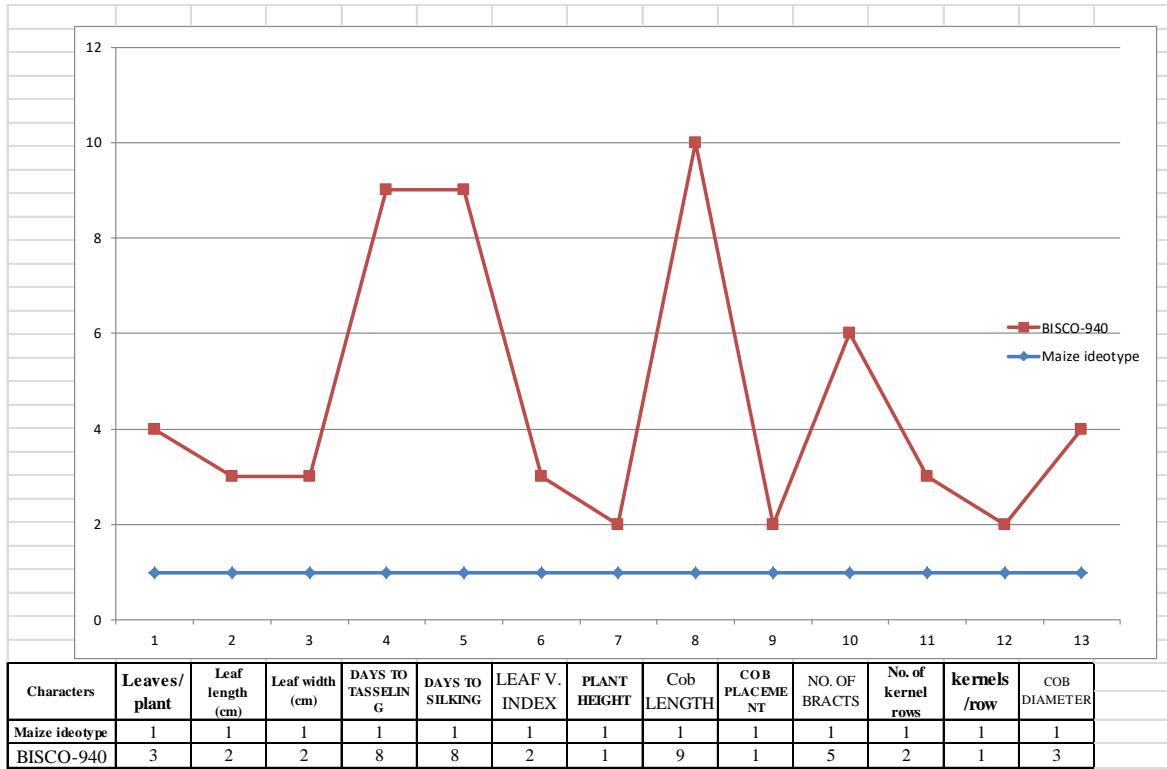 Figure 1: BISCO-940 compared graphically with the maize ideotype being imagined here
Table 4.3: Same as table 2 but after sorting on CR or NCR values in increasing order
<table><tr><td rowspan="2">Sort order (rows) VARIETY (down)</td><td>Leaves/plant</td><td>Leaf length (cm)</td><td>Leaf width (cm)</td><td>DAYS TO TASSELING</td><td>DAYS TO SILKING</td><td>LEAF V. INDEX</td><td>PLANT HEIGHT</td><td>EAR LENGTH</td><td>COB PLACEMENT</td><td>NO. OF BRACTS</td><td>No. of kernel rows</td><td>kernels /row</td><td>COB DIAMETER</td><td rowspan="2">CR</td><td rowspan="2">NCR</td></tr><tr><td>1</td><td>1</td><td>1</td><td>1</td><td>1</td><td>0</td><td>1</td><td>0</td><td>1</td><td>1</td><td>0</td><td>0</td><td>0</td></tr><tr><td>BISCO-940</td><td>3</td><td>2</td><td>2</td><td>8</td><td>8</td><td>2</td><td>1</td><td>9</td><td>1</td><td>5</td><td>2</td><td>1</td><td>3</td><td>47</td><td>1</td></tr><tr><td>KAVERI 25K-60</td><td>3</td><td>1</td><td>1</td><td>6</td><td>6</td><td>1</td><td>7</td><td>3</td><td>6</td><td>2</td><td>2</td><td>6</td><td>7</td><td>51</td><td>1.09</td></tr><tr><td>H4226</td><td>1</td><td>5</td><td>8</td><td>2</td><td>2</td><td>5</td><td>9</td><td>6</td><td>2</td><td>9</td><td>1</td><td>1</td><td>6</td><td>57</td><td>1.21</td></tr><tr><td>TATA 849</td><td>3</td><td>6</td><td>5</td><td>4</td><td>4</td><td>6</td><td>6</td><td>4</td><td>4</td><td>7</td><td>2</td><td>1</td><td>5</td><td>57</td><td>1.21</td></tr><tr><td>TMMH826</td><td>8</td><td>8</td><td>3</td><td>1</td><td>1</td><td>3</td><td>3</td><td>1</td><td>5</td><td>7</td><td>2</td><td>8</td><td>9</td><td>59</td><td>1.26</td></tr><tr><td>RMH 1818</td><td>1</td><td>7</td><td>6</td><td>4</td><td>5</td><td>7</td><td>4</td><td>5</td><td>8</td><td>2</td><td>9</td><td>5</td><td>2</td><td>65</td><td>1.38</td></tr><tr><td>RASI 4640</td><td>3</td><td>3</td><td>7</td><td>7</td><td>7</td><td>9</td><td>5</td><td>7</td><td>7</td><td>2</td><td>6</td><td>1</td><td>1</td><td>65</td><td>1.38</td></tr><tr><td>KANAK</td><td>3</td><td>4</td><td>4</td><td>8</td><td>8</td><td>4</td><td>2</td><td>8</td><td>3</td><td>1</td><td>6</td><td>9</td><td>7</td><td>67</td><td>1.43</td></tr><tr><td>RAJAJI</td><td>8</td><td>9</td><td>9</td><td>3</td><td>3</td><td>8</td><td>8</td><td>2</td><td>9</td><td>5</td><td>6</td><td>6</td><td>4</td><td>80</td><td>1.7</td></tr></table>
## IV. SUMMARY AND CONCLUSIONS
On critical examination of tables 1, 2 and 3, it could be safely concluded that top few (say five) varieties namely BISCO-940, KAYERI 25K-60, H4226, TATA 849 and TMMH826 could be recommended to farmer of this region for trials. On the other hand, maize breeders may try hybrid, synthetic and/or composite varieties involving these varieties in various combinations. This analysis could also involve screening inbreds, mutants and all kinds of variants for maize breeding.
Generating HTML Viewer...
References
7 Cites in Article
C Donald (1968). The breeding of crop ideotypes.
S Singh (2017). Normalized Cumulative Ranks for Plant Breeding: An Example.
Mohit Pandey,Dan Singh,Akanksha Singh (2018). KNOWLEDGE AND ADOPTION LEVEL OF FARMERS WITH RESPECT TO PACKAGE OF PRACTICES OF BASMATI RICE CULTIVATION.
S Singh,S Kant (2022). Varietal selection, recommendation and comparison with crop ideotype.
S Singh,R Sahu,Tarkeshwar (2018). Development of Betalain Producing Callus Lines from Colored Quinoa Varieties (Chenopodium quinoa Willd).
S Singh,U Tiwari (2020). Hexaploid Wheat (Triticum aestivum L. em Thell).
M Yadav,S Singh,R Tarkeshwar,Sahu,K Kumar,P Yadav (2020). Selecting Suitable Wheat (Triticum aestivum L.) Variety for Gorakhpur and Deoria Region through Normalized Cumulative Ranks.
Explore published articles in an immersive Augmented Reality environment. Our platform converts research papers into interactive 3D books, allowing readers to view and interact with content using AR and VR compatible devices.
Your published article is automatically converted into a realistic 3D book. Flip through pages and read research papers in a more engaging and interactive format.
Our website is actively being updated, and changes may occur frequently. Please clear your browser cache if needed. For feedback or error reporting, please email [email protected]
Thank you for connecting with us. We will respond to you shortly.