
I. INTRODUCTION
By the term "normative" we mean the existence of some external, fully informed and disinterested observer in the historical process. The normative model of history is built from the point of view of just such an observer. Note that this is not only some methodological preset. Looking ahead, we note that the presence of an external observer, from the point of view of which history is modeled, makes it possible to build a single, global historical space and time. If we follow Hegel [1], then, in essence, the external observer is an "absolute idea" or "world spirit". Previously, this mathematical model of global history was published in Russian [2,3].
Consider the global political system, a schematic view of which is shown in Figure 1. Let's formally represent it as a set of some atoms, which we will further call patoms (short for Political ATOM). We need a patom only to the extent that it is indivisible and indestructible.
Let's give the concept of "patom" a concrete content. Since we are interested in describing phenomena of a global scale, it is natural to consider under the patom, first of all, large political and territorial formations. This approach is typical in general for such disciplines as political geography and geopolitics. In connection with the chosen interpretation, it is natural to call a patom a "geopatom" (short for GEO Political ATOM). It should be noted that the choice of a geopatom as a patom makes it possible to maximize the scope of the studied historical interval, during which the patom can be considered indivisible and indestructible.
Depending on the goals of modeling certain aspects of history, it may turn out that the set of patoms is not limited to geopatoms. In this case, nothing prevents us from identifying other patoms comparable in importance and scale to geopatoms and also responsible for world political dynamics. For example, religious, ethnic, ideological and other factors can be "atomized" and introduced into the general set of patoms of the global political system. In this regard, one of the main tasks of modeling will be to identify the necessary and sufficient set of patoms to describe the world historical dynamics. In the future, we proceed from the hypothesis that this set is limited to geopatoms. At the same time, the state structure of the political system is considered secondary in relation to geopatoms, which are primary.
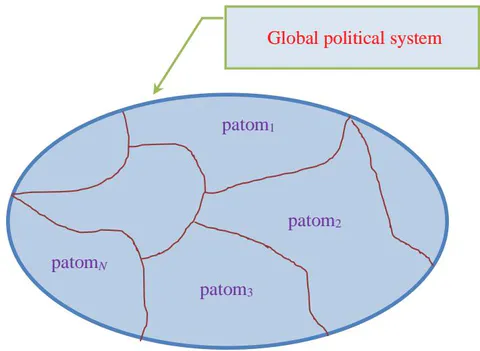
Figure 2 shows the modern global political system from the point of view of a set of individual states acting as geopatoms. Due to the fact that states can arise (for example, modern Israel was formed in 1948) and disintegrate (for example, the collapse of the USSR occurred in 1991), their dynamics sets the time dimensions during which geopatoms-states can be considered indivisible and indestructible.
What can we say about the number of geopatoms? What is their internal difference? Some of the answers to these questions are given by political geography [4] and geopolitics [5,6]. For us at this stage, it is only important that there is some finite number of them . So, let the political system contain geopatoms. We assign them the number and introduce the set . We will assume that geopatoms can enter into various alliances: bi-, tripartite, etc.
An arbitrary union is a subset of the set , i.e. , , where — numbers of geopatoms, while they are pairwise different and their order is not significant. An arbitrary union is also an element of the set , which is the set of all subsets of the set , i.e. . Let us define the rank of an arbitrary union in the following form: , when , i.e. the function is simply the number of geopatoms participating in its formation. The rank(s) value can vary from 1 to , while for those unions that consist of one geopatoms. Thus, by definition, a geopatom is considered to enter into a one-sided alliance with himself.
The set of all possible unions of rank is denoted by , i.e., . The cardinality of a set, or the number of elements included in it, will be denoted by the symbol . Thus, the cardinality of the set is , i.e. , where is the number of combinations from to ( , ). The set of unions of rank will be denoted by the symbol , i.e. . Since , one can find that .
Let us introduce the concept of geopolitical configuration and denote it by the symbol . The geopolitical configuration is the totality of all geopatoms (or alliances of rank one) and some set of their alliances , i.e. , where the set of all subsets of the set of unions of rank ). The entire set of geopolitical configurations will be denoted by the symbol and we will call this set the (geo)political, historical universe or configuration space. It is easy to estimate the size of the configuration space: it is equal to .
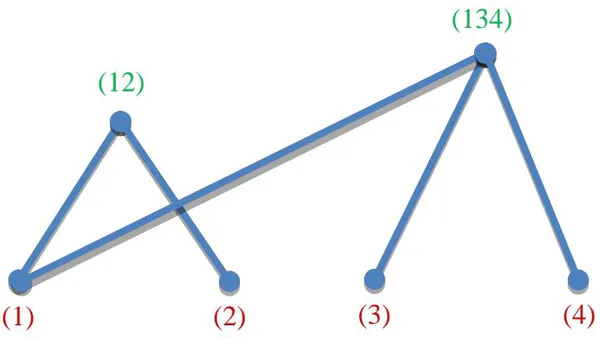
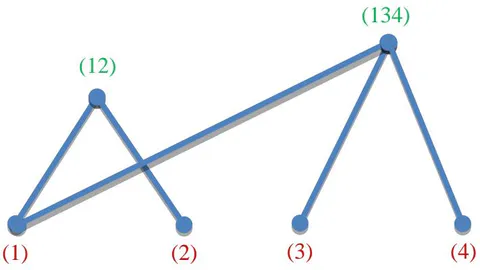
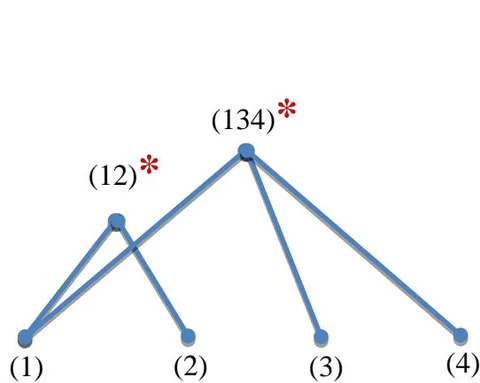
Figure 3 shows an example of a geopolitical configuration with . The configuration in Figure 3 consists of four one-way unions (1),..., (4), two- and three-way unions (12) and (134), respectively. The configuration in Figure 3 can be represented as . Total configurations in the geopolitical system with four geopatoms , because . Note that each of the configurations includes four geopatoms, which are considered indivisible and indestructible.
The constructed historical universe contains the initial material from which the historical process is "assembled". For this model, the global historical process is a chain of changes in configurations, or, in other words, the dynamics of the formation and disintegration of unions, and subsequent sections will be devoted to studying the mechanism of transition from the current configuration to the next one.
From the point of view of politics, the main interest is the answer to the question: what patoms and their unions are actors (player; the term actor is widely used in sociology and political science) of the political system? This means that this patom or union has objective and subjective conditions to be a participant in the global political game. Objective conditions are reduced to the availability of resources (energy, minerals, etc.), subjective conditions — to will and freedom, and more briefly — to free will (these attributes are studied in more detail in the model of psiphysics [2,3]). The concept of an actor is central to the history model. These or those actors are the main acting figures of history, the subjects of history, while the actors can not always be personified.
In the following sections, the concept of freedom will be formalized in the sense of freedom of political choice for an individual actor and the world as a whole. Freedom, along with resources, is the main regulator of the relations of actors with each other. Freedom for the world as a whole will lead us to the formulation of two global metahistorical goals: the realm of freedom and the realm of necessity.
The next section is devoted to the study of the question of the grounds for preference by certain actors of either the realm of freedom or the realm of necessity in their global goals and aspirations. This question is the subject of the ethics of actors, and it will be reduced to the definition of a key state in global history, which will be called Choice. What is the Choice, and what is its meaning in the context of World history, we will discuss further.
II. POLITICAL CHARACTERISTICS OF THE ACTOR
Regarding the actor, let us formulate the question of the extent to which he is a political subject. Let us define the concepts of political subject and political object, as well as the subject-object measure of an arbitrary actor. This measure will be interpreted as sovereignty. To the extent that an actor has sovereignty, to that extent he is a political subject. The less sovereignty, the closer the actor is to the state of a political object. Since the state of sovereignty is transient, in some cases an actor, being a subject, can become an object and vice versa. Thus, the concepts of a political subject and a political object are mutually complementary.
First, for simplicity, we will assume that geopatoms are actors and there are no other actors. Later this restriction will be lifted. On the elements of the configuration space, we define the function , which denotes the number of unions of rank with the participation of the -th geopatom in this geopolitical configuration . By definition, we assume that , for any configuration , , i.e. a geopatom is indecomposable in itself and enters into a one-sided union with itself one and only time. Little is known about the relationship between the numbers , . It is easy to see that for any configuration from the following formula is true:
where is the number of different unions of the -th rank in , while they can take the values . The values take the values and already, according to (1), they are not independent. For example, for and it follows from formula (1) that .
To characterize the -th geopatome-actor as right or left in the political sense of the word, we introduce the political function , . Its meaning is simple. It is positive, i.e. a geopatom is right oriented when he enters into a small number of alliances of the -th rank with other geopatoms. Conversely, the political function is negative, i.e. a geopatom is left-oriented when he enters into a large number of unions of the -th rank with other geopatoms. It is this interpretation of the signs of the political function (plus — right, minus — left) that takes into account well-known political science traditions.
Since the total number of unions of the -th rank that a geopath can join is equal to , then we will choose the value as a separator between a small and a large number of unions. Normalizing the range of changes in the values of the political function for the interval from to , we introduce an auxiliary function , which is defined for non-negative integers and , and . In this case , . For , we assume that , i.e. geopaths are always left oriented. This is natural, because geopatomes are, by definition, indecomposable. Finally, for we assume that . As a result, we write
A typical form of the function in two different cases, when is even and odd ( is an integer), respectively, is shown in Figure 4. The analytical expression of the function has the following form:
where is the logical "and" symbol.
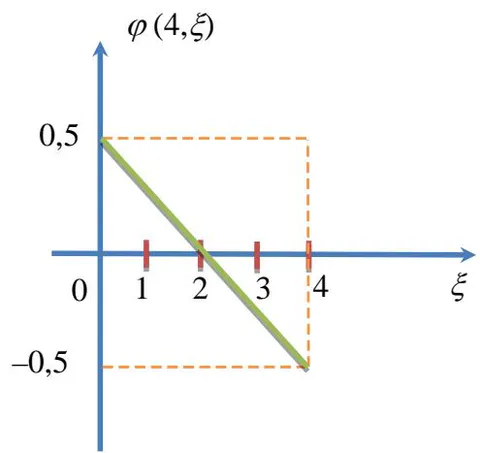
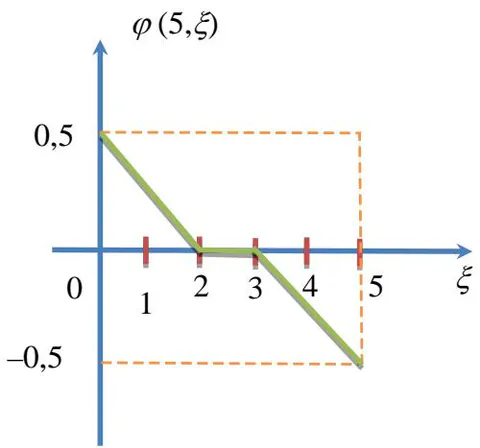
The political function varies from at to at . When , the -th geopatom enters into all possible unions of rank ( ), and this state will be called the state of lacing of the -th rank. When , the -th geopatom does not enter into any of the unions of rank , and this state will be called the state of self-identification of the -th rank.
For the -th geopatom-actor, we define a nonnegative sovereignty function , or simply sovereignty, using the following simple formula:
According to definition (3), sovereignty varies from 0 to its maximum value , i.e. .
Let's define the meaning of the terms lacing and self-identification. To do this, we note that if a geopatom is going (or not going) to enter into any alliances, then he must have some doctrine that approves or disapproves of certain alliances. Assume that a geopatom approves and enters into all alliances. Then, naturally, he does not have a non-trivial doctrine, just as in the opposite case, when he is self-identified and rejects all unions. If in the first case he is completely conditioned in his choice, then in the second he is completely unconditioned, i.e. self-identified, falling out of the context of world relations.
A geopatom who enters into all unions will also be called a super-left. In this case, each political function from the corresponding set takes on a value of , i.e. , . The minus sign emphasizes the "leftness" of the laced geopatom, whose location on the segment is extremely left. A geopatom who does not enter into alliances can also be called a super-right. In this case, each political function takes the value , , . The plus sign emphasizes the "rightness" of the self-identified geopatom, whose location on the segment is extremely right.
It is clear that the over-left laced and over-right self-identified geopatoms are degenerate cases. In general, the geopatom has some doctrine of selecting alliances favorable to him. At the same time, not all |\ho_{i,n}| = 0.5, , are equal to 0.5. In the language of the sovereignty function, this means that . In the limiting case of a laced and self-identified geopatoms, there is no sovereignty, i.e. .
Note that the lack of sovereignty is characteristic not only for the laced and self-identified geopatoms. The equation , allows configurations that differ in the choice of signs for the values of political functions of different ranks, i.e. , . Thus, when some geopatom acts according to the rule of joining or not joining all unions of one rank or another, then he, like a laced and self-identified geopatom, has no sovereignty. In this regard, we note that, by virtue of the definition in (3), the sovereignty function is invariant under the operation of replacing all unions with non-unions and, vice versa, all non-unions with unions, i.e. is invariant under the transformation or
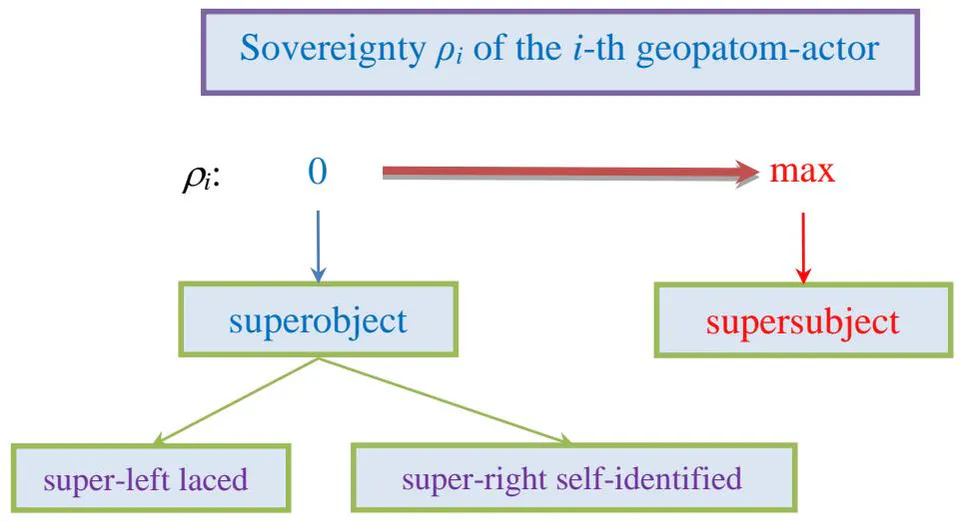
Considering that, according to (3), the maximum value of sovereignty is , we can estimate the extent to which the -th geopatom-actor is a political subject (object). It is clear that when sovereignty is minimal or, otherwise, it is absent. In this case, the -th geopatom does not have a nontrivial doctrine of selecting favorable unions for him, and he, of course, is a super object. We will consider the maximum possible value of the sovereignty of an individual geopatom-actor as a sign of such a doctrine, the possession of which puts the geopatom into the state of a super subject. Thus, from the superobject at we come to the supersubject at . The values of are between and characterize the -th geopatom as a subject and an object in different proportions. Figure 5 contains the nomenclature used to describe the gradations of sovereignty of the -th geopatom-actor.
The sovereignty function is a measure that allows one to rank geopatoms-actors according to their power. In particular, it is possible to formulate the concept of world domination. One or another geopatom-actor has world domination in a weak sense, if his function of sovereignty is greater than the others. And, finally, this or that geopatom has world domination in a strong sense, when his sovereignty is maximum, and the sovereignty of all others is minimum.
Let's consider the general situation, when the actors can be both individual geopatoms and some of their unions. Denote by the set of all unions, including one-sided ones. The symbol
denotes a non-empty set of actors of the geopolitical system. It is clear that is a subset of , i.e., .
One of the main attributes of an actor is that he is. This means that any geopolitical configuration must contain the entire set of actors . Such a set of configurations does not coincide with the original configuration space . We introduce the symbol to denote those configurations that are possible for a given set of actors . We construct the set , based on the fact that is given.
Let us define the operation of combining a pair of unions and into a third , i.e. according to the rule of set-theoretic union of elements of the set of geopatoms numbers . Let us construct the set of those unions that are formed by the union of an arbitrary set of unions-actors from and those that differ from , i.e.
Taking into account that the set of actors is present in all configurations from and that only actors are responsible for the formation and dissolution of unions, we have
According to the definition in (4), for any , , while . Thus, the truncated configuration space coincides with the original one only if the actors are all geopatoms and there are no other actors, i.e. when .
Consider an example. Let , , , then
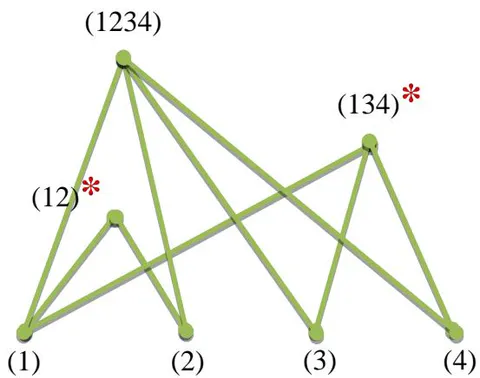
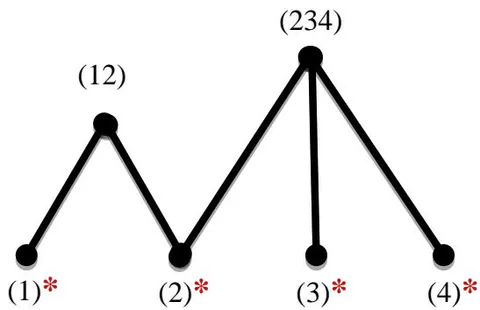
wherein |U_A| = 2. Figure 6 shows both valid configurations from U_A, asterisks here and below denote the property to be an actor.
Let the symbol denote the set of unions of the -th rank with the participation of the -th actor , i.e.
Let , where is an integer function of the number of unions of the -th rank with the participation of the -th actor, while it can take values from 0 to , i.e. . By analogy with the case when , i.e. when the actors were geopatoms, we define the political function and the function of sovereignty in the general case of an arbitrary set of actors . Taking into account (2), (3), by analogy we have
The functions , and are constructed in such a way that they coincide with , and for .
III. CHOICE OF DOCTRINE
As above, we first consider the case , i.e., all geopatoms are actors and there are no other actors. Let us dwell on the choice of two types: the choice of doctrine by an individual geopatom against the background of others and by the world as a whole. Note that the world as a whole is not an actor and cannot choose directly. However, determining the doctrine of choice by the world as a whole and the number of such doctrines is important when choosing doctrines by individual geopatoms. Here we mean that the world as a whole chooses indirectly through the choice of individual geopatoms in the aggregate. We will not be interested in the specific content of this or that doctrine, that is, which alliances are preferred by certain actors. It is important to determine the power of the class of doctrines from which the choice is made. This power of the class of doctrines, which can be understood as the number of choice alternatives, will be called freedom in the sense of freedom of political choice both for an individual actor and for the world as a whole.
As stated above, the -th geopatom is a supersubject when . At the level of -party unions ( ), this means that the doctrine of the -th geopatom approves and disapproves of an approximately equal number of alliances from the set of allowed ones. Indeed, the -th geopatom can join and not join unions of the -th rank. A specific set of alliances and non-unions defines some doctrine of the -th rank of the -th geopatom. The total number of doctrines is , it is maximum at or more precisely at , where when is even and or , when is odd. Thus, the -th supersubject selects its doctrine from the class containing the maximum number of doctrines of the -th rank. This class of doctrines is characterized by alliances and non-alliances.
So, the -th geopatom-actor, striving to become a supersubject, is interested in the class of doctrines in which their maximum number, i.e. it maximizes the functional
f_{i}(u) = \prod_{n=2}^{N} C_{C_{N-1}^{n-1}}^{\μ_{i,n}} ,which in what follows will be called the freedom functional, or simply freedom.
For the world as a whole, the doctrine of choice is simply some configuration , and the number of doctrines , or the freedom of the geopolitical system as a whole, is the power of the configuration space , i.e. . Freedom for the world as a whole can be calculated differently, it is a deuce raised to the power of the number of possible unions. The deuce takes into account two options: there is a union or it is not, i.e.
Let's return to section 2 in the part where the political function was defined. According to its definition in (2), it is equal to zero at . Thus, the -th geopatom is neither right nor left at the level of unions of rank , when he is a supersubject, i.e. has maximum freedom. Any deviation both to the right and to the left leads to a decrease in freedom. This also means that the most free geopatom-actor is located in the exact center of the political spectrum, if by spectrum we mean the range of values of the political function.
The totality of the doctrines of the supersubject can be characterized as follows. Let some geopatom can enter into the maximum possible number of unions. At the same time, at the level of unions of rank , he acts according to the rule of "tossing a coin": if "heads" falls out, he enters an alliance, if "tails" falls out, he does not join this union. In this case, he, with a probability close to one, will become a supersubject and will have maximum freedom.
Any geopatom-actor striving to become a subject is concerned with increasing his freedom, freedom in the sense of choosing from the maximum number of doctrines. At the same time, freedom can be maximum for a supersubject. Given the fact that everyone is connected to everyone, it seems impossible for all geopatoms to become supersubjects at the same time. If any geopatom or a group of geopatoms become supersubjects, then at the expense of the freedom of the others. The statement about the impossibility of all geopatoms being simultaneously supersubjects is not proven, however, the analysis of particular cases confirms this conclusion.
Let's make a brief digression in connection with how the freedom of the geopatom-actor was defined in
(5). The definition of freedom in (5) is not unique. It can be assumed, for example, that geopatoms do not distinguish between the ranks of unions. In this case, given that the total number of alliances with a fixed geopatom is , we have
where is the number of unions of rank greater than two, with the participation of the -th geopatom. As the study of particular cases in determining freedom according to formula (7) shows, geopatoms can become supersubjects at the same time. Thus, when each geopatom-actor does not distinguish between ranks when counting the number of doctrines, he and every other geopatom-actor can become supersubjects in the aggregate. In this case, freedom is not "scarce" for them. The latter circumstance seems to be uncharacteristic of the behavior of the geopatom-actor. That is why we tend to count the number of doctrines of the geopatom according to formula (5), based on the criterion: the individual freedom of the supersubject of the geopatom-actor should be as "scarce" as possible.
The relationship between formulas (5), (7) can be illustrated as follows. Let us unite the sets of unions of the same rank, i.e. in groups, can take the values so that , where the index denotes some partition into groups . So, for we have , and for we consider .
We will assume that within a group of some division geopatoms do not distinguish between ranks when counting the number of doctrines. Let the maximum number of unions with the participation of some geopatom within the group be , and the number of unions with the participation of the -th geopatom in the -th group is . In this case, the number of doctrines of the -thgeopatom is calculated by the formula
It can be proved that the supersubject has maximum freedom at and minimum at , i.e.
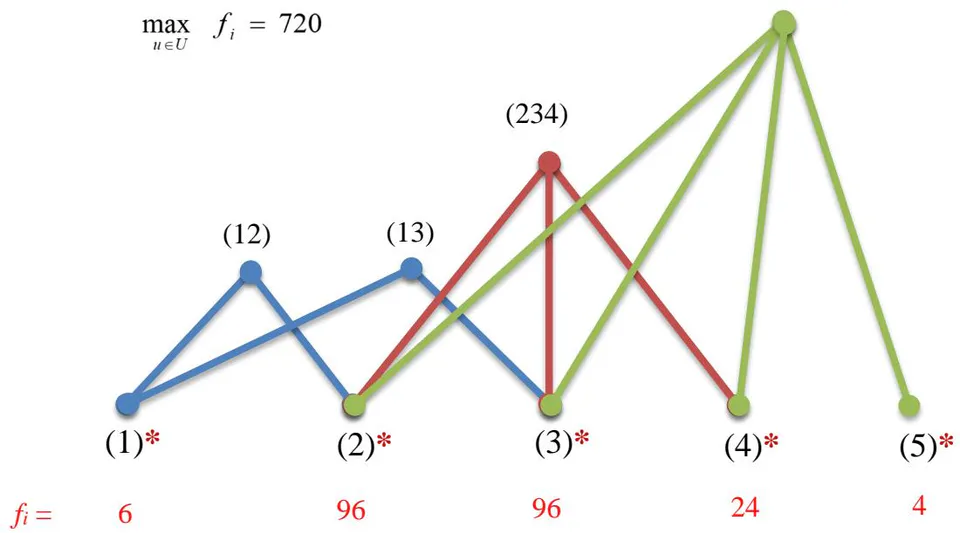
Figure 7 shows an example of a configuration for , in which freedom is calculated using formula (5). For each of the geopatom-actors, the freedom was {6,96,96,24,4} respectively, and, in addition, the maximum possible individual freedom (720) was found. Geopatoms in Figure 7 as actors are marked with stars "★"
Let us introduce a notation for the maximum value of the number of doctrines of the -th supersubject in the general case, i.e. . Let us estimate in order of magnitude the amount of information for the -th geopatom-supersubject according to the well-known formula and the world as a whole . We assume that for the -th supersubject , then, taking into account (5), (6), we find
Assuming that the number of states and territories with a different status on Earth is 261, we put . Noteworthy in (8) is the term , which at is an astronomically large number . Thus, according to the most conservative estimates, each of the supersubjects-states needs to process information in the amount of about bits for the correct choice of the doctrine of behavior.
The values given in (8) can be given a different, entropy interpretation. The entropy interpretation of the values and is that they characterize the maximum degree of uncertainty in the choice of doctrines of behavior by the supersubject and the world as a whole.
In addition, the value of can also be interpreted as a measure of the complexity of the geopolitical system as a whole. Below we will return to the concept of "complexity" in connection with stability and historical time.
Summarizing the list of interpretations of the value , we can say the following:
- — is the amount of freedom for the world as a whole,
- — is the volume of processed information necessary to select the doctrine of the behavior of the actor-supersubject,
- — entropy as a measure of uncertainty when choosing the doctrine of the behavior of an actor-supersubject,
- — is a measure of the complexity of the global geopolitical system.
Very briefly, the interpretation of the value of is reduced to the following metaphorical equality:
Now let's remove the initial restriction that the set of actors is limited only by geopatoms, i.e. we assume that — an arbitrary subset of the set . In this case, the analogues of formulas (5), (6) are the following:
where f_{a}^{(A)} = 1, when (a) = N, | S_{A} | — is the cardinality of the set of unions that are not actors and are formed by the union of an arbitrary number of actors. Formulas (5'), (6') coincide with (5), (6) for A = S_{1}, i.e. f_{i}^{(S_{i})} = f_{i}, D_{S_{i}} = D. The functional f_{a}^{(A)} = f_{a}^{(A)}(u), u \in U_{A} defines the freedom of the actor a, a \in A, and D_{A} — the freedom for the world as a whole for a given set of actors A.
From the point of view of thermodynamics, when freedom is interpreted as entropy, one can speak of a regular increase in entropy-freedom in the event that the global geopolitical system is closed. However, it is essentially open, primarily through resources. There are a number of factors (strength, will and power, which are determined in the model of psiphysics [2,3]), through which the geopolitical system is also open.
Freedom for the world as a whole is maximum at , i.e.
Thus, maximum freedom for the world as a whole is possible only where and when the actors are geopatoms and there are no other actors. The world in which maximum freedom is possible, we will call the realm of freedom. In contrast to the realm of freedom, we define the realm of necessity by the condition . The realm of necessity is not unique. For example, for , we have , which can be verified directly.
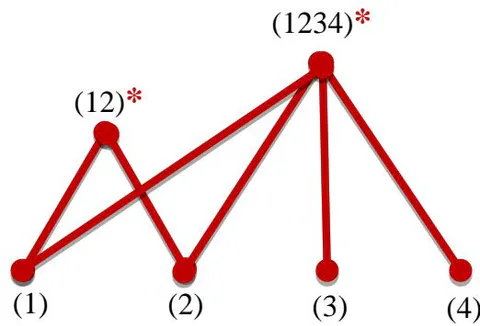
Figure 8 shows examples of configurations from the realms of freedom and necessity, when the number of geopatoms is 4, i.e. . The realm of necessity is limited to a single configuration, which is shown in Figure 8.
IV. RESOURCE LIMITS
Consider the resource constraints in our model. Let the number of such resources be . Each of the geopatoms is a direct producer of one or another group of resources. Denote by the intensity with which the -th geopatom produces the -th resource. These resources, after distribution, are consumed both by the geopatoms themselves and by all unions. The intensity is understood as the amount of resources produced per unit of physical time. This circumstance stands out due to the fact that the concept of "historical time" will be formulated below, which has little in common with its physical counterpart. The connection between the intensity of resource production and physical time characterizes the natural rootedness of the geopolitical system in the physical world surrounding it.
Denote by the set of alliances involving the -th geopatom, including himself. The cardinality of the set is . The set is determined by a specific configuration, i.e. , . Let us define NM non-negative value-functions , , . The value characterizes the distribution of the -th resource of the -th geopatom within the set , while proceeding from the fact that
If the sum in (9) is normalized not by one, but by , then the values acquire the meaning of taxation rates for the -th geopatom as a direct producer of the -th resource from those unions in which the -th geopatom takes part.
Let us determine the consumption of the -th resource by the -th union ( ) by the formula:
that is, the consumption of the -th union consists of the shares of the -th resource transferred by each of the geopatoms included in . In order for the union to exist, it must consume the -th resource not less than some threshold value , i.e.
while for simplicity it is assumed that , are constants, although they can also be functions of the -th union, i.e. .
Taking into account (10), we determine the resource constraints in our model by the formula:
where — sign of conjunction (logical multiplication). According to (11), the configuration satisfies the resource constraints when and otherwise. Recall that the terms true and false in Boole algebra mean true and false. In other words, some configuration can exist in reality if and cannot exist when .
We note the following circumstance. In the general case, it is necessary to proceed from the assumption that a particular configuration has an inverse effect on the intensity of resource production (the global situation affects the local production of certain resources), i.e. , , which in general is the subject of political economy. Accounting for this factor makes the task of describing global historical dynamics even more difficult.
Only the actors of the political system know (naturally, within certain limits) how to spend the produced resources. They, in the final analysis, carry out the distribution of consumption as they see fit, i.e. they control the form of quantities , responsible for taxation. At the same time, the actors, being intertwined within the framework of a certain geopolitical configuration, enter into various kinds of relations with each other regarding resources. These include relations of competition, cooperation, etc.
Each of the actors of the set A is characterized by the possession of a certain plan of its existence in the context of the world as a whole. In the general case, there can be as many plans as there are actors. If there are fewer of them, then we can talk about coalitions of actors adhering to the same plan. Since we have already singled out two special states in history, which are called the realms of freedom and necessity, let us consider what is the attitude towards them from the side of the individual plans of the actors. If a group of actors adheres to the same metahistorical goal — the construction of the realm of freedom (the realm of necessity), then each of the actors in this group has a special unified plan, which we will call progressive (traditionalist). The first plan is characterized by a strategy for increasing the freedom of the world as a whole, i.e. orientation towards the progressive crushing of large scale actors, when, in the limit, the set of actors is exhausted by geopatoms. The second plan is characterized by an orientation towards traditional ideas about actors as unions of a fairly high rank.
Both plans have a huge number of adherents. Let's give some examples. L. Mises [7] and F.A. Hayek [8], defending liberal democratic values, connects them with the right to freedom in the sense of freedom of political choice. Plato in his theory of the ideal state left no room for freedom of choice. The largest traditionalist of our time is R. Guenon [9].
Let us formulate the following question: on what basis does this or that actor adhere to either progressive or traditionalist plans in achieving a global metahistorical goal — the realm of freedom, the realm of necessity? We will refer this question to the group of questions: "How should it?", "On the basis of what should it be?" etc., i.e. we will refer it to the field of ethics.
V. MODELING OF HISTORY
From the point of view of an external observer, the historical process is presented as a chain of configuration changes, i.e.
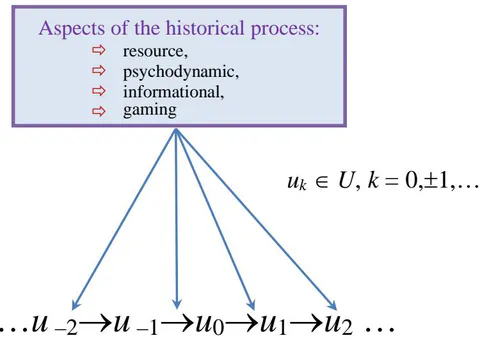
What are the reasons for the arbitrary transition ? While these causes can be extremely varied, there is some typology among them. Let us present such a typology in the form of four aspects of the historical process. Let's call them
- resource,
- psychodynamic,
- information and
- gaming.
The allocation of the resource aspect is due to the fact that, in general, resources are given to us from the outside. The psychodynamic aspect is studied within the framework of the model of psiphysics [2,3]. The information aspect of the historical process is characterized by the desire of actors to gain maximum freedom. Finally, the game aspect includes everything related to the mutual struggle of actors for resources.
The transition from the current geopolitical configuration to the next, i.e. the transition , ( ), let's call it an elementary historical event, an elementary dynamic act of history. It seems that the reasons for such a transition, i.e. the mechanism of historical dynamics, can be exhaustively described within the framework of one of the four aspects of the historical process (resource, psychodynamic, informational and gaming) or from some combination of them.
Let's look at all four aspects in more detail. First of all, it is necessary to divide them into two groups. The first group includes resource and psychodynamic, the second — information and play. The division into two groups is due to the fact that the resource and psychodynamic aspects, in contrast to the informational and game ones, cannot be fully controlled by the actors. In other words, aspects of world history from the first group can be attributed to objective conditions, and those from the second — to subjective ones.
Figure 9 shows the methodology for studying the historical process from the point of view of analyzing the contribution of one or another aspect of the four listed to a given historical event.
Further, we will dwell in more detail on the second group of aspects of history, considering that the resource and psychodynamic aspects are fixed.
A characteristic feature of the informational aspect of the historical process is the striving of actors for maximum freedom. Since gaining maximum freedom requires maximum information, the quantitative assessment of which is given in (7) on the example of the realm of freedom, the informational aspect of history is directly related to the information industry. The confirmation of the reality of the information aspect is the goal of building an "information civilization" proclaimed for the first time in the West [10]. Let us present the mathematical formulation of the informational aspect of the historical process. Considering (5'), (11), we have
According to (12), each of the actors tends to the state of maximum freedom under given resource constraints. Aiming for the maximum in (12) means that the -th actor, before entering into a new union or before leaving the old one, calculates the freedom functional . If a new state leads to an increase in freedom and it is acceptable due to resource constraints, the actor tries to update it. Of course, it must be taken into account that these assessment procedures are carried out by all actors from in the aggregate.
Along with the psychodynamic, the game aspect of the historical process seems to be the most loaded with mathematics, since it is reduced to a well-known section of mathematics — the theory of games of many persons in its most complex version — coalition games of many persons [11].
Let us consider equations (9) more carefully. Their political meaning is twofold. On the one hand, they mean how many shares of a particular resource are transferred to various unions. In this case, the special preferences of each geopatom in relation to various unions may affect. On the other hand, it is necessary to take into account that the actors are primarily responsible for the distribution of resources. This duality can be removed in the following way. We will assume that the actors take into account both their own interests and those preferences that are characteristic of individual geopatoms. The state structure of the geopolitical system can act as special preferences of geopatoms.
Let some political configuration be given. It satisfies the resource constraint, i.e. true and contains some set of actors . Denote by symbol the set of alliances involving the -th actor, including himself. The set of sets , does not exhaust all unions from the configuration , since some geopatoms may not be actors, although they are always contained in by definition. Let the numbers of geopatoms that are not actors be , respectively, while can take values from 0 to . In this case,
Consider an arbitrary union from the configuration , formed with the participation of at least one actor. Let us define non-negative value-functions , , such that
where . These values characterize the distribution of the degree of control of the -th resource between those actors that entered the s-th alliance during its formation. The total amount of the -th resource controlled by the a-th actor can be determined by the formula:
If we sum over all actors, we can find
The meaning of formula (15) is as follows. The set , is simply some distribution of control over the -th resource among all actors minus the minimum necessary to support non-actor geopatoms.
Now we have everything to formulate the game aspect of the historical process. As part of the game aspect of the historical process, each of the actors, making changes to the global configuration, is concerned about the following. First, he must be, since the rules of the game allow for his death. Second, assuming the first is true; he needs to maximize the amount of resources he controls. Thus, taking into account (14), (15), we have the following game-theoretic problems:
Each of the tasks in (16) is represented by a game of a variable number of persons with payoff functions , . The control parameters on the part of the players are the function quantities , , , , , satisfying equations (9), (13).
Problem (16) should be considered, generally speaking, as a coalition game, but unlike the classical theory, the number of players is variable. Note that if the number of resources is more than one, uncertainty may arise between the game tasks for each of the resources. Removing this uncertainty assumes that the utility of each of the resources can be recalculated in units of any other resource. In other words, to remove uncertainty, it is necessary to assume that the utility of each resource is transferable.
Comparing the informational and game aspects of the historical process, one can see that the actors adhere to different values in them. If in the first case the value is freedom, then in the second — resources.
Speaking of history, there was no mention of time anywhere. This circumstance is not accidental, because it is necessary to clarify what time it is. The number of the configuration in the chain is called historical time, then the historical time interval is simply the number of configuration changes between two arbitrary fixed configurations. Historical time is thus an integer. Time in the usual, physical sense, i.e. physical time arises only when there is a single measure of all historical events. Such a measure can be the dating of changes in historical configurations in units of astronomical time, i.e. , , where , — past, — current, , — future events. What can be said about the times , ? Their specific meanings depend on all four aspects of the historical process, i.e. on what are the characteristic times of each of the aspects. Both historical and physical time are secondary to the dynamics of the geopolitical system, which is the dynamics of the formation and dissolution of alliances.
Considering that actors can be born and die, from the point of view of an external observer, we can talk about a chain of changes in the sets of actors:
and the corresponding time of the actors . From the standpoint of actors' time, the historical process is the dynamics of the birth and death of actors. The transition mechanism from the current set to the next () will be studied further. Let us also define the space of actors by the formula , i.e. the set of actors can be any non-empty subset of the set of all unions of all ranks. It is easy to estimate the cardinality of the set , namely .
Let us return to the interpretation of the freedom of the actor and the world as a whole as a measure of complexity. In cybernetics, there is an idea that a system is more stable the more complex it is. In relation to the global geopolitical system, it should be clarified with respect to what time stability is estimated. If this time is historical time, then yes, indeed, the geopolitical system is the more stable the more complex it is. From the standpoint of physical time, this is not so. The difference in the assessment of stability in terms of historical and physical time is especially pronounced in the interpretation of natural or social cataclysms on a global scale. Thus, a military conflict with the unlimited use of nuclear weapons is the "end of history" from the point of view of physical time and the "triumph" of history from the standpoint of historical time. The last statement is deciphered simply: at the moment of conflict, the intensity of the dynamics of the formation and disintegration of unions increases sharply. Thus, despite the fact that the complexity-freedom of the world as a whole is growing, the "fragility" of society as a single biogeophysical body within the bounds of its enclosing biosphere does not necessarily decrease.
Note that neither historical time nor the time of actors play such an essential role as time plays in physics. If in physics, time is substantial and directly woven into the physical-dynamic reality, then in history historical time is mediated by an external observer and is only a statement of events by an external observer. The real historical dynamics is concentrated in the existence of actors who are born, die and make certain decisions about the formation and disintegration of unions. In other words, in this model of history, time seems to be absent, but the historical process takes place.
VI. THE MORAL CODE OF THE ACTOR
The normative model of global history built in the previous sections is not closed conceptually, because does not answer the following question: on what basis does this or that actor adhere to either a progressive or traditionalist plan in achieving a global historical goal — the realm of freedom, the realm of necessity, respectively? We will refer this question to the group of questions: "How should it be?", "On the basis of what should?" etc., i.e. we will refer to the field of ethics. Since in the model the actors (geopatoms and their unions) are chosen as the subjects of historical dynamics, it is necessary to build something in the spirit of the ethics of actors, or, in other words, to formulate the moral code of the actor.
The actor's moral code is not an "anthropomorphic" ethics. Indeed, if actors are understood as geopatoms and their unions, ethnic groups, states, etc., then it is extremely difficult to bring their behavior under the ethics of human relations, because they "live" according to other laws and, if you like, in other "spatio-temporal dimensions". So the logic of general humanistic morality [12] cannot be used as an adequate tool in planning and predicting the behavior of certain actors. Due to the fact that the ethics of actors is global in nature, in the general case it may have nothing to do with individual moral systems developed within the framework of one or another actor or taken from one or another religious denomination.
Taking into account the results of modeling in the previous sections, we list the attributive properties of the actors. First, there must be an actor, because the rules of the game allow for his death. Now let life be secured.
In this case, the second attributive property of the actor is his striving for a state of maximum freedom. It was stated above how he does this by forming (disintegrating) alliances with other actors (see formula ), which also constitutes the essence of the informational aspect of the historical process. And, finally, the third attributive property is the desire of the actor to control more and more resource(s) (see formulas (14), (16)). This intention of the actor is realized in the competition for resources with other actors and constitutes the essence of the game aspect of the historical process.
All three attributes, intentions, each actor implements in interaction and in conjunction with other actors. At the same time, regardless of whether or not some actor(s) are considered with others in the implementation of their attributive properties, an ideal, universal scheme of the actor's behavior is developed, which we will call the moral code of the actor. The latter can be formulated in several ways. So, following I. Kant [13], let's use his categorical imperative, giving it a specific content.
The categorical imperative of the actor.
Actor:
- must be, (17)
- must be free,
- must be rich.
Note that all three duties are subordinated (with some reservations, which are set out below) in importance from top to bottom and outline the main intentions of the actor. All three duties considered in universality, i.e. in relation to each of the actors, are the categorical imperative implemented in three requirements. So, the actor should not just be, be free and be rich, but in such a way that these intentions are realized not to the detriment of other actors. It was in this that I. Kant saw the formal realization of the moral law and virtuous behavior. Thus, the actor acts morally, well, i.e. does a good deed when his actions in accordance with the three main motives (17) do not conflict with other similarly motivated actions of other actors.
Taking into account (17), we will give a more detailed expression in the form of the moral law of the actor.
Actor:
- must be — not to the detriment of other actors;
- must strive for maximum freedom not to the detriment of others; (17')
- must strive to control the maximum amount of resource(s) — not to the detriment of others.
The actor's moral code can be taken either in the form of a categorical imperative (17) or in the form of a moral law . There is no difference between them, except that the first is formulated more concisely than the second, and the maximization of freedom and resources in (17) is understood implicitly.
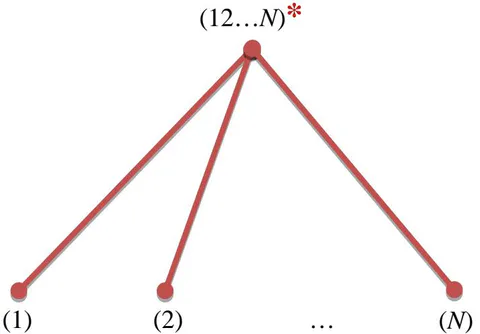
So, since actors have a moral law, they become moral subjects, they can evaluate their actions within the framework of the dichotomy: "good — bad", "good — evil", etc. The experience of the dichotomy "good — bad" act is the central existential, the existence of the actor as a moral subject. Let's talk about this existence as a burden. Let's ask ourselves the following question. Can an actor get rid of moral existence as a burden? Yes, it can be in the one and only case when the number of actors is reduced to one. There are many single-actor configurations. Of these, we choose one and only one on the basis of the following considerations. Since in the modern world the intensity of communication is so great that it cannot be said that any of the regions on Earth is not covered by them, we arrive at the following global geopolitical configuration with one actor:
Figure 10 shows a graphical representation of the geopolitical configuration (18) with one actor.
Consideration, on the basis of which the configuration (18) was chosen, we will call the compression of space, or the communication limit. Modern means of communication bring closer the moment when the geopolitical space (more precisely, the space of actors) will become super-compressed and accessible everywhere, shrinking to the limit into a "point".
Configuration (18) (Fig. 10) is nothing but the realms of necessity. A single actor has the ultimate freedom in a world with one actor, which is equal to the ultimate lack of freedom, i.e. necessity. It is in this world that the "good — evil" dichotomy is removed. The actor becomes on the other side of good and evil, i.e. becomes transcendentally free. Thus, we need to distinguish between this-worldly freedom in the sense of freedom of political choice and otherworldly freedom — transcendental freedom, and the first can be realized in a world with at least two actors, and the second (in full) — with one actor. The burden of existence of the moral actor is completely removed with the experience of transcendental freedom, which from this worldly point of view is nothing [14,15].
Why did you have to pay attention to this circumstance? This is due to the fact that the basis of freedom in the sense of freedom of political choice is transcendental freedom, which is confirmed by all world religions that see the root of any ethical systems in the sense of mystical experience of the transcendental world as absolute freedom [16]. From these positions it is natural to interpret the existence of the moral actor as (his) burden. Thus, according to Scripture, man separated from the Creator after the fall, taking upon himself the burden of knowing good and evil. Rising to an independent life, he became like God, but only became like him, since this gift (of freedom) is too heavy, and it is and will always remain a burden, since man himself, due to his short-sightedness, has made a substitution of otherworldly freedom on thise-worldly.
VII. VIOLATIONS OF THE MORAL CODE BY ACTORS
Having clarified the meaning of this and otherworldly freedom, let us return to the subordination of freedom and wealth in the moral code of the actor. If freedom is interpreted as otherworldly, then it certainly comes to the forefront (after being) as a more ancient and deeper motive for the existence of an actor. If freedom is seen as this-worldly, then freedom and wealth may not be mutually subordinated. In this case, both freedom and wealth are simply components of the actor's this-worldly existence.
The splitting of freedom into this and the other world lies at the basis of the dichotomy "progressism — traditionalism", i.e. in the preferences of the actors either the realm of freedom or the realm of necessity. At the same time, from the otherworldly point of view, the meaning of the terms "the realm of freedom" and "the realm of necessity" is directly opposite, i.e. from the transcendent point of view, the this-world realm of freedom is the realm of necessity, and the realm of necessity is the realm of freedom. Given the entropy
interpretation of this-worldly freedom, one could say that the realm of freedom is the "realm of chaos", and the realm of necessity is the "realm of cosmos". Based on the foregoing, instead of the terms "progressism", "traditionalism" one can also use Becker's terminology — "secular", "sacred" [17].
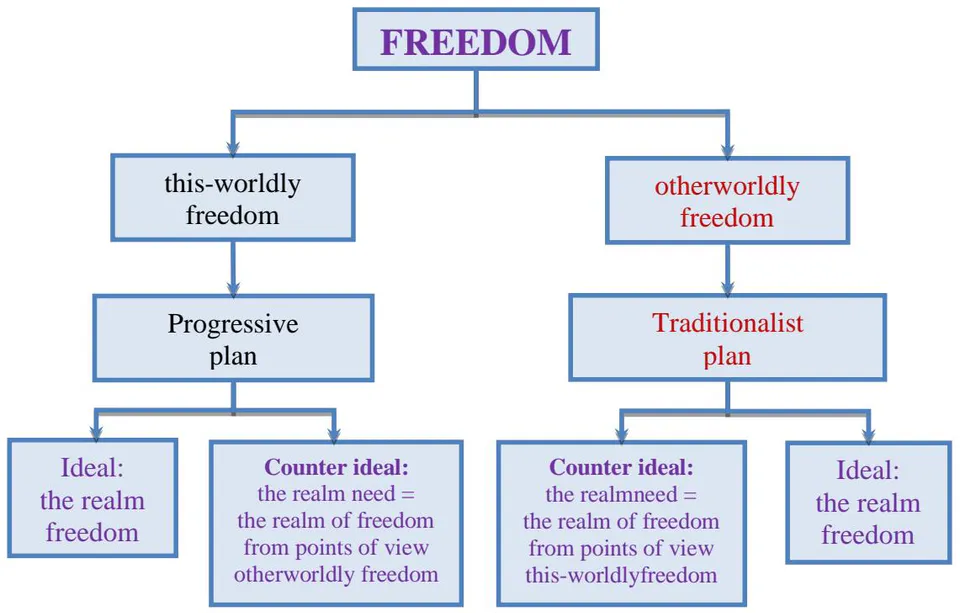
Let us answer the question: why was it necessary to invoke a religious interpretation of the realm of necessity? This is due to the fact that neither scientific nor actually desacralized ethics can give grounds for choosing between the realms of freedom and necessity. From the last two points of view, a person, through his free will, can will both without any reason (provided that space is compressed), which completely removes the ultimate historical goals from the control of a person, since their choice becomes absolutely random. Such a situation can be qualified as the horror of a completely secularized world before global history. From this point of view, science, acting as a fighter against religion, is terrible, because it gives two equally unacceptable answers to the choice between the realms of freedom and necessity. So, if it proves that free will does not exist, then we build an "anthill". If it proves that free will exists, then the choice between two global metahistorical goals is taken out of our control. Within theology, the (non)existence of free will has been discussed for a long time [18], in our time, discussions on this issue periodically arise in connection with the ambitions of science for a monopoly in the field of worldview. In the model of psychophysics [2,3], the issue of free will is solved in the sense that without will and without freedom it is impossible to formulate and, in a certain sense, solve the psychophysical problem in relation not only to the operator, but also to an arbitrary actor of the global political system.
Figure 11 shows a block diagram showing how freedom is interpreted from the point of view of two global metahistorical goals: the realm of freedom and the realm of necessity.
What is the meaning of the moral code of actors in connection with global history? He appears in two roles. Firstly, it gives a moral assessment to all the historical actions of actors, and secondly, it acts as a global status quo. Let's discuss these two interpretations in more detail.
The moral code exhausts the ethical experiences of actors in evaluating their actions as "good — bad", "good — evil", and so on. Is it really that important to stick to a code of ethics? In our time, its importance is becoming extreme, because it has a real material content in the form of means of mass destruction. The presence of the latter deters actors from unilateral actions that conflict with the interests of others. Thus, the presence of means of mass destruction leaves a very small "range" for the actor, where he can get a new ethical experience of knowing good and evil. Or, in other words, any attempts by the actor, if not to get out of, then to weaken the action of the ethical code are fraught with the loss of the actor's being. Despite this, a number of actors violate the ethical code. What are the reasons for these phenomena?
There may be two such reasons. The first is associated with drastic changes in the environment, the second — with the pressure of the will to power. The second reason is characterized in terms of the philosophy of F. Nietzsche [16].
Possible catastrophic changes in the human environment have long been discussed and modeled not only by the scientific community, but also by the general public, primarily by the "green" movement [19]. The main problem is that the "man + biosphere" system cannot be reproduced more or less self-identically. The growth of mankind is carried out due to the destruction and degradation of the biosphere. The unrestrained growth of population and the unlimited consumption of irreplaceable resources leaves no hope that humanity can stop its expansion on its own. Mankind can stop only by responding to the already thrown challenge from the biosphere. This will require a global restructuring of the geopolitical configuration, which will take place under the sign of environmental protection and will consist in the transfer of additional powers to the central body. Restructuring itself will be "evil", because a number of actors may not agree to the voluntary transfer of their powers to the central body. Humanity's response to the challenge of the biosphere (hereinafter, we will use the terminology of A. Toynbee [20]) creates the prerequisites for a new rethinking of the traditionalist metahistorical plan.
The second factor leading to the violation of the moral code is determined by the desire, the will to power. The actor does evil deeds not because he seeks power, but because this passion becomes excessive. On the one hand, the desire for power is woven into the power-volitional infrastructure of the world, and on the other hand, its overabundance tears this structure. Moral condemnation receives not the desire for power itself, but its overabundance. In the model of psiphysics [2,3], the power-volitional infrastructure and dynamic principles of the formation and decay of the actor(s) will be determined and investigated.
From a religious point of view, the desire for power is rooted in the transcendent. Excessive desire for power can be interpreted as an invasion of the transcendent world into the this-world. The intrusion of the transcendent is rooted in our experience of absolute freedom, which is nothing or absolute evil from the this-world. The intrusion of the transcendent is rooted in our experience of absolute freedom, which is nothing or absolute evil from the point of view thise-world [21]. Insofar as man has separated himself from the Creator, he has created his own "human" ethical code, from the standpoint of which the transcendent world is the source of absolute evil. This expresses the God-fighting character of the moral code of the actor, for whom the freedom of this world is not just a value, but a value in itself. In irreconcilability to otherworldly, transcendental freedom lies the danger, which S. Huntington speaks of as "God's revenge" [22]. N.A. Berdyaev [23] and K. Jaspers [24] warned about the same danger.
Speaking of politics as "the art of the possible", we generally stand for the observance of the moral code of actors. From the point of view of an overly power-hungry actor, one might say of politics as "storming the impossible". Terror as a phenomenon of modern times is an illustration of the thesis that politics can be "storming the impossible" [25].
So, the global political system as an ensemble of actors lives in accordance with the moral code (17) or (17'). The principles of violation of the latter are listed above. The question arises: is it possible, being within the framework of the ethical code, to come both to the realm of freedom and to the realm of necessity from the current configuration? As will be seen below, the last question should be answered in the negative. In particular, this means that the actor's moral code serves only to fix the status quo between actors and acts as a mechanism for grasping and curbing history. Since the observance of the moral code prevents the possible construction of other historical configurations, the historical process from the point of view of the code is immoral and evil, because it goes independently and against the pressure of the code. Thus, the moral code of the actor acts as an instrument of total control not only over man, but also over nature. The emancipation of the actor from the code is identical with his death. In accordance with these assessments, the moral code acquires a special ontological status. He strives to exhaust and replace the existence of actors, which is in fact rooted in absolute freedom.
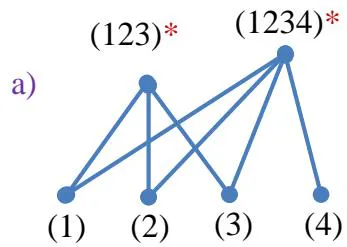
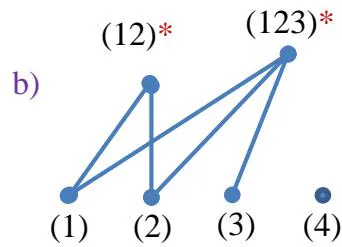
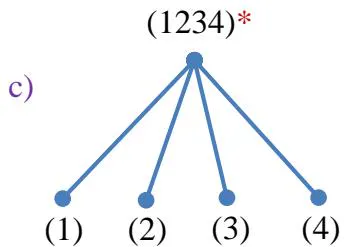
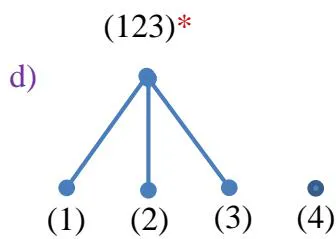
Let us return once more to the clarification of the term "traditionalism" ("sacred"). According to the definition of the realm of necessity, it was noted that it is not unique. Figure 12 with shows examples of the realm of necessity in four cases: a) there is space compression and a moral code; b) there is no compression, there is a code; c) there is compression, there is no code; d) there is no compression and no code. The traditionalist plan of history implies the realization not of an arbitrary realm of necessity, but only one in which there is a contraction of space and the moral code of the actor is absent, i.e. case c) in Figure 12 or configuration (18) in the general case.
The moral code of the actors, in the sense in which it was formulated above, is the ethics of the status quo. As will become clear later, the ethics of the status quo does not extend to the two target sets of actors of the realms of freedom and necessity. For them, their own ethical principles will be formulated, which, in
contrast to the ethics of the status quo, have the universal properties of global metahistorical goals.
VIII. THE CHOICE BETWEEN THE REALMS OF FREEDOM AND NECESSITY
Let us discuss the choice between the realms of freedom and necessity. Let's start with the geopolitical reasons for the choice. Imagine mentally two limiting geographic locations of land and sea on the surface of the Earth. The first geography is as follows: islands, more or less the same in area, are scattered evenly over the surface of the Earth. In the second geography there is one large island-continent (for example, in the past, according to some specialists in geophysics, the procontinent was Pangea). Most of the actors of the first geography are characterized by an orientation towards a progressive metahistorical plan of development, while for the majority of actors of the second geography they are oriented toward a traditionalist metahistorical plan. On the site [26], from the point of view of the theory of plate tectonics, there is a multiplication of the movement of continents on the surface of the Earth in time, where both extreme forms of geography are clearly visible.
Now we can comprehend from the geopolitical point of view the geography in which we live. It is clear that the configuration of land and sea is such that it is neither island nor continental, while it has both components. During the period of space contraction, it is not clear a priori what choice will be made. Space compression is the culminating point of confrontation between insular and continental geopolitical devices. The confrontation itself is understood and formulated primarily in the works of the largest geopoliticians, such as F. Ratzel, J.R. Kjellén, H.J. Mackinder, K. Haushofer and some others. More details about geopolitics in terms of climate, relief and traffic can be found in the work of the author [6].
Let's imagine a confrontation scheme. Let the geopolitical system have the following simple structure and other unions are not actors}, (19) where . In (19) are one-rank actors oriented towards the realm of freedom; is a high-ranking actor oriented towards the realm of necessity. The confrontation between them will consist in mutual challenge and response. Thus, a high-ranking actor can respond to a challenge from one-rank actors by disintegration, for example, in the following way:
where . To a challenge from a large-ranked actor, single-ranked actors can respond by combining, for example, according to the following scheme:
If according to scheme (20) the realm of freedom is approaching, then according to scheme (21) — the realm of necessity. Which of the schemes (20), (21) will work depends on what exactly these or those actors will offer each other, i.e. what exactly will be their challenge to each other. It is clear that both schemes (20), (21) do not fit into the moral code of the actor, because the existence of the original actor(s) after the collapse (combination) ceases. Thus, the mutual actions of actors according to the challenge-response scheme in the "island-continent" confrontation are, generally speaking, morally evil.
Let us take into account the grounds for choosing from the side of possible catastrophic changes in the biosphere. It has already been noted above that the answer to the challenge from the biosphere will be such a restructuring of the global geopolitical system, which is deliberately oriented towards the traditionalist metahistorical plan, i.e. towards the realm of necessity. By itself, this restructuring does not mean the coming of the realm of necessity, but its trace may play an important role in the moment of space compression.
Let us take into account the power component of choice. From the foregoing, it is clear that the invasion of the transcendent can occur anywhere, but this breakthrough is most likely in continental regions. The superpower gap in the power-volitional infrastructure of the world can have a decisive impact on the choice at the moment of space compression. However, the outcome of the choice is unclear, and there may be several such gaps. If there is only one such gap, then in the period of the communication limit it can definitely push the choice towards the realm of necessity.
Let's sum up the intermediate result. It became clear that it was necessary to speak not just about choice, but about Choice with a capital letter. It lasts a finite time, during which space is compressed and the communication limit is reached. At the same time, the Choice cannot occur without space compression, and the space compression is primarily due to the Choice. At the moment of the Choice, the space is drawn into a "point", both metahistorical goals of the realms of freedom and necessity become available for realization simultaneously. There is a final presentation by actors to each other of arguments for and against ultimate metahistorical goals. Next comes the most important thing — the Choice itself. Its outcome is a mystery, it is fatal and irreversible. The person after the Choice will become different irrevocably. All previous history is a preparation for the outcome of the Choice, while the actors will solve not just some ethical problem, but the Metaethical problem of the whole history.
So, in addition to the moral code of the actor, outlined above, there is the Metaethical problem of the outcome of the Choice. Each of the actors at the time of the Choice must decide on its outcome and present those arguments that he considers decisive for this. We do not know all these arguments, but some of them are already obvious. These are such dilemmas of choice as "liberalism - autocracy", "science - religion", "secular - sacred", "harmony - disharmony" with the biosphere, "good - evil" within the actor's moral code, present and future weapons of mass destruction, genetic engineering, eugenics, parapsychology, drugs, and some others.
IX. SPACE AND TIME OF ACTORS
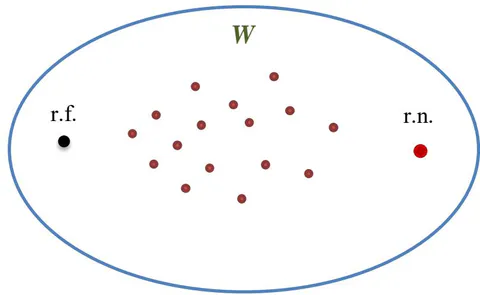
Let's move on to a deeper study of the space and time of actors. Figure 13 schematically shows the space of all sets of actors , the number of elements in which is . Two special points are singled out: the realm of freedom and the realm of necessity (hereinafter we will use the abbreviated names "r.f." and "r.n.", respectively). It is believed that for r.f. , i.e. all geopatoms are actors and there are no other actors, for r.n. , i.e. in r.n. one and only actor embracing all geopatoms.
Since actors are born and die, from the point of view of an external observer, one can speak of a chain of changes in the sets of actors, i.e.
In this case, is the time of the actors, are the past; is the current one, are the future sets of actors.
Let us discuss what are the reasons for the arbitrary transition , ? By analogy with how the reasons for the transition from one configuration to the next were analyzed within the framework of the historical process, we will define a certain typology of the reasons for changing the sets of actors. Let us present such a typology in the form of four aspects of the historical dynamics of actors. Let's call them
- resource,
- psychodynamic,
- target and
- gaming.
The resource and psychodynamic aspects are related to the objective conditions for the existence of actors. The game aspect is entirely responsible for the struggle of actors among themselves in their competition for resources. And, finally, the target aspect describes the desire to implement the global goals of the community of actors, i.e. striving to build either the realm of freedom (r.f.) or the realm of necessity (r.n.).
Now we can understand that the point depicting a certain set of actors ( ) in Figure 13 does not just randomly drift on the set , but has some attracting and repulsive ones — in the face of r.f. and r.n. — goals. Consider the r.f. and r.n. as what they are, i.e. already implemented as goals. Their implementation as goals implies that they must be there. The necessity of goals is the essence of the progressive and traditionalist metahistorical plans.
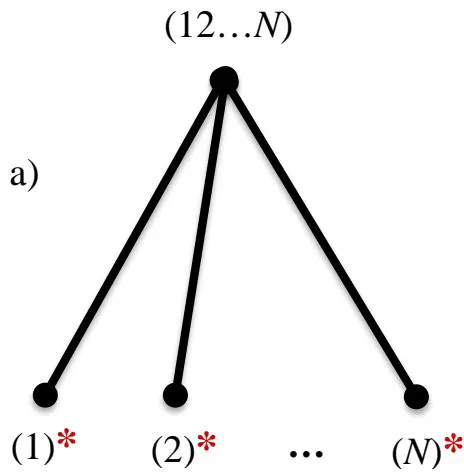
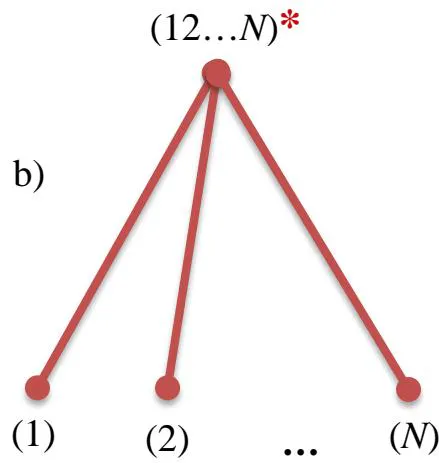
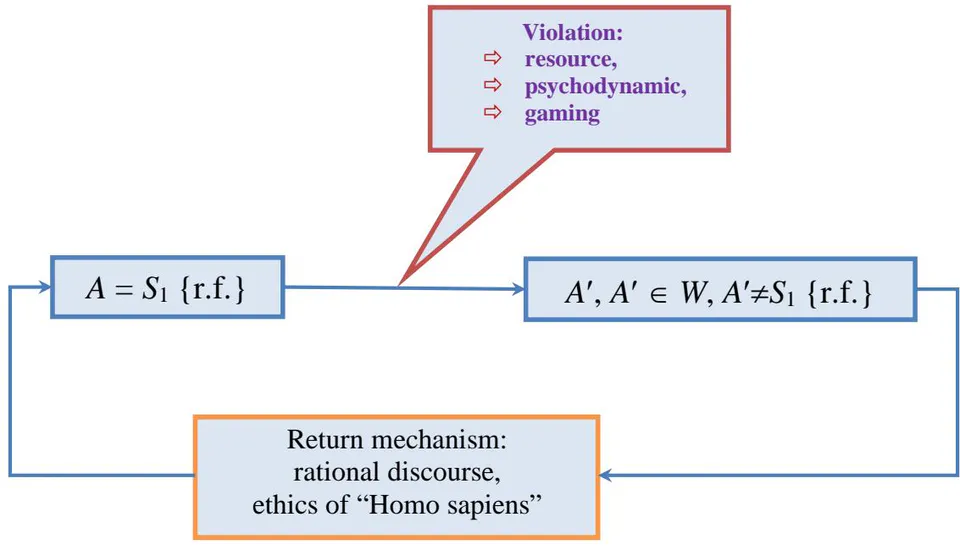
The need for r.f. suggests that the actors "insist" that there are exactly as many of them as there are geopatoms, so that they are geopatoms. This means that in the event of a violation of this state of affairs, there must be an effective mechanism for returning to the r.f. Under violation of r.f. is understood as any event caused by the resource, psychodynamic or game aspect of the historical dynamics of actors. Since the return mechanism can be applied to any element of the set , it must have universal properties. What are these properties? In general, we will characterize such properties, following J. Habermas [27] and other sociologists, by the term "rational discourse" in contrast to the opposite term "irrational intuition". The meaning of the terms "rational discourse" and "irrational intuition" is manifested in the nature of the unions that geopatoms make among themselves. Figure 14 shows examples of unions of rank , which were formed on the basis of rational discourse and irrational intuition, respectively.
In Figure 14,a, geopatoms-actors voluntarily enter into an alliance (12...N), rationally agreeing on the appropriate deductions of the resource to ensure the existence of the alliance. In Figure 14,b, the existence of the union-actor from the point of view of geopatoms is absolutely irrational, because they a priori proceed from the fact that the union-actor already exists, and it is not they (geopatoms) who transmit the corresponding resource, but the union-actor transfers their own resource to them, based on their goals. Irrational intuition is characterized by sensory experience of such concepts as "homeland", "nation", "faith", "state", etc.
The mechanism of return to the r.f. with various kinds of violations is a universal methodology of rational discourse, which calls into question the existence of any non-geopatoms actors. The mechanism of return to the
r.f. with various kinds of violations is a universal methodology of rational discourse, which calls into question the existence of any non-geopatoms actors. The procedure of rational discourse cannot be applied only to geopatoms-actors, because they are by definition indivisible and indestructible. The application of the methodology of rational discourse cannot be considered as a kind of ideology in itself, automatically working. It requires from its participants, i.e. from geopatoms -actors, constant vigilance. Vigilance in the sense that this methodology remains authentic, and not alienated from its bearers — geopatoms -actors. In general, the mechanism of alienation is associated with the dual nature of man, both this- and otherworldly creatures. Options for weakening vigilance were discussed by J. Habermas [27] in the critique of "functional reason", as well as by M. Horkheimer [28] in the critique of "instrumental reason" and some others. We can say that rational discourse is a method of declaring a permanent choice in favor of the r.f. for various kinds of disorders.
It would be naive to think that rational discourse is a natural tool of communication. It is highly unnatural and requires constant support for itself. In particular, rational discourse receives this support in ethics, in which an appeal is made to the duty of a person to be reasonable, i.e. to the ethics of "Homo sapiens". Figure 15 shows a diagram of the mechanism for returning to the r.f. for various kinds of disorders.
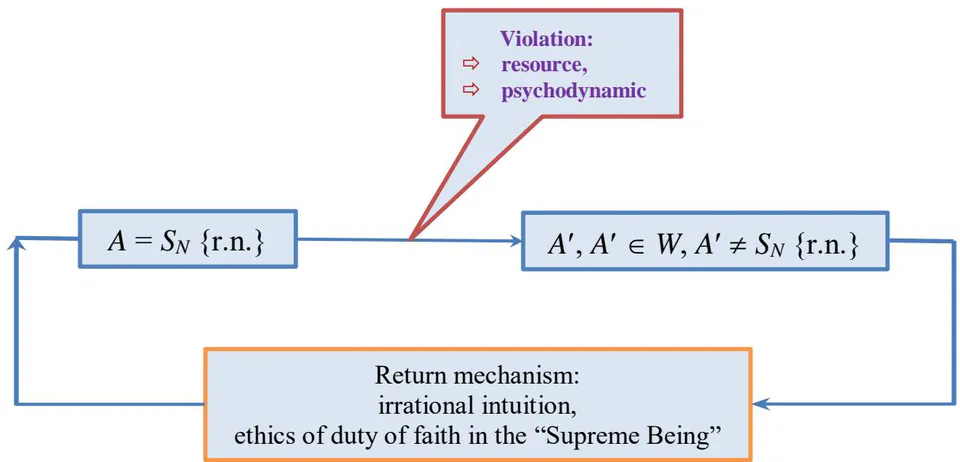
The need for a target setting of the traditionalist plan presupposes that the central and only union-actor "insists" that the it (union-actor) exists. This means that there is a mechanism for returning to the r.n. for various kinds of disorders. Under violation of r.n. any event caused by the resource or psychodynamic aspect of the historical process is understood. As in the case of the r.f., the mechanism for returning to the r.n. must be universal, because it can be applied to any element of W. The basis of the mechanism of return to r.n. is an irrational intuition, the action of which is expressed in the merger of all those actors that, for one reason or another, were formed as a result of a violation of the previous r.n. Irrational intuition is a way of declaring a constant choice in favor of the r.n. for various disorders.
Irrational intuition is not natural, it, like rational discourse, is subject to alienation, which is expressed in its support from the sacralized ethics of the duty of faith in the "Supreme Being". Figure 16 shows a diagram of the mechanism for returning to the r.n. for various kinds of disorders.
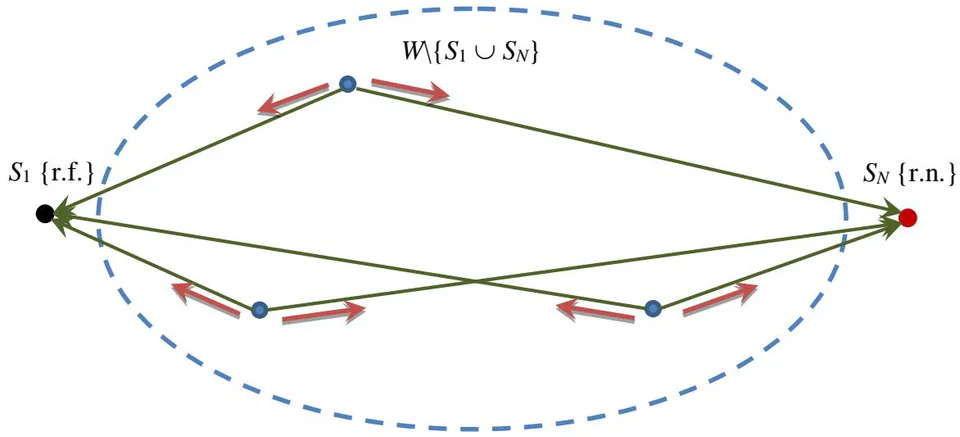
Earlier, we found out that for any set of actors from the space , a certain effort is required in order to be. This is expressed in the fact that any non-target set of actors has its own status quo ethics, and the target sets of r.f. and r.n. — the ethics of "Homo sapiens" and the ethics of belief in the "Supreme Being", respectively. Thus, each non-target element of the set persists, according to VI.S. Solovyov [29], in its separateness and independence. Since there are two target elements in the space , any other elements can persist in their separateness, representing the status quo or the dynamic balance of two forces directed towards the r.f. and r.n. respectively.
Figure 17 shows a diagram of the field of forces acting from the r.f. and r.n. to other non-target elements of the set .
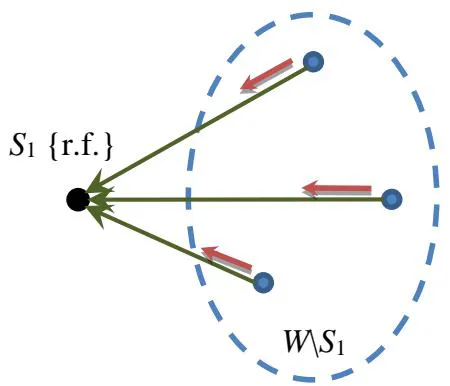
Let us now mentally assume that one of the target elements of the set is fully realized. This means that any other elements of the set cannot rely on the status quo, i.e. cannot persist in their independence and separateness. They are rather virtual to the extent that the target state has not recovered itself from the violation. In this case, the power tension comes from a single center — r.f. and r.n. respectively. Figure 18 shows the diagram of the force field in these two cases. In each of them, the space and time of the actors, as it were, cease to exist, converging to one of the target elements.
Comparing Figure 17,18, one can see that history as a chain of changes of sets of actors is possible, since both metahistorical goals are actualized, and the choice did not occur. And vice versa, since there is a chain of changes of sets of actors independent in their status quo, both metahistorical goals exist, and the choice has not occurred.
Let's pay attention to Figure 17. It can be seen that a non-target point, representing a certain set of actors, in its drift can come either to the r.f. or to the r.n. However, as noted above, due to the mechanism of alienation and under the influence of various kinds of violations, the state of the realized goal is not eternal. Sooner or later, the representative point will leave the past target state and go to the opposite one. As a result, up to non-target elements of the set , the inversion mode will be supported:...→r.f.→r.n.→r.f.→... In this mode, the selection is permanent. In the inversion mode, the rule of many (r.f.) is replaced by the rule of one (r.n.) and vice versa. At the regional level, the inversion scheme reproduces the historical cycle of various forms of government considered by Aristotle [30].
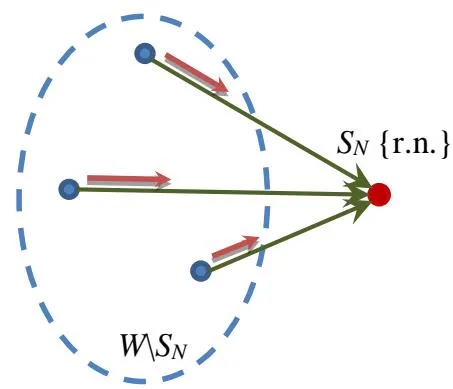
The choice that has been discussed so far does not serve as the desired one, since it is not irreversible. The possibility of the inversion mode completely discredits the choice, because it loses any eschatological meaning. In this case history is an endless series of transitions:...→r.f.→r.n.→r.f.→..., and choice is only the moment of switching from one target state to another. Since it is possible to overcome the "bad" infinity (Hegel's term) of the inversion regime, sooner or later it will be realized. Let's call this opportunity Choice with a capital letter. So, a person can face a Choice that is irrevocable and irreversible. It is the Choice that makes it possible to overcome the bad infinity of the inversion mode and stop history forever. Is Choice fatal? Both yes and no. Choice is rather the limit of human freedom. A person is free to cross the border, but he is also free not to transgress. If a person refuses to Choice, then he is in the inversion mode from one target state to another, and history, as you know, can wait and wait for a person to decide on a Choice. It is the last decision that is of particular interest and the subject of the Metaethics of the outcome of Choice, formulated in the previous section.
X. METAETHICS OF CHOICE OUTCOME
The essence of the Metaethics of the outcome of the Choice is to completely equalize the chances of winning each of the two target states. Both the realm of freedom and the realm of necessity must persist in their opposition as long as possible, increasing the tension of the struggle without limit. It is in this tension that the hope of overcoming and consummating World history is hidden. And in this lies the Secret of World History. No one knows to what extent the struggle must be brought to bear in order for the Choice to take place. As a result, the Choice is extremely difficult, because it can always end with a banal choice of one of the target states. From this point of view, Choice is a gift, something that is extremely difficult to acquire, but also extremely desirable. Choice, because it is a gift, can be interpreted as a temptation. Since Choice is both a gift and a temptation, it is also a "trap".
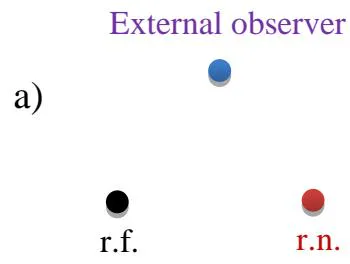
We have come to the most important thing — to the removal, to the completion of the Choice. What is Choice? Choice as a confrontation between two can only be realized with the help of a third. This third is the external observer, from whose positions the model has been built so far. The essence of the Choice is that the external observer, as it were, enters the actors of the r.f. and r.n. and, conversely, the actors of the r.f. and r.n. acquire an external observer in themselves. The Choice is reminiscent of the return of the Hegelian absolute idea to itself after its otherness, when the external observer is interpreted as an absolute idea. Figure 19 shows the states of the target sets of actors and the external observer before and after the Choice.
CHOICE
External observer
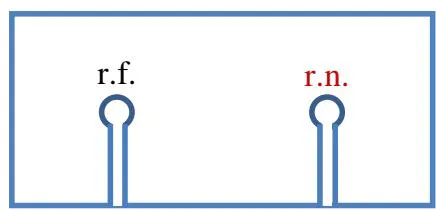
If before the Choice (Figure 19,a) the target states and the external observer oppose each other in mutual alienation, then at the moment of the Choice (Figure 19,b) they acquire each other and become one. Not only target states become a whole, but also all other elements of the space of actors . Thus, an external observer, penetrating all elements of the set , makes them one. But they are united only insofar as they are permeated by an external observer, and as elements of the set they are different.
Here is a symbolic interpretation of the Choice in a mechanistic language. Everyone is well aware of the symbol of the pendulum, which deviates either to the right or to the left. Under the deviation to the left we mean the choice of r.f., by the deviation to the right — the choice of r.n. The endless oscillations of the pendulum symbolize the mode of inversion in global history. Let's turn now to the mechanics. Consider a pendulum that can rotate around its fulcrum in the gravitational field. Figure 20 shows an image of an ideal pendulum fixed at the fulcrum O and consisting of a weightless rod of length I, at the end of which a load of mass m is placed.
According to mechanics, the pendulum has its own oscillation frequency ( — free fall acceleration in the gravity field). Oscillations (or rotations by ) always take place, with the exception of two cases. The trivial case is when the pendulum is at rest and is at point . The non-trivial case of the absence of an oscillatory regime in the dynamics of a pendulum corresponds to a well-defined selection of initial conditions. Let us give the pendulum initially resting at point an angular velocity of either or , where plus corresponds to rotation to the right, and minus to rotation to the left. In these two special cases, the pendulum will indefinitely approach the position of the exact vertical either from the right or from the left. The formula for the dependence on time of the angle of the position of the pendulum relative to the vertical axis is as follows:
where — time.
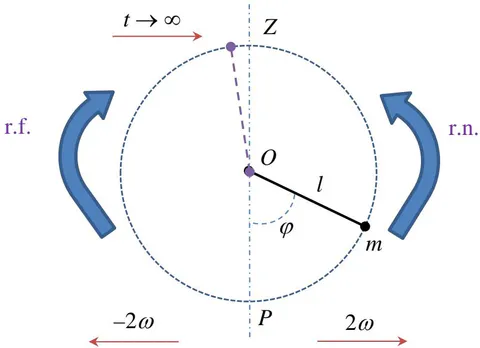
Expression (22) is the solution of the pendulum equation under the initial conditions , , which corresponds to the motion along the separatrix. Considering (22) and tending to infinity, we find that . As a result, we have that in such a well-known image as a pendulum, there is an unoscillating mode of motion, which by analogy corresponds to the Choice in our model, and a well-defined selection of initial conditions that provide a non-oscillatory mode of motion — the Metaethics of the outcome of the Choice.
XI. CONCLUSION
With the onset of the Choice, all actors of the geopolitical system acquire the vision of an external observer of themselves and acquire the attributes of an external observer of complete awareness and disinterest in the historical process. It is in this sense that the End of history comes, which before the Choice was the history of the struggle of a pair of metahistorical goals: the realms of freedom and necessity. The end of history does not mean that the world ceases its physical existence, it only means that the space and time of the actors become one, shrinking into a point. In this case, questions like: what and how many actors are in the geopolitical system are meaningless? Are they born or do they die? The Choice removes the dualism of this-worldly and otherworldly freedom and carries out their synthesis.
The normative model of global history developed in the previous sections was built around the concept of "freedom" and its calculus. The analysis showed that the freedom calculated above is this-worldly freedom. Precisely insofar as it is this-worldly freedom can be equated with information, entropy, and the degree of complexity of an individual actor and the world as a whole. This-worldly freedom is significant for actors because they do not realize their inner relationship, their unity with each other through the experience of otherworldly freedom. The latter will be the subject of study of the model of psiphysics, where a typical actor will be "designed" and the internal unity of an arbitrary number of actors will be shown.
Choice is at the same time a communication limit. But communication is not in the sense in which it was defined above, i.e. type of rational discourse or irrational intuition. So, from the point of view of the Russian philosophical school, the Choice leads to the transformation of logic, it becomes the logic of unity, which, starting with V.S. Solovyov, was also developed in the works of E.N. Trubetskoy, S.N. Bulgakov, P.A. Florensky, S.L. Frank, L.P. Karsavin and a number of other authors. Speaking, for example, in the words of S.L. Frank [31], Choice as a communication limit is "antinomic monodualism — the unity of separateness and interpenetration, transrational hovering over opposites".
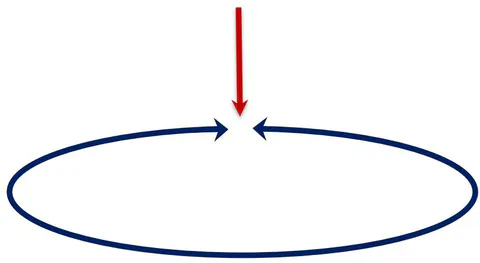
Figure 21 shows the symbol of the normative model of global history, which illustrates the central event of World history — the Choice, presented as a meeting of three — actors of r.f., r.n. and an external observer.
It is clear that the problem of completing the history does not depend on what and who is understood by the subjects of history, called actors in the model. All conceivable interpretations of actors become unified from the point of view of an external observer entering them at the moment of completion of the historical process. If we follow the philosophy of history of Hegel, then, in essence, the external observer acts as an "absolute idea", or "world spirit", and Choice is the return of the world spirit to itself.