MD Ziaul Haque
I. INTRODUCTION
Nuclear fuel cycle and its application to the marine propulsion draw attention to the international and maritime policymakers. It has further been geared up after the Copenhagen summit on global climate change. This worldwide congregation has facilitated to conceptualise the fundamental issues of regarding global warming that leads to global climate change. It seems that the nuclear fuel and its application in marine propulsion and environmental issues should be looked at in parallel. From that point of view, it has been given an assignment on nuclear fuel which is much talked, global concerns, and expectation nowadays. The regular atomic enrichment program and some allegations of handing the nuclear technology over led the global concerns and dismay. With the emergence of atomic technology and clandestine nuclear supply besides global needs for electricity to promote the civilization ahead, all these elements have put the nuclear fuel cycle under controversy and suspicions and mistrust internationally. In this occasion, the efforts have been made to understand the nuclear fuel cycles in broader perspectives and its implications on merchant ship if nuclear propulsion is introduced in broader scale into the marine industry.
a) Aim & Objectives
To grasp the nuclear cycle and the impacts of the atomic propulsion with the fuels with a relatively low enrichment of uranium U-235 consistent with use in merchant marine practice.
b) Methodology
This particular study has been developed through secondary research which includes consulting relevant books, some legislation national and international. However, a few numbers of professionals working in the maritime industries have been interviewed in this particular context.
II. NUCLEAR FUEL CYCLE (FRONT END)
Source: Japan's Nuclear Power Program
a) Uranium Recovery and Conversion process
It is distinctive and complicated cycle rather than other energy resources such as coal, oil and natural gas. Nuclear fuel emerges from uranium, which is the raw material of nuclear fuel and at the same time, it is slightly radioactive metals. To have nuclear fuel, uranium recovery is an important part which focuses on extracting (or mining) natural ore from the Earth crust and concentrating (or milling) that ore which results from Yellow Cake. (USA NRC)
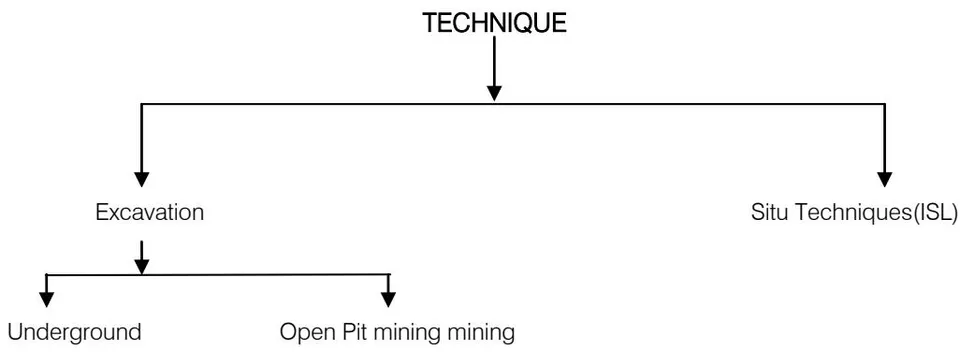
Two techniques are generally used to recover uranium ore such as Excavation and situ techniques-
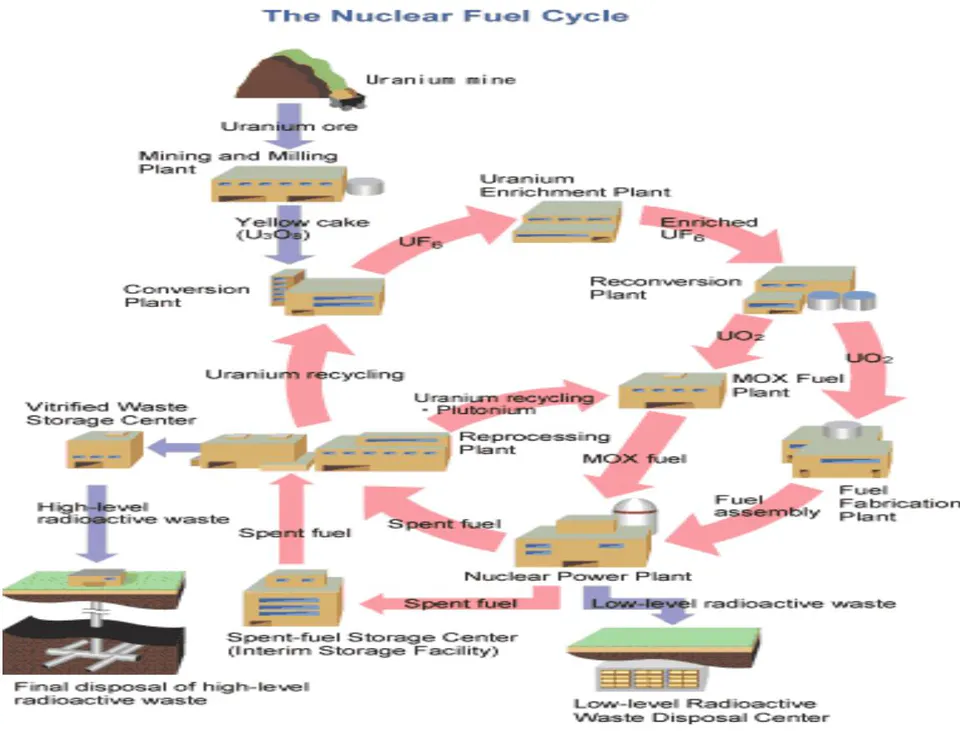
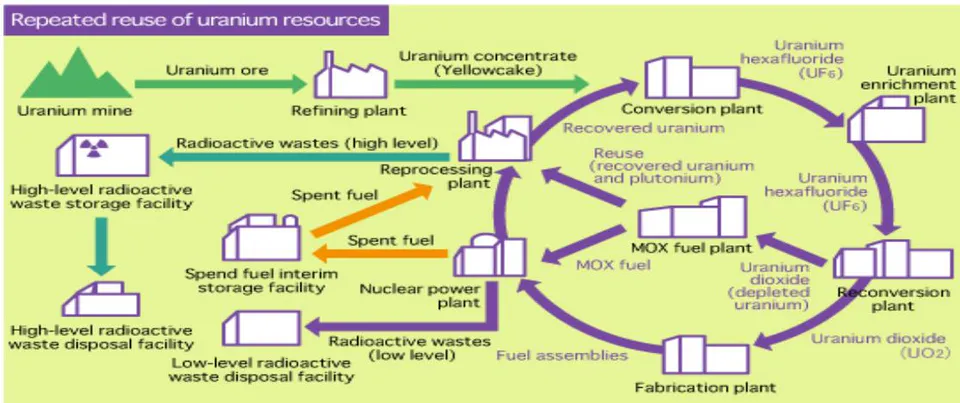
Yellow Cake is commonly known as U3O8. This yellow cake transforms into fuel for the nuclear reactor. To achieve so, a series of industrial processes need to be conducted, and the aftermath of these sorts of operations lead to the production of electricity in the nuclear reactors. The nuclear fuel cycle starts with mining and ending with disposal through specific intermediary processes as shown below-
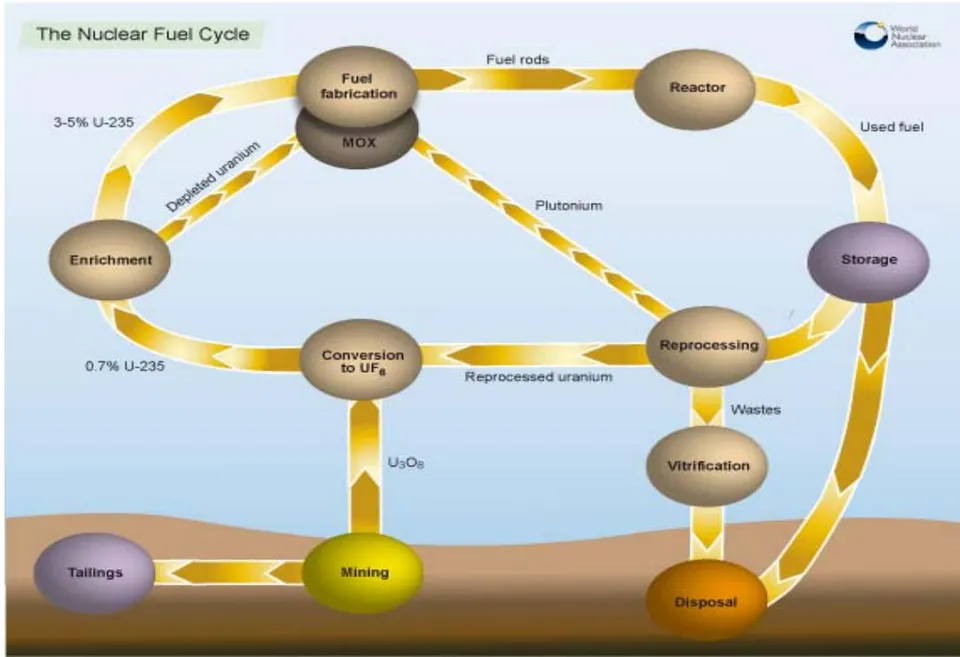
These collective activities can be referred to the nuclear fuel cycle
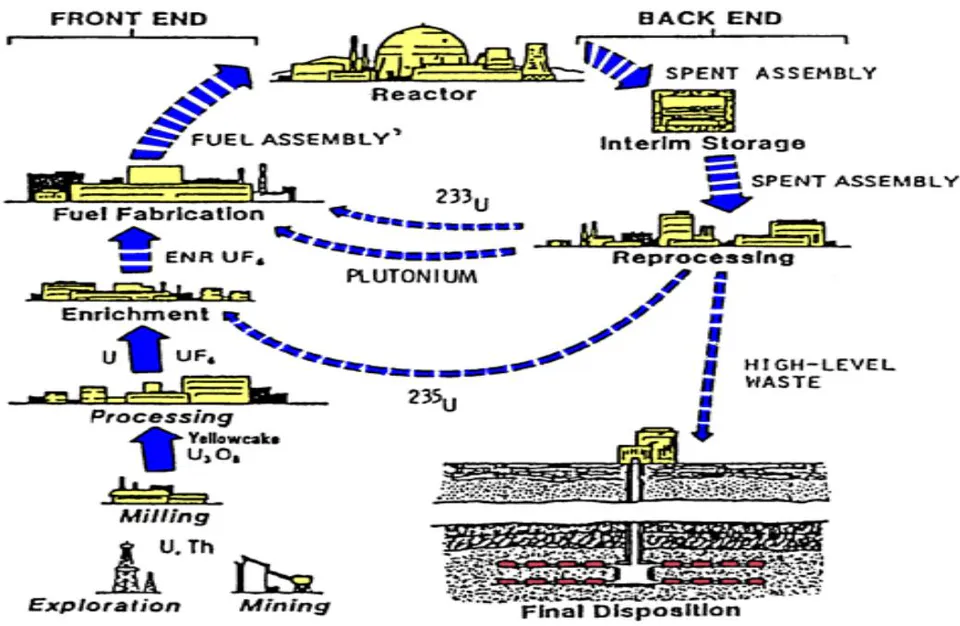
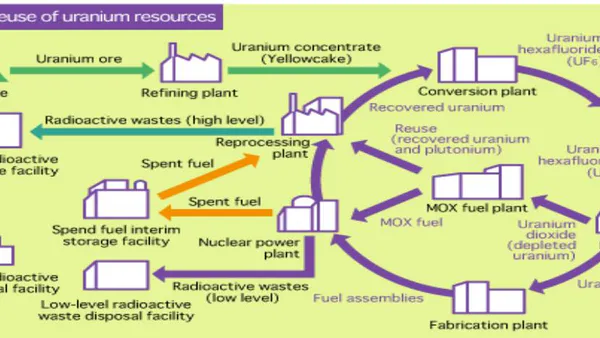
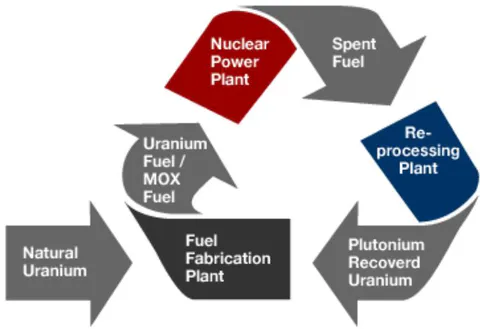
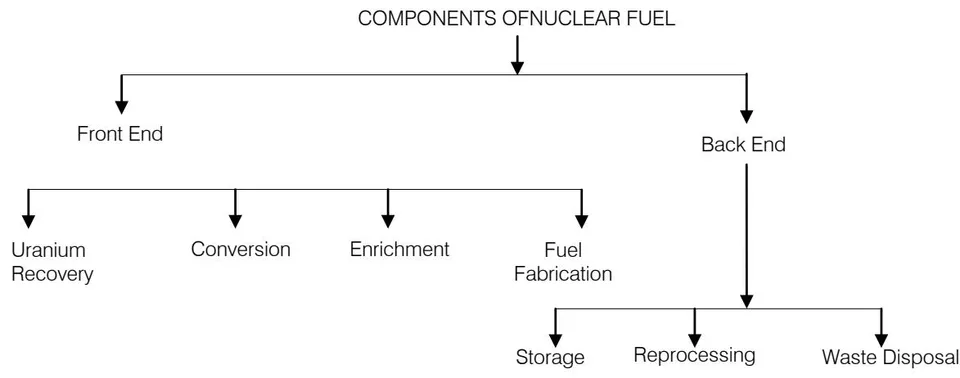
It has two ends such as Front End and Back End. The Front End includes mining and milling, conversion, enrichment and fuel fabrication stages where the uranium is prepared accordingly to use in the nuclear reactor. On the other hand, Back End involves temporary storage, reprocessing, recycling and eventual disposal of nuclear waste. From the Figure01 mentioned above and Figure02, it is evident that the source of atomic energy is plutonium which comes up from the used fuel through reprocessing stage. From that point of view, reprocessing of used or spent fuel can be considered as an option of nuclear energy. The global concerns are centred on the end of reprocessing of used fuel or spent fuel as it is the only way to produce plutonium and plutonium is the central element to acquire nuclear weapons.
b) Conversion
The conversion process involves the conversion of yellowcake (U3O8) into the uranium hexafluoride (UF6) gas combining the Uranium and Fluorine which is suitable for the enrichment operations. All impurities are removed in this conversion process, and UF6 is pressurised and cooled to a liquid which is taken into 14-ton cylinders where it solidifies after cooling for approximately five days. An enrichment plant replaces UF6 cylinders.
c) Enrichment
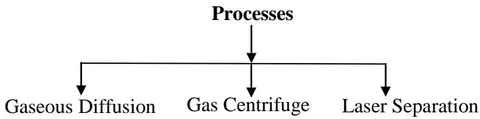
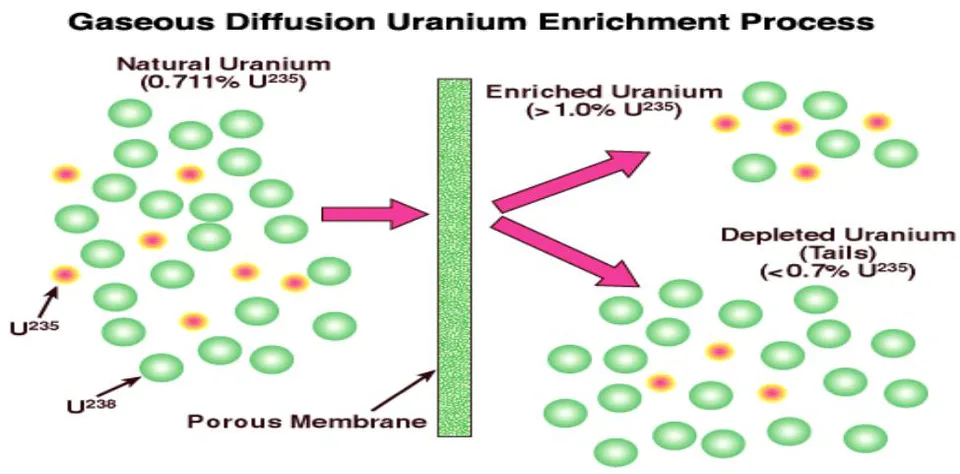
It is the process through which the concentration and increase of U-235 fissile isotope are ensured to undergo fission to produce energy into the nuclear reactor. Uranium Hexafluoride (UF6) needs to be enriched to having fissile isotope U-235 as Uranium Hexafluoride (UF6) gas contains both isotopes U-235 and U-238 in the ratio of 0.7 to 99.3. It means that only 0.7% of natural uranium is fissile and capable of undergoing into fission and fission is the process through which the energy is produced in a nuclear reactor. However, the enrichment process increases the fissile isotope U-235 ranging from 0.7% to 3.5% or little more. Generally, a nuclear reactor requires the concentration of fissile uranium U-235 ranging from 3.5% to 5%. There are two enrichment processes out of three primarily used to concentrate on fissile isotope U-235 as-
d) Fuel Fabrication
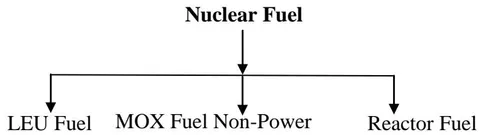
It is the process of conversion of enriched Uranium Hexafluoride (UF6) into fuel for a nuclear reactor and is the last stage of Front End of the nuclear cycle. In the fuel fabrication stage, there are three kinds of nuclear fuel can be produced as-
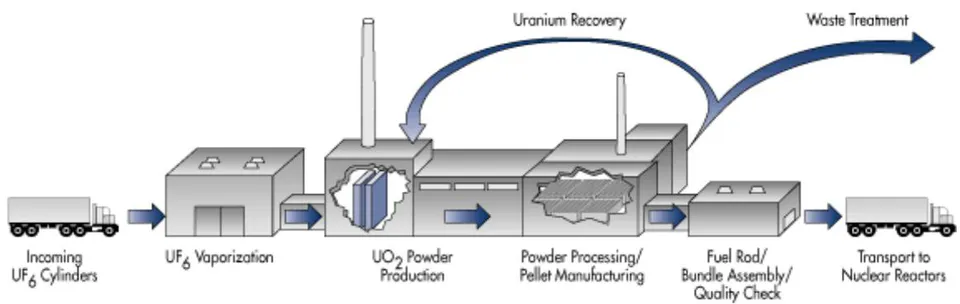
This powder is used to form fuel rod by pressing it into pellets and then putting it into metal tubes (Zircaloy tubes). With the help of these fuel rods, a fuel assembly is formed through putting all fuel rods together. These fuel assemblies are placed into the core of nuclear reactor along with moderator such as graphite or water where control rods used to stop or slow down the nuclear chain reaction process into the reactor where they absorb the neutrons.
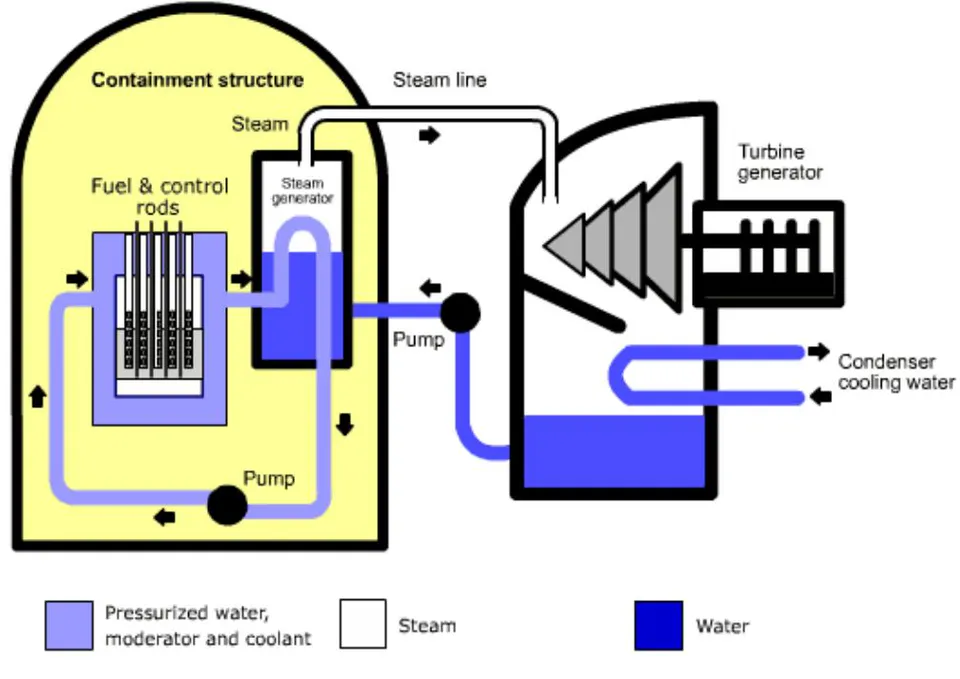
Water absorbs the heat and ultimately converted into steam which operates the turbines and generates electricity. On the other hand, MOX fuel differs from LEU fuel in that in case of MOX fuel, Dioxide powder in the pellets is a combination of uranium dioxide UO2 and plutonium dioxide PO2. This MOX fuel used to make nuclear weapons. The no power reactor fuel is used for research, testing and training purposes. It is not used to produce electricity.
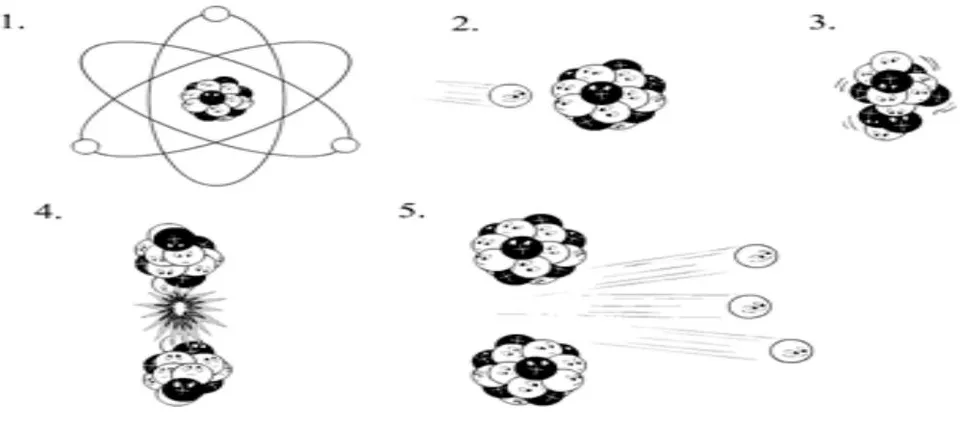
the nuclear fission process takes place where the nuclei of U-235 split and release energy. The energy released inside the reactors makes the water heated and eventually produces steam. The steam produced operates the turbine and generates electricity. Here the fission process is shown where atoms splitting process is visible.
e) Reactor
It is a sandwich stage between the Front End and Back End of the nuclear cycle. Inside the reactor,
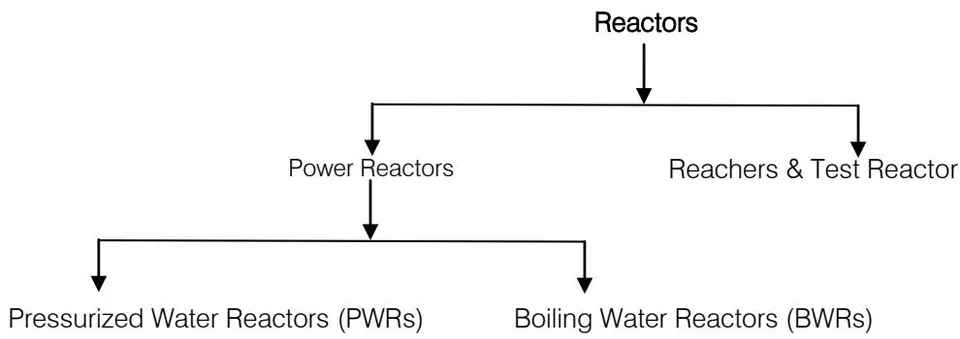
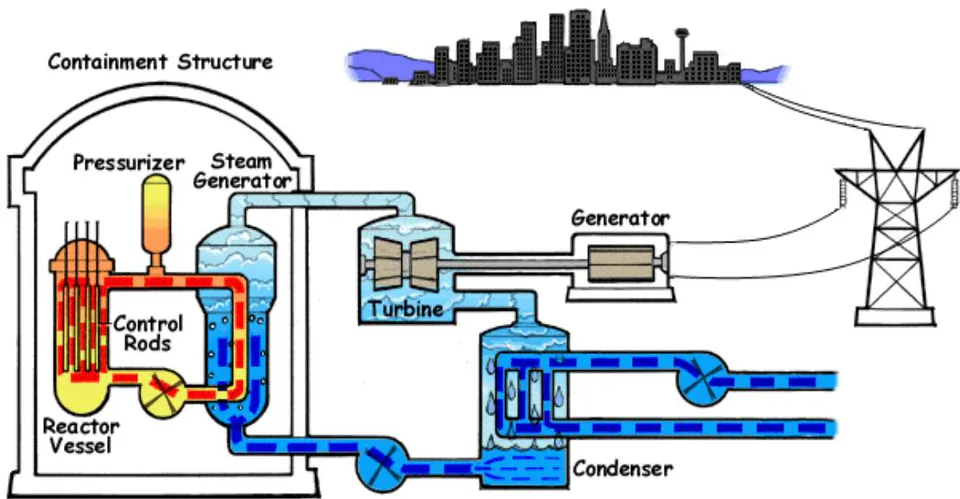
There are different types of reactors in use as-
III. BACK END OF NUCLEAR CYCLE
a) Spent Fuel
With the pace of time, the concentration of fission fragments and heavy elements are formed inside the reactors, and after a certain point it becomes convenient that the fuel should no longer use and which dictates the authority concerned to remove the spent fuel from the reactors. However, the ultimate point is that it is as risky as the spent fuel is very hot and radioactive.
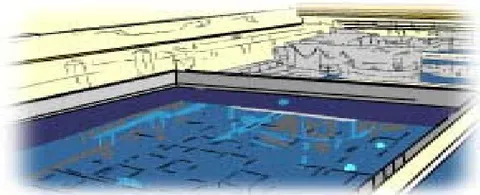
Fig. 12: Spent Fuel Cooling Pond In consideration of the fact, the spent fuel is discharged into the storage pond immediately to decreasing the radiation. These two functions of the cooling pond as it shields the radiation and absorbs the heat which protects the people involved in the workplace. It may be mentioned that the spent fuel requires to be either reprocessed or permanent disposal and it depends on the policy of the respective party.
b) Reprocessing of Nuclear Fuel
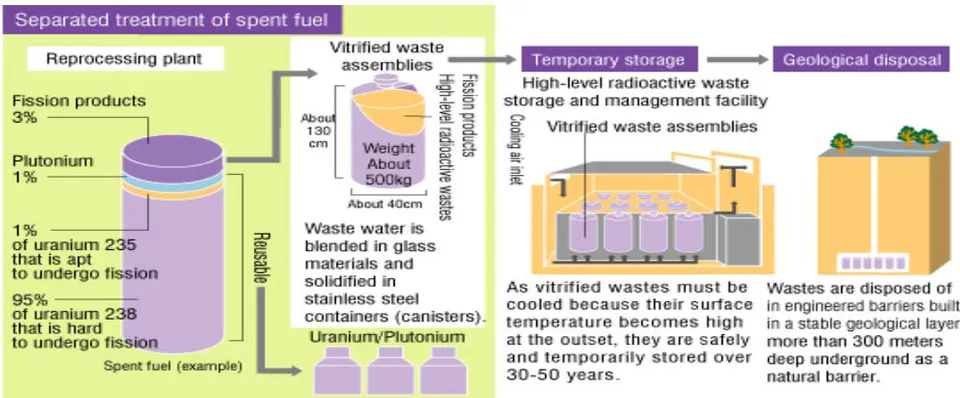
Regarding reprocessing of Nuclear Fuel, it needs to mention that the spent fuel contains about 96% of un-burnt uranium and about 1% of plutonium which comes from U-238 that absorbed neutrons. The above mentioned 96% un-burnt uranium contains about 1% U-235(fissile) and 95% U-238. The sole purpose of reprocessing of spent fuel is to recover the uranium and plutonium to generate power through the repeated use of them as it is the basis of nuclear energy policy. Following diagram enables to grasp the reprocessing of nuclear fuel in wider perspectives.
Regarding reprocessing of nuclear MOX fuel, a plus thermal process can be used.
c) Waste Disposal
The waste disposal is substantial environmental and safety concerns as nuclear waste is radioactive. Two methods are applied to serve the purposes as-
i. Method of Low-Level Radioactive Waste Treatment and Disposal
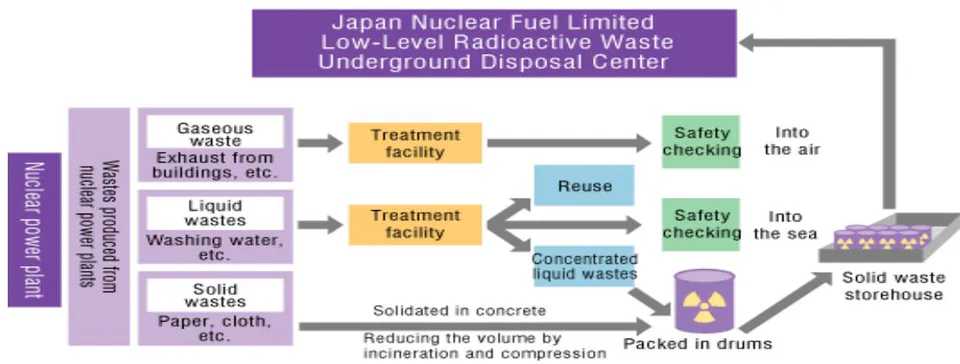
It is evident from the schematic diagram that a nuclear power plant produces three types of waste as Gaseous, Liquid and Solis waste. Gaseous waste is released into the atmosphere once sure standard safety checking is done with confirmation that the radioactivity is adequately attenuated. In case of liquid from waste, a small amount of such waste is released from outlets after filtration, ion exchange, and concentration etc. Most of the liquid wastes are reused after the treatments mentioned above.
ii. Method of High-Level Radioactive Waste Treatment and Disposal
When spent fuel is reprocessed then some amount of wastewater has remained from the extraction of uranium and plutonium which is highly radioactive and contains fission products. Following schematic diagram depicts a clear picture in the understanding disposal of the High-Level Radioactive Waste where wastewater is blended in glass materials and solidified in canisters. This process is called vitrification process. It is the safe method of treating, transporting and storing of HLW.
IV. NUCLEAR PROPULSION IN MERCHANT SHIP OPERATIONS AND IMPLICATIONS
Following the schematic diagram enables to grasp the nuclear propulsion system where the main turbine is connected with main propulsion motor through the reduction gear and shafting with a propeller. In an earlier attempt (in section 2.2), it has been discussed how nuclear fission takes place inside the reactor and produces energy to rotate the turbine. The atomic propulsion ship is considered to be the source of radiation as the reactor deals with uranium which is one of the few materials that can produce heat in a self – sustaining the chain reaction. From that point of view, it has great significance regarding the generation of propulsion power.
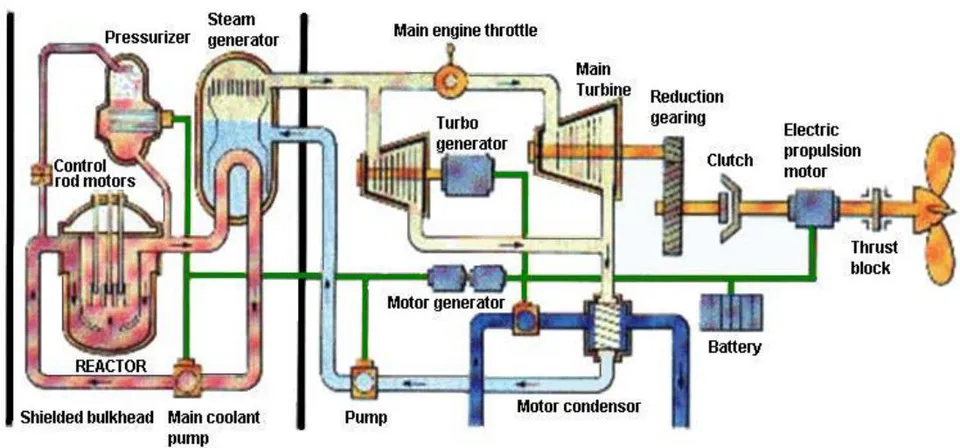
Moreover, it is contributing to global warming and greenhouse gases and harming ozone layer which permits UV rays to reach in the Earth. On the other hand, nuclear fuel requires no oxygen (O2) in the fission process and zero emission characteristics (no exhaust gases) which attract the attention of the decision makers of the marine industry. In nuclear propulsion, a ship has zero spill possibilities which save the increasing cost of bunkering. It needs to bear in mind that the liability of oil spillage in ports or sea is strict and severe. Possible impacts of NOX and SOX on the conventional engines and environment are other concerns.
Regarding the reliability of the engines, the fossil fuel engines are not reliable for a long time in the sense that it requires the continuous and constant supply of fuel. In contrast, an atomic engine, where nuclear fission takes place, is the compact source of an endless amount of heat it can last a long time without refuelling. Moreover, much marine accident takes place due to the failure of conventional propulsion system where nuclear propulsion system rules out those chances with the higher degree. From that point of view, it has excellent reliability characteristics. When the world is welcoming the containerization concepts, the container ship needs excellent speed characteristics to serve global peoples. To meet those, nuclear propulsion ship has a speed advantage over fossil fuel propulsion ship. There is no scope to deny that nuclear propulsion system is economically and environmentally superior to the conventional propulsion system. Moreover, atomic fuel concept will reduce the vibration of machinery and gives the stable propulsion and motion of the ship if the nuclear reactor is installed amidships. The debate on the nuclear issues are still on, the issues raised regarding international approach, economic justification, nuclear acceptability in world community especially in the green lobby and the fact of fossil fuel pricing and global reserve and environmental issues.
According to Mr John Carlton, Global Head, Marine Technology and Investigation- "The technology is there to commence building nuclear ships. The issues regarding their acceptability and the need for a culture step-change in shipping still need to be addressed so that society is comfortable any risk is being managed."
Source: MER.(2010), IMarEST
However, the other side of the coin is- if nuclear fuel introduced on merchant vessel propulsion system then what would be the scenario in case of piracy? The significant global security concern can arise. Nowadays any sort of decommissioning is costly if nuclear plants need to dismantle it can cause substantial costs, the safety concern for both those who will be involved in the decommissioning process and the surrounding environment. Although nuclear fuel life is very long. Other issues are –what will be the regulatory process of nuclear plant onboard, and training of seagoing staffs?
Moreover, also need to think about the mutual relation between the shipping management and nuclear management, and necessary legal framework to ensure the safety of atomic fuel onboard, the Environment Group and People's perception need to be considered as well.
V. CONCLUSION
Is Nuclear fuel the best alternative or not, it is difficult to predict right now as the full information has not been disclosed yet. However, it seems a good idea and concept if the vulnerability and consequence matrix can be identified and appropriate global collective efforts and framework can be established.