I. INTRODUCTION
Since 1905, scientists has tried to collect dew to obtain water, using the so-called Zibold condensers [1-3]. Recently, many studies concerning natural condensation of water vapor are oriented towards agriculture (plants and animals), the source of drinking water and the study of the soil cooling[4-8]. Dew is a type of precipitation where water molecules droplets form on the ground, which is usually not explicitly considered in hydrologic cycle, because the amounts are small. However, in semiarid and arid regions harvesting dew can reach or even exceed all other forms of precipitation for extended periods or indeed a whole year. Water scarcity well becomes especially severe in many countries of Africa (South Morocco, Senegal, Mali, etc). One possible solution lies in alternative water sources, such as nocturnal radiative cooling. Dew formation is the result of nocturnal radiation. Practically, Dew is a natural phenomenon that occurs under particular meteorological conditions and on a dew plate condenser with high radiative cooling properties specially designed for this purpose. Dew forms when the temperature of a surface (collector sheet or dew condenser) cools below the dew point temperature of the surrounding air so that water vapor contained in this air condenses on the collector sheets. The cooling effect of a collector sheet is caused by a radiation loss. The importance of water vapor as a reservoir of heat can be seen by comparing the daily temperature ranges of a semi-arid environment to that of a humid area. Semi-arid and humid environments may heat up in the same manner during the day but, due to the relative absence of water molecules and dioxide the carbon to absorb and hold the heat energy, the semi-arid region cools down much more at night than the humid region. How much it cools down depends on the meteorological data.
We attempt to create an efficient and cheap dew plate condenser has not yet been exploited. In this modeling study we focus on the harvesting dew onto lawsonite radiant mineral as a dew condenser, and investigate the potential for its collection. The planar dew condenser was set at an angle of with respect to horizontal. Numerical simulations using the energy balance equation to identify the meteorological factors which determine the degree of cooling, and to assess their effect on harvesting dew were performed. These meteorological parameters were found to be ambient temperature , cloud cover (N), wind speed , soil heat flux (G), and relative humidity (Hr). The temperature of the collector sheets (Ts) dew forms on is also important. The impact of water vapor on soil is important in arid or semi-arid environments.
a) Sample description and characterization
Lawsonite, , is one of the key mineral used as an indicator of high-P and low-Z metamorphic environments like blueschists-facies metabasalts and metagreywackes[9-10]. Lawsonite can occur as isolated needle-like crystals, aggregates displaying a radiating pattern, or as tabular crystals. The structure, which contains both discretehydroxyl groups (OH) and molecule, was first solved by Wickman [11]. In addition to groups, lawsonite contain also the unit. At ambient conditions, lawsonite is orthorhombic with space group and the following designation of crystallographic axes has been adopted: , , . The structure consists of chains of edge sharing Al-O octahedra and which are linked by Si2O7 groups. The non-centred primitive unit cell (spectroscopic cell) is half as large and contains 38 atoms; hence, there are a total of 114 vibration modes at the centre of the Brillouin zone[12-13]. A knowledge of atomic positions and
symmetries leads to the following irreduciblere presentation of the 114 modes:
It is assumed that the polyhedra, OH and groups are preserved as distinct structural units. The site symmetry of both and water molecules within lawsonite is mm and that of hydroxyl groups OH is m . Labotka and Rossman [12] have assigned the bands of the vibrations of OH and in lawsonite. The stretching motions of polyhedra were assigned by Hofmeister et al [13]. The stretching vibrations of one unit can be divided into the vibrations of and the vibrations of Si-O-Si bridges[14].
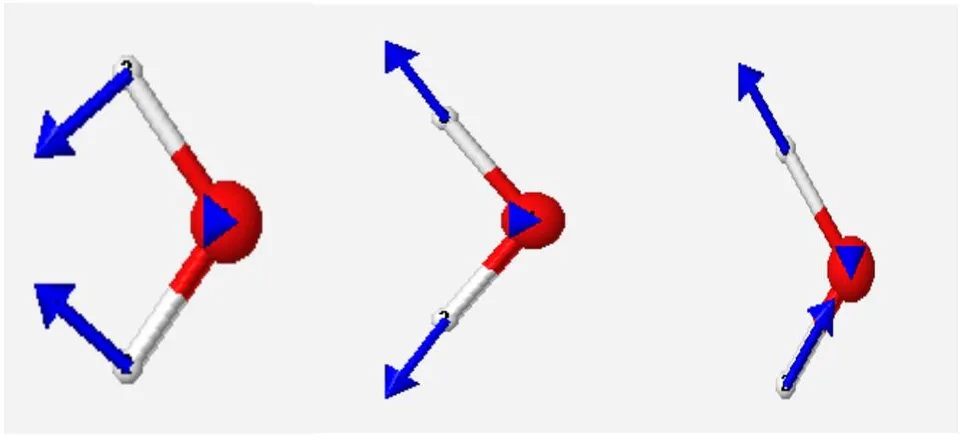
Bending of water Stretching symmetric Stretching antisymmetric ( )
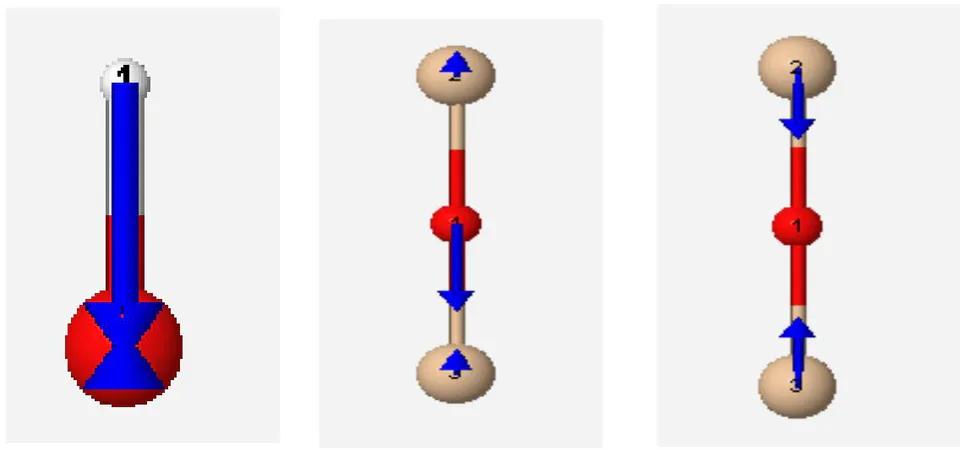
Stretching antisymmetric (Si-O-Si) Stretching symmetric (Si-O-SIIIIISiSi)
Stretching symmetric in plan Stretching antisymmetric in plan Stretching antisymmetric out of plan
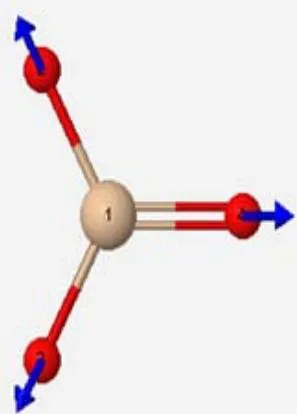
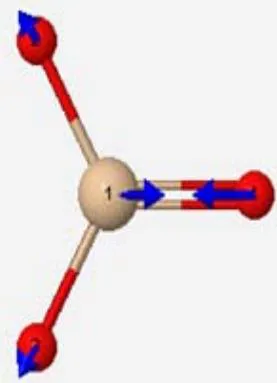
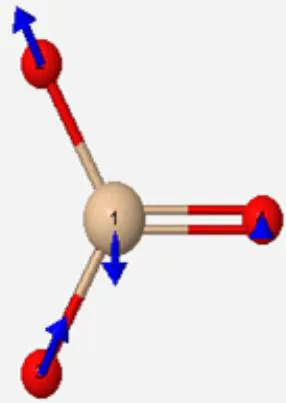
Frequency IR (cm-1) Frequency Raman (cm-1) Symmetry type Assignments 622 694 Aq νs(Si-O-Si) 1030 1047 B2a νas(Si-O-Si) 888 916 Aq νs'(SiO3) --- 912 B2a νs',νas(SiO3) 950 963 Aq νas(SiO3) --- 959 B1a νas(SiO3) 923 936 B3a νas(SiO3)
b) Dew model description
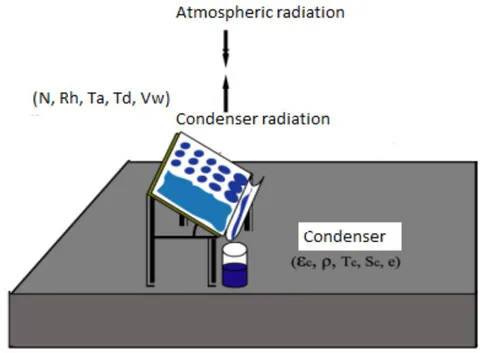
The dew plate condenser in our model is an inclined collector sheet of natural lawsonite mineral
(Fig.2). The parameter values used in our dew formation model are tabulated in table 2.
| Parameter | Value |
| Sheet specific heat capacity Cc871J kg-1K-1 | |
| Sheet density ρc3100 Kg m3 | |
| Sheet IR emissivity | 0.83 |
It was difficult to grind lawsonite because of its hardness (Tab.2); for that reason, flat lawsonite pieces were chosen in the dew harvesting model.
| Specimen | Chemical formula | Hardness |
| CaAl2Si2O7(OH)2·H2O | 8 |
In implementing the model that describes the harvesting dew, we followed the approach presented by Nikolayev et al., Wahlren, 2001, Jacobs et al. and O. Clus[16-20]. The heat energy balance as given by the following equation:
where , and are the dew condenser's temperature, mass and specific heat capacity, respectively. The dew condenser's mass is given by , where and are its density, surface area (square meter) and thickness (see Table 1). and are the specific heat capacity and mass of water, representing the cumulative mass of dew water that has condensed onto the collector sheet (Fig. 2).
and describe the powers involved in the heat exchange processes. The radiation term, is given by
where and are the incoming thermal infrared radiation flux from the atmosphere and the outgoing radiative power from the dew condenser, respectively. and are the condenser and the sky emissivity.
Returning to Eq. (1), the term describes the conductive heat exchange between the dew condenser surface and the ground (blackbody). We assume perfect insulation; the conductive heat exchange is negligible.
The convective heat-exchange term , is given by:
where is the ambient air temperature and is the heat transfer coefficient [21].
The final term in Eq. (1), , represents the latent heat released by the condensation of water:
is the specific latent heat of condensation for water For the rate of condensation, we can write a mass balance equation by the following relationship:
is the mass transfer coefficient.
is the saturation pressure at the dew point temperature.
is the vapor pressureover the condenser sheet.
The dew point temperature is defined by [22]:
where RH is the relative humidity.
II. RESULTS AND DISCUSSION
The average of relative humidity in the Mirleft region is about for dry season but reaches for the wet season. In table, 4 we present the key statistics of the daily average of the day and night average, maxima and minima[22].
| RH(%) | Daily | Daily maximum | Daily minimum | Diurnal | Nocturne |
| Dry season | |||||
| average | 80.6 | 88.7 | 69.6 | 77.9 | 83.6 |
| Wet season | |||||
| average | 75.8 | 86 | 63.7 | 75.7 | 76.7 |
The daily wind speed recorded at the Mirleftstation does not exceed . Low speed wind was found at the night during the study period with an average of . In wet season, wind speed is generally less than that of the dry season .
| Wind speed (m s-1) | Daily | Daily maximum | Daily Minimum | Diurnal | Nocturne |
| Dry season | |||||
| Average | 2.47 | 4.98 | 0.46 | 2.65 | 2.25 |
| Wet season | |||||
| Average | 2.08 | 4.49 | 0.16 | 2.19 | 1.93 |
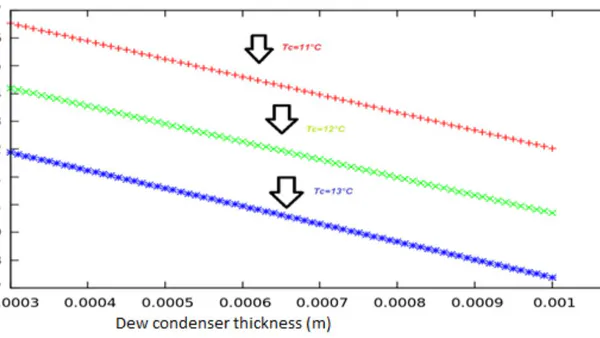
Dew water is influenced by ambient temperature , dew temperature , dew condenser temperature and other metrological factors. Cumulative dew was calculated hourly for 12 h period (per night) as a function of temperature dew condenser is shown in Fig. 3. It shows that the effect of dew plate condenser temperature on dew formation per night is linear for all parameters combination employed. Fig.3 illustrates also that dew formation declines linearly with dew condenser temperature. The amount of condensed water obtained varied from 0.56 to per night as a function of dew condenser temperature . For the given dew condenser, creating an imbalance between the incoming thermal radiation from the sun and the outgoing thermal radiation from the surface dew condenser through the transparency window , is key to achieving dew condensation. The algorithm imposes an approximate relation condition, with and , provides a reasonable estimation of dew occurrence [24-25]:
This condition cannot be used to estimate the cumulative dew; however, it can give a good estimation of its occurrence. Condition (7) can be expressed as a condition on relative humidity corresponds to relative humidity [25]) and condensation occurrence whenthe temperature of the dew condenser is below the dew point temperature .
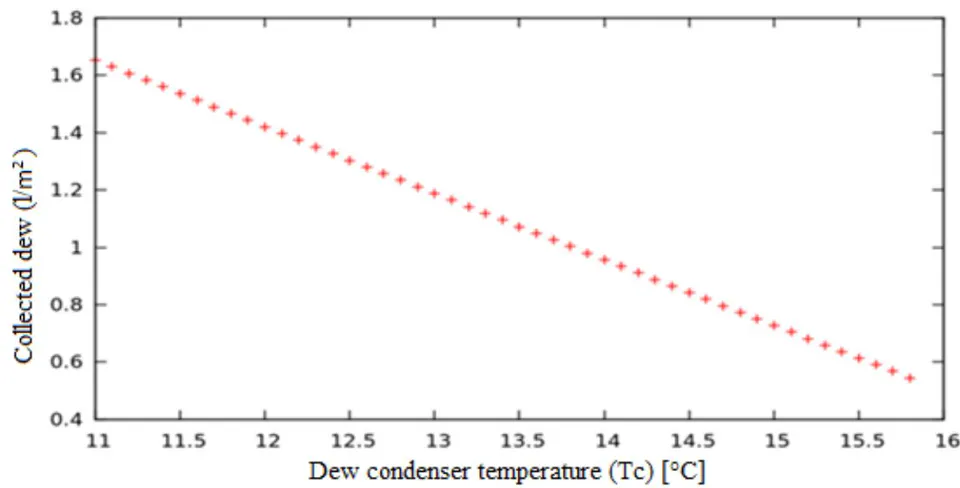
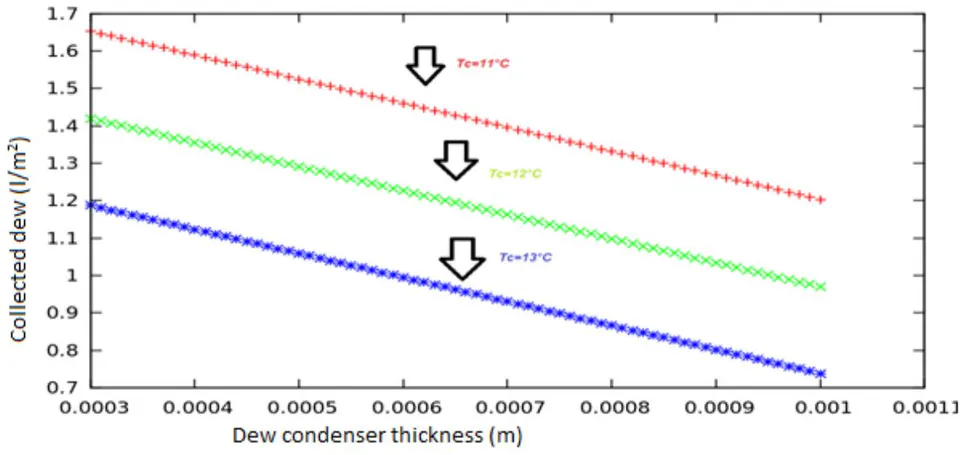
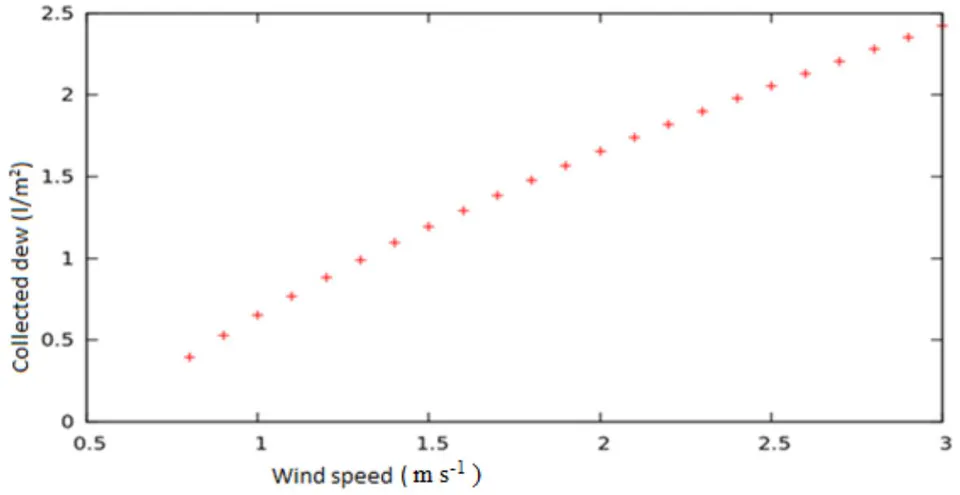
Figure 5 shows that the effect of wind speed on dew formation is non-linear. The effect of wind speed on dew formation (Fig. 5) is more complicated than that of the dew condenser thickness and dew condenser temperature parameters just discussed above. Beysens et al found that the wind speed of is the threshold for dew occurrence [25]. However, Monteith found that the dew formation is negligible when the wind speed drops below , and that the dew formation increases when wind speed is [26]. We observe that collected dew increases with wind speed up to a certain value of and then decreases again. Similarly, the wind speed of is the threshold for dew occurrence.
III. CONCLUSION
The numerical simulations for dew formation on lawsonite collector sheet were investigated by implementing a dew collection model bases on solving the energy balance equations. We show that dew collection yield depends on several meteorological factors such as relative humidity, cloud cover and wind speed. On the other hand, we observe that dew collection yield depends also on the dew condenser thickness and dew condenser temperature. The result obtained is that the lawsonite sheet condenser collected between 0.5 and /night of water. The lawsonite thin film has high emissivity across ; which indicates that it can be used as good radiative cooling and dew water condenser mineral. Further experiments and numerical simulations are required for new minerals that can increase dew collection yields.