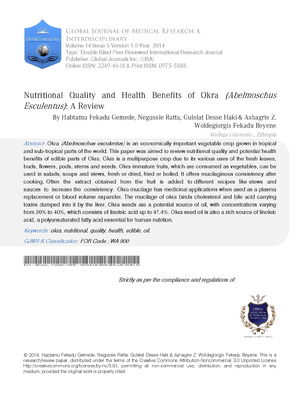
Nutritional Quality and Health Benefits of Okra (Abelmoschus Esculentus): A Review

Habtamu Fekadu Gemede
Negussie Ratta
Negussie Ratta
Gulelat Desse Haki
Gulelat Desse Haki
Ashagrie Z. Woldegiorgis
Fekadu Beyene
Fekadu Beyene
Addis Ababa University Addis Ababa University

Send Message

To: Author

Nutritional Quality and Health Benefits of Okra (Abelmoschus Esculentus): A Review

Article Fingerprint

ReserarchID

2CGBM

Nutritional Quality and Health Benefits of Okra (Abelmoschus Esculentus): A Review Banner

AI TAKEAWAY

Connecting with the Eternal Ground
  • English
  • Afrikaans
  • Albanian
  • Amharic
  • Arabic
  • Armenian
  • Azerbaijani
  • Basque
  • Belarusian
  • Bengali
  • Bosnian
  • Bulgarian
  • Catalan
  • Cebuano
  • Chichewa
  • Chinese (Simplified)
  • Chinese (Traditional)
  • Corsican
  • Croatian
  • Czech
  • Danish
  • Dutch
  • Esperanto
  • Estonian
  • Filipino
  • Finnish
  • French
  • Frisian
  • Galician
  • Georgian
  • German
  • Greek
  • Gujarati
  • Haitian Creole
  • Hausa
  • Hawaiian
  • Hebrew
  • Hindi
  • Hmong
  • Hungarian
  • Icelandic
  • Igbo
  • Indonesian
  • Irish
  • Italian
  • Japanese
  • Javanese
  • Kannada
  • Kazakh
  • Khmer
  • Korean
  • Kurdish (Kurmanji)
  • Kyrgyz
  • Lao
  • Latin
  • Latvian
  • Lithuanian
  • Luxembourgish
  • Macedonian
  • Malagasy
  • Malay
  • Malayalam
  • Maltese
  • Maori
  • Marathi
  • Mongolian
  • Myanmar (Burmese)
  • Nepali
  • Norwegian
  • Pashto
  • Persian
  • Polish
  • Portuguese
  • Punjabi
  • Romanian
  • Russian
  • Samoan
  • Scots Gaelic
  • Serbian
  • Sesotho
  • Shona
  • Sindhi
  • Sinhala
  • Slovak
  • Slovenian
  • Somali
  • Spanish
  • Sundanese
  • Swahili
  • Swedish
  • Tajik
  • Tamil
  • Telugu
  • Thai
  • Turkish
  • Ukrainian
  • Urdu
  • Uzbek
  • Vietnamese
  • Welsh
  • Xhosa
  • Yiddish
  • Yoruba
  • Zulu
Font Type
Font Size
Font Size
Bedground

Abstract

Okra is an economically important vegetable crop grown in tropical and sub-tropical parts of the world. This paper was aimed to review nutritional quality and potential health benefits of edible parts of Okra. Okra is a multipurpose crop due to its various uses of the fresh leaves, buds, flowers, pods, stems and seeds. Okra immature fruits, which are consumed as vegetables, can be used in salads, soups and stews, fresh or dried, fried or boiled. It offers mucilaginous consistency after cooking. Often the extract obtained from the fruit is added to different recipes like stews and sauces to increase the consistency. Okra mucilage has medicinal applications when used as a plasma replacement or blood volume expander. The mucilage of okra binds cholesterol and bile acid carrying toxins dumped into it by the liver. Okra seeds are a potential source of oil, with concentrations varying from 20% to 40%, which consists of linoleic acid up to 47.4%. Okra seed oil is also a rich source of linoleic acid, a polyunsaturated fatty acid essential for human nutrition.

References

77 Cites in Article
  1. Robert Aman,Andeas Schieber,Reinhold Carle (2005). Effects of Heating and Illumination on <i>Trans</i>−<i>Cis</i> Isomerization and Degradation of β-Carotene and Lutein in Isolated Spinach Chloroplasts.
  2. Csaba András,Béla Simándi,Ferenc Örsi,Charalambos Lambrou,Doukeni Missopolinou‐tatala,Costas Panayiotou,János Domokos,Fruzsina Doleschall (2005). Supercritical carbon dioxide extraction of okra (<i>Hibiscus esculentus</i> L) seeds.
  3. N Ansari,L Houlihan,B Hussain,A Pieroni (2005). Antioxidant activity of five vegetables traditionally consumed by south-Asian migrants in Bradford, Yorkshire, UK.
  4. P Arapitsas (2008). Identification and quantification of polyphenolic compounds from okra seeds and skins.
  5. S Atawodi,J Atawodi,G Idakwo,B Pfundstein,R Haubner,G Wurtele,Spiegelhalder,R Owen,S Avallone,T Tiemtore,E Rivier,C Treche,S (2008). Nutritional value of six multi-ingredient sauces from Burkina Faso.
  6. L Bakre,K Jaiyeoba (2009). Effects of drying methods on the physicochemical and compressional characteristics of Okra powder and the release properties of its metronidazole tablet formulation.
  7. James Bemiller,Roy Whistler,David Barkalow,Chyi-Cheng Chen (1993). ALOE, CHIA, FLAXSEED, OKRA, PSYLLIUM SEED, QUINCE SEED, AND TAMARIND GUMS.
  8. C Benjawan,P Chutichudet,S Kaewsit (2007). Effect of green manures on growth yield and quality of green okra (Abelmoschus esculentusL) har lium cultivar.
  9. U Bhat,R Tharanathan (1987). Functional Properties of Okra (<i>Hibiscus esculentus</i>) Mucilage.
  10. S Calisir,M Yildiz (2005). A study on some physico-chemical properties of Turkeyokra (Hibiscus esculenta) seeds.
  11. J Cook,D Jagt,A Pastuszyn,G Mounkaila,R Glew,M Millson,R Glew (2000). Nutrient and chemical composition of 13 wild plant foods of Niger.
  12. M Davey,M Van Montagu,D Inze,M Sanmartin,A Kanellis,F Smirnof (2000). Plant Lascorbic acid: Chemistry, function, metabolism, bioavailability and effects of processing.
  13. S Dilruba,M Hasanuzzaman,R Karim,K Nahar (2009). Yield response of okra to different sowing time and application of growth hormones.
  14. R Ebermann,G Alth,M Kreitner,A Kubin (2006). Natural products derived from plants as potential drugs for the photodynamic destruction of tumor cells.
  15. C Ewa,G Agnieszka,F Adametal (2011). The content of protein and of amino acids in Jerusalem artichoke tubers (Helianthus tuberosus L.) of red variety Rote Zonenkugel.
  16. A Farinde,O Owolarafe,I Ogungbemi (2007). An overview of production, processing, marketing and utilisation of okra in egbedore local government area of Osun State, Nigeria.
  17. N Georgiadis,C Ritzoulis,G Sioura,P Kornezou,C Vasiliadou,C Tsioptsias (2011). Contribution of okra extracts to the stability and rheology of oil-in-water emulsions.
  18. Sneha Jakhotia,Branislav Nastasijević,Gordana Joksić,Sreenivasa Reddy,G Reddy (2007). Gentiana lutea AND DIABETIC COMPLICATIONS.
  19. Alexander Gosslau,Kuang Chen (2004). Nutraceuticals, apoptosis, and disease prevention.
  20. I Gurbuz (2003). Antiulcerogenic activity of some plants used as folk remedy in Tur key.
  21. K Hirose,K Endo,K Hasegawa (2004). A convenient synthesis of lepidimoide from okra mucilage and its growth promoting activity in hypocotyls.
  22. R Holser,G Bost (2004). Hybrid <i>Hibiscus</i> seed oil compositions.
  23. T Kahlon,M Chapman,G Smith (2007). In vitro binding of bile acids by okra beets asparagus eggplant turnips green beans carrots and cauliflower.
  24. T Kahlon,M Chapman,G Smith (2007). In vitro binding of bile acids by okra, beets, asparagus, eggplant, turnips, green beans, carrots, and cauliflower.
  25. Cyril Kendall,David Jenkins (2004). A Dietary portfolio: Maximal reduction of low-density lipoprotein cholesterol with diet.
  26. Panadda Khomsug,Walaiporn Thongjaroe,Noppakun Pakdeenaro,Maitree Suttajit,Piyanete Chantirati (2010). Antioxidative Activities and Phenolic Content of Extracts from Okra (Abelmoschus esculentus L.).
  27. Norman Krinsky (2001). Carotenoids as antioxidants.
  28. R Kumar,M Patil,S Patil,M Paschapur (2009). Evaluation of Abelmoschus esculentus mucilage as paracetamol suspension.
  29. S Kumar,S Dagnoko,S Haougui,A Ratnadass,D Pasternak,C Kouame (2010). Okra (Abelmoschus spp.) in West and Central Africa: potential and progress on its improvement.
  30. Christian Lengsfeld,Fritz Titgemeyer,Gerhard Faller,Andreas Hensel (2004). Glycosylated Compounds from Okra Inhibit Adhesion of<i>Helicobacter pylori</i>to Human Gastric Mucosa.
  31. Christian Lengsfeld,Fritz Titgemeyer,Gerhard Faller,Andreas Hensel (2004). Glycosylated Compounds from Okra Inhibit Adhesion of<i>Helicobacter pylori</i>to Human Gastric Mucosa.
  32. H Liao,H Liu,K Yuan (2012). A new flavonol glycoside from the Abelmoschus esculentus Linn.
  33. Kuei-Long Liao,Mei-Chin Yin (2000). Individual and Combined Antioxidant Effects of Seven Phenolic Agents in Human Erythrocyte Membrane Ghosts and Phosphatidylcholine Liposome Systems: Importance of the Partition Coefficient.
  34. I Liu,Shorong-Shii Liou,Ting-Wei Lan,Feng-Lin Hsu,Juei-Tang Cheng (2005). Myricetin as the Active Principle of<i>Abelmoschus moschatus</i>to Lower Plasma Glucose in Streptozotocin-Induced Diabetic Rats.
  35. D Madison (2008). Renewing America's Food Traditions.
  36. Claudine Manach,Gary Williamson,Christine Morand,Augustin Scalbert,Christian Rémésy (2005). Bioavailability and bioefficacy of polyphenols in humans. I. Review of 97 bioavailability studies.
  37. R Maramag (2013). Diuretic potential of Capsicum frutescens L., Corchorus oliturius L., and Abelmoschus esculentus L.
  38. D Marinova,F Ribarova,M Atanassova (2005). Total phenolics and total flavonoids in Bulgarian fruits and vegetables.
  39. Mef (2013). Biology of Okra. Series of crop specific biology document.
  40. J Messing,C Thöle,M Niehues,A Shevtsova,E Glocker,A Hensel (2014). Antiadhesive properties of Abelmoschus esculentus (Okra) immature fruit extract against Helicobacter pylori adhesion. PLoS One, 9(1), e84836. heart disease and cancer.
  41. Y Mihretu,G Wayessa,D Adugna (2014). Multivariate Analysis among Okra (Abelmoschus esculentus (L.) Moench) Collection in South Western Ethiopia.
  42. Anuradha Mishra,James Clark,Sunita Pal (2008). Modification of Okra mucilage with acrylamide: Synthesis, characterization and swelling behavior.
  43. T Moekchantuk,P Kumar (2004). Promoting a Sustainable Agriculture and Food Sector in Thailand.
  44. Emmanuel Moyin-Jesu (2007). Use of plant residues for improving soil fertility, pod nutrients, root growth and pod weight of okra (Abelmoschus esculentum L).
  45. (2006). Lost Crops of Africa: Volume II: Vegetables.
  46. Abdul Naveed,Asif Khan,Saeed Rauf (2009). The Potential of Breeding Okra (Abelmoschus esculentus L.) for Water Stress Tolerance.
  47. C Ndangui,A Kimbonguila,J Nzikou,L Matos,N Pambou,A Abena,Th Silou,J Scher,S De Sobry (2010). Nutritive Composition and Properties Physico-chemical of gumbo(Abelmoschus esculentu s L.) Seed and Oil.
  48. R Ndjouenkeu,F Goycoolea,E Morris,J Akingbala (1996). Rheology of okra (Hibiscus esculentus L.) and dika nut (Irvinia gabonensis) polysaccharides.
  49. J Ndunguru,A Rajabu (2004). Effect of okra mosaic virus disease on the above-ground morphological yield components of okra in Tanzania.
  50. T Ngoc,N Ngo,T Van,V Phung (2008). Hypolipidemic effect of extracts from Abelmoschus esculentus L. (Malvaceae) on Tyloxapol-induced hyperlipidemia in mice.
  51. J Nzikou,M Mvoula-Tsi,L Matos,E Matouba,A Ngakegni-L,M Linder,S Desobry (2006). Solanum nigrum L. Seeds as an Alternative Source of Edible Lipids and Nutriment in Congo Brazzaville.
  52. S Ofoefule,A Chukwu,E Chima,G Ebi (2001). Spectrophotometric Determination of Chlorpheniramine in Some Dosage Forms Using the Charge – Transfer Complexation Technique.
  53. E Middleton (2000). The effects of plant flavonoids on mammalian cells: Implications for inflammation, binder for poorly water soluble drug.
  54. L Ohr (2004). Clubs im Club – Europas Zukunft?.
  55. O Owolarafe,H Shotonde (2004). Some physical properties of fresh okro fruit.
  56. O Oyelade,B Ade-Omowaye,V Adeomi (2003). Influence of variety on protein, fat contents and some physical characteristics of okra seeds.
  57. Z Qhureshi (2007). Genetic studies in F2 generation of bhendi [Abelmoschus esculentus (L.) Moench].
  58. Monica Rossetto,Paola Vanzani,Fulvio Mattivi,Michele Lunelli,Marina Scarpa,Adelio Rigo (2002). Synergistic antioxidant effect of catechin and malvidin 3-glucoside on free radical-initiated peroxidation of linoleic acid in micelles.
  59. V Rubatzky,M Yamaguchi (1997). World vegetables: principles, production, and nutritive values.
  60. V Sabitha,S Ramachandran,K Naveen,K Panneerselvam (2011). Antidiabetic and antihyperlipidemic potential of Abelmoschus esculentus (L.) Moench. in streptozotocin-induced diabetic rats.
  61. M Saifullah,M Rabbani (2009). Evaluation and characterization of okra (Abelmoschus esculentus L. Moench.) genotypes.
  62. K Sanjeet,D Sokona,H Adamou,R Alain,P Dov,K Christophe (2010). Okra (Abelmoschus spp.) in West and Central Africa: Potential and progress on its improvement.
  63. D Sathish,A Eswar (2013). A Review on: Abelmoschus esculentus (Okra).
  64. Paul Savello,Franklin Martin,John Hill (1980). Nutritional composition of okra seed meal.
  65. J Schalau (2002). Backyard Gardener.
  66. N Sengkhamparn,R Verhoef,H Schols,T Sajjaanantakul,Agj Voragen (2009). Characterization of cell wall polysaccharides from okra (Abelmoschus esculentus (L.) Moench).
  67. Nipaporn Sengkhamparn,René Verhoef,Henk Schols,Tanaboon Sajjaanantakul,Alphons Voragen (2009). Characterisation of cell wall polysaccharides from okra (Abelmoschus esculentus (L.) Moench).
  68. Linn Esculentus Unknown Title.
  69. Sorapong Benchasr (2012). Okra (Abelmoschus esculentus(L.) Moench) as a Valuable Vegetable of the World.
  70. H Tindall (1983). Vegetables in the Tropics.
  71. M Tomoda,N Shimizu,R Gonda,M Kanari,H Yamada,H Hikino (1989). Anticomplementary and hypoglycemic activity of okra and hibiscus mucilage.
  72. Sonia Trombino,Simona Serini,Fiorella Di Nicuolo,Leonardo Celleno,Sebastiano Andò,Nevio Picci,Gabriella Calviello,Paola Palozza (2004). Antioxidant Effect of Ferulic Acid in Isolated Membranes and Intact Cells: Synergistic Interactions with α-Tocopherol, β-Carotene, and Ascorbic Acid.
  73. Uma K P,Bhuvan Kumar Shetty,Surya K D (2011). REGIONAL POTHOLE DETECTION USING DEEP LEARNING.
  74. Wilfred Vermerris,Ralph Nicholson (2006). Biosynthesis of Phenolic Compounds.
  75. M Woolfe,F Martin,G Otchere (1977). Studies on the mucilages extracted from okra fruits (Hibiscus esculentus L.) and baobab leaves (Adansonia digitata L.).
  76. N Zaharuddin,M Noordin,Ali Kadivar (2014). The Use of Hibiscus esculentus(Okra) Gum in Sustaining the Release of Propranolol Hydrochloride in a Solid Oral Dosage Form.
  77. G Shui,L Peng (2004). An improved method for the analysis of major antioxidants of Hibiscus.

Funding

No external funding was declared for this work.

Conflict of Interest

The authors declare no conflict of interest.

Ethical Approval

No ethics committee approval was required for this article type.

Data Availability

Not applicable for this article.

How to Cite This Article

Habtamu Fekadu Gemede. 2014. \u201cNutritional Quality and Health Benefits of Okra (Abelmoschus Esculentus): A Review\u201d. Global Journal of Medical Research - K: Interdisciplinary GJMR-K Volume 14 (GJMR Volume 14 Issue K5).

Download Citation

Journal Specifications

Crossref Journal DOI 10.17406/gjmra

Print ISSN 0975-5888

e-ISSN 2249-4618

Version of record

v1.2

Issue date
December 25, 2014

Language
en
Experiance in AR

Explore published articles in an immersive Augmented Reality environment. Our platform converts research papers into interactive 3D books, allowing readers to view and interact with content using AR and VR compatible devices.

Read in 3D

Your published article is automatically converted into a realistic 3D book. Flip through pages and read research papers in a more engaging and interactive format.

Article Matrices
Total Views: 4668
Total Downloads: 2085
2026 Trends
Related Research
Our website is actively being updated, and changes may occur frequently. Please clear your browser cache if needed. For feedback or error reporting, please email [email protected]

Request Access

Please fill out the form below to request access to this research paper. Your request will be reviewed by the editorial or author team.
X

Quote and Order Details

Contact Person

Invoice Address

Notes or Comments

This is the heading

Lorem ipsum dolor sit amet, consectetur adipiscing elit. Ut elit tellus, luctus nec ullamcorper mattis, pulvinar dapibus leo.


High-quality academic research articles on global topics and journals.

Nutritional Quality and Health Benefits of Okra (Abelmoschus Esculentus): A Review

Habtamu Fekadu Gemede
Habtamu Fekadu Gemede <p>Addis Ababa University</p>
Negussie Ratta
Negussie Ratta
Gulelat Desse Haki
Gulelat Desse Haki
Ashagrie Z. Woldegiorgis
Fekadu Beyene
Fekadu Beyene

Research Journals