Obesity and its Relation to Coronary Artery Disease (CAD) Incidence

Article ID

313KW

Obesity and Coronary Artery Disease incidence research in clinical studies.

Obesity and its Relation to Coronary Artery Disease (CAD) Incidence

Lt Col Md Fakhrul Alam
Dr. Israt Jahan
Dr. Israt Jahan
Dr. Md. Ataul Hoque
Dr. Md. Ataul Hoque
Capt Swapnil Kumar Roy
Dr. Atia Sharmin Bonna
DOI

Abstract

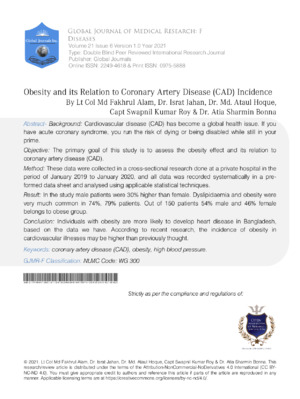
Background: Cardiovascular disease (CAD) has become a global health issue. If you have acute coronary syndrome, you run the risk of dying or being disabled while still in your prime. Objective: The primary goal of this study is to assess the obesity effect and its relation to coronary artery disease (CAD). Method: These data were collected in a cross-sectional research done at a private hospital in the period of January 2019 to January 2020, and all data was recorded systematically in a preformed data sheet and analysed using applicable statistical techniques. Result: In the study male patients were 30% higher than female. Dyslipidaemia and obesity were very much common in 74%, 79% patients. Out of 150 patients 54% male and 46% female belongs to obese group. Conclusion: Individuals with obesity are more likely to develop heart disease in Bangladesh, based on the data we have. According to recent research, the incidence of obesity in cardiovascular illnesses may be higher than previously thought.

Obesity and its Relation to Coronary Artery Disease (CAD) Incidence

Background: Cardiovascular disease (CAD) has become a global health issue. If you have acute coronary syndrome, you run the risk of dying or being disabled while still in your prime. Objective: The primary goal of this study is to assess the obesity effect and its relation to coronary artery disease (CAD). Method: These data were collected in a cross-sectional research done at a private hospital in the period of January 2019 to January 2020, and all data was recorded systematically in a preformed data sheet and analysed using applicable statistical techniques. Result: In the study male patients were 30% higher than female. Dyslipidaemia and obesity were very much common in 74%, 79% patients. Out of 150 patients 54% male and 46% female belongs to obese group. Conclusion: Individuals with obesity are more likely to develop heart disease in Bangladesh, based on the data we have. According to recent research, the incidence of obesity in cardiovascular illnesses may be higher than previously thought.

Lt Col Md Fakhrul Alam
Dr. Israt Jahan
Dr. Israt Jahan
Dr. Md. Ataul Hoque
Dr. Md. Ataul Hoque
Capt Swapnil Kumar Roy
Dr. Atia Sharmin Bonna

No Figures found in article.

Abu Hanif Mohammad Sayeduzzaman. 2021. “. Global Journal of Medical Research – F: Diseases GJMR-F Volume 21 (GJMR Volume 21 Issue F6): .

Download Citation

Journal Specifications

Crossref Journal DOI 10.17406/gjmra

Print ISSN 0975-5888

e-ISSN 2249-4618

Classification
GJMR-F Classification: NLMC Code: WG 300
Keywords
Article Matrices
Total Views: 1827
Total Downloads: 823
2026 Trends
Research Identity (RIN)
Related Research
Our website is actively being updated, and changes may occur frequently. Please clear your browser cache if needed. For feedback or error reporting, please email [email protected]

Request Access

Please fill out the form below to request access to this research paper. Your request will be reviewed by the editorial or author team.
X

Quote and Order Details

Contact Person

Invoice Address

Notes or Comments

This is the heading

Lorem ipsum dolor sit amet, consectetur adipiscing elit. Ut elit tellus, luctus nec ullamcorper mattis, pulvinar dapibus leo.

High-quality academic research articles on global topics and journals.

Obesity and its Relation to Coronary Artery Disease (CAD) Incidence

Lt Col Md Fakhrul Alam
Dr. Israt Jahan
Dr. Israt Jahan
Dr. Md. Ataul Hoque
Dr. Md. Ataul Hoque
Capt Swapnil Kumar Roy
Dr. Atia Sharmin Bonna

Research Journals