Article Fingerprint
ReserarchID
8N7BA
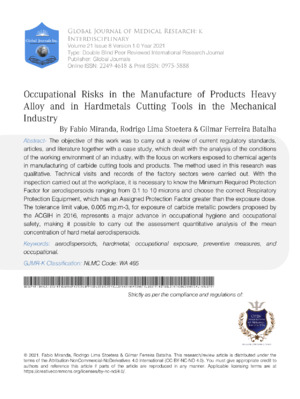
The objective of this work was to carry out a review of current regulatory standards, articles, and literature together with a case study, which dealt with the analysis of the conditions of the working environment of an industry, with the focus on workers exposed to chemical agents in manufacturing of carbide cutting tools and products. The method used in this research was qualitative. Technical visits and records of the factory sectors were carried out. With the inspection carried out at the workplace, it is necessary to know the Minimum Required Protection Factor for aerodispersoids ranging from 0.1 to 10 microns and choose the correct Respiratory Protection Equipment, which has an Assigned Protection Factor greater than the exposure dose. The tolerance limit value, 0.005 mg.m-3, for exposure of carbide metallic powders proposed by the ACGIH in 2016, represents a major advance in occupational hygiene and occupational safety, making it possible to carry out the assessment quantitative analysis of the mean concentration of hard metal aerodispersoids.
Fabio Miranda. 2021. \u201cOccupational Risks in the Manufacture of Products Heavy Alloy and in Hardmetals Cutting Tools in the Mechanical Industry\u201d. Global Journal of Medical Research - K: Interdisciplinary GJMR-K Volume 21 (GJMR Volume 21 Issue K8): .
Crossref Journal DOI 10.17406/gjmra
Print ISSN 0975-5888
e-ISSN 2249-4618
Explore published articles in an immersive Augmented Reality environment. Our platform converts research papers into interactive 3D books, allowing readers to view and interact with content using AR and VR compatible devices.
Your published article is automatically converted into a realistic 3D book. Flip through pages and read research papers in a more engaging and interactive format.
Total Score: 103
Country: Brazil
Subject: Global Journal of Medical Research - K: Interdisciplinary
Authors: Fabio Miranda, Rodrigo Lima Stoeterau, Gilmar Ferreira Batalha (PhD/Dr. count: 0)
View Count (all-time): 143
Total Views (Real + Logic): 1762

Total Downloads (simulated): 800

Publish Date: 2021 12, Thu
Monthly Totals (Real + Logic):
This paper attempted to assess the attitudes of students in
Advances in technology have created the potential for a new
Inclusion has become a priority on the global educational agenda,
The objective of this work was to carry out a review of current regulatory standards, articles, and literature together with a case study, which dealt with the analysis of the conditions of the working environment of an industry, with the focus on workers exposed to chemical agents in manufacturing of carbide cutting tools and products. The method used in this research was qualitative. Technical visits and records of the factory sectors were carried out. With the inspection carried out at the workplace, it is necessary to know the Minimum Required Protection Factor for aerodispersoids ranging from 0.1 to 10 microns and choose the correct Respiratory Protection Equipment, which has an Assigned Protection Factor greater than the exposure dose. The tolerance limit value, 0.005 mg.m-3, for exposure of carbide metallic powders proposed by the ACGIH in 2016, represents a major advance in occupational hygiene and occupational safety, making it possible to carry out the assessment quantitative analysis of the mean concentration of hard metal aerodispersoids.
Lorem ipsum dolor sit amet, consectetur adipiscing elit. Ut elit tellus, luctus nec ullamcorper mattis, pulvinar dapibus leo.