Article Fingerprint
ReserarchID
IHFXG

Choose where you want to hide AI Takeaway. Your site-wide choice will be remembered in this browser.
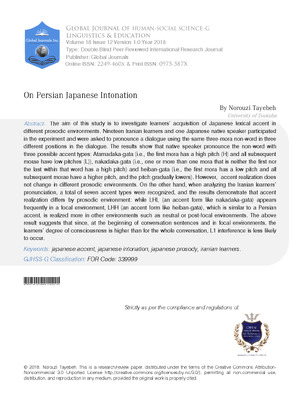
The aim of this study is to investigate learners’ acquisition of Japanese lexical accent in different prosodic environments. Nineteen Iranian learners and one Japanese native speaker participated in the experiment and were asked to pronounce a dialogue using the same three-mora non-word in three different positions in the dialogue. The results show that native speaker pronounce the non-word with three possible accent types: Atamadaka-gata (i.e., the first mora has a high pitch (H) and all subsequent morae have low pitches (L)), nakadaka-gata (i.e., one or more than one mora that is neither the first nor the last within that word has a high pitch) and heiban-gata (i.e., the first mora has a low pitch and all subsequent morae have a higher pitch, and the pitch gradually lowers). However, accent realization does not change in different prosodic environments. On the other hand, when analyzing the Iranian learners’ pronunciation, a total of seven accent types were recognized, and the results demonstrate that accent realization differs by prosodic environment: while LHL (an accent form like nakadaka-gata) appears frequently in a focal environment, LHH (an accent form like heiban-gata), which is similar to a Persian accent, is realized more in other environments such as neutral or post-focal environments. The above result suggests that since, at the beginning of conversation sentences and in focal environments, the learners’ degree of consciousness is higher than for the whole conversation, L1 interference is less likely to occur.
Norouzi Tayebeh. 2018. "On Persian Japanese Intonation". Global Journal of Human-Social Science - G: Linguistics & Education GJHSS-G Volume 18 (GJHSS Volume 18 Issue G12).
Crossref Journal DOI 10.17406/GJHSS
Print ISSN 0975-587X
e-ISSN 2249-460X
v1.2
Explore published articles in an immersive Augmented Reality environment. Our platform converts research papers into interactive 3D books, allowing readers to view and interact with content using AR and VR compatible devices.
Your published article is automatically converted into a realistic 3D book. Flip through pages and read research papers in a more engaging and interactive format.
Total Score: 146
Country: Japan
Subject: Global Journal of Human-Social Science
Authors: Norouzi Tayebeh (PhD/Dr. count: 0)
View Count (all-time): 351
Total Views (Real + Logic): 1364
Total Downloads (simulated): 109
Publish Date: 2018 01, Mon
Monthly Totals (Real + Logic):
We use cookies and similar technologies to improve site performance, understand traffic, and enhance your publishing experience. Cookie Policy
Choose which optional cookies Global Journals can use. Your preference applies across this platform and can be updated any time.
These cookies are required for core website functionality and security.

Lorem ipsum dolor sit amet, consectetur adipiscing elit. Ut elit tellus, luctus nec ullamcorper mattis, pulvinar dapibus leo.