I. INTRODUCTION
Stellarator refers to the number of magnetic traps, on the basis of which it is possible to create a fusion reactor. An attractive feature of this type of fusion device is the possibility of a stationary, self-sustaining fusion reaction.
In the case of a conventional stellarator, in which the plasma-holding magnetic field is created by a system of continuous helical currents, the amplitude of the helical magnetic field in homogeneity turns out to be greater than the toroidal field in homogeneity . In this case, the neoclassical plasma losses become quite high, which, combined with other loss mechanisms, can make it difficult to achieve modes of self-supported fusion reaction.
In recent years, ideas of creating quasi-symmetric magnetic configurations in stellarators have become popular [1]. The drift trajectories of trapped particles in such systems weakly deviate from magnetic a surface, which lead to reduced plasma losses. The trapping magnetic field in stellarators with quasi- symmetry properties is created by a system of deformed current coils. These traps include the W7-X stellarator. In case of W7-X a quasi-isodynamic configuration has been chosen - yields reduced neoclassical transport and, in particular, good fast ion confinement which is a prerequisite for any type of fusion reactor[2].
In expressions for diffusion fluxes loss reduction is provided by reduction of effective ripple of the helical harmonic . Thus real values of harmonics of the helical field can remain large or decrease together with reduction of depending on a way of creation of quasi-symmetry. In the present paper we consider a case when quasi-symmetry provides smallness not only of effective ripples, but also the amplitudes of the helical field harmonics.
In fusion plasma, many different transport mechanisms are present simultaneously, including diffusive, convective, radiation-related, and others. The large number of transport mechanisms does not allow us to unambiguously distinguish the functional dependences of transport flows on the physical and technical parameters of the plasma trap.
As a result of the analysis of experimental data obtained in plasma studies on various stellarators, it was found that the confinement properties of these devices obey certain dependences, which are commonly called scalings [3,4]. Scaling is quite good at predicting the confinement properties of next-generation fusion devices, the parameters of which do not differ much from the current traps. However, it is hardly possible to reliably predict the parameters of a fusion reactor using them. In a full-scale reactor, new energy sources and additional loss mechanisms are included. In addition, the parameters of operating experimental facilities are still far from the parameters of a fusion reactor. More realistic results can be obtained by numerical modeling of the processes taking place, taking into account, if possible, the main mechanisms of transfer and energy release in the reactor plasma.
At determination of diffusion transport fluxes in numerical codes the condition of their ambipolarity is laid, at which equality of fluxes is provided by the radial electric field arising due to quasi-neutrality of plasma. Under the conditions of neoclassical transport, the equality of fluxes can be realized at three values of the electric field. Depending on plasma parameters, flux equality can arise either at one negative sign of (the ionic root) or at a positive one (the electron root).
When the temperatures of electrons and plasma ions are close to each other, as a rule, ion transport fluxes are predominant and therefore the ion root is realized. In cases of preferential heating of electrons, for example by ECR methods, in sufficiently rarefied plasma the temperature of electrons can be much higher than the temperature of ions, at which the diffusion losses of electrons become larger than the ion losses. In this case, an electron root with positive values of is realized.
The problem of determining the magnitude of the ambipolar electric field turns out to be more complicated when conditions for the realization of different roots of the electric field may occur at different radii of the plasma column. At that, the transition from one sign of the field to another sign occurs in a very narrow region of space with large values not only of the potential gradient, but also of the electric field gradient. For such cases there is no analytical description of diffusive transport flows.
In [5-7], to determine the sign and magnitude of the ambipolar field, the equation obtained in [8], which has the form of the diffusion equation, is used:
where is the permittivity, is the volume of the magnetic surface, is the diffusion coefficient of the electric field. The condition of plasma quasi-neutrality gives enough grounds to consider the right side of the equation equal to zero. In this case, it is necessary to know the correct values of diffusion fluxes. The term with the time derivative in equation (1) does not play a real role. The flows are aligned in relaxation times of the order of , so taking into account the diffusion of the electric field loses its meaning. The diffusion term on the left side of the equation is rather an additional contribution to one of the diffusion fluxes; however, the value of the diffusion coefficient remains unknown. The main reason for taking into account the contribution of to particle fluxes is the need for a smooth transition from one sign of the root to another sign. The expression for was not given in the publication [8]. In [9], such an expression was obtained, but it contains obvious errors and is unsuitable for application. Thus, the problem of determining the electric field and transport flows in regimes in which a change in the signs of the electric field inside the plasma is possible remains unresolved. It can be circumvented by choosing the plasma parameters at which the sign reversal of the ambipolar field is impossible.
In order to model transport processes in experimental stellarators and reactor plasma, several numerical codes have been developed and used. One of the well-known ones is the DKES (Drift kinetic equation solver) numerical code[10, 11]. This code was used to simulate transport processes in several experimental facilities, in particular, in the Vanderbilt7-AS stellarator [12]. Numerical estimates of ambipolar fluxes performed using the DKES code in this work were based on experimental plasma temperature and density profiles. The solutions obtained with this code are not self-consistent and do not take into account the spatial distributions of sources and sinks of particles and energy changing in time.
In [13] the results of comparison of numerical calculations with experiments on determination of in stellarator W 7-AS are presented. Several different estimations were used in calculations: with application of equation (1), in which value of diffusion coefficient was chosen such that to get calculated electric field distribution close to experimental one; from equality of fluxes , and also by zeroing of gradient combination in expression for neoclassical diffusion flux of ions. The last assumption proceeds from the fact that at a relation between diffusion coefficients , equality of fluxes can come only at small value of combination of gradient terms in the ion flux. Therefore, the magnitude of the potential gradient can be estimated by equating the above combination to zero. In experiments on W 7-AS, the maximum value of the electric field reached values of when the ion root was realized. In the data presented in the paper, the greatest coincidence of the calculation and experimental results is observed in the estimates from the equality of fluxes at the experimental values of the density and temperature profiles.
In [14], using the DCOM numerical code [15], neoclassical transport in LHD under sufficiently dense plasma conditions was studied. The neoclassical transport coefficients in this code are calculated using the Monte Carlo method. In [14], the NNW (neural network) technique, which allows one to work in conditions of limited data, is also used. The cases are considered when the plasma density is of the order of , and the and profiles differ little and have a maximum near . It is shown that, in this case, only one ion root is realized in the transport fluxes. In this case, the calculation of the transport fluxes and the ambipolar field value was also carried out with the given (experimental) plasma density and temperature profiles.
Neoclassical losses in the TJ-II and LHD stellarators [16] were investigated using the PRETOR code. In the TJ-II stellarator, the plasma was heated by electron-cyclotron heating. The code uses experimental plasma density and temperature profiles. Two modes in terms of plasma density were calculated, small and large . Positive ambipolar field values at the center of the plasma were obtained in the calculations. In the case of LHD, the discharges in which a high temperature difference at the plasma center is observed and the density profile has a dip at the center of the plasma cord were chosen for the calculations. In these calculations, positive values of were also obtained.
The publications cited present calculations of the profiles of plasma parameters in the formed stationary state. The temporal evolution of the discharges is absent. Note also that none of the mentioned codes solves the problem in a self-consistent way. For calculations of the electric field, fixed (experimental or model) plasma density profiles are necessarily used. Separate calculations were also carried out with fixed temperature profiles.
In [5] an attempt was made to analyze transport processes in several experimental facilities: LHD, TJ-II, and W7-AS, and to make predictions on the parameters of W7-X and on the scale of the fusion reactor. When analyzing the parameters of the experimental facilities, the publication uses model rather than experimental plasma density and temperature profiles. The transport code [6] is used in this work. In the calculations of transport processes in the LHD facility, the plasma density distribution is model-based. The temperature profiles are obtained as a result of solving the transport model under the assumption of ECR heating.
Calculations were made of the spatial distributions of the electric field and energy fluxes for the LHD facility and for a stellarator with twice the size of the LHD. The plasma density in these calculations is of the order of , maximum is , and the ion temperature is close to . At these parameters, an electron root is obtained in the center of the plasma, which is replaced by an ion root in the middle of the plasma radius. This result is given without any comparison with the results of the experiments at the LHD facility. In [17] the results of experimental measurement of the radial electric field in LHD are presented, in which it is noted that the electron root occurs only at density .
Experiments on the W7-X stellarator confirm the presence of transport processes close to neoclassical ones [18]. Under conditions of ECR heating in a relatively rarefied plasma with a temperature , an electron root is realized. At a higher density, the losses are determined by the ionic component of the plasma.
Designs of stellarator-based fusion reactors are being developed taking into account the design of existing stellarator-type experimental facilities. For example, the design of the Helias reactor [19] is based on the design of the W7-X stellarator, the design of the Heliotron H reactor is based on the design of the LHD stellarator. The physical parameters of the reactors are selected on the basis of stellarator scaling. Publications on calculations of the parameters of stellarator reactors, in which steady-state fusion modes would be achieved by using numerical codes with a self-consistent solution of a system of diffusion equations that takes into account transport processes in the reactor, are unknown to the author of this publication, except for publication [20] and his own works.
In [20] an attempt is made to calculate the parameters of the LHR-S reactor, the linear scale of which is four times larger than that of the LHD stellarator. For the analysis, both a zero-dimensional model based on scaling and a one-dimensional Transport Analysis Linkage code (TOTAL) based on the neoclassical transfer with the inclusion of semi-empirical anomalous losses associated with drift-wave turbulence are used. Using a zero-dimensional model, the plasma density and temperature profiles were given by parabolic distributions. In the one-dimensional transport code, the radial parameter profiles were calculated with anomalous transport coefficients, which were determined by adding the coefficient , an improving correction to the ISS95 scaling.
The principle of introducing heating power into the plasma is not given in the publication. The constancy of the plasma density is maintained by injection of fuel pellets, but there is also no information about the order and method of their introduction. It is noted only that when using gas-puffing to implement a self-sustaining process, it is necessary to increase the "enhancement" factor in proportion to the decrease in plasma density. Note also that in these calculations, the temperatures of the electrons and ions differ little and the sign of the ambipolar field corresponds to the negative ionic root.
The author of this publication performed a number of studies by numerically solving the problem determining the spatiotemporal processes in the plasma of fusion traps of the stellarator type [21-27]. In these works, the neoclassical plasma loss mechanism was assumed to be the main one. As a result of these works, the possibility of implementing both a self-supported thermonuclear reaction and a reaction using additional plasma heating in reactors with different values of the helical in homogeneity of the plasma-holding magnetic field was shown.
It is traditionally assumed that particles leaving the plasma as a result of diffusion will be removed from the reactor using a diverter. However, it is unlikely that such particles will be completely removed. Some of them will return to the plasma, which gives a certain contribution to the balance of energy and particles in the plasma. Publication [27] was made taking this effect into account.
In early studies of plasmas on stellarators it was found that plasma lifetime corresponded to Bohm diffusion [28, 29]. The Bohm diffusion was explained by the influence of drift instabilities [30]. Possibilities of stabilization of instabilities by means of a shire and a "magnetic well" have been shown. Nevertheless, complete elimination of the influence of various instabilities on plasma losses is hardly possible, so there are reasons to assume the presence of some level of bomb-like diffusion in plasma.
The present work is devoted to the study of the physical parameters of the research reactor-stellarator, the calculations of which are based on the assumption of neoclassical losses in conjunction with anomalous losses caused by bohm-like diffusion with a reduced coefficient of proportionality. The influence of some recycling fraction was also taken into account.
II. INITIAL PARAMETERS AND NUMERICAL MODEL
As in [24, 27], a stellar reactor with a holding magnetic field of 5 Tesla, a large torus radius of m, and a small plasma radius of m were used for the calculations. The work was performed using the numerical code previously developed and described by the author in the publications [26, 27]. A system of four spatially one-dimensional equations is solved: thermal conductivities of electrons and ions, plasma diffusion, and diffusion of neutral atoms.
The equation of thermal conductivity of electrons (2) in the right part, except for the term with thermal conductivity, takes into account the heating of electrons arising during braking of -particles born in fusion, heating from external energy sources, losses by braking and cyclotron radiation, heat exchange with ions due to Coulomb collisions and due to an ambipolar electric field. Equation of heat conduction for ions (3), except for heat exchange with electrons contains a source of external heating of plasma. Diffusion fluxes and heat fluxes in the heat conduction equation for ions were represented as a sum of neoclassical and bohmian fluxes. The diffusion equations for plasma and neutral atoms of deuterium and tritium, except for diffusion terms, contain as source and sink terms taking into account ionization of atoms. In equations (4) and (5) the diffusion flux of electrons and the source, responsible for ionization of neutral particles in plasma, takes into account the flux of neutral atoms in plasma.
Equal amounts of deuterium and tritium were assumed in the reactor. The density was maintained at a constant level by modeling the injection of fuel pellets and by ionizing neutral atoms entering the plasma by recycling. The value of the radial electric field was found from the equality of the ion and electron diffusion fluxes at each node of the spatial grid along the small radius of the plasma. Different models of plasma heating by external sources were used in the calculations: separately heating of electrons, ions, or simultaneous heating of two components. It was also assumed that the specific heating power is proportional to the plasma density.
The maximum of neoclassical losses in the stellarator is in the region where the effective collision frequency appears near the doubled plasma rotation frequency in the radial electric field [31]. Here is frequency of Coulomb collisions of ions or electrons of plasma; is effective amplitude of helical magnetic field corrugations. According to [31], if turns out to be larger than the amplitude of in homogeneity of the toroidal magnetic field , the diffusion coefficient to the left of the maximum is proportional to the root squared of , while in case of opposite inequality ( ), diffusion increases linearly with collision frequency . To the right of the maximum the diffusion losses decrease with frequency as the collisions .
The possibility of creating a regime of a self-sustaining fusion reaction in a reactor for the case was considered in [22, 23]. In this work, as well as in [26], the calculations were performed for the case of a reactor with small corrugations of the helical magnetic field, when the inequality is satisfied.
A decrease in leads to an increase in . In works [22,23,25] studied modes of reactor operation with plasma density (7-8) , at which for ions practically always performed a condition , which corresponded to dependence on frequency of collisions of transfer coefficients for plasma ions . At the same plasma parameters in stellarator with small inequality may change on the opposite, therefore for calculations were chosen more high mean values of plasma density ( , ), as a result, almost always the diffusion coefficients of electrons and ions corresponded to the dependence .
In most cases, the dome-shaped model of fuel pellet ablation was used: , where is the half-width of the evaporation region, which was equal to 0.5, 0.75, and 1 in different calculations relative to the plasma radius. The magnitude of the pellet varied within 1 to 2 percent of the total number of particles in the reactor plasma. When the number of particles in the plasma decreased below 0.99, another pellet was thrown into the plasma. The energy consumption for heating the injected particles was taken into account, and the energy losses for pellet evaporation and atom ionization were neglected due to their smallness.
The radius of the first wall of the vacuum chamber was taken to be . Also, as in [26], the reactor was calculated with the helical magnetic field corrugation amplitudes , which approximately corresponds to the helical ripples of the W-7X stellarator. Note that in a conventional stellarator, the magnitude of the helical corrugation is an order of magnitude larger.
Under recycling conditions ionization of atoms occurs many orders of magnitude faster than diffusion processes, which need to be calculated simultaneously, so different time scales were used in the numerical model. Initially the problem is solved with small timestep and, after establishing approximately constant profile of neutral atoms, the time step is increased so that in acceptable time diffusion processes can be considered.
Neutral particles in the surrounding plasma of the reactor will have a wide spectrum of energies, from a few to tens of electron-volts [32]. The numerical code does not allow taking into account the energy distribution of the particles involved in the recycling, so the calculations were carried out for fixed values of the energies of the neutral atoms. The fraction of particles participating in recycling, relative to the total number lost by plasma, was determined by the recycling coefficient , which in most calculations was equal to 0.25 and in some cases - 0.5. The level of anomalousness in plasma losses was given by different value of the proportionality coefficient in the expression for Bohm diffusion.
The calculations used different initial and boundary conditions for plasma density and temperature. Common to these conditions was the requirement of equality to zero of spatial derivatives in the center of the plasma and close to zero values of these parameters at its boundary. In different calculations, plasma heating was provided by different powers - from 50 to . The source of plasma heating could switch off when the reactor's fusion power reached a predetermined level. In this case, the reactor could switch to a self-sustaining burning. At the same time, simultaneously with the stationary reactor power, stationary spatial profiles of plasma density, neutral atoms, ion and electron temperatures, and the ambipolar electric field, which did not depend on the power of external plasma heating sources and the initial distributions of its parameters, were established.
III. RESULTS OF CALCULATIONS
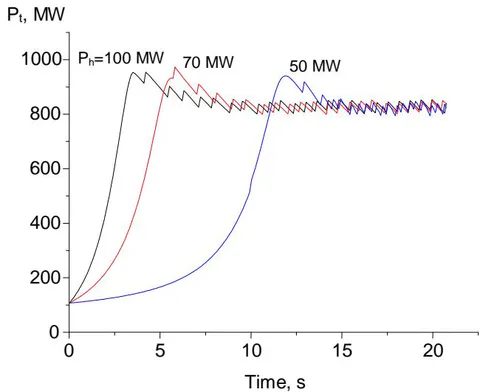
Figure 1 shows the behavior of the fusion power of the reactor in the process of bringing it to steady-state burning by using different heating powers supplied to the electron component of the plasma. The mean value of the plasma density - , the recycling factor - , the energy of neutral particles - , and the half-width of the pellet ablation region - are shown in the caption to the figure. In this case the influence of Bohm diffusion on plasma losses was not taken into account, and the recycling coefficient , which means that half of the particles that left the plasma are returned to it as a result of diffusion. The maximums on the curves correspond to the moments of switching off the heating power from external sources. After switching off the heating sources, the reactor reaches the same level of thermal power over time. At the same time, the spatial profiles of the plasma parameters also repeat. Some ripples in the curves are the result of fuel pellets injected into the plasma. The use of lower plasma heating powers leads to a slowing down of the reactor's exit to the self-supported reaction.
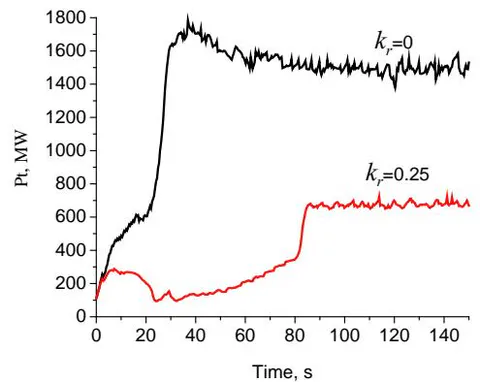
Figure 1 shows the behavior of the reactor's fusion power when recycling is taken into account. Consideration of recycling leads to a noticeable reduction in the fusion power of the reactor. Figure 2 shows the time dependences of the reactor's thermal power during its steady-state burning when recycling is taken into account and when it is not.
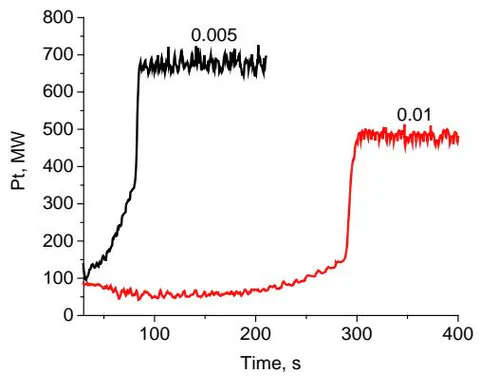
In contrast to Figure 1, the effect of anomalous losses with a coefficient of proportionality with respect to Bohm diffusion was also taken into account here. Even a small fraction of particles involved in recycling ( ) leads to a significant decrease in the reactor thermal power practically by 2.5 times. It also turned out that, for the chosen reactor parameters, anomalous losses in the form of a small fraction of the Bohm diffusion coefficient significantly affect the achievement of stable fusion in the reactor. Acceptable fusion reaction modes were obtained only at values of
the proportionality factor in the expression for Bohm diffusion . The time it takes for the reactor to warm up and enter stationary combustion mode is significantly delayed when the fraction of anomalous losses increases. At the same time, the reactor power level also decreases (Fig. 3).
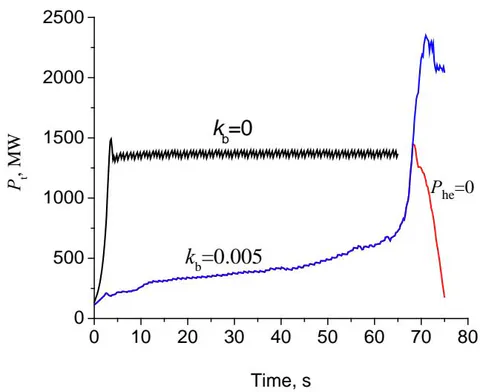
Even at such small values of , regimes with a self-sustaining fusion reaction cannot be obtained. Figure 4 shows the time dependences of the thermal power of the reactor for the cases of the absence of anomalous losses and when they are taken into account with . In the absence of anomalous losses ( ), turning off the heating when the thermal power of the reactor reaches MW leads to stationary self-sustaining combustion. At , turning off the heating leads to a rapid decay of the reactor power (falling section of at sec). The section of the dependence with at a thermal power of more than 1500 MW corresponds to the mode with the power of external sources of plasma heating turned on.
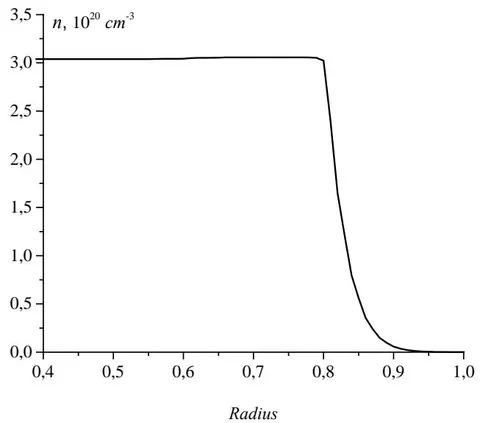
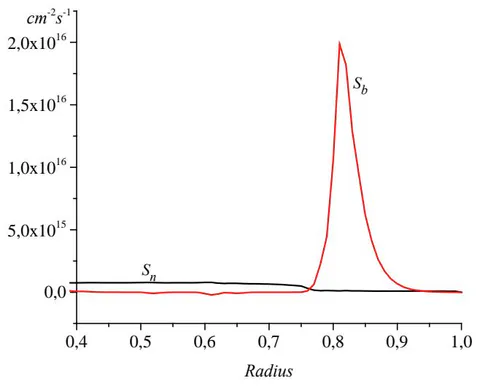
The reasons for the strong influence of anomalous losses on plasma confinement lie in the features of the formation of diffusion and heat fluxes. In this paper, we consider reactor operation modes that correspond to neoclassical losses with the dependences of the transfer coefficients of both plasma components . In this case the ion transfer coefficients turn out to be almost times greater than the corresponding electron coefficients. However, diffusion and heat fluxes are determined by electrons. Diffusion fluxes are aligned due to the ambipolar electric field, which is included in the corresponding combination of density and temperature gradients. Fluxes determined by anomalous transfer coefficients do not depend on the electric potential gradient and, therefore, turn out to be anomalously high in the region of density and temperature gradients. Figure 5 shows the radial plasma density profile and Figure 6 shows the diffusion fluxes: neoclassical electron and bohmian. For the sake of clarity, the calculation was performed in the absence of recycling. In the central part of the plasma, where the density gradient is small, the Bohm flow is even smaller than the neoclassical one. However, in the region of a steep density gradient, there is a sharp jump in the anomalous flow, which is many times greater than the neoclassical one even at a small Bohm loss reduction factor ( ).
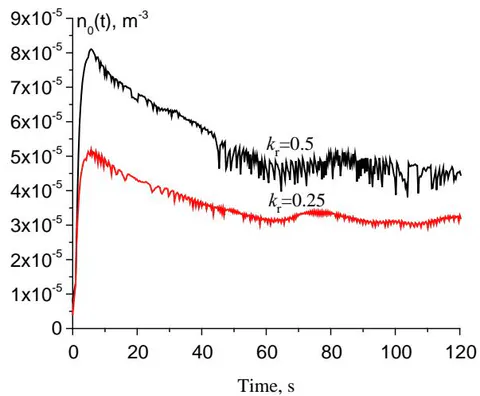
The density of neutral atoms in the space between the reactor wall and the plasma boundary turns out to be several orders of magnitude lower than the plasma density in the containment volume, grows as the fraction of particles involved in recycling increases (Fig. 7) and drops rapidly inside the plasma toward its center.
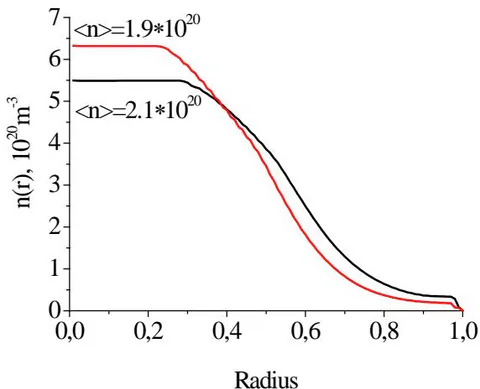
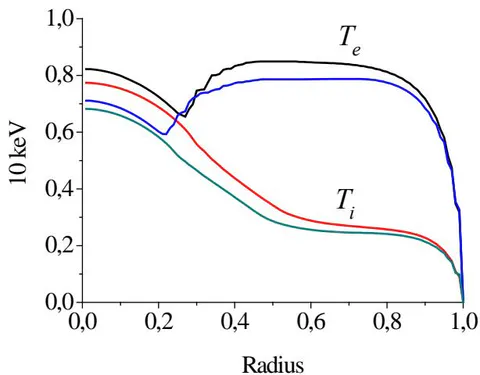
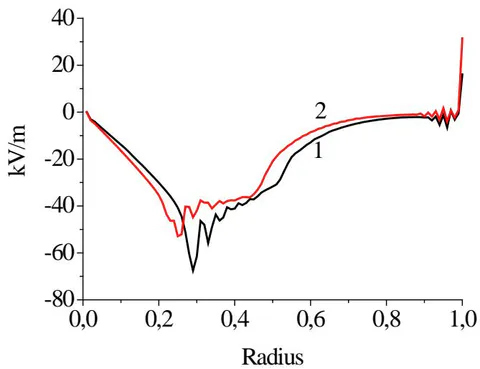
When the reactor is in the self-sustaining fusion reaction mode, its energy characteristics and the spatial distribution of plasma parameters do not depend on how it is brought into this mode. When additional heating is on, the plasma parameters also depend on the heating methods used. Thus, if additional heating is applied to plasma electrons, as a rule, there is a significant gap in the values of temperatures of electrons and ions at the periphery of the plasma cord. This is the result of weak collision energy exchange between plasma components under conditions of low plasma density. Figures 8-10 show plasma density, temperature, and ambipolar electric field profiles for two average values of plasma density.
IV. CONCLUSION
Calculations of the synthesis reaction modes in the stellarator reactor, carried out taking into account recycling and anomalous losses, showed their significant effect on the possibility of achieving a self-sustaining synthesis process. The effect of even a very small fraction of Bohm diffusion is especially destructive. In the parameters of the stellarator reactor adopted for calculations, it was not possible to obtain self-sustaining combustion even in the presence of a two-hundredth fraction of Bohm losses in the plasma. The recycling process significantly reduces the parameters of thermonuclear combustion. The results of the work indicate the need to take into account these processes when calculating the expected parameters of the stellarator reactor and take measures to reduce their destructive effect.