## I. INTRODUCTION
One from the main characteristic of a sea-going ship is seaworthiness. It defines the safety of sailing, comfort of using and service at sea. The complete characteristic includes some partial ones, and some of them contradict to others. A lot of standards of seakeeping were proposed by various authors from the middle of the XX century, some propositions are shown by the table. The proposed standards belong to higher habitability, restriction of external loads, ensuring a ship service. The table contains some proposed standards.
Table 1: Some Proposed Standards of Seakeeping. [1]
<table><tr><td>No</td><td>Year, author, ship.</td><td>Wetness</td><td>Slamming</td><td>Acceleration</td><td>Pitch</td><td>Roll</td><td>Bare propeller</td></tr><tr><td>1</td><td>1972, Lipis, Kondrikov, «storm diagrams»</td><td>3 cases at 100 sec, Frame 20</td><td>1 case at 500 sec.</td><td>0.4g at Frame 20.</td><td></td><td></td><td>1 danger. case at 5 hours</td></tr><tr><td>2</td><td>1974, Aertssen, Container carrier</td><td>7 cases at 100 sec, Frame 20</td><td>3 cases at 100 sec, Fr. 17</td><td>0.4g Fr. 20</td><td></td><td></td><td>25 cases at 100 sec</td></tr><tr><td>3</td><td>1974, Ochi,</td><td></td><td></td><td>Possibility 0.4g at Fr. 20 - no more 7% for full load, no more. 3% - for ballast</td><td></td><td></td><td></td></tr><tr><td>4</td><td>1975, Connoly, Frigate, destroyer.</td><td>1 case at 110 sec, Fr.20</td><td>1 case at 1360 sec, Fr. 16.</td><td>Less 1 at 673 sec, Fr. 16.</td><td></td><td></td><td></td></tr><tr><td>5</td><td>1975, Tasaki, Takerava, Takaishi, cargo</td><td>Possib. Less 0.01</td><td>Possib. less 0.01</td><td>Possib. more 0.8g - 0.001 Ft. 20, Possib. more 0.6g - 0.01 at bridge</td><td></td><td>Possib. more 25 deg.-0.001</td><td>Blade tip possib. - 0.1, 0.3 diam. - 0.1</td></tr><tr><td>6</td><td>1976, Moiseeva, fish-tech. base, Fishery ship</td><td></td><td></td><td></td><td></td><td>Ampl.3% -7 degr., Ampl.3% -18degr.</td><td></td></tr><tr><td>7</td><td>1979, Chilo, cargo</td><td>Possib. 7% at Fr. 20.</td><td>Possib.3% at 3 Fr.17</td><td>0.4g at Fr. 20</td><td></td><td></td><td></td></tr><tr><td rowspan="2">8</td><td>1980, Comstock, Aircraft carrier::</td><td></td><td></td><td></td><td></td><td></td><td></td></tr><tr><td>• Crew</td><td></td><td></td><td>0.4g all, 0.2g-bridge</td><td></td><td></td><td></td></tr><tr><td rowspan="6"></td><td>• Hull
• Usual</td><td>30 cases at hour, Fr.20</td><td>20 cases at hour, Fr.17</td><td></td><td></td><td></td><td></td></tr><tr><td>• Hull
• (Swath)</td><td>Bottom 5 cases at hour</td><td>Bow, 20 cases at hour</td><td></td><td></td><td></td><td>No more 25% of diameter</td></tr><tr><td>• Elevator</td><td></td><td></td><td></td><td>Level displ.
No more 7,65 m</td><td></td><td></td></tr><tr><td>• Flying Deck, SWATH</td><td>At bow, 5 cases at hour</td><td></td><td></td><td></td><td></td><td></td></tr><tr><td>• Usual aircraft</td><td></td><td></td><td></td><td>1 deg.,
vert.
velocity 2 m/sec,
stern</td><td>5 degrs.</td><td></td></tr><tr><td>• Vert.Fly-Off</td><td></td><td></td><td></td><td>3 degrs.</td><td>5 degrs.</td><td></td></tr><tr><td>9</td><td>• 1982,
• Landsburg,
Tanker</td><td></td><td>6 cases at 100 sec,
Fr.17</td><td>0.5g at Fr.20 0.4g – at bridge</td><td></td><td>30 degrs.</td><td>25 cases at 100 sec.</td></tr><tr><td>10</td><td>• 1983,Hosoda,
Patrol Ship:</td><td></td><td></td><td></td><td></td><td></td><td></td></tr><tr><td rowspan="5"></td><td>• Forhelic.</td><td></td><td></td><td>less 0.2g</td><td></td><td></td><td></td></tr><tr><td>• Radar</td><td></td><td></td><td></td><td></td><td>less 25 degrs</td><td></td></tr><tr><td>• Crew, Full Workab.</td><td></td><td></td><td>less 0.1g</td><td>3 degrs.</td><td>8 degrs.</td><td></td></tr><tr><td>• The Same, 50%
Workability.</td><td></td><td></td><td>Vertical. 0.35g, horizont.
0.15g</td><td></td><td></td><td></td></tr><tr><td>• The Same, 10%
Workability.</td><td></td><td></td><td>Vert.0.5g, horiz. 0.2g</td><td>7.5 degrs.</td><td>20 degrs.</td><td></td></tr><tr><td rowspan="4">11</td><td>1984, Gerritsme:</td><td></td><td></td><td></td><td></td><td></td><td></td></tr><tr><td>Level A</td><td>30 at hour</td><td>20 at hour</td><td>Vert. 0.4g, horiz. 0.2g,
vert. speed 0.2m/sec</td><td>3 degr.</td><td>5 degr.</td><td></td></tr><tr><td>Level B</td><td>30 at hour</td><td>20 at hour</td><td>0.4g & 0.2g</td><td>3 degr.</td><td>10 degr.</td><td></td></tr><tr><td>Level C</td><td>50 at hour</td><td>50 at hour</td><td>0.4g &0.4g</td><td>8 degr.</td><td>30 degr.</td><td></td></tr><tr><td>12</td><td>1984, Petrie,
Bongort</td><td>Free board at Fr.2012.8 m</td><td>Draft at Fr. 20 9.76 M, vert. speed 4.2 m/sec</td><td>Less, than 0.4g for upper raw of cont.</td><td></td><td>40 degr.
For cargo</td><td>Axe deep 5.5M</td></tr><tr><td rowspan="4">13</td><td>1985, Creight,
Stahl:</td><td></td><td></td><td></td><td></td><td></td><td></td></tr><tr><td>destroyer</td><td>30 at hour at Fr. 20</td><td>20 at hour at Fr.17.</td><td>0.4g at Fr. 14</td><td>3 degr.</td><td>5 degr.</td><td></td></tr><tr><td>• Frigate</td><td>same</td><td>same</td><td>At Fr. 15</td><td>same</td><td>same</td><td></td></tr><tr><td>• Swaship</td><td>30 at hour,
Fr. 18</td><td>same</td><td>At Fr. 18</td><td>same</td><td>same</td><td></td></tr><tr><td>14</td><td>1986, Kent, Battle ships</td><td>20 at hour,
Fr.20</td><td>20 at hour</td><td></td><td></td><td></td><td></td></tr><tr><td rowspan="5">15</td><td>1987,
Karppinen, crew:</td><td></td><td></td><td></td><td></td><td></td><td></td></tr><tr><td>• Short Time</td><td></td><td></td><td>0.275g</td><td></td><td></td><td></td></tr><tr><td>• Light Profess.
Work</td><td></td><td></td><td>0.2g</td><td></td><td></td><td></td></tr><tr><td>• - Hardwork</td><td></td><td></td><td>0.15g</td><td></td><td></td><td></td></tr><tr><td>• - Long Time Sailing</td><td></td><td></td><td>0.1g</td><td></td><td></td><td></td></tr><tr><td rowspan="2"></td><td>-Sea
- Seakness,
10% Of Passengers</td><td></td><td></td><td>0.05g</td><td></td><td></td><td></td></tr><tr><td>- Cruise Liners</td><td></td><td></td><td>0.02g</td><td></td><td></td><td></td></tr><tr><td>16</td><td>1988, Kehoe</td><td>1 at minute</td><td>1 at min., Fr.17</td><td></td><td></td><td></td><td></td></tr><tr><td>17</td><td>1988, Luis</td><td>10 at hour,
Fr.20.</td><td>5 at hour</td><td></td><td></td><td>Subj, crit.
15.</td><td>Less 2 at hour</td></tr><tr><td>18</td><td>1988, Lloid</td><td>1 at 100 sec.
Fr. 20</td><td></td><td>Shock accel. At island -
less 0.05g</td><td></td><td></td><td></td></tr><tr><td rowspan="6">19</td><td>1988, OTAN standards:</td><td></td><td></td><td></td><td></td><td></td><td></td></tr><tr><td>• USA</td><td></td><td></td><td>0.2g at bridge</td><td>5 deg.</td><td>8 deg.</td><td></td></tr><tr><td>• The Netherlands</td><td></td><td></td><td>0.16g at Fr.16</td><td>The same</td><td>The same</td><td></td></tr><tr><td>• Germany</td><td></td><td></td><td>0.18g at Fr.20</td><td>The same</td><td>The same</td><td></td></tr><tr><td>• UK</td><td></td><td></td><td>0.14g at mass center</td><td>The same</td><td>The same</td><td></td></tr><tr><td>• Canada</td><td></td><td></td><td>0.2g at Fr.16</td><td>The same</td><td>The same</td><td></td></tr><tr><td rowspan="8">20</td><td>1988, USSR, Fishery Ministry</td><td>Middle free boardmore 0.13 of overall beam; Bow free boardmore 0.3 of overall beam.</td><td></td><td>K1 = (σ2 + xσ2 + σ2)05
Y z K2 = (σ2 + x σ2), y</td><td colspan="2">K3=(øpitch2+øro l2)0.5
|σi - standard of i-th process</td><td></td></tr><tr><td>• At Not Noted Apartments</td><td></td><td></td><td>K1 = 0.08g</td><td colspan="2">K3 = 4.5</td><td></td></tr><tr><td>• At Bridge</td><td></td><td></td><td>K1 = 0.15g, K2=0.2g</td><td colspan="2"></td><td></td></tr><tr><td>• At Engine Room</td><td></td><td></td><td>K1 = 0.15g, K2 = 0.2g</td><td colspan="2"></td><td></td></tr><tr><td>• At Upper Deck</td><td></td><td></td><td>K2 = 0.12g</td><td colspan="2"></td><td></td></tr><tr><td>• At Cook</td><td></td><td></td><td>K2 = 0.15g</td><td colspan="2"></td><td></td></tr><tr><td>• At Passenger Apartments</td><td></td><td></td><td>K2 = 0.16g</td><td colspan="2"></td><td></td></tr><tr><td>• At Process Apartment</td><td></td><td></td><td>K2 = 0.18</td><td colspan="2"></td><td></td></tr><tr><td>21</td><td>1992, Wilson</td><td>30 at hour</td><td>20 at hour</td><td>Vertical. 0.4g, Horiz. 0.2g for crew</td><td colspan="2"></td><td></td></tr></table>
Let us note, the shown standards are proposed for displacement ships or for ships of the transient speed mode. And it must be noted, the horizontal accelerations decrease the labor productivity more strongly, than vertical acceleration. Then the restrictions of the firsts is twice bigger, than the seconds.
The table does not contain the standards of acceleration of planning boats, which are bigger, than shown, at about an order - and decreasing of the accelerations of planning boats can't be decreased by any measurements.
It can be supposed, the shown values of standards correspond to $14\%$ repeatability, i.e. are so named "sufficient" values.
1. Establishment of seakeeping standards by classification societies.
It can be supposed, establishment of seakeeping standards can promote the seakeeping increasing, i.e. higher habitability and bigger safety of sea-going ships.
Today the contemporary level of science development (accessibility of the experimental method of seakeeping prediction and fast development of digital methods of prediction) allows introduction of such standards for most wide-spread types of ships, as a minimum.
It seems the standards must be divided by the aims of using for their wider applicability.
The standards, which are connected with labor productivity and rest conditions, and with ensuring of permissible conditions of structures and equipment exploitation, must be general ones for all types of ships.
Evidently, these standards will be applicable only for not combat ships, and for displacement or transient modes of speed regimes. Possible, such general standards will be established for ships, which are classified by corresponded societies, and by ship owners for the other ships.
2. Standards, which define the conditions of labor productivity.
These standards can be established, for example, on the base of special research of Japan scientists,[1].
Figure 1 contains the dependence of various labor productivity from vertical accelerations of motion.
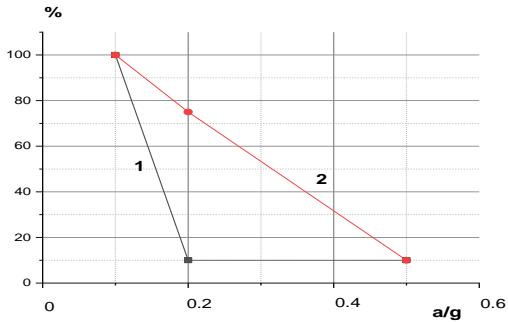 Fig. 1: Dependence of Labor Productivity from Motion Acceleration: 1 – Hard Manual Labor; 2 – Light Mental Labor
The comparison of Fig. 1 with previously presented standards (0.25g and 0.4g) shows the smaller value correspond to minimal productivity of hard manual labor, but affects on the mental labor not sufficiently.
Bigger value of acceleration leads to elimination of manual labor, and to sufficient decreasing of mental labor, evidently - ship control too.
Figure 2 contains the dependence of labor productivity from pitch amplitudes.
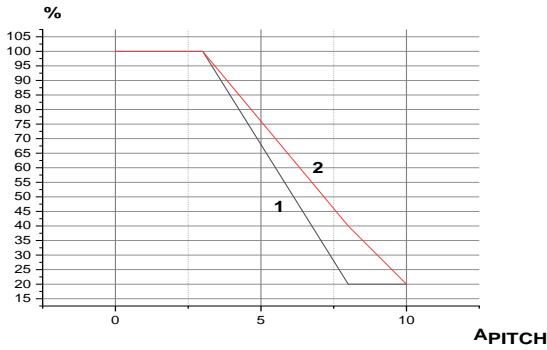 Fig. 2: Labor Productivity Versus Pitch Amplitudes: 1 – Hard Manual Labor; 2 – Light Mental Labor
The comparison the data of Fig. 2 with the proposed standards from the Table (3 and 5 degrees) shows the smaller restriction not changes the productivity of any labor. But the second restriction leads to labor productivity at about $30\%$.
Figure 3 contain the dependence of labor productivity from roll amplitudes.
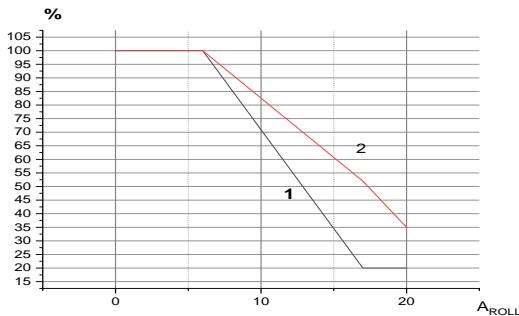 Fig. 3: Labor Productivity Versus Roll Amplitudes: 1 – Hard Manual Labor; 2 – Light Mental Labor
Evidently, the shown by the table restriction 5 degrees does not decrease the labor productivity, and even more strongly the restriction (8 degrees) decreases the productivity not so notable.
It must be noted, most possible, the standards can't be introduced for ships of any displacement: usually small enough ships of the traditional type, monohulls, can't ensure the same level of seakeeping, as big enough ships.
3. Standards, which are connected with conditions of structures and equipment exploitation.
Such standards, firstly, include number (or frequency) of slamming of any structures. The characteristic ultimately defines the shock loads from slamming: bigger frequency of slamming usually means higher shock loads. Of course, straight measurement of shock loads gives most exact picture of such loads. But, unfortunately, the maximal load placement can't be defined previously... Than limitation of shock number seems more simple and convenient method. For example, it can be no more, than 20 shocks per a hour, referring to practical experience.
If more danger of wet deck, than of slamming, will be taken into account, possible, number of wet deck cases must be no bigger, than 20 cases at a hour too.
It seems, the permissible frequency of propeller baring, must be connected with characteristics of the equipment, which restricts the frequency.
## II. CONCLUSIONS, RECOMMENDATIONS
1. Permanently repeated propositions of seakeeping standards mean the practical need for their official introduction into classification rules of registers.
2. Introduction of seakeeping standards will stimulate wider examination of seakeeping characteristics by experiments and calculations and introduction of motion mitigation methods and ship types with higher seakeeping.
3. The method of seakeeping estimation by one digit [2] is recommended for wide using after introduction of corresponded standards. Some other restriction of seakeeping characteristics, which correspond to a ship purpose, can be used together with official standards.
Generating HTML Viewer...
References
2 Cites in Article
Victor Dubrovsky,Konstantin Matveev (2016). Airpower Aspects of Multi-Hull Ships, From Small To Large Vessels.
V Dubrovsky (2000). Complex Comparison of Seakeeping: Method and Example.
No ethics committee approval was required for this article type.
Data Availability
Not applicable for this article.
How to Cite This Article
Victor A. Dubrovsky. 2026. \u201cOn Standards of Seakeeping.\u201d. Global Journal of Research in Engineering - J: General Engineering GJRE-J Volume 23 (GJRE Volume 23 Issue J4): .
Explore published articles in an immersive Augmented Reality environment. Our platform converts research papers into interactive 3D books, allowing readers to view and interact with content using AR and VR compatible devices.
Your published article is automatically converted into a realistic 3D book. Flip through pages and read research papers in a more engaging and interactive format.
Our website is actively being updated, and changes may occur frequently. Please clear your browser cache if needed. For feedback or error reporting, please email [email protected]
Thank you for connecting with us. We will respond to you shortly.