
I. INTRODUCTION
Solar energy is one of the most suitable options for generating electricity since it is inexhaustible, absolutely free (in terms of its availability), and environmentally friendly. [1-2].
Due to the need to develop hydrocarbon deposits in remote areas that do not have transport and energy infrastructure, the need to electrify the objects of the oil and gas transport system, autonomous power plants using resources of different physical nature are becoming increasingly relevant.
Renewable energy sources – wind and photovoltaic power plants-have future prospects. Their advantages are no need for fuel, a long service life, the possibility of long-term operation in automatic mode, sufficiently proven energy conversion technologies. The rapid development of wind power in recent years determines the practical interest in its use in autonomous power supply systems, including in the oil and gas industry.
There are also many works in the literature devoted to optimizing and increasing the efficiency of solar panels .
One of the key parameters for evaluating the efficiency of solar batteries and photovoltaic cells is the fill factor.
During operation, the solar battery operates 95% of the time in completely different conditions, with various illumination or temperature from the test conditions, which leads to a change in the operating point of maximum power. When the light is low or the temperature of the element is high, parasitic losses that occur in the solar cell have a great influence. As we have already determined above, a higher Fill Factor indicates a high quality of the element. Thus, when the external operating conditions change, relative to the test conditions, a solar battery with a high Fill Factor can be expected to be more efficient in the entire range of illumination and temperature, relative to a solar battery with a low Fill Factor, but with the identical declared efficiency and power.
A solar cell is an electronic device that directly converts sunlight into electricity. The light falling on the solar panel produces both current and voltage to generate electricity. This process requires, firstly, a material in which the absorption of light raises an electron to a higher energy state, and, secondly, the movement of this higher energy electron from the solar cell to the external circuit. The electron then dissipates its energy in the external chain and returns to the solar cell. Various materials and processes can potentially meet the requirements for the conversion of photovoltaic power. Still, in practice, almost all photovoltaic energy conversions use semiconductor materials in the form of a p-n junction. Like all other semiconductor devices, solar cells are sensitive to temperature. An increase in temperature reduces the bandgap of the semiconductor, thereby affecting most of the parameters of the semiconductor material. A decrease in the band gap of a semiconductor with an increase in temperature is associated with an increase in the energy of electrons in the material. Therefore, less energy is required to break the connection. In the semiconductor bandgap model, a decrease in the binding energy leads to a decrease in the band gap. Hence, an increase in temperature reduces the forbidden zone. In this regard, the question arises about the dependence of the fill factor on the temperature.
II. MATERIALS AND METHODS
The paper uses the method of functional analysis.
III. RESULTS
The fill factor is a parameter that, in combination with the no-load voltage and short-circuits current, determines the maximum power of the solar cell. The specified fill factor is equal to
where is the voltage at the maximum power point, V; is the current at the maximum power, A; is the no-load voltage, V; is the short-circuit current, A.
The formula (1) includes four parameters that depend on the temperature. Let's consider each parameter.
In a solar cell, the most affected by an increase in temperature is the open-circuit voltage. The figure below shows the dependence of the volt-ampere characteristics of a solar cell on temperature (fig. 1).
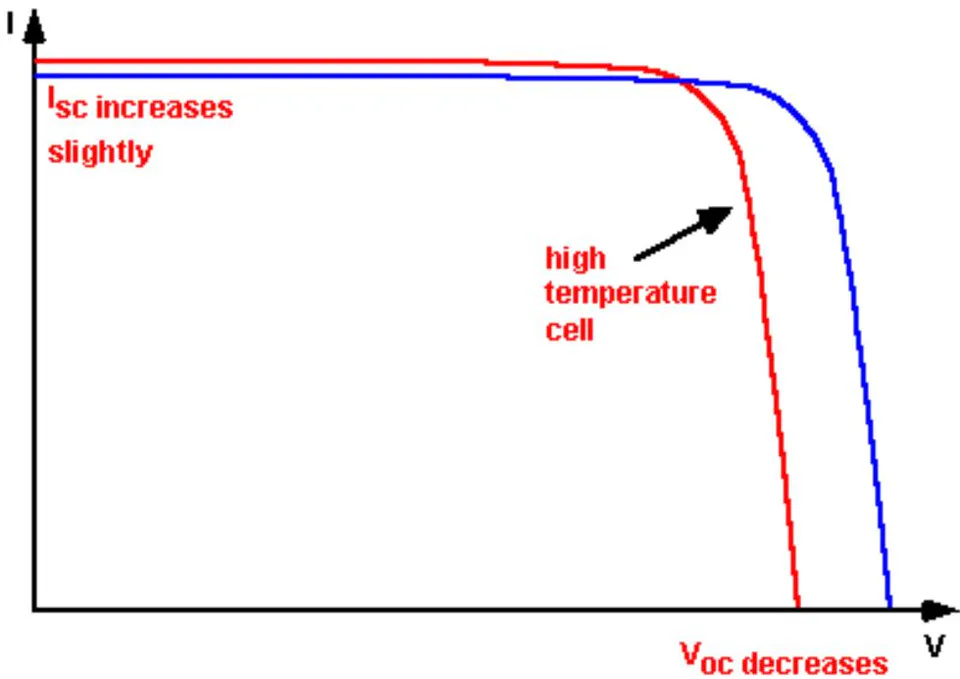
The short-circuit current, Isc, increases slightly with temperature as the bandgap energy decreases, and more photons have enough power to create pairs of electrons and holes. However, this is a small effect, and the temperature dependence of the short-circuit current for a silicon solar cell is usually zero. Most solar cells are silicon semiconductor photodiodes. Therefore, we will not take into account the change in current from temperature in the calculations.
For further research, we will simplify the formula (1). From the technical characteristics for solar modules, it follows that the short-circuit current is approximately 95% of the current at the maximum power point ( ). Then
In turn, the voltage at the maximum power point is related to the no-load voltage by the following ratio.
where kT/q is the thermal voltage, n is the internal concentration of charge carriers.
Replace the no-load voltage in the expression (2)
To estimate the scope of the fill factor, we will perform a limit analysis of the resulting expression (4). To do this, we will introduce a constant c
let's direct the temperature to zero and infinity. Since
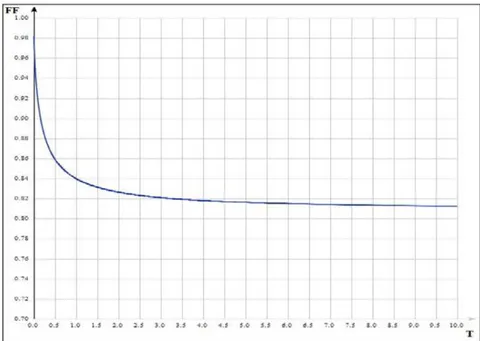
then the value of the fill factor FF lies in the range (0.808; 0.983).
Let's plot the functional dependence of the fill factor on the temperature (fig. 2). As can be seen, the filling coefficient decreases with increasing temperature.
We will also conduct a study of the dependence of the fill factor on the voltage at the point of maximum power. To do this, consider the behavior of the expression located in the denominator of the fraction (4).
Let's find the ratio for different values of voltages at the point of maximum power , making the necessary mathematical transformations.
when this fraction decreases.
As follows from the obtained formula (4), the fill coefficient decreases with increasing temperature, since an increase in temperature reduces the band gap of the semiconductor, thereby affecting most of the parameters of the semiconductor material that is part of the solar cell.
The above equation (9) shows that the temperature sensitivity of a solar cell depends on the voltage of the open circuit of the solar cell, and solar cells with a higher voltage are less affected by temperature.
V. CONCLUSION
The work is devoted to the conversion of solar energy by solar panels into electric power. The article shows that one of the clue parameters for evaluating the efficiency of solar cells and photovoltaic cells, the fill factor decreases with increasing temperature, since an increase in temperature reduces the bandgap of the semiconductor, thereby affecting most parameters of the semiconductor material from which the solar panel is made. Also interesting is the result that the temperature sensitivity of a solar cell depends on the voltage of the open circuit of the solar cell, and the greater the no-load voltage, the less the influence of temperature.
When choosing solar panels, it is necessary that the no-load voltage is as high as possible to reduce the influence of the temperature factor. The obtained result can be useful for further engineering calculations and the production of solar modules.