I. INTRODUCTION
In this paper, we aim to achieve a qualitative study of some behavior and solutions in a non-linear differential equations
where the coefficients A, B, a, b, c and while k and are positive integers. The initial conditions are arbitrary positive real numbers such that . Qualitative analysis of difference equation is not only interesting in its own right, but it can provide insights into their continuous counterparants, namely, differential equations.
There is a set of nonlinear difference equations, known as the rational difference equations, all of which consists of the ratio of two polynomials in the sequence terms in the same from.there has been many work about the global asymptotic of solutions of rational difference equations [2][3][5][6][7][8][11].
There has been much recent investigation and interest in difference equations by several authors such Devault[4] has studied the global stability and the periodic character of solutions of the equation
Kalabusic at al [12] investigated the global character of solutions of the nonlinear, third order, rational difference equation,
Zayed[14] have studied the recursive sequence
In the following we present some basic definitions and known results which will be useful in our study.
Definition 1. Consider a difference equation in the form
Ref
where is a continuous function, while and are positive integers. An equilibrium point of this equation is a point that satisfies the condition . That is, the constant sequence with for all is a solution of that equation.
Definition 2. Let be an equilibrium point of Eq.(1.2). Then we have (i) An equilibrium point of Eq. is said to be locally stable if for every there exists such that, if with , then for all .
(ii) An equilibrium point of Eq.(1.2) is said to be locally asymptotically stable if it is locally stable and there exists such that, with , then .
(iii) An equilibrium point of Eq.(1.2) is said to be a global attractor if for every we have .
(iv) An equilibrium point of Eq.(1.2) is said to be globally asymptotically stable if it is locally stable and a global attractor.
(v) An equilibrium point of Eq.(1.2) is said to be unstable if it is not locally stable.
Definition 3. The sequence is said to be periodic with period if for ,
Definition 4. Eq.(1.2) is said to be permanent and bounded if there exists numbers m and M with 0 < m < M < such that for any initial conditions there exists a positive integer N which depends on these initial conditions such that for all .
Definition 5. The linearized equation of Eq.(1.2) about the equilibrium point is defined by the equation.
y_{n+1} = p_0 y_n + p_1 y_{n-k} + p_2 y_{n-ell}The characteristic equation associated with Eq. (1.3) is
Theorem 1.1. [9] Assume that and . Then
is a sufficient condition for the locally stability of Eq.(1.2).
II. LOCAL STABLE OF THE EQUILIBRIUM POINT
The equilibrium point of Eq. (1.1) is the positive solution of the equation
which gives
Now let be a function defined by
Then, we have
and
In the following theorem we study the local stability character of the solution of (1.1).
Theorem 2.1. If
then the equilibrium point of eq (1.1) is local stable.
Proof. From (2.2)-(2.4), we get
Thus, the linearized equation associated with Eq. (1.1) about , is
It follows by Theorem References [9] that Eq. (1.1) is locally stable if
By moltiplicating the last inequality by , we obtain
Notes
which is true if
The proof is completed
Remark 2.1. If , then the condition (2.5) reduce to
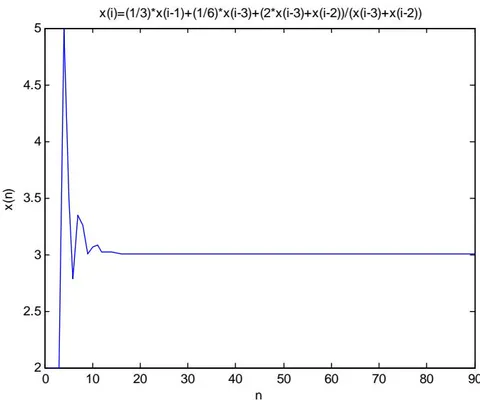
Example 2.1. Fig. 1, shows that Eq. (1.1) has Local stable solutions if , , , , , , , , .
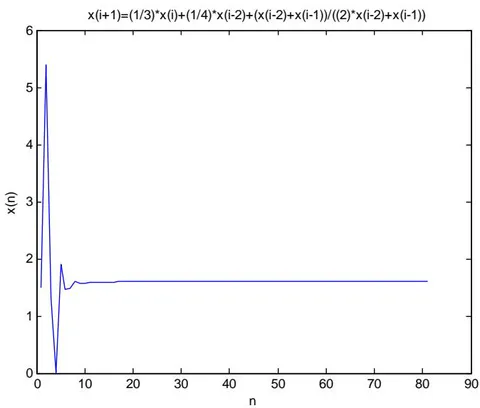
Example 2.2. Fig. 2, shows that Eq. (1.1) has Local stable solutions if , , , , , , , , .
Theorem 3.1. In the all following cases, Equation (1.1) has no positive prime period-two solutions:
(1) If and are bath even positive numbers.
(2) If and are bath odd positive numbers.
Proof. Case(1) Suppose that there exists a prime period-two solution
if and are both even positive numbers, then we get .
It follows from Eq. (1.1) that
and
We get,
since then,
Theorem 3.2. Eq. (1.1) has prime period two solution If
Proof. For case (1) suppose that there exists a prime period-two solution
Notes of (1.1). We will prove that condition (3.1) holds.
We see from (1.1) that if even and odd, then ,
and
Thus, we have
and
By subtracting (3.3) and (3.4), we have
then
By Combining (3.3) and (3.4), we have
Form (3.5), (3.6) and (3.7), we get
Notes
Now it is clear from (3.5) and (3.8) that p and q are both two positive distance roots of the quadratic equation
Thus, we obtain
which is equivalent to
Hence, the proof is completed.
For case (2) suppose that there exists a prime period-two solution
of (1.1). We will prove that condition (2.3) holds.
We see from (1.1) that if even and odd
and,
By subtracting (3.10) and (3.11), we have
By Combining (3.3) and (3.4), we have
then
We have
Notes
so that,
We hava,
also
so we get,
Example 3.1. Fig.3.1, shows that Eq. (1.1) has prime period two solutions if k - even, , a = c = 1, b = 0.0003, d = 3, A = B =
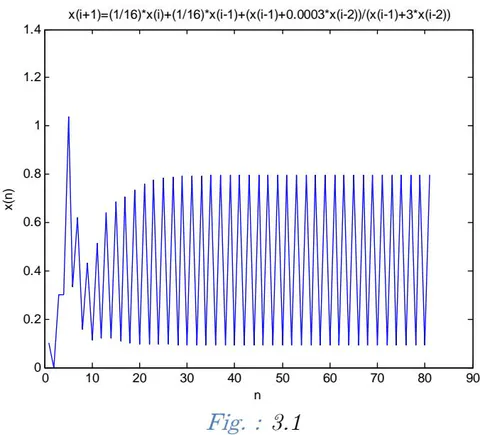
Table (3.1) IV. GLOBAL STABILITY
| n | x(n) | n | x(n) | n | x(n) | n | x(n) |
| 1 | 0.1000 | 16 | 0.1095 | 31 | 0.7928 | 46 | 0.0932 |
| 2 | 0 | 17 | 0.7054 | 32 | 0.0934 | 47 | 0.7953 |
| 3 | 0.3000 | 18 | 0.1015 | 33 | 0.7939 | 48 | 0.0932 |
| 4 | 0.3000 | 19 | 0.7328 | 34 | 0.0934 | 49 | 0.7954 |
| 5 | 1.0375 | 20 | 0.0980 | 35 | 0.7945 | 50 | 0.0932 |
| 6 | 0.3337 | 21 | 0.7584 | 36 | 0.0933 | 51 | 0.7954 |
| 7 | 0.6212 | 22 | 0.0963 | 37 | 0.7949 | 52 | 0.0932 |
| 8 | 0.1566 | 23 | 0.7740 | 38 | 0.0933 | 53 | 0.7954 |
| 9 | 0.4316 | 24 | 0.0951 | 39 | 0.7951 | 54 | 0.0932 |
| 10 | 0.1144 | 25 | 0.7825 | 40 | 0.0933 | 55 | 0.7954 |
| 11 | 0.5130 | 26 | 0.0943 | 41 | 0.7952 | 56 | 0.0932 |
| 12 | 0.1205 | 27 | 0.7877 | 42 | 0.0933 | 57 | 0.7954 |
| 13 | 0.6389 | 28 | 0.0938 | 43 | 0.7953 | 58 | 0.0932 |
| 14 | 0.1201 | 29 | 0.7909 | 44 | 0.0932 | 59 | 0.7954 |
| 15 | 0.6862 | 30 | 0.0936 | 45 | 0.7953 | 60 | 0.0932 |
Theorem 4.1. If and , then the equilibrium point of Eq. (1.1) is global attractor.
Proof. We consider the following function
where
f non-decreasing for and non-increasing for . Let and
we have,
and, from (4.1)
By subtracting (3.10) and (3.11), we have
Notes
SO,
then
Hence, the proof is completed.
V. BOUNDED
Theorem 5.1. Let be asolution of Eq (1.1), then the following statements are true:-
(1) Assume that and let for some , , are valid, then we have
(2) Assume that and for some are valid, Then we have
Proof. (1) if and
Then
Then
Notes
Similarly, we can prove other cases which is omitted here for convenience. Hence, the proof is completed.