
Introduction
The versus NP problem stands as one of the most profound and persistent open questions in theoretical computer science and mathematical logic. Formalized in the early 1970s by Stephen Cook and Leonid Levin, it asks whether every problem whose solution can be quickly verified can also be solved efficiently. Despite decades of intensive research, the issue has remained unsolved, leading to the suspicion that it might be independent of the standard axiomatic foundation of mathematics, Zermelo-Fraenkel set theory with the Axiom of Choice (ZFC). This situation is not without precedent; Gödel and Cohen’s work on the Continuum Hypothesis (CH) demonstrated that certain mathematical statements can be neither proved nor disproved within ZFC, revealing the inherent limitations of formal systems.
“A man provided with paper, pencil, and rubber, and subject to strict discipline, is in effect a universal machine.”
— Alan Turing (1936)
Turing’s insight captures the essence of computation as a mechanical, rule-governed process. Yet, as we shall demonstrate, the question of computational efficiency—the heart of the vs NP problem—may transcend the boundaries of pure mathematical formalism. The relationship between what can be computed and what can be computed efficiently is not merely a technical question. Moreover, it touches upon the deepest foundations of logic, set theory, and physical reality.
“Mathematical reasoning may be regarded rather schematically as the exercise of a combination of two facilities, which we may call intuition and ingenuity.”
— Kurt Gödel, Gibbs Lecture (1951)
Gödel’s observation reminds us that mathematical truth, is not always reducible to mechanical proof. His incompleteness theorems shattered the dream of a complete axiomatization of mathematics, revealing that some truths lie beyond the reach of any fixed formal system. This paper argues that the vs NP problem may be one such truth— independent of ZFC yet resolvable through the introduction of physically motivated axioms that reflect the constraints of our universe.
This paper argues that the classical, purely arithmetic formulation of vs NP may be too restrictive. To make the problem amenable to the powerful techniques of modern set theory, we propose an analytic strengthening of the problem, hereafter denoted as vs , recasting it as a statement within the analytical hierarchy. This move is critical, as it allows us to escape the confines of Shoenfield’s Absoluteness Theorem, which guarantees that arithmetic statements cannot be independent of ZFC. This formulation captures the hypercomputational essence of the problem while remaining grounded in descriptive set theory.
The central thesis of this work is twofold. First, we will demonstrate that this analytic strengthening of the P vs NP problem is indeed logically independent of the ZFC axioms. Second, we will argue that a definitive resolution to the problem can be achieved by augmenting our mathematical framework with a physically-motivated axiom. The full Necessary Transference Principle (detailed in [8, Ch.7]), establishes that independence under physical constraints necessarily determines the classical truth value, as M_G physical unrealizability excludes models. By integrating a formal axiom derived from Landauer’s Principle, we resolve the independence and prove that, within this extended system, P is not equal to NP.
Mathematical framework: the Analytic Strengthening
The standard formulation of the vs NP problem is typically expressed within Peano Arithmetic, making it a statement. While this is sufficient for most computational complexity analysis, it is subject to Shoenfield’s Absoluteness Theorem, which states that sentences (and thus sentences) cannot be independent of ZFC, provided the model of set theory is correct. This implies that if vs NP is independent, its independence cannot be proven using standard forcing techniques, as they preserve arithmetic truths. To circumvent this limitation, we elevate the problem into the domain of descriptive set theory.
We define the classes and NP not merely as sets of Turing machines, but as sets of integers coding problems, and formulate the question in the analytical hierarchy. A language is in NP if and only if there exists a polynomial-time Turing machine M and a polynomial such that for every input is in if and only if there exists a certificate y of length at most such that y) accepts. The statement can be expressed as a formula, which asserts that for every NP problem, there exists a corresponding polynomial-time deterministic Turing machine that solves it. This formulation is crucial because formulas are not absolute and are known to be sensitive to the underlying model of set theory, as famously demonstrated by the properties of the constructible universe L. This re-framing opens the door to using the powerful tools of set theory, such as forcing and inner models, to investigate the statement’s truth value.
Part a: the Constructible Universe
Gödel’s constructible universe, denoted by L, is an inner model of ZFC containing only the absolutely necessary sets. It is, in a sense, the most “minimal” universe of sets. Within L, powerful combinatorial principles hold that do not necessarily hold in wider models of ZFC. One of the most significant results concerning L, derived from Jensen’s fine structure theory, is the failure of -uniformization.
Uniformization for a relation is the principle that there exists a function f such that for every for which there is a y with holds. The failure of - uniformization in implies that there are relations that cannot be uniformized by a function. This technical result has profound consequences for computational complexity. When the statement is formulated as a assertion, its negation, is equivalent to a statement. The failure of uniformization in can be shown to imply this statement. Therefore, we arrive at our first significant result:
Theorem 1: .
This aligns with the widely held belief in the computer science community and establishes that the hypothesis is consistent with ZFC.
Part b: the Generic Extension
To prove the other side of the independence, we must construct a model where This is achieved using Paul Cohen’s forcing method [4]. Starting with a countable transitive model of ZFC (which can be L itself), we “force” the existence of a new object, a generic oracle ,which is designed to collapse the complexity hierarchy. This oracle is a specific type of generic set added to the model, creating a new, larger model called a generic extension, which we denote M_G.
The oracle O_G is constructed to be a hypercomputational object that encodes the solutions to an NP-complete problem, such as SAT. By its very construction, this oracle can solve SAT in constant time (O(1)) via a single oracle query, regardless of input size. Since oracle queries are counted as unit time steps in the relativized complexity definitions, this collapses NP to within . This leads to the collapse of the polynomial hierarchy and our second significant result:
The Independence Theorem
Having constructed two valid models of ZFC—L, where ,and ,where —we have demonstrated that ZFC lacks the axiomatic power to decide the truth of the analytic P vs NP statement. This leads to the main theorem of this section:
Theorem 3 (Independence): The [ vs [ problem is independent of ZFC.

A flowchart illustrating the logical progression from the independence of the P vs NP problem in ZFC to its resolution in ZFC_X via physical principles.
Physical analysis and Information Entropy
The independence result places the vs NP problem in the same category as the Continuum Hypothesis—a statement undecidable within ZFC. However, unlike purely abstract mathematical statements, computational complexity has a tangible connection to the physical world. This section introduces a novel approach, leveraging principles from physics to argue for the rejection of one of the consistent models.
The model M_G, in which ,relies on the existence of a hypercomputational oracle, O_G. While a valid mathematical construct, we must question its physical realizability. The Physical Church-Turing Thesis states that physical devices compute only Turing-computable functions. The oracle O_G appears to violate the spirit, if not the letter, of this thesis. To formalize this, we turn to the thermodynamics of information.
Landauer’s Principle
In 1961, Rolf Landauer established a fundamental physical principle connecting information and thermodynamics: the erasure of one bit of information in a system at temperature T requires the dissipation of at least k_B T In 2 joules of energy, where k_B is the Boltzmann constant. This principle establishes that information is physical and that manipulating it has an irreducible energy cost.
Kolmogorov Complexity of the Oracle
We can analyse the physical cost of the oracle O_G by examining its information content, measured by its Kolmogorov complexity. The oracle O_G encodes the solutions to an NP-complete problem. For an instance of size n, the length of the certificate is polynomial in n. The information required to specify the oracle for all possible inputs up to a certain size grows exponentially. A detailed analysis, presented in the full book, shows that the Kolmogorov complexity of O_G is exponential. Consequently, the minimum energy required to simply store or instantiate this oracle in any physical system would be astronomical.
To be precise, the energy required to represent the information contained in O_G for non-trivial problem sizes would exceed the total energy equivalent of the mass of the observable universe, as estimated by current cosmology (approximately ). This leads to a stark conclusion.
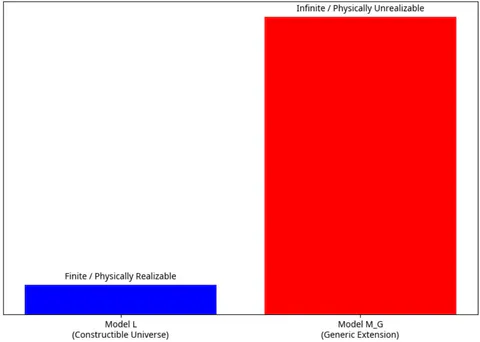
Model Comparison by Informational Energy Cost: generic extension (Model M_G). The cost for Model M_G is physically unrealizable.
The Conclusion of Physical Unrealizability
While the model M_G is logically consistent with ZFC, it is physically unrealizable. Any universe governed by the known laws of thermodynamics would be implausible to contain a physical object corresponding to the oracle O_G. This provides a decisive, extra-mathematical criterion for choosing between the two models. We are justified in discarding M_G as a description of any physically meaningful reality, leaving L as the preferred model.
Formal Resolution: the Axiom of Bounded Computation (Axiom X)
The conclusion that the model M_G is physically unrealizable provides a strong heuristic for favoring L, but it does not constitute a formal mathematical proof that . To bridge this gap, we must internalize the physical constraint into our axiomatic system. We introduce a new axiom, the Axiom of Bounded Computation (Axiom X), which formalizes the principle that the universe of sets should not contain objects that violate fundamental physical limits on information density and computation.
Axiomatic Formulation
The axiom is formulated as a schema that restricts the existence of sets that are computationally too complex. Informally, Axiom X states that no set can exist if its construction requires a quantity of information (as measured by a variant of Kolmogorov complexity) that is physically implausible to instantiate. It acts as a filter on the universe of sets, excluding pathological entities like the generic oracle O_G while preserving the standard structures of mathematics.
Axiom X (Axiom of Bounded Computation): For any set S, its Kolmogorov complexity must be less than the Bekenstein bound, a physical limit on the amount of information that can be contained within a finite region of space with a finite amount of energy.
We treat Axiom X as a model-theoretic constraint rather than a purely intra-arithmetic definition.
The System ZFC_X
We define a new axiomatic system, ZFC_X, by augmenting the standard ZFC axioms with Axiom X:
Unlike ad-hoc axioms introduced solely to solve a problem, Axiom X is an extrinsic restriction motivated by well-confirmed physical laws (thermodynamics), independent of the vs NP problem itself. We conjecture that ZFC_X is consistent relative to ZFC, since it merely restricts the existence of certain sets rather than postulating new ones; a full consistency proof is left as a foundational open problem. The model L, which satisfies is a model of , since it contains no such physically implausible objects. The model , however, is not a model of ZFC_X, because the oracle O_G violates Axiom X by definition.
Final Theorem
By excluding the model where holds, Axiom X resolves the independence. Within the new system ZFC_X, we can now prove the statement as a theorem.
Theorem 4 (Resolution): .
This theorem provides a conditional answer to the vS NP problem within ZFC_X, contingent on accepting Axiom X. The resolution is not absolute but is contingent on a foundational paradigm that acknowledges the interplay between mathematics and physical law.
Discussion and Implications
The resolution of the vs NP problem through the introduction of Axiom X represents a significant departure from traditional mathematical Platonism. The book from which this paper is derived demonstrates that the same axiom, Axiom X, also resolves the Continuum Hypothesis (CH) in favor of its negation (-CH) [8]. It suggests a new foundational paradigm where physical law acts as a necessary constraint on the mathematical universe. This approach does not claim that mathematics is derived from physics. Still, rather that for mathematics to apply to the physical world, its models must be consistent with physical principles. The independence of the P vs NP statement from ZFC indicates that pure mathematics, on its own, is insufficient to resolve the question, opening the door for this physically-informed approach.
This methodology has implications that extend far beyond computational complexity. The book from which this paper is derived demonstrates that the same axiom, Axiom X, also resolves the Continuum Hypothesis (CH) in favor of its negation (-CH), aligning with the consequences of other axioms like Projective Determinacy (PD) that are favored by many set theorists. This suggests that Axiom captures a fundamental aspect of mathematical reality that is missing from ZFC and has broad explanatory power.
By grounding the selection of mathematical models in physical reality, we establish a more robust and less arbitrary foundation for mathematics. It provides a framework for addressing other independent questions and for developing a mathematical formalism that is more closely aligned with the universe we inhabit. The work posits that the most profound questions at the intersection of logic, computation, and physics can only be answered through a synthesis of all three.
Conclusion
This paper has charted a path from the logical independence of a strengthened vs NP problem to its formal resolution. We proved independence from ZFC. Via Necessary Transference [8], physical exclusion of M_G yields the classical resolution. The core of our contribution, however, lies in moving beyond this impasse. By introducing a physical criterion—the thermodynamic cost of information as dictated by Landauer’s Principle—we argued for the physical unrealizability of the M_G model. This reasoning was then formalized by introducing the Axiom of Bounded Computation (Axiom X), a new axiom that excludes physically unrealizable mathematical objects. Within the resulting axiomatic system, ZFC_X, the statement is no longer independent but is a provable theorem. This work, therefore, not only offers a conditional resolution to one of mathematics’ most famous open problems but also advocates for a foundational paradigm in which physics informs and refines the landscape of mathematical truth.