
I. INTRODUCTION
Analogous to the wires that connect different points in an electric circuit, axons are responsible for the transmission of information over the nervous system. The axon, as a part of a cell, separates the internal medium from the external one with the plasma membrane and any perturbations of a membrane potential (signal) conducted along the axon. The membrane potential is the result of ionic gradient currents perpendicular to the membrane.
The following events characterize the transmission of a nerve impulse (Figure 1):
The resting potential describes the polarized state of a neuron ( ).
A graded potential is a change in the resting potential in the response to a stimulus, which causes or gated channels to open. If channels open, the membrane depolarizes. If the channels open, then positive potassium ions exit across the membrane and hyperpolarizes it (Figure 1). A graded potential occurs in cell bodies and dendrites and is a local event that does not travel from its origin.
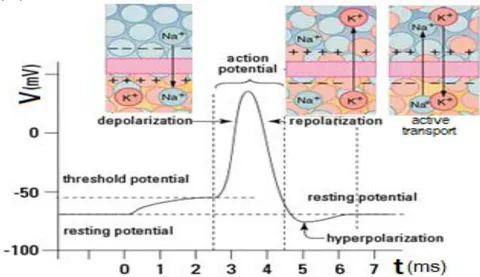
Unlike a static graded potential, an action potential is dynamic and capable of traveling along with a nerve fiber. If a graded potential is sufficiently large, channels open, and on the outside of the membrane becomes depolarized (-70 to +30 mV). If the stimulus exceeds a certain threshold level ( mV) - additional gates open, increasing the flow of , causing an action potential, which stimulates neighboring gates to open. In this manner, the action potential travels down the length of the axon as opened gates stimulate neighboring gates to open...
The inflow of , channels open, allowing movement out of the cell causes repolarization by restoring the original membrane polarization by pumps in the cell membrane.
II. CABLE EQUATION
Nerve impulses flow in only one direction, accompanied by currents across and along the axon trunk. Current across the membrane is
where is the membrane potential, is the capacity of an unmyelinated cylindrical axon with a length of L (=1m), a membrane thickness of b = 10 nm, and a radius of a = 2.5 m. The length of the myelinated section is 1.4 mm and the thickness is b = 2 m.
In turn, these ionic currents give rise to longitudinal currents that allow the regeneration of the membrane potential changes in the axon [1]:
where x is the axis along the axon, is the resistance per unit length of the axon plasma.
The propagation of the action potential is described by the well-known cable differential equation [1-3]:
where is the space constant and is the time constant,
The evolution of any initial impulse is given by the integral
The nerve impulse describing by this equation changes its form soon during propagation along with the nerve fiber. For example, for the evolution of -shape initial impulse, integration leads to
that describes an ink drop diffusion in water, hence the nerve impulse spreads in space-time, distorting initial form, therefore the transmission information. Therefore, the transition of information through the nerve fiber should be occurring by a pulse-wave mechanism that does not change its initial shape.
III. A New Equation for the Signal Transmission
Because of longitudinal current, a flow of substance takes place along the axon plasma with an effective speed
where is the molar mass of type ion and is corresponding mobility. The mass flow in the axon plasma requires the use of the substantial derivative,
instead of partial , in the left-hand side of the cable equation (2).
where the constant parameter characterizes the longitudinal flow of substance.
Introduction of dimensionless running wave variable , where w is the speed of transmission of an electric signal (potential change) over the nervous system, gives ordinary nonlinear differential equation for perturbed potential
where prime means derivative with respect .
The general solution of nonlinear equation (4), considering is:
For the intensity of electric field corresponding to generated potential (5), we obtain
Taking into account the following boundary conditions:
For constants and we obtain:
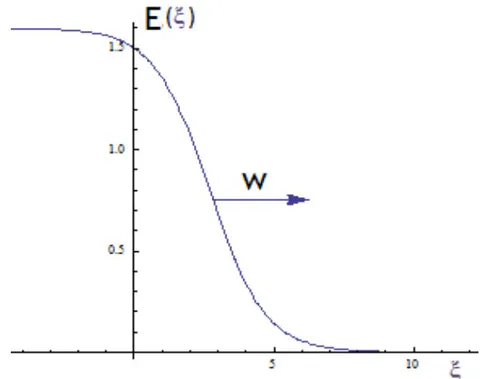
With the use of numerical values of parameters , we can establish the profile of the electric intensity in the running wave (Fig. 2).
IV. CONCLUSION
Considering the longitudinal flow in the electrolyte of an axon plasma and introducing the substantial derivative, we have established nonlinear differential equation (3) describing signal propagation along with the axon fiber as a running wave without changing its profile in contrast to cable equation (2). The solution to this equation is obtained in the form of a running wave. The speed of this wave is
which changes proportionally to the square root of the axon fiber radius, a.