On the Subject Complement and its Basic Types in Chinese

1
Yingjie Zhang
Yingjie Zhang
2
Huifen Tong
Huifen Tong

Send Message

To: Author

GJHSS Volume 21 Issue G15

Article Fingerprint

ReserarchID

4OBZ7

On the Subject Complement and its Basic Types in Chinese Banner
  • English
  • Afrikaans
  • Albanian
  • Amharic
  • Arabic
  • Armenian
  • Azerbaijani
  • Basque
  • Belarusian
  • Bengali
  • Bosnian
  • Bulgarian
  • Catalan
  • Cebuano
  • Chichewa
  • Chinese (Simplified)
  • Chinese (Traditional)
  • Corsican
  • Croatian
  • Czech
  • Danish
  • Dutch
  • Esperanto
  • Estonian
  • Filipino
  • Finnish
  • French
  • Frisian
  • Galician
  • Georgian
  • German
  • Greek
  • Gujarati
  • Haitian Creole
  • Hausa
  • Hawaiian
  • Hebrew
  • Hindi
  • Hmong
  • Hungarian
  • Icelandic
  • Igbo
  • Indonesian
  • Irish
  • Italian
  • Japanese
  • Javanese
  • Kannada
  • Kazakh
  • Khmer
  • Korean
  • Kurdish (Kurmanji)
  • Kyrgyz
  • Lao
  • Latin
  • Latvian
  • Lithuanian
  • Luxembourgish
  • Macedonian
  • Malagasy
  • Malay
  • Malayalam
  • Maltese
  • Maori
  • Marathi
  • Mongolian
  • Myanmar (Burmese)
  • Nepali
  • Norwegian
  • Pashto
  • Persian
  • Polish
  • Portuguese
  • Punjabi
  • Romanian
  • Russian
  • Samoan
  • Scots Gaelic
  • Serbian
  • Sesotho
  • Shona
  • Sindhi
  • Sinhala
  • Slovak
  • Slovenian
  • Somali
  • Spanish
  • Sundanese
  • Swahili
  • Swedish
  • Tajik
  • Tamil
  • Telugu
  • Thai
  • Turkish
  • Ukrainian
  • Urdu
  • Uzbek
  • Vietnamese
  • Welsh
  • Xhosa
  • Yiddish
  • Yoruba
  • Zulu

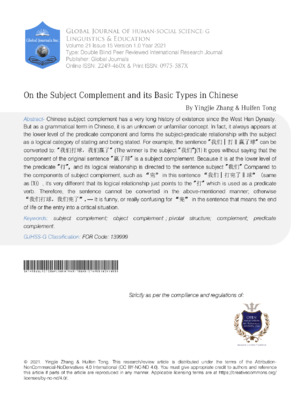
Chinese subject complement has a very long history of existence since the West Han Dynasty. But as a grammatical term in Chinese, it is an unknown or unfamiliar concept. In fact, it always appears at the lower level of the predicate component and forms the subject-predicate relationship with the subject as a logical category of stating and being stated. For example, the sentence “我们│打‖赢了球” can be converted to: “我们打球,我们赢了” (The winner is the subject “我们”)⑴ It goes without saying that the component of the original sentence “赢了球” is a subject complement. Because it is at the lower level of the predicate “打”, and its logical relationship is directed to the sentence subject “我们” Compared to the components of subject complement, such as “完” in this sentence “我们│打完了‖球”(same as ⑴), it’s very different that its logical relationship just points to the “打” which is used as a predicate verb. Therefore, the sentence cannot be converted in the above-mentioned manner; otherwise “我们打球,我们完了”.-It is funny, or really confusing for “完” in the sentence that means the end of life or the entry into a critical situation.

Funding

No external funding was declared for this work.

Conflict of Interest

The authors declare no conflict of interest.

Ethical Approval

No ethics committee approval was required for this article type.

Data Availability

Not applicable for this article.

Yingjie Zhang. 2022. \u201cOn the Subject Complement and its Basic Types in Chinese\u201d. Global Journal of Human-Social Science - G: Linguistics & Education GJHSS-G Volume 21 (GJHSS Volume 21 Issue G15): .

Download Citation

Alt text: Study on Chinese sentence complements and their basic types, emphasizing language structure and syntax.
Issue Cover
GJHSS Volume 21 Issue G15
Pg. 21- 31
Journal Specifications

Crossref Journal DOI 10.17406/GJHSS

Print ISSN 0975-587X

e-ISSN 2249-460X

Keywords
Classification
GJHSS-G Classification: FOR Code: 139999
Version of record

v1.2

Issue date

January 15, 2022

Language

English

Experiance in AR

The methods for personal identification and authentication are no exception.

Read in 3D

The methods for personal identification and authentication are no exception.

Article Matrices
Total Views: 1945
Total Downloads: 834
2026 Trends
Research Identity (RIN)
Related Research

Published Article

Chinese subject complement has a very long history of existence since the West Han Dynasty. But as a grammatical term in Chinese, it is an unknown or unfamiliar concept. In fact, it always appears at the lower level of the predicate component and forms the subject-predicate relationship with the subject as a logical category of stating and being stated. For example, the sentence “我们│打‖赢了球” can be converted to: “我们打球,我们赢了” (The winner is the subject “我们”)⑴ It goes without saying that the component of the original sentence “赢了球” is a subject complement. Because it is at the lower level of the predicate “打”, and its logical relationship is directed to the sentence subject “我们” Compared to the components of subject complement, such as “完” in this sentence “我们│打完了‖球”(same as ⑴), it’s very different that its logical relationship just points to the “打” which is used as a predicate verb. Therefore, the sentence cannot be converted in the above-mentioned manner; otherwise “我们打球,我们完了”.-It is funny, or really confusing for “完” in the sentence that means the end of life or the entry into a critical situation.

Our website is actively being updated, and changes may occur frequently. Please clear your browser cache if needed. For feedback or error reporting, please email [email protected]
×

This Page is Under Development

We are currently updating this article page for a better experience.

Request Access

Please fill out the form below to request access to this research paper. Your request will be reviewed by the editorial or author team.
X

Quote and Order Details

Contact Person

Invoice Address

Notes or Comments

This is the heading

Lorem ipsum dolor sit amet, consectetur adipiscing elit. Ut elit tellus, luctus nec ullamcorper mattis, pulvinar dapibus leo.

High-quality academic research articles on global topics and journals.

On the Subject Complement and its Basic Types in Chinese

Yingjie Zhang
Yingjie Zhang
Huifen Tong
Huifen Tong

Research Journals