
Opportunities and Challenges Facing the Profession of Translator in Africa

1
Dr. Servais Martial Akpaca
1 University of Abomey

Send Message

To: Author

GJHSS Volume 23 Issue G8

Article Fingerprint

ReserarchID

43450

Opportunities and Challenges Facing the Profession of Translator in Africa Banner
  • English
  • Afrikaans
  • Albanian
  • Amharic
  • Arabic
  • Armenian
  • Azerbaijani
  • Basque
  • Belarusian
  • Bengali
  • Bosnian
  • Bulgarian
  • Catalan
  • Cebuano
  • Chichewa
  • Chinese (Simplified)
  • Chinese (Traditional)
  • Corsican
  • Croatian
  • Czech
  • Danish
  • Dutch
  • Esperanto
  • Estonian
  • Filipino
  • Finnish
  • French
  • Frisian
  • Galician
  • Georgian
  • German
  • Greek
  • Gujarati
  • Haitian Creole
  • Hausa
  • Hawaiian
  • Hebrew
  • Hindi
  • Hmong
  • Hungarian
  • Icelandic
  • Igbo
  • Indonesian
  • Irish
  • Italian
  • Japanese
  • Javanese
  • Kannada
  • Kazakh
  • Khmer
  • Korean
  • Kurdish (Kurmanji)
  • Kyrgyz
  • Lao
  • Latin
  • Latvian
  • Lithuanian
  • Luxembourgish
  • Macedonian
  • Malagasy
  • Malay
  • Malayalam
  • Maltese
  • Maori
  • Marathi
  • Mongolian
  • Myanmar (Burmese)
  • Nepali
  • Norwegian
  • Pashto
  • Persian
  • Polish
  • Portuguese
  • Punjabi
  • Romanian
  • Russian
  • Samoan
  • Scots Gaelic
  • Serbian
  • Sesotho
  • Shona
  • Sindhi
  • Sinhala
  • Slovak
  • Slovenian
  • Somali
  • Spanish
  • Sundanese
  • Swahili
  • Swedish
  • Tajik
  • Tamil
  • Telugu
  • Thai
  • Turkish
  • Ukrainian
  • Urdu
  • Uzbek
  • Vietnamese
  • Welsh
  • Xhosa
  • Yiddish
  • Yoruba
  • Zulu

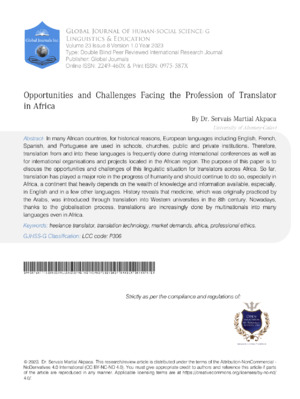
In many African countries, for historical reasons, European languages including English, French, Spanish, and Portuguese are used in schools, churches, public and private institutions. Therefore, translation from and into these languages is frequently done during international conferences as well as for international organisations and projects located in the African region. The purpose of this paper is to discuss the opportunities and challenges of this linguistic situation for translators across Africa. So far, translation has played a major role in the progress of humanity and should continue to do so, especially in Africa, a continent that heavily depends on the wealth of knowledge and information available, especially, in English and in a few other languages. History reveals that medicine, which was originally practiced by the Arabs, was introduced through translation into Western universities in the 8th century. Nowadays, thanks to the globalisation process, translations are increasingly done by multinationals into many languages even in Africa.

Funding

No external funding was declared for this work.

Conflict of Interest

The authors declare no conflict of interest.

Ethical Approval

No ethics committee approval was required for this article type.

Data Availability

Not applicable for this article.

Dr. Servais Martial Akpaca. 2026. \u201cOpportunities and Challenges Facing the Profession of Translator in Africa\u201d. Global Journal of Human-Social Science - G: Linguistics & Education GJHSS-G Volume 23 (GJHSS Volume 23 Issue G8): .

Download Citation

High-quality ALT text highlighting keywords like Translator, challenges, opportunities, Africa, research journal.
Issue Cover
GJHSS Volume 23 Issue G8
Pg. 101- 109
Journal Specifications

Crossref Journal DOI 10.17406/GJHSS

Print ISSN 0975-587X

e-ISSN 2249-460X

Keywords
Classification
GJHSS-G Classification: LCC code: P306
Version of record

v1.2

Issue date

August 25, 2023

Language

English

Experiance in AR

The methods for personal identification and authentication are no exception.

Read in 3D

The methods for personal identification and authentication are no exception.

Article Matrices
Total Views: 1398
Total Downloads: 18
2026 Trends
Research Identity (RIN)
Related Research

Published Article

In many African countries, for historical reasons, European languages including English, French, Spanish, and Portuguese are used in schools, churches, public and private institutions. Therefore, translation from and into these languages is frequently done during international conferences as well as for international organisations and projects located in the African region. The purpose of this paper is to discuss the opportunities and challenges of this linguistic situation for translators across Africa. So far, translation has played a major role in the progress of humanity and should continue to do so, especially in Africa, a continent that heavily depends on the wealth of knowledge and information available, especially, in English and in a few other languages. History reveals that medicine, which was originally practiced by the Arabs, was introduced through translation into Western universities in the 8th century. Nowadays, thanks to the globalisation process, translations are increasingly done by multinationals into many languages even in Africa.

Our website is actively being updated, and changes may occur frequently. Please clear your browser cache if needed. For feedback or error reporting, please email [email protected]
×

This Page is Under Development

We are currently updating this article page for a better experience.

Request Access

Please fill out the form below to request access to this research paper. Your request will be reviewed by the editorial or author team.
X

Quote and Order Details

Contact Person

Invoice Address

Notes or Comments

This is the heading

Lorem ipsum dolor sit amet, consectetur adipiscing elit. Ut elit tellus, luctus nec ullamcorper mattis, pulvinar dapibus leo.


High-quality academic research articles on global topics and journals.

Opportunities and Challenges Facing the Profession of Translator in Africa

Dr. Servais Martial Akpaca
Dr. Servais Martial Akpaca University of Abomey

Research Journals





























































