Loading menu…

Optical Activity in Weakly Coupled Nonorods

Send Message

To: Author

Optical Activity in Weakly Coupled Nonorods

Article Fingerprint

ReserarchID

SFR6KJ7G

Optical Activity in Weakly Coupled Nonorods Banner

Key Research Insights

Synthesized scholarly intelligence & interactive research assistant
  • English
  • Afrikaans
  • Albanian
  • Amharic
  • Arabic
  • Armenian
  • Azerbaijani
  • Basque
  • Belarusian
  • Bengali
  • Bosnian
  • Bulgarian
  • Catalan
  • Cebuano
  • Chichewa
  • Chinese (Simplified)
  • Chinese (Traditional)
  • Corsican
  • Croatian
  • Czech
  • Danish
  • Dutch
  • Esperanto
  • Estonian
  • Filipino
  • Finnish
  • French
  • Frisian
  • Galician
  • Georgian
  • German
  • Greek
  • Gujarati
  • Haitian Creole
  • Hausa
  • Hawaiian
  • Hebrew
  • Hindi
  • Hmong
  • Hungarian
  • Icelandic
  • Igbo
  • Indonesian
  • Irish
  • Italian
  • Japanese
  • Javanese
  • Kannada
  • Kazakh
  • Khmer
  • Korean
  • Kurdish (Kurmanji)
  • Kyrgyz
  • Lao
  • Latin
  • Latvian
  • Lithuanian
  • Luxembourgish
  • Macedonian
  • Malagasy
  • Malay
  • Malayalam
  • Maltese
  • Maori
  • Marathi
  • Mongolian
  • Myanmar (Burmese)
  • Nepali
  • Norwegian
  • Pashto
  • Persian
  • Polish
  • Portuguese
  • Punjabi
  • Romanian
  • Russian
  • Samoan
  • Scots Gaelic
  • Serbian
  • Sesotho
  • Shona
  • Sindhi
  • Sinhala
  • Slovak
  • Slovenian
  • Somali
  • Spanish
  • Sundanese
  • Swahili
  • Swedish
  • Tajik
  • Tamil
  • Telugu
  • Thai
  • Turkish
  • Ukrainian
  • Urdu
  • Uzbek
  • Vietnamese
  • Welsh
  • Xhosa
  • Yiddish
  • Yoruba
  • Zulu
Reading Preferences
Font Size
Line Spacing
Background
This converted HTML version may contain rendering inconsistencies. Please refer to the PDF for the authoritative version, or click here to provide feedback.

Abstract

We introduce a matrix method and we derive a formula for phase retardation effects in plasmonic systems. We analyze the circular dichroic response (CD) of two orthogonal Au nanorods in detail and we show that, although, theoretically, circular dichroism for forward scattering is directly proportional to the dipole-dipole interaction between the particles, CD response of the system can be much greater in weak coupling due to the trade off between two different types of phases.

Achiral and chiral configurations of coupled plasmonic nanorods manifest circular polarization effects due to the phase difference between the light scattered from different parts of the system. In the Born-Kuhn coupled oscillator model and in its plasmonic versions [1−4] optical activity emerges as a result of the coupling (dipole-dipole interaction) between the particles.

For simple nanosystems, it is usually sufficient to investigate the system's behavior under a single polarization excitation. However, for coupled nanoparticles in three-dimensional space, it is often necessary to study different excitation polarizations and matrix methods comprising all possible modes become important [5-7]. In this note, we examine the optical response of coupled metallic nanorods at the far field by means of the scattering matrix (Jones matrix) of the system. In particular, we study the case of two coupled orthogonal metallic nanorods and derive a formula for the far field circular dichroic response (CD) of the system that depends on two different phase factors besides the electromagnetic coupling coefficient. We observe that the phase due to the chiral geometry is doubled and we show that the CD response of the system can be much greater for weakly coupled particles.

II. THE SCATTERING MATRIX

Nanorods are the basic elements of a class of more complex systems. Their optical response can be modeled as oriented dipoles with polarization characteristics similar to that of linear polarizers in a certain interval of photon energy. We assume that the polarizability of each rod is fully anisotropic, i.e., it can polarize only along a particular direction. Hence, scattering properties of a nanorod can be represented by a linear polarizer Jones matrix:

J=α(cos2⁡θcos⁡θsin⁡θcos⁡θsin⁡θsin2⁡θ)

where α is the Lorentzian polarizability associated with the particle and θ is the orientation angle in the x-y plane.
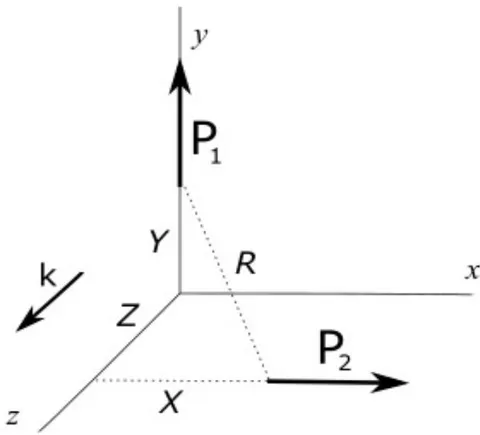
Figure 1: Coupled dipoles (nanorods). CD response is maximum for weak coupling.

We study a chiral configuration of coupled oriented dipoles (nanorods) depicted in Fig.1. Particles are excited by a plane wave that propagates along the z-axis. We calculate the components of the far field electric vector by taking into account the mutual interactions as described in the Appendix.

Ex=F(e2εαEx+e1εα2δEy)1−e12α2δ2
Ey=e2F(e1e2εα2δEx+εαEy)1−e12α2δ2

where ε is the permittivity of the medium, E0x and E0y are electric field components at z=0, F is the far field factor, e1=e2πiR/λ, e2=e2πiZ/λ, δ is the coupling coefficient defined as δ=−XYk2B/R2 (B is given in the Appendix). There is an extra e2 in Ey because the vertical rod is behind the horizontal rod at a distance Z.

From the far field components we extract the Jones matrix of the system:

(4)J=εαF1−e12α2δ2(e2e1αδe1e22αδe2)

This is an asymmetric Jones matrix with a non-zero γ parameter which is associated with the circular anisotropy of the system [9]:

(5)γ=i(J12−J21)2

where Jij are the elements of the Jones matrix. According to Eq.(4):

(6)γ=εαF(1−e22)e1αδ2(1−e12α2δ2)

In terms of the elements of the Jones matrix given in Eq.(4)

(9)ΔI(R,Z,λ)=8gg∗sin⁡(2πZλ)Re(αδei2πR/λ)

where g=εαF/(1−e12α2δ2).

III. WEAK COUPLING

In plasmonic models optical activity emerges due to the coupling. As shown in the previous section, the optical activity is directly proportional to the coupling coefficient. When the nanorods are well separated from each other γ and ΔI vanishes, and one may expect that chiroptical effects would increase with decreasing distance. However, according to Eq.(9), for Z = 0, the Jones matrix of the system reduces to a symmetric matrix, hence, there is no chiroptical effect for scattering in the z-direction 1. In short, when Z = 0; γ=0, ΔI=0 and, in general, ΔI may not be maximum for too closely packed nanorods. It is worth noting that, there are two phase factors in Eq.(9). e2=ei2πZ/λ is the phase due to the 3D chiral geometry and e1=ei2πR/λ is the phase that involved in the dipole-dipole interaction. Only the imaginary part of e2 appears in the equation. Maximum of the CD response is determined by the trade off between these two phase factors.

We continue our work with the simulations of the far field scattering intensities IRCP and ILCP corresponding to RCP and LCP excitation polarization states. We observe that it is possible to maximize ΔI by playing with the spatial parameters associated with e1 and e2. Especially, for nanorods with length L >200 nm, R can be made very large compared to the size of the rods (weak coupling). As an example, for nanorods with length 400 nm and radius 50 nm, by setting X = Y = 430 nm and Z = 240 nm (R = 654 nm) ΔI is 1/3 of the total intensity at λPR (plasmon resonance wavelength), i.e., (IRCP−ILCP)/(IRCP+ILCP)≈1/3. BEM simulations for this configuration is given in Fig.2. Dashed line is for ΔI. In the MATLAB implementation of the BEM method [11] we use optical constants of Au by Johnson and Christy [12](Supplemental Material).
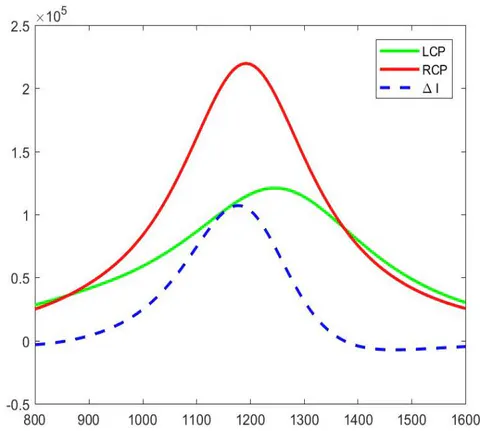
Figure 2: Scattering intensities I_{RCP}, I_{LCP} and \Delta I for nanorods of length 400 nm and radius 50 nm with X = Y = 430 nm, Z = 240 nm.
Figure 2: Scattering intensities IRCP, ILCP and ΔI for nanorods of length 400 nm and radius 50 nm with X = Y = 430 nm, Z = 240 nm.

IV. CONCLUSION

In the case of coupled nanoparticles in three-dimensional space, it is often necessary to study different excitation polarizations in different scattering directions and matrix methods using all possible modes of excitation become important. In this work, we examine the optical response of coupled metallic nanorods at the far field by means of the Jones matrix of the system. We study the case of two coupled orthogonal metallic nanorods in detail and derive a formula for the far field circular dichroic response of the system that depends on two different phase factors besides the electromagnetic coupling coefficient. We observe that the phase due to the chiral geometry is doubled and the CD response of the system can be much greater for weakly coupled particles.

V. APPENDIX

When a nanorod is excited by a plane wave the induced electric dipole moment vector, P, is proportional to the incident electric field, E0(r):

P=εJE0(r),

where ε is the permittivity of the medium at the dipole (nanorod) position and J is the 2×2 Jones matrix of the nanorod.

When we put two nanorods close to each other we have to consider mutual interaction contributions. Each one of the dipoles experiences the field of the other dipole which should be taken into account to find the actual dipole fields [8]:

P1=J1[εEo(r1)+k2G¯¯(r1−r2)⋅P2],
(13a)A=14πR(1+ikR−1k2R2),
(13b)B=14πR(−1−3ikR+3k2R2),

thus,

(14)G¯¯⋅P=AP+B(u^⋅P)u^.

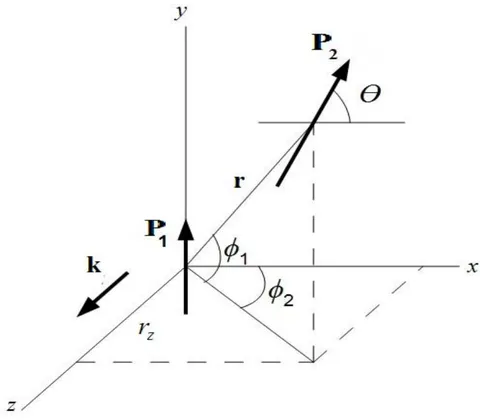
We study the circular polarization effects for the geometry given in Fig. 3, wherer(|r|=R) is the relative position vector between the dipoles. The plane wave excitesP1first andP2after a delay. According to Fig. 3,e1=ei2πR/λis the phase difference between the dipoles along the distanceR, ande2=ei2πZ/λis the phase difference in thez-direction. The Jones matrix of the first dipole is fixed along theyaxis:

(15)J1=α1(0001)

The second dipole is tilted at an angle of θ:

(16)J2=α2(abbc)
Figure 3: Two oriented dipoles (nanorods) where

α1 and α2 are the Lorentzian polarizabilities of the dipoles and a=cos2⁡θ, b=cos⁡θsin⁡θ, c=sin2⁡θ. Let C1=cos⁡ϕ1, S1=sin⁡ϕ1, C2=cos⁡ϕ2, S2=sin⁡ϕ2 then the unit vector along r can be written as

(17)u^(r2−r1)=(C1C2,S1,C1S2)

We calculate P1 and P2 with the Green function contributions:

P1=εJ1(E0xE0y)+k2J1(e1AP2x+(C1C2P2x+S1P2y)C1C2e1Be1AP2y+(C1C2P2x+S1P2y)S1e1B)
(19)P2=εJ2(e2E0xe2E0y)+k2J2(C1C2S1e1BP1ye1AP1y+S12e1BP1y)

E0x,E0y are the components of the planewave excitation at z = 0. We solve the components of the dipoles at the far field for scattering in the z-direction and we find the scattering matrix (Jones matrix) of the interacting system:

(20)J=εFN[e2α1(0001)+e2α2(abbc)+e1α1α2(0Δ1e22Δ1(1+e22)Δ2)]

where N=1−e12α1α2(2bδ1δ2+cδ12+aδ22), F is the far field factor, δ1=k2(A+S12B), δ2=k2(C1C2S1B), Δ1=bδ1+aδ2 and Δ2=cδ1+bδ2 are the coupling coefficients that result from the dipole-dipole interaction. Here we write the Jones matrix of the system as a linear combination of three Jones matrices, first two of them corresponding to symmetric

J=g[e2(1000)+e2(0001)+e1(0αδe22αδ0)]=g(e2e1αδe1e22αδe2)

where

(22)g=εαF1−e12α2δ2

Extremum points of the denominator of the overall factor g determines the intensity peaks corresponding to the hybridized modes which occur at the energies that make Re(e1αδ)=±1 [5]. Separation between the higher and lower energy modes decreases and eventually they overlap for large R, but two modes can still be monitored by means of the parameter e1αδ which can be found from the Jones matrix.
References

12 Cites in Article
  1. 1. Werner Kuhn (1929). Quantitative Verhältnisse und Beziehungen bei der natürlichen optischen Aktivität. Zeitschrift für Physikalische Chemie, 4B(1), 14-36.
  2. 2. M Schaferling (2017). Chiral Nanophotonics. Chiral nanophotonics: chiral optical properties of plasmonic systems
  3. 3. X Yin,M Schaferling,B Metzger,H Giessen (2013). Unknown Title. Nano Lett, 13, 6238.
  4. 4. Atefeh Najafabadi,Tavakol Pakizeh (2017). Analytical Chiroptics of 2D and 3D Nanoantennas. ACS Photonics, 4(6), 1447-1452.
  5. 5. M Kuntman,E Kuntman,J Sancho-Parramon,O Arteaga (2018). \Light scattering by coupled oriented dipoles: decomposition of the scattering matrix. Phys. Rev. B, 98, 45410.
  6. 6. E Kuntman (2020). Mathematical work on the foundations of Jones-Mueller formalism and its application to nano optics. Mathematical work on the foundations of Jones-Mueller formalism and its application to nano optics
  7. 7. Mehmet Kuntman,Ertan Kuntman,Oriol Arteaga (2020). Asymmetric Scattering and Reciprocity in a Plasmonic Dimer. Symmetry, 12(11), 1790.
  8. 8. Pablo Albella,M Poyli,Mikolaj Schmidt,Stefan Maier,Fernando Moreno,Juan Sáenz,Javier Aizpurua (2013). Low-Loss Electric and Magnetic Field-Enhanced Spectroscopy with Subwavelength Silicon Dimers. The Journal of Physical Chemistry C, 117(26), 13573-13584.
  9. 9. Ertan Kuntman,M Ali Kuntman,Oriol Arteaga (2017). Vector and matrix states for Mueller matrices of nondepolarizing optical media. Journal of the Optical Society of America A, 34(1), 80.
  10. 10. Ertan Kuntman,M Kuntman,Jordi Sancho-Parramon,Oriol Arteaga (2017). Formalism of optical coherence and polarization based on material media states. Physical Review A, 95(6), 63819.
  11. 11. Ulrich Hohenester,Andreas Trügler (2011). MNPBEM – A Matlab toolbox for the simulation of plasmonic nanoparticles. Computer Physics Communications, 183(2), 370-381.
  12. 12. P Johnson,R Christy (1972). Optical Constants of the Noble Metals. Physical Review B, 6(12), 4370-4379.

Funding

No external funding was declared for this work.

Conflict of Interest

The authors declare no conflict of interest.

Ethical Approval

No ethics committee approval was required for this article type.

Data Availability

Not applicable for this article.

How to Cite This Article

M. A. Kuntman, E. Kuntman. 2020. "Optical Activity in Weakly Coupled Nonorods". Global Journal of Science Frontier Research - A: Physics & Space Science GJSFR-A Volume 20 (GJSFR Volume 20 Issue A13).

More Citation Formats

Download Citation

Journal Specifications

Crossref Journal DOI 10.17406/GJSFR

Print ISSN 0975-5896

e-ISSN 2249-4626

Keywords
Classification
GJSFR-A Classification FOR Code: 020599
Version of record
v1.2

Issue date
December 14, 2020

Language
English
Order Article Reprint
Experience in AR

Explore published articles in an immersive Augmented Reality environment. Our platform converts research papers into interactive 3D books, allowing readers to view and interact with content using AR and VR compatible devices.

Read in 3D

Your published article is automatically converted into a realistic 3D book. Flip through pages and read research papers in a more engaging and interactive format.

Article Matrices
Total Views: 863
Total Downloads: 48
All Trends

Request Access

Please fill out the form below to request access to this research paper. Your request will be reviewed by the editorial or author team.
X

This is the heading

Lorem ipsum dolor sit amet, consectetur adipiscing elit. Ut elit tellus, luctus nec ullamcorper mattis, pulvinar dapibus leo.

High-quality academic research articles on global topics and journals.

Optical Activity in Weakly Coupled Nonorods

M. Kuntman
M. Kuntman
E. Kuntman
E. Kuntman