I. INTRODUCTION
Nowadays, chemotherapy is the only way for the treatment of cancer affected cells in human body. Less than 0.1% drugs are taken by the affected cells during chemotherapy. The rest of the drugs are wasted. Moreover, physicians always face an upper limit in the treatment dose to avoid damage of healthy cells. This limit obstructs the chance of successful treatment of the tumor cells. By magnetic drug targeting (MDT), we can accumulate more drugs on cancer affected cells by using permanent magnet. At first, nanoparticles accumulate on blood vessels and then diffuse to the cells. Drug released from nanoparticles are introduced by changing some physical parameters. The magnetic liquids such as ferrofluids, biocompatible magnetic nanocarrier, etc., play an important role as drug carriers in the human body. Effectiveness of magnetic drug delivery largely depends on the design of an effective magnet system. Proper magnet system can trap more nanoparticles on the targeted site.
Magnetic drug targeting (MDT) refers to the attachment of therapeutics to magnetizable particles, and then applying magnetic fields to concentrate them to disease locations such as to solid tumors, regions of infection, or blood clots. Usually ferromagnetic particles are directly injected into the circulation of blood by a vein or artery. Particles so injected will circulate throughout the vasculature as the applied magnetic field is used to attempt confinement at target locations. Depending on the vessel into which the particles were injected (vein or artery), MDT will occur before the particles pass through the liver or after the particles pass through the liver, lung and heart. The latter is more common, but reduces the drug amount available that can be attached to the nanoparticles since a large portion of the drug is filtered by the liver and kidney.
In the recent years, Finite Element Method (FEM) has been widely used in biomedical engineering. Creation of recirculation by applied magnetic field is observed [1]. Amount of nanoparticles captured can be increased by proper design of magnet system. Using array of magnet rather than single magnet is suggested by several researcher [2]. Wedge shape magnet can increase conciseness of recirculation [3]. Array of wedge shaped or rectangular magnet can generate more recirculation [4]. In our Study we compare the performance of different type of magnet system with respect to velocity field and volume fraction of nanoparticles within the recirculation zone. We also show the strength of magnetic field and magnetic field gradient for different magnet configuration and their relation with nanoparticles accumulation within recirculation.
II. MATHEMATICAL MODELING
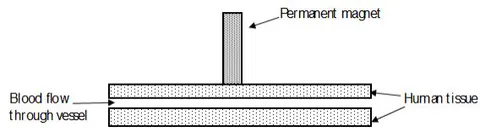
As shown in fig. 1 the model geometry consists of a blood vessel, a permanent magnet, surrounding tissue, and air. Blood enters into the vessel from left side of the figure. Magnetic field generated by the permanent magnet is evaluated by the numerical simulation. This magnetic field generates a volume force on nanoparticles presents in ferrofluids.
Since magnetic field is static, so According to Maxwell-Ampere's law for the magnetic field (A/m) and the current density (A/m2)
Furthermore, Gauss' law for the magnetic flux density states that,
The constitutive equations describing the relation between B and H in the permanent magnet, blood vessel, air of the modeling domain are respectively
Here, is the magnetic permeability of vacuum (Vs/(A·m)); is the relative magnetic permeability of the permanent magnet (dimensionless); Brem is the remnant magnetic flux (A/m); and is the magnetization vector in the blood stream (A/m), which is a function of the magnetic field, H.
Defining a magnetic vector potential A such that
Combining the above equations gives, for zero currents
Note that this equation assumes that the magnetic vector potential has a nonzero component only perpendicularly to the plane, .
An arc tangent expression with two material parameters (A/m) and (m/A) characterizes the induced magnetization of a ferrofluids.
For the magnetic fields of interest, it is possible to linearize these expressions to obtain
where , is magnetic susceptibility.
Blood flow though the vessel can be expressed by Incompressible Navier Stoke's equations
The F term is a magnetic volume force; act on nanoparticles that can be expressed as-
On the vessel walls, we have applied no-slip conditions, . At the outlet, we can set an outlet pressure condition, . At the inlet boundary, we have specified a parabolic flow profile on the normal inflow velocity according to 4 Um s(1-s), where is a boundary segment length parameter that goes from 0 to
1 along the inlet boundary segment and Um is the maximal flow velocity. To emulate the heart beat, the inflow velocity follows a sinusoidal expression in time:
Selecting the angular velocity to be rad/s gives a heart beat rate of 60 beats per minute.
III. NUMERICAL DATA
Numerical data used for the current simulation are given below.
| Relative permeability, magnet | 1 |
| Remanent flux density, magnet | -2 T (Y-direction) |
| Magnetic susceptibility, ferrofluid, | 0.3 |
| Ferrofluid mass fraction in blood stream | 0.05 |
| Density, blood | |
| Density, Nanoparticles | |
| Maximum flow velocity | 0.5 m/s |
| Heart-beat rate,f | 60 [1/min] |
IV. DESCRIPTIONS OF STUDY
We start our numerical simulation with one rectangular magnet. Then array of two rectangular magnet. One wedge shaped magnet and array of two wedge shaped magnet. We compare the result of different simulation. Finite Element Method (FEM) is used to solve the problem.
V. RESULTS
Target of our magnetically drug therapy is to accumulate more nanoparticles on targeted site. Due to pulsating flow behavior of blood under applied magnetic field, nanoparticles create recirculation inside the blood vessel. Within recirculation zone, the concentration of nanoparticles is much higher than other areas. Thus the percentage of particles trapped in the affected region is increased with the introduction of MDT. Effectiveness of magnetic drug delivery largely system. Proper magnet system can trap more nanoparticles on the targeted site.
The simulation is divided into two important parts. Firstly, only magnetic potential is computed with time independent and stationary state. Secondly, the results of first step are applied to calculate velocity field by Navier Stokes equations in time dependent state.
a) Magnetic field visualization
Required magnetic field is created by permanent magnet. Magnetic field strength decreases as distance from the magnet increase. This decrease in strength create magnetic field gradient.
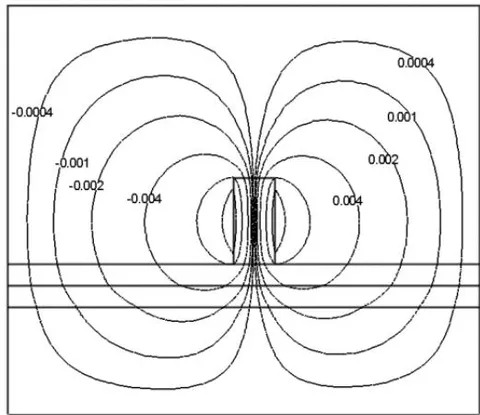
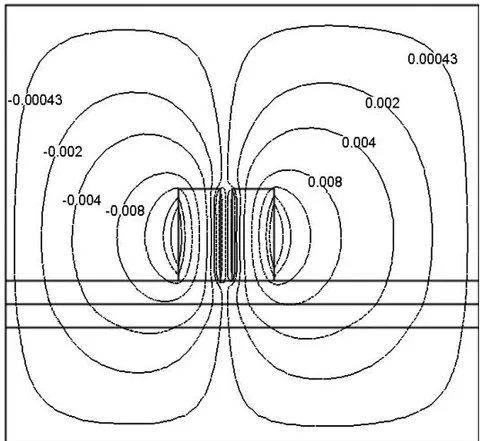
From fig. 2 and fig. 3, it is clear that strength of magnetic field due to two rectangular magnet array is higher than one rectangular magnet and magnetic gradient is higher for two rectangular magnet.
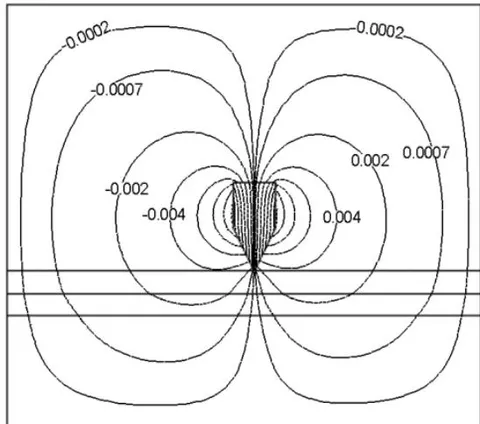
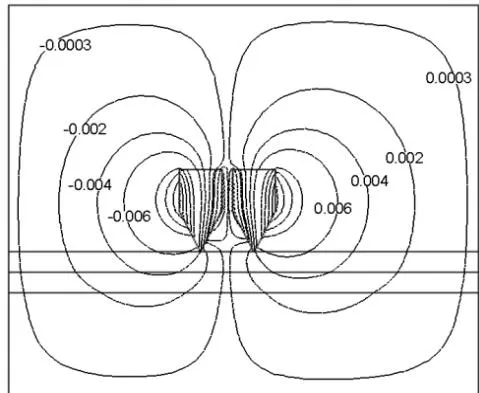
From fig. 4 and fig. 5, it is clear that strength of magnetic field due to two wedge shaped magnet array is higher than one wedge shaped magnet and magnetic gradient is higher for two wedge shaped magnet.
If we compare two-wedge shape magnet with two rectangular magnet, magnetic field and gradient due to two rectangular magnet is higher than two wedge
b) Velocity field visualization
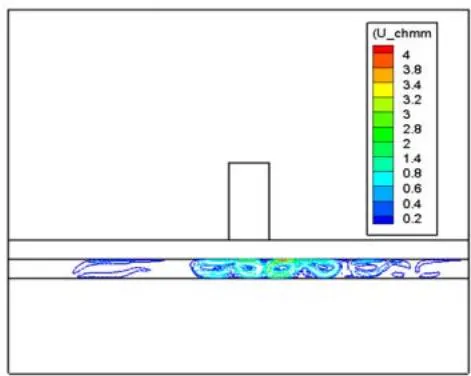
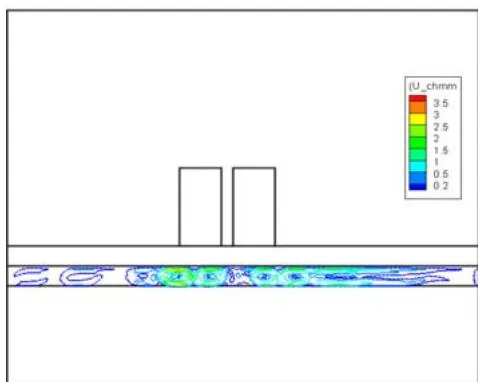
From fig. 6 and fig. 7, more recirculation is created due to two rectangular magnet arrays than one rectangular magnet.
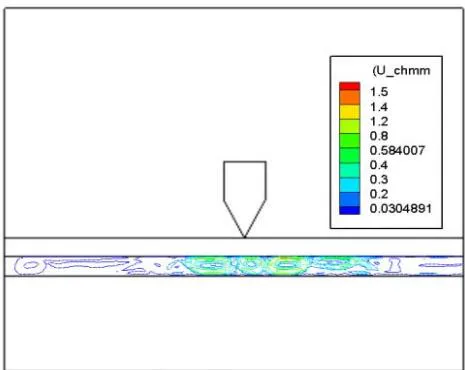
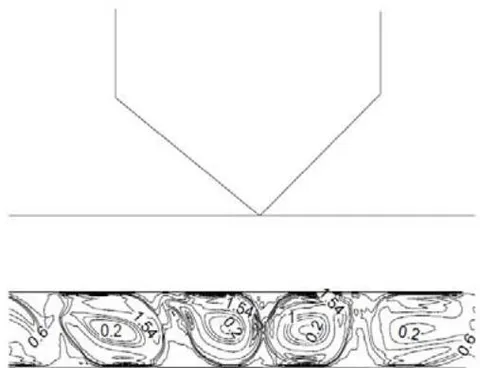
Fig. 9 makes it clear that the velocity in the outer phase of the recirculation for wedge shaped magnet is much higher than a single rectangular magnet. The recirculation is very close under the vertex of the wedge.
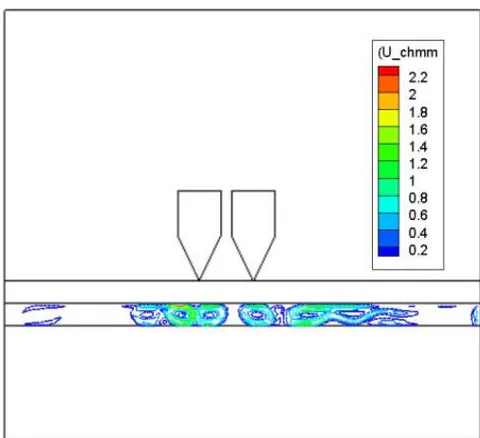
From fig. 8 and fig. 10, more recirculation is created due to two wedge shape magnet array than one wedge shape magnet. Recirculation is more concise due to wedge shape magnet but numerical value of velocity within the recirculation is low. Strength of recirculation due to two rectangular magnets is higher than two wedge shape magnet.
VI CONCLUSIONS
Both magnetic field strength and magnetic field gradient has a significant importance in creation of recirculation in magnetic drug targeting. Use of rectangular magnet array can provide better magnetic field strength and magnetic field gradient to improve nano particles capture efficiency. Wedge shape magnet can be used to produce more localized recirculation. Though velocity within the recirculation is decreased due to use of wedge shaped magnet, recirculation zone is more concise in case of wedge shaped magnet. The present investigation concludes that if the cancer cell is in a small area, it would be better to apply single wedge-shaped magnet. On the other hand, if the area is comparatively large then two arrays of rectangular magnet is more useful than two wedge-shaped magnets.