This paper offers a holistic approach in reducing energy consumption in industrial facilities, specifically warehouse & logistics facilities by exploring various ways or methods companies can adopt to reduce their warehouse & logistics facilities energy consumption, environmental impact, and operational expenses. It highlights the importance of why companies should invest in these green initiatives, as it will assist companies in complying with increasing regulations and mandates regarding greenhouse gas emissions (GHG), fulfilling their social responsibility to increasingly environmentally conscious consumers, rising utilization of ecommerce, and rising populations. The demand for these facilities will increase, and companies must be ready to meet this demand carefully, to balance their social responsibilities by reducing their GHGs, and their commitments to their shareholders by maintaining or improving their profit margins. Throughout this paper, measures for existing or in operation warehouse & logistics facilities will be highlighted, and then the paper will propose measures for future warehouse & logistics facilities to be considered to minimize their environmental impact.
## I. INTRODUCTION
Warehouse facilities faces a multitude of challenges in the future, from multiple perspectives. From the regulatory perspective, there are several regulations and agreements to reduce companies GHGs that many countries signed or committed to, such the Paris Climate Agreement, and the UN Sustainable Development Goals (SDG) 2050 agreement to substantially reduce GHGs, to name a few [1]. From a societal perspective, population numbers are rising, as well as the environmental awareness of consumers. A US study revealed in many categories, there is a clear and material link between consumer spending and products making ESG (Environmental, social, and governance)-related claims. In addition, the study stated that products making ESG-related claims accounted for nearly half of all retail sales in the categories examined in Figure 1, as well outperforming products that do not make ESG-related claims in the majority of the categories, in terms of growth.[2].
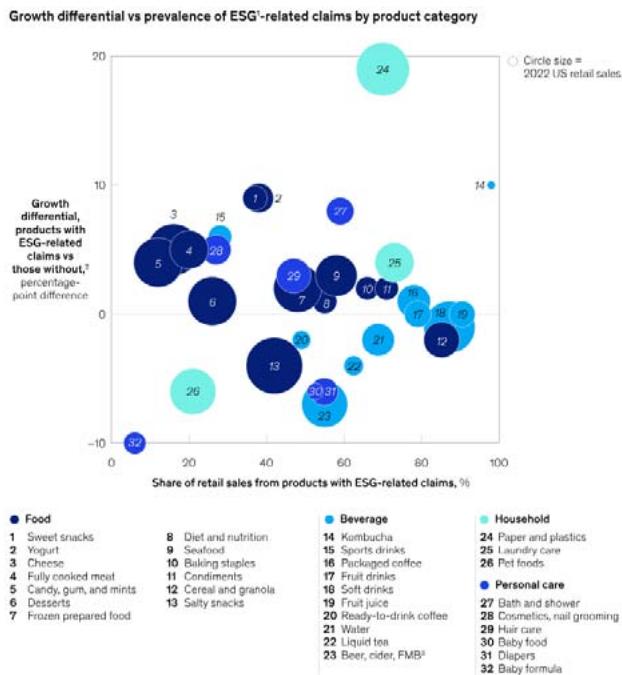 Figure 1: Comparison between products making ESG-related claims and products that do not make ESG-related claims in growth rates and share of US 2022 retail sales. (Mckinsey, 2023)
Consumers are not only environmentally conscious, they are utilizing e-commerce more and more, which will increase demands for warehouse & logistics facilities. The below figure illustrates the ongoing rise of e-commerce (figures are in billion U.S dollars):
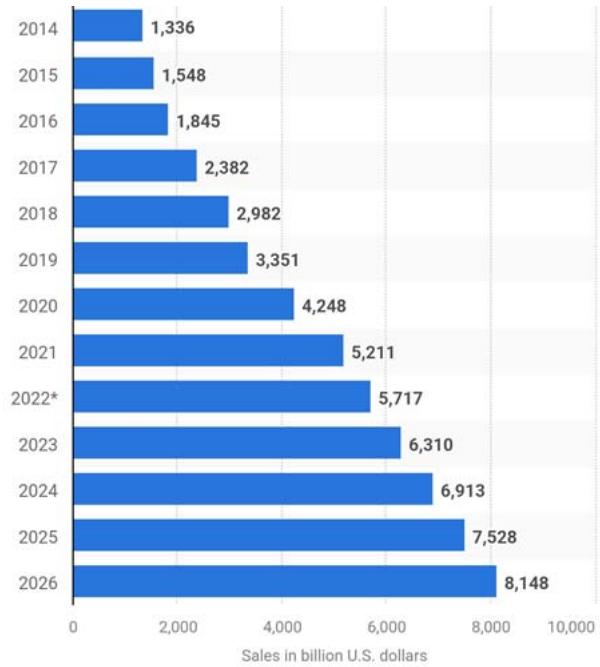 Figure 2: Worldwide retail sales of e-commerce from 2014 to 2026 (Statista, 2022) [3]
Moreover, the world's population is expected to increase from 8 billion to 9.7 in the upcoming 30 years, approximately a 2 billion increase, and could reach as high as 10.4 billion by the mid-2080s [4].
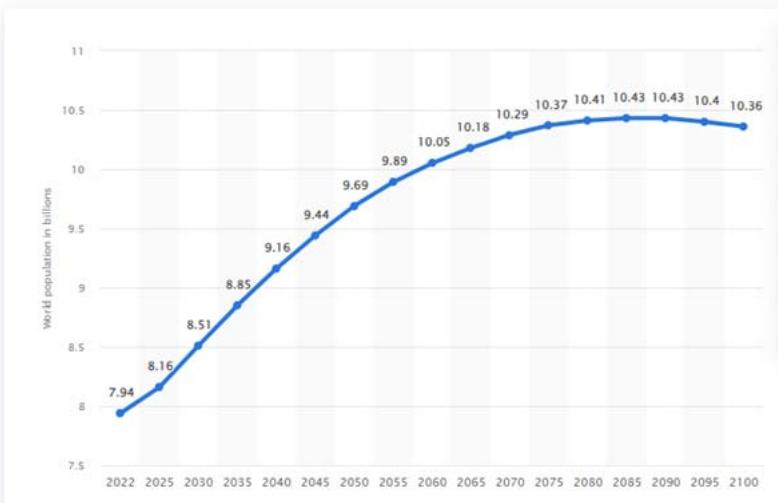 Figure 3: Development of the world's population from 2022 to 2100. (Statista, 2022) [5]
30% of produced GHGs is stemming from industrial buildings alone, which includes indirect emissions from increased energy consumption and other factors. In addition, warehouses account for a large portion of industrial buildings [6]. In 2021, the warehousing and storage industry consumed nearly a quarter of total electricity consumption in the US, when combining direct and indirect emissions [7]. The implication here is that the warehouse sector is the largest GHG emitter in the US economy, comprising 29.6% of total emissions [8]. The demand for them will go up due to increased population numbers and utilization of e-commerce, as mentioned before. It is imperative for companies to address these increasing demands, while fulfilling their ESG responsibilities.
In the upcoming section, the paper will compare the currently implemented measures in an oil and gas company with the proposed solutions, with a suggested path forward for the company to take to address any identified gaps.
## II. MEASURES TO REDUCE ENERGY CONSUMPTION IN AN EXISTING WAREHOUSE & LOGISTICS FACILITIES
In this section, the paper will illustrate a number of measures to be taken to reduce energy consumption in warehouses, specifically warehouses already in operation. Note that the following is not inclusive of all possible ways to reduce energy consumption, as advancements in technologies may offer more or better ways to be adopted in the future. However, this does not mean that these measures should be ignored.
### a) Adjusting the Lighting System
## i. Adopting an LED Lighting System
Warehouse & logistics facilities need a lot of artificial lighting to function, as lighting is of the main energy-using systems in non-refrigerated warehouses [9]. So, the choice of which type of lighting to utilize to operate warehouse & logistics facilities is a crucial one in terms of energy consumption and GHG emissions. The best choice for these facilities is to adopt an LED lighting system, as it is the most efficient in terms of energy efficiency and light control, as LED lights have shorter switching times, more efficient dimming techniques, and higher light intensity when compared to traditional lighting systems (e.g. incandescent bulbs and fluorescent lamps). Moreover, they emit less heat than traditional lighting systems [10]. In fact, in warehouse & logistics facilities, studies have found that we can reduce their electricity costs by $75\%$ by switching to LED lights and taking measures to control heat [9]. The following figures highlight a number of differences between LED light bulbs and traditional light bulbs \[11\]:
Figure 4: A comparison between LED lights and traditional light bulbs (Washington University in St. Louis, 2020)
<table><tr><td>LED</td><td>CFL</td><td>Incandescent</td></tr><tr><td>Avg Life: 25,000 Hrs</td><td>Avg Life: 8,000 Hrs</td><td>Avg Life: 1,200 Hrs</td></tr><tr><td>No Mercury</td><td>Mercury</td><td>No Mercury</td></tr><tr><td>6-8 Watts</td><td>13-15 Watts</td><td>60 Watts</td></tr><tr><td>Uses 84% less energy</td><td>Uses 75% less energy</td><td>90% energy lost to heat</td></tr></table>
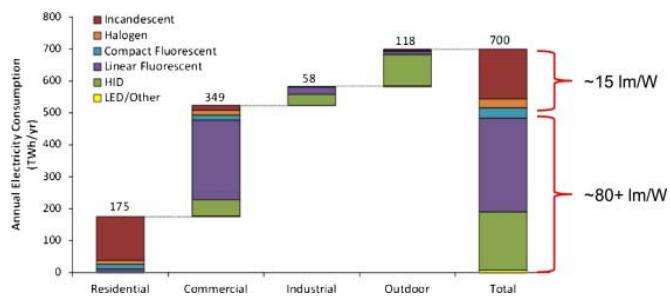 Figure 5: Light sources used in different sectors and their distribution of total energy consumption. (Marc Fontoynont, 2018) [12]
## ii. Installing a Photovoltaic System with Light Sensors
If the geographical location is rich with natural light, an organization can enhance their lighting system by installing light sensors bundled with a photovoltaic system, where during natural light abundant times of the day, the system turns off the light source since it is already covered by natural light [13].
### b) Temperature Control
As mentioned in section 2.1, heat is also a huge contributor in high electricity costs in warehouse & logistics facilities. Due to the nature of warehousing activities (such as receiving and issuing), temperature in a warehouse is volatile, with the constant flow materials going in and out, plus personnel going in and out of the warehouse, especially in high temperature or humidity areas [14].
## i. Partition between Areas Inside Warehouses with Different Temperatures
To control the temperature and make it more consistent, install in warehouses doors that open and close quickly[15], and to achieve higher effectiveness, the doors should be automated with no human interaction needed to achieve higher degrees of temperature control [16].
## ii. Insulation
Even if the temperature is mitigated with isolation efforts suggested in 2.2.1, the insulation of a warehouse plays a huge role in temperature control, so it is not enough to invest in isolation measures to control the temperature. Companies should install heavy and thick insulation to enhance temperature control inside a warehouse & logistics facility [17]. This will also reduce the energy required for constantly adjusting the temperature [14].
## iii. Installing Smart Sensors for HVAC Systems
To improve temperature control efficiency, installing a smart temperature control system in a facility, instead of the traditional thermostat On/Off control model will further stabilize the temperature in the warehouse & logistics facility, and in turn will reduce energy consumption.
A study has simulated the traditional heating control method energy with three thermal control algorithms to compare each method's EUI (Energy Use Intensity). Due to its clarity and intuitiveness, Energy analysts compare building energy performances using the EUI indicator, as it is intuitive and clear. Fig 6 and Fig 7 illustrate the study's findings \[9\]:
<table><tr><td>No.</td><td>Model</td><td>Component</td></tr><tr><td>1</td><td>Thermostat On/Off (On/Off)</td><td>On/Off controller, PMV signal modifier</td></tr><tr><td>2</td><td>Fuzzy Inference System (FIS)</td><td>Damper angle controller, resistance coil, PMV signal modifier</td></tr><tr><td>3</td><td>Artificial Neural Network (ANN)</td><td>Damper angle controller, resistance coil, PMV signal modifier</td></tr><tr><td>4</td><td>Artificial Neural Network with 2 steps PMV signal modifier (ANNd)</td><td>Damper angle controller, resistance coil, 2 steps PMV signal modifier</td></tr></table>
Figure 5: Each model and its components (Park et al. 2018)
<table><tr><td rowspan="2">No.</td><td rowspan="2">Controller</td><td colspan="3">Annual Energy Use (GJ)</td><td rowspan="2">EUI(kWh/m2·yr)</td></tr><tr><td>Cooling</td><td>Heating</td><td>Total</td></tr><tr><td>1</td><td>On/Off</td><td>339.2</td><td>482.3</td><td>821.5</td><td>115.4</td></tr><tr><td>2</td><td>FIS</td><td>372.5</td><td>810.7</td><td>1183.2</td><td>166.2</td></tr><tr><td>3</td><td>ANN</td><td>331.2</td><td>479.7</td><td>810.9</td><td>113.9</td></tr><tr><td>4</td><td>ANNd</td><td>321.7</td><td>447.1</td><td>768.9</td><td>108.0</td></tr></table>
Figure 6: Each model and its EUI (Park et al. 2018) As showcased in, the fourth model has the least EUI, with $6.7\%$ less than the ON/Off model [9]. While this $6.7\%$ might seem insignificant, pairing this effort with the other proposes measures will yield great results, especially when you scale up your operations.
### c) Energy Efficient Handling and Storage Equipment
In warehouse & logistic facilities, various equipment is needed to perform its main functions, which depends on the type of material stored in these facilities. These MHEs (material handling equipment) range from forklifts and its types, among other MHEs. Historically, these MHEs are powered through gasoline or other similar fuel, both which emit of GHGs.
To offset this, companies need to invest in LIB (Lithium-ion battery) MHEs to reduce their environmental impact [18]. In doing so, their operations will resume as normal, while they save on energy costs since the batteries will be charged instead of fueling the MHEs with gas or any other type of fuel.
### d) Utilizing Renewable Energy
Depending on the areas' location, renewable energy sources (such as solar, wind or kinetic energy) can be leveraged to decrease electricity costs and lessen GHGs for existing warehouse & logistics facilities, For areas rich with natural sunlight, installing solar panels or solar cell generators is a sound investment to reduce energy costs.
A study has found that solar energy can be used to power the warehouse utilities in the case of solar panels, which can be installed on the roof of a warehouse. The study projected that $60\%$ of the total energy consumption of a facility can be generated by from installing solar cells.
Kinetic energy can also be used in conjunction with automation, but it is very expensive [19], so it will be proposed in the next section.
## III. CONSIDERATIONS FOR FUTURE WAREHOUSE & LOGISTICS FACILITIES
### a) Automation
As mentioned in 2.4, pair kinetic energy with automation for better results. Automatic solution require less heating and lighting, which are two of the biggest energy consumers in warehouse as previously mentioned section 2.1.
According to Lewczuk et al., 2021, the breakdown of actual energy consumption in warehouse & logistics facilities is as follows, with the highest being heating and cooling, and lighting:
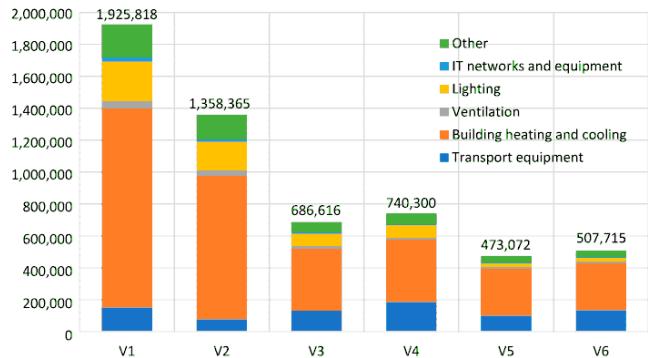 Figure 7: Warehouses end use categories and their energy consumption under different technologies (Variants of warehouses)
If you raise the level of automation, you decrease your dependence on labor, safeguard yourself from crises such pandemics social changes, military conflicts, and so forth, and ensure business continuity.
### b) Mini Containers
Temperature controlled food transport are equipped with vapor compression refrigeration (VCR), and they emit huge amounts of GHGs. Alternative refrigeration technologies can be used to minimize or reduce emissions.
For example, Bagheri et al (2017) [20] recommends replacing fuel (engine) driven refrigerated transport with battery-powered transport, similar to what is discussed in 2.3. With battery-powered transport, weight will be reduced and emissions too.
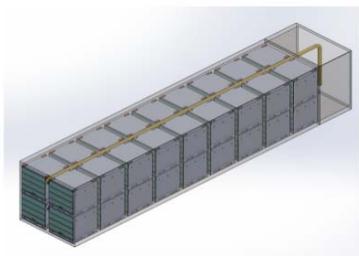
A newer approach is to use MCs (mini containers), as illustrated in fig 8:
 (a)
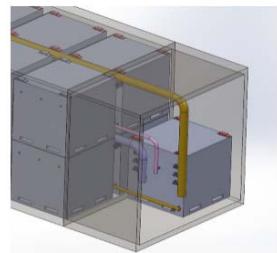 (b) Figure 8: Conceptual design of MCs in a truck, with central driving unit (CDU) shown in (b)
The modular design of the MCs is designed to fit into various types of pick-up vehicles or equipment. In addition, the CDU maintains the required temperature and humidity, which enables companies to mix material or food in the same load, reducing the number of truckloads required to transport items. Overall, there are reductions in the cost, energy consumption, and GHGs emission when compared to using traditional loading methods [19].
### c) Centralized Warehousing
The location of industrial facilities is a significant determinant of their sizes, construction time, and proximity to local markets, seaports, and intermodal terminals. The reason is that the location increases the potential industrial impact on the population. Also, the size of warehouse and logistics facilities indicate their environmental impact, as discussed by Mashudet al. (2022) [21] When developing warehouse & logistics facilities, a large portion of the surrounding natural environment is consumed usually (by Ulucak et al. (2019) [22] and Clayton et al. (2021) [23]. These facilities require a lot of power to operate due to their various machineries and equipment, and this power is extracted from local services and local infrastructure, which they are highly dependent on [19].
The implication here is that the location of a warehouse & logistics facility is strategic, with numerous ESG considerations to take into account, as well as profitability.
## IV. DISCUSSION
The discussion in this paper intends to go in depth in the challenges and factors that existing and future warehouse & logistics facilities will face, from ESG-related concerns and their compliance, and to their organization's bottom line. This section will serve as a platform for further analysis and discussion on the aforementioned factors and more.
# a) Developing Technologies (IoT, Industrial Revolution
Smart systems will undoubtedly significantly benefit from advancements in technologies, with better power savings and energy efficiency. Advancements and higher adoption of Internet of Things, A.I. and machine learning (as part of the Industrial Revolution 4.0) will provide organizations for more opportunities to automate temperature and humidity control, among other benefits.
### b) Investment Opportunities
There are many measures to go about reducing a warehouse & logistics facility's energy consumption or emitted GHGs. From adjusting the lighting system, temperature control, or using renewable energy, organizations might be discouraged or hesitant to invest in these measures.
Depending on the organization's size, investing in these measures might be costly. However, investing in them will net a positive Return on Investment on their operation costs, environmental impact, and consumer goodwill. A holistic investment in all the facilities' factors will generate the most returns. However, as a good starting point, companies should invest in their lighting systems and try to control the temperature of their facilities.
### c) The Role of Automation
Automation will shape the future warehouse & logistics facilities in a major way. Automation will affect operations costs, energy consumption and emitted GHGs. However, the labor force will be disrupted significantly, as we increase the level of automation, the need of some job positions might be diminished or be eliminated entirely. While increasing levels of automation is inevitable, the changes in the labor force is a material issue that needs to approached carefully, as organizations have commitments all relevant shareholders, which include the labor force.
### d) ESG Commitments
The case of reducing energy consumption in warehouse & logistics facilities is clear. Organizations have environmental, social, and government compliance commitments, as well as commitments to their bottom line. Organization who invest in these measures in their future facilities will have lower environmental impact by reducing their emissions, which in turn will satisfy and ever increasing environmentally conscious consumers. Moreover, they have higher probability of converting consumers into loyal or life-long consumers.
With increasing scrutiny and regulations from multiple governments, organizations can protect themselves from increased regulation or litigation, which will decrease their costs. On the operational side, reducing energy consumption will also decrease their operational costs.
Organizations have the opportunity to march into the next transformative period while balancing more than their bottom line, so the balancing act of fulfilling all these commitments will decide the future market leaders.
### e) Centralization or Warehouse Hubs
A lot of natural land and power is required to host warehouse and logistics facilities. Organization have two methods when laying out their facilities' network, having decentralized or centralized facilities. Both methods have their benefits and disadvantages, as with decentralized you have more of a safety net in cases of failure, as opposed in a centralized warehouse, and in some cases have facilities closer to certain customers. Regardless, selecting a strategic location to construct a new centralized facility will have lower energy consumption and emissions, less facilities to operate, and if it is within proximity to an organization's major costumers, it will also reduce transportation costs. When constructing new facilities, it is of high priority to consider having centralized facilities to serve customers and lower organizations emissions. Centralized facilities may also present opportunities to form strategic partnerships within an organization's supply chain.
## V. CONCLUSION
In conclusion, the paper explores some of the available methods and future concepts that aims to reduce energy consumption in warehouse & logistics facilities, whether they are in operation to be constructed. By investing in green initiatives and planning and designing for lower energy consuming facilities, organizations will ensure they are compliant with regulations, enhance their customers relationship, lower their environmental impact, and improve their profits by lowering their operating costs. This paper may be used as preliminary guidelines for organizations to follow in tackling the multitude of challenges facing their facilities from multiple areas, in order to have greener existing or future warehouse & logistics facilities that maximize value for all stakeholders.
Generating HTML Viewer...
References
22 Cites in Article
R Ulucak,I Özturk,A Yücel,E Koçak (2019). Chapter 5 -The Process of Sustainability: From Past to Present.
J Am,V Doshi,S Noble,A Malik (2023). Consumers care about sustainabilityand back it up with their wallets.
S Chevalier (2022). Global retail ecommerce sales 2026.
Fengcheng He (2023). iPhone Sales Prediction Based on Multilinear Regression Model: Evidence from Statista.
Summaira Malik,Fareena Fatima,Asma Imran,Lai Chuah,Jiří Klemeš,Imran Khaliq,Saira Asif,Muhammad Aslam,Farrukh Jamil,Abdullah Durrani,Majid Akbar,Muhammad Shahbaz,Muhammad Usman,A Atabani,Salman Naqvi,Suzana Yusup,Awais Bokhari (2019). Improved project control for sustainable development of construction sector to reduce environment risks.
Sen Huang,Yunyang Ye,Di Wu,Wangda Zuo (2021). An assessment of power flexibility from commercial building cooling systems in the United States.
Shufan Zhang,Minda Ma,Xiwang Xiang,Weiguang Cai,Wei Feng,Zhili Ma (2022). Potential to decarbonize the commercial building operation of the top two emitters by 2060.
Sung-Yong Park,Soolyeon Cho,Jonghoon Ahn (2018). Improving the quality of building spaces that are planned mainly on loads rather than residents: Human comfort and energy savings for warehouses.
Marc Füchtenhans,Eric Grosse,Christoph Glock (2021). Smart lighting systems: state-of-the-art and potential applications in warehouse order picking.
C Steyer (2022). Light Bulbs and Lighting Systems.
M Fontoynont (2018). LED lighting, ultra-low-power lighting schemes for new lighting applications.
Michalene Grebski,Anna Maryniak (2020). Benefits of Installing a Photovoltaic Power-Generation System for a Warehouse Facility.
Nurainaa Elias,Nafrizuan Yahya,Er Sing (2018). Numerical Analysis of Fuzzy Logic Temperature and Humidity Control System in Pharmaceutical Warehouse Using MATLAB Fuzzy Toolbox.
J Kurnitsk,K Ahmed,R Simson,E Sistonen (2016). Temperature distribution and ventilation in large industrial halls.
Ranil Sugathadasa,Deshan Wakkumbura,H Perera,Amila Thibbotuwawa (2021). Analysis of Risk Factors for Temperature-Controlled Warehouses.
Jie Xu,Tao Wu,Wei Sun,Chuang Peng (2017). Characterization of Insulation Performance, Poststability, and Foaming Process of Rigid Polyurethane Sandwich Panel for Cold Storage Warehouse.
Tiziana Modica,Sara Perotti,Marco Melacini (2021). Green Warehousing: Exploration of Organisational Variables Fostering the Adoption of Energy-Efficient Material Handling Equipment.
Konrad Lewczuk,Michał Kłodawski,Paweł Gepner (2021). Energy Consumption in a Distributional Warehouse: A Practical Case Study for Different Warehouse Technologies.
F Bagheri,M Fayazbakhsh,M Bahrami (2017). Real-time performance evaluation and potential GHG reduction in refrigerated trailers.
Abu Mashud,Dipa Roy,Ripon Chakrabortty,Ming-Lang Tseng,Magfura Pervin (2022). An optimum balance among the reduction in ordering cost, product deterioration and carbon emissions: a sustainable green warehouse.
Olakunle Oloruntobi,Kasypi Mokhtar,Norlinda Mohd Rozar,Adel Gohari,Saira Asif,Lai Chuah (2023). Effective technologies and practices for reducing pollution in warehouses - A review.
Jim Clayton,Avis Devine,Rogier Holtermans (2021). Beyond building certification: The impact of environmental interventions on commercial real estate operations.
No ethics committee approval was required for this article type.
Data Availability
Not applicable for this article.
How to Cite This Article
Qassim A. Abahussaien. 1970. \u201cOptimizing Energy Consumption in Warehouse & Logistics Facilities: Measures for Existing and Future Facilities\u201d. Global Journal of Research in Engineering - G: Industrial Engineering GJRE-G Volume 23 (GJRE Volume 23 Issue G2): .
Explore published articles in an immersive Augmented Reality environment. Our platform converts research papers into interactive 3D books, allowing readers to view and interact with content using AR and VR compatible devices.
Your published article is automatically converted into a realistic 3D book. Flip through pages and read research papers in a more engaging and interactive format.
This paper offers a holistic approach in reducing energy consumption in industrial facilities, specifically warehouse & logistics facilities by exploring various ways or methods companies can adopt to reduce their warehouse & logistics facilities energy consumption, environmental impact, and operational expenses. It highlights the importance of why companies should invest in these green initiatives, as it will assist companies in complying with increasing regulations and mandates regarding greenhouse gas emissions (GHG), fulfilling their social responsibility to increasingly environmentally conscious consumers, rising utilization of ecommerce, and rising populations. The demand for these facilities will increase, and companies must be ready to meet this demand carefully, to balance their social responsibilities by reducing their GHGs, and their commitments to their shareholders by maintaining or improving their profit margins. Throughout this paper, measures for existing or in operation warehouse & logistics facilities will be highlighted, and then the paper will propose measures for future warehouse & logistics facilities to be considered to minimize their environmental impact.
Our website is actively being updated, and changes may occur frequently. Please clear your browser cache if needed. For feedback or error reporting, please email [email protected]
Thank you for connecting with us. We will respond to you shortly.