## I. INTRODUCTION
G lamping (Wikipedia Contributors, 2022; Grand View Research, 2022) is now a well-known term to describe the fusion of luxury accommodation with camping for tourists seeking the amenities and services of excellent hotel accommodation along with the escapism and adventure of camping. While the tents or cabins used are, strictly speaking, temporary lodging, they are fitted out to a much higher standard than typical tents and often incorporate air-conditioning, ensuite bathrooms, decks with baths or plunge pools, outdoor rain showers, kitchenettes and other facilities more often associated with high quality hotel rooms. Also, like a traditional hotel, the tents or cabins are kept in place semi-permanently and serially rented to transient guests and are thoroughly cleaned and restocked between visitor stays. This is all very different to the normal camping situation where holidaymakers bring their own tents, assemble and use them during their stay and dismantle and take them away at the end of their holiday.
Glamping is often associated with eco-tourism of various kinds and these properties are typically sited in relatively remote locations where utilities grid connectivity may not be viable. It also works best in temperate and warmer climates with extended periods of stable and drier weather conditions so that a mix of indoor and outdoor living is appropriate. Tent or simple cabin accommodation is usually relatively small and so outdoor space is typically used to expand the living area. In environmentally sensitive areas, tents have the added advantage of requiring minimal site preparation and disturbance, thus maintaining the attractiveness of the location.
Remote glamping is becoming more popular for several important reasons (Grand View Research, 2022). Increasing numbers of tourists are looking for more exotic experiences, and they are willing to pay handsomely for them. There is a relatively large, and growing, group of well educated, socially and environmentally progressive people who are looking for new products and services that offer an authentic experience and real connections with suppliers. These consumers are happy to pay a premium for the right novel experience that gives them opportunities to learn and interact with suppliers. See Honeywell (n.d.), for example.
For efficiency, resilience and other reasons, many communities share infrastructure for electricity generation and distribution, potable water collection and distribution, sewerage collection and treatment and Internet and other communications. These shared resources are generally called utilities grids. They work well when grid participants are close together, but distribution infrastructure costs rise quickly with distance so that this approach is not worthwhile for spread out, lightly populated and remote areas. Thus, in such locations it is usually far more cost effective to provide smaller facilities at the point of use, which is often denoted as being "off-grid."
The regulatory and other hurdles needed to get approval for semi-permanent glamping lodgings are often significantly lower than for comparable traditionally constructed permanent hotels. For instance, the extensive engineering and fire services analysis required for hotel buildings is often minimal for tents. Additionally, the design and construction costs for glamping accommodations are generally much lower than traditional hotel development (Smitherman, 2021). Moreover, glamping properties are very well suited to prefabricated modular construction, which has many advantages for hotel developments in remote locations, e.g., see Whitfield & Noordzy (2022) or Noordzy, Whitfield, Saliot & Ricaute (2021). Specifically, prefabricated modular construction is usually significantly less expensive for the same build quality, far quicker to construct and is much less reliant on the quality and capacity of the local labour force available in remote locations. It also leads to much less site disturbance and onsite waste, which are especially important issues for remote and fragile natural environments. All this means that glamping can be a very cost-effective way to "test the waters" for new vacation concepts in remote locations while simultaneously minimizing their environmental impacts.
The rest of this paper presents a comprehensive financial model for developing and operating typical off-grid glamping properties and explains the logic underpinning its constituent elements. This financial model follows the common approach for evaluating the potential return from an investment, whereby the investments needed to create an asset are put on a timeline along with reasonable estimates of the income and expenses that can be generated by subsequently operating the asset. In this way the Payback Period, Internal Rate of Return and Net Present Value of the potential investment can be estimated to help decide whether or not it is worthwhile to proceed with the venture.
First, the components of a typical off-grid glamping property are described along with how it should be designed and built and the overall structure of the financial model representing it. Then the constituent costs and revenues from subsequently operating the business, are explained including methods for estimating their values. Finally, the model is run for different development and operating scenarios to illustrate the variability in the overall costs and returns and to help identify optimal development strategies for such properties.
## II. THE NATURE OF A TYPICAL OFF-GRID GLAMPING PROPERTY
Based on reviews of public information, see Smitherman (2021) for example, a typical glamping property consists of a bounded and attractively landscaped area holding a well separated collection of individual glamping units that are usually grouped into several clusters to share electricity, water and other services infrastructure and road access. In many cases the property is a natural bushland area or working agricultural property, where the needed access roads and utilities infrastructure are well hidden.
Vehicle access to each unit is usually via a branching access road from the property entrance to each cluster of sites and then to each individual unit. Guest parking may be centralized or distributed to each cluster of sites or, most commonly, to each individual unit. Generally, scattered individual site parking is preferred because it is much less obtrusive and has significantly lower environmental impact. The area normally has some kind of entrance and access control to monitor usage of the property, which may be via a central reception facility near the entrance.
Each glamping unit usually accommodates individual guests, couples, or small families. Site clusters can be for unrelated guests, or they may be group booked by extended families and other groups that want private sleeping arrangements along with a shared communal gathering space. Either way, the sites in clusters are usually well separated for better privacy, but may have communal eating areas and shower blocks.
Accommodation units typically offer a raised platform deck with a large tent or small cabin on it with internal sleeping and sitting spaces that may be heated /air-conditioned. The deck also usually holds seating for an outdoor living space that may be partly covered and incorporate a fire-pit, outdoor bathing and/or other amenities. Individual units may also have attached outdoor kitchens/BBQs, or these may be shared by a cluster of sites. The outdoor kitchen-dining facilities may also be partly covered. Similarly, each unit may have an attached ensuite bathroom or a larger bathroom block may be shared by a cluster of units. These structures are normally designed to minimize site disturbance and are made from "environmentally friendly" materials like canvas and timber. Roads an parking areas are often permeable gravel instead of tarmac.
Furthermore, off-grid glamping properties must usually provide infrastructure for electricity, water, Internet and sewerage and other waste disposal and these may be provided at individual sites or may be shared by site clusters or the whole property. For example, the whole property may have a small solar electricity farm and battery system and then use electric supply cables to distribute the generated power to each cluster and thence to each individual site. Similarly, a reasonable and modern solution for providing Internet and Wi-Fi to each unit is to have a central Starlink (www.starlink.com) ground station that interconnects to a router and a set of Wi-Fi mesh network nodes (Lloyd, 2017) located at each cluster or site to cover the entire property. (The router and mesh network nodes may be interconnected via Ethernet or fibreoptic cabling or Wi-Fi.) For water, there may be a central dam or large water tank with a piping network that distributes water to smaller header tanks for each cluster and then to each unit. Finally, sewerage may be processed at each unit or collected via pipe to property wide or cluster based settling tanks and then onto a leach field or other further processing equipment.
Glamping properties often only offer a relatively small subset of the services provided in traditional hotels. Like traditional hotels they usually have sophisticated online booking and service websites, but they rarely have a conventional reception area or traditional check-in and check-out processes, or even room keys. Guests simply book online and proceed direct to their site on arrival and depart at the end of their stay. They normally carry their own luggage in and dirty laundry out and there are often no clothes washing facilities. Typically, sites are only cleaned and restocked after each guest leaves, and garbage is also normally removed as part of this process. There are rarely any conventional daily hotel room cleaning and turn down services. If guests need special or extra items, they are typically ordered via the property's online systems and specially delivered.
Glamping properties seldom provide traditional hotel meals services. There is rarely a breakfast, lunch or other meals room, or room service meals. Guests are generally expected to dine out or to order takeaway meals or to order in food hampers so they can cook for themselves. There may be nearby restaurants and cafes, but they are usually separate businesses. Similarly, glamping properties rarely incorporate bars or cafes. Typically, each accommodation unit will have a kettle and other kitchenette facilities along with a refrigerator and drinks/snacks locker so that guests can serve themselves.
Finally, glamping properties rarely incorporate a business centre, gym, etc. or other traditional concierge services (although some of these facilities may be nearby, operated as separate businesses). Most often, the property's online systems allow guests to learn about nearby attractions and services and self-book them. Generally, guests are expected to bring any business or other equipment that they need to use during their stay with them and take it away themselves when they leave.
All this means that most glamping properties have minimal facilities beyond guest accommodation, and thus their staffing levels are usually much lower than traditional hotels. For example, assuming a minimum 2-night stay, which is popular for glamping properties, the housekeeping workload is less than half that of a comparable traditional hotel that provides daily room cleaning. Similarly, the glamping property will have no kitchen staff because it does not directly provide any meals.
### a) Designing and Building the Property
Particularly for relatively remote locations, prefabricated modular construction is often the fastest and most cost-effective construction methodology to adopt and it has many well recognized advantages (Jones & Laquidara-Carr, 2020). In this approach, the property is first designed in its entirety in detail with all the structures divided into separately transportable modules. Then while the site is being prepared, the modules for buildings and other structures are prefabricated offsite in factories. The completed modules are finally transported to the prepared site and assembled into position.
Glamping accommodations often consist of large tents or tented cabins which are always prefabricated before being delivered to site for assembly. It is also common industry practice to prefabricate bathroom pods for delivery to site and insertion into hotel buildings. The same approach is becoming common for outdoor BBQs and kitchens and can readily be done for outdoor living spaces. Prefabricated construction for lightweight roofing based on sails is also very common and can also be cost-effective for other kinds of lightweight roofing. While decking is often made in situ there is no difficulty in prefabricating it, and this can lead to significant cost savings and reductions in onsite construction times and wastes.
Renewable electricity generation and storage systems are also inherently prefabricated. Similarly, large water storage tanks, pumps and other water handling equipment are commonly pre-made in pieces in factories and then delivered to site for final assembly. And the same is true for sewerage settling tanks and other processing equipment, and for Internet infrastructure.
Thus, besides access roads, landscaping, and pipe and cable laying for electricity, water, Internet, and sewerage, and possibly dams, there is very little within a glamping project that cannot be prefabricated offsite, delivered and quickly assembled in place. Moreover, there are many cost, construction, speed-to-market, and other benefits in adopting this approach. And it does not limit design creativity or flexibility and enforces the adoption of good project management practices and minimizes onsite land disturbance and construction wastes.
Therefore, prefabricated modular construction is unarguably the best way to design and build remote, off-grid glamping properties and the financial model being developed here assumes that it is adopted for building the entire property which we divide into three major stages:
- Property design and construction preparation – including overall project management, land acquisition, detailed design of all the facilities and infrastructure, licensing and regulatory approvals and selection and contract negotiations with all onsite and offsite construction partners.
- Site Preparation - Including overall property landscaping, access roads and parking areas, deck and building pads and foundation piles, electricity, water, Internet, sewerage and other waste distribution and collection piping and cabling and property fencing, fire and flood mitigation structures and other security arrangements.
- Prefabricated Module Manufacturing, Transportation, and Installation - Including modules for electricity generation and storage, water collection, storage, pumping and purification, Internet equipment, sewerage treatment, site cluster shared kitchen, bathroom, outdoor living interior design and fit-out and provision of other facilities and site-specific individual accommodation, kitchen, bathroom and outdoor living and other spaces, as well as some form of reception area.
Adopting prefabricated modular construction means that the entire property must be designed in fine detail before any actual construction work commences. Suppliers cannot bid to prepare the location and make the modules to be delivered and assembled there until they know exactly what is to be built and how the site preparation works will inter-connect with the building modules. As an added benefit, combining all this leads to good project management with few late-stage design changes or other development "surprises" or delays.
### b) Estimating the Infrastructure Capacity Needed
Off grid properties are unusual in that utility's infrastructure must be incorporated within the development. This is not usually a separate major consideration for traditional "on grid" hotel development.
When providing infrastructure for electricity, water, sewerage, and Internet both peak and average demand must always be considered. Luckily, when the central, cluster and site facilities are designed for a new off-grid glamping property, the infrastructure consumption loads are important and well known considerations and so peak and average values for each will emerge during the design process and will be available well before any actual construction work begins.
For environmental and cost reasons, new glamping properties should always try to use renewable electricity generation technologies. These must all generally be combined with batteries for electricity storage because they can only intermittently generate power, e.g., photovoltaic panels only work during the daytime and wind generators only work in suitable weather conditions.
The necessary renewable electricity generating capacity is then simply the sum of the average loads from all of the facilities to be put in place multiplied by a safety factor. Our financial model uses a safety factor of two, but this can be easily changed. In the authors' view this safety factor is more than adequate to provide power to recharge the electricity storage system while simultaneously satisfying all the ongoing electrical loads from the property. Transient peak loads, which nearly always occur at different times for different clusters of sites, can be readily handled by drawing additional power from the batteries as needed.
Our financial model further assumes that it is prudent to design the electrical system so that the batteries have the capacity to store two full days of average electricity consumption for the whole property, but this value can also be easily changed. If it ever becomes necessary, a portable fossil fuel powered generator can be used in emergencies to supplement the renewable energy generation equipment.
Similarly, as part of the facilities design, water consumption and storage values will be specified. Generally, water is only consumed by guests, and wastes are only produced by them. Guest water allocations generally include the water consumed for drinking, washing and handling wastes. Finally, Internet connectivity costs are generally fixed overheads and normally charges are set according to peak data transfer rates with little consumption variability. Again, guests are the primary Internet users, and it is typical to give guests a fixed allocation. Based on the total guest capacity of the property, computer vendors can advise on the total Internet connectivity capacity needed and the associated costs. Like electricity, all of these are also well-known considerations that will emerge as part of the property design.
Luckily, renewable electricity systems are relatively low maintenance and are already popular for remote locations so that maintenance and repair expertise is usually readily available. The same can be said for water, Internet and sewerage treatment infrastructure. Nonetheless, the local availability of expertise in these fields is an important question to be answered during the feasibility analysis for any new glamping property.
### c) The Financial Model
The financial model for off-grid glamping properties that is presented here is divided into three parts, as shown in Figure 1. First, it incorporates a flexible definition of the proposed property that considers access roads, the placement of centralized electricity, water, Internet, and sewerage treatment facilities, along with the positions of glamping site clusters and the individual units within each cluster. It also considers the phasing of the overall development of the property. Entrepreneurs wanting to use the model need to fully define the property they wish to develop.
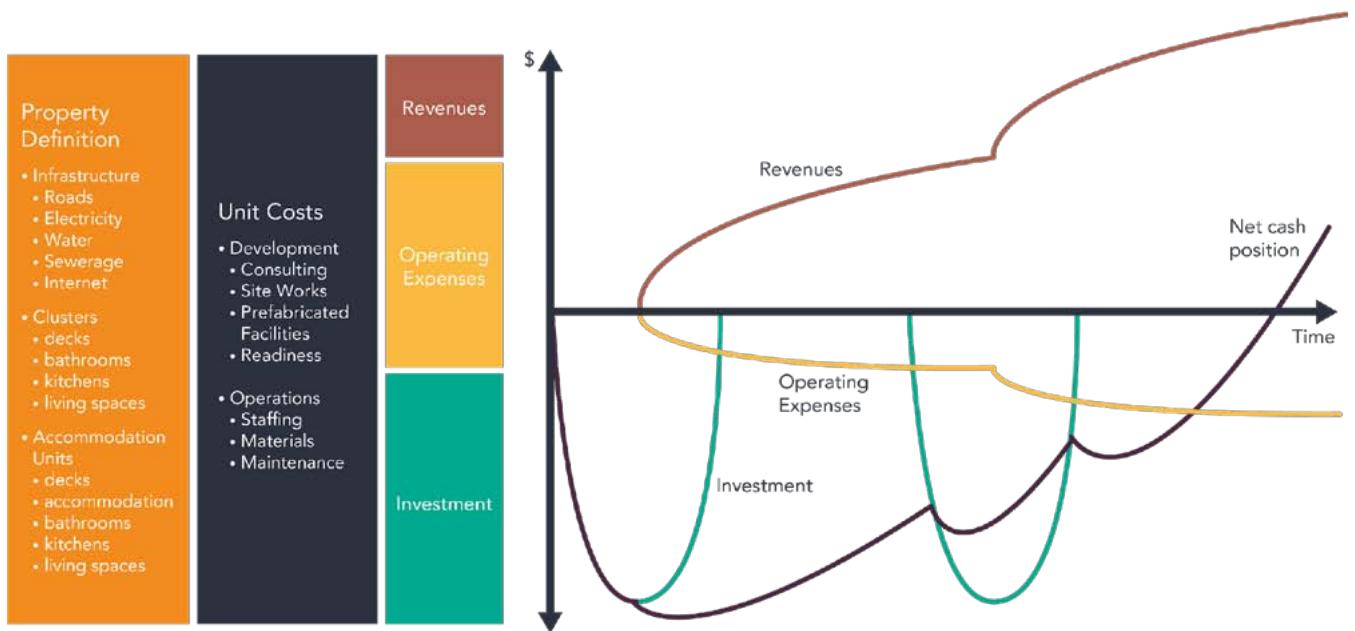 Figure 1: Off-grid Glamping Property Financial Model
For each phase of the property development, the property definition part of the financial model describes the centralized facilities and the clusters of accommodation units and the individual units within each cluster that are to be built. Entrepreneurs and their advisors can often define the design for their proposed property simply using a map to decide the best locations for access roads, centralized utilities infrastructure, and clusters of glamping accommodation units and deciding the best sequential phases to use for building them.
Second, the model considers unit costs for developing and operating the property based on local circumstances. Entrepreneurs using the model can ask advisors and potential suppliers for values for each of the property's development and operating costs. Generally, these correspond to items in the property description. For example, in Germany in 2022, based on surveys, the median installed cost for electricity storage battery systems bigger than 10kWh was about AU$ 1,300 (€870) per kWh (Lichner, 2022).
Third, the model estimates the 10-year investment and operating costs and returns for a proposed property for both optimistic and pessimistic operating scenarios and for different ways of phasing the development. Modern, well-made glamping tents often have a 10 year, or even longer, economic life, although some furniture and fittings may need more
frequent replacement. Three development phasing scenarios are considered: (1) build the entire property at the beginning, (2) build the property in two halves, one at the beginning (year 0) and the other at year 5, and (3) build the property in three equal phases, at years 0, 4 and 8. It also considers optimistic and pessimistic occupancy growth, i.e. patronage gradually rising to meet projected occupancy targets over 2 years and 4 years, respectively. It summarizes the estimated investment, operating expenses and income profile for these scenarios and determines estimates for the maximum investment that must be financed and the IRR (Internal Rate of Return) for this investment. The financial modelling duration and development phasing can be changed in the model.
As illustrated by the graphs in Figure 1, once all the investments, revenues and costs are reasonably estimated, it is a simple matter to model the movements of money into and out of the venture over time. The graph in Figure 1 shows these cashflows over time. The estimated investments made to build property phases are shown in red, and revenues are shown in green and operating expenses are in yellow, and finally, the net cash position is shown in black. For any given point in time, the investment made to establish the venture, less the profit accruing after subtracting the subsequent operating costs from the corresponding operating revenues, gives the net cash the entrepreneur still has in
the business. For a venture to be worthwhile, entrepreneurs should recoup their entire investment within a reasonable payback period and thereafter the venture should generate an acceptable free cash flow that can continue to be withdrawn.
## III. MODELLING A PROPOSED OFF-GRID GLAMPING PROPERTY
Following Noordzy and Whitfield (2021), the development of a new hotel can be divided into Conceptualization, Delivery and Operations stages. During Conceptualization, the nature of the property is defined, and the financial and other aspects of its viability are evaluated to decide whether the venture should move forward. Then, the resources needed to develop the property are assembled and it is designed and constructed and made ready to accept guests during the Delivery stage. Finally, once it is fully ready, the property begins operating. A glamping property is not dissimilar to a hotel, in terms of planning and development, but here we refactor this development process to first consider the issue of managing the overall project, followed by conceptualising, and designing the property and then building it and preparing it to accept guests and, finally, modelling its ongoing operations. This refactoring is useful when adopting modular construction for the venture because this building methodology demands more "up front" design effort. It also makes the costs for managing the overall project more explicit and easier to quantify.
### a) Project Management and Coordination
Generally, along with others, Noordzy & Whitfield (2021) strongly recommend appointing an experienced and competent project manager at the very beginning of every new hotel development project. The project includes settling on the land, conceptualizing, and designing the property and getting operating licenses and approvals, building everything, recruiting staff, and ensuring all technical, operational and commercial systems and supplier relationships are in place to handle paying guests and finally launching business operations. Managing the project generally involves setting up and overseeing and coordinating the work of many specialist consultants and suppliers.
The work effort to project manage a new hotel development is typically proportional to the scale of the property and in the authors experience it may cost $1\% - 3\%$ of the total project investment. As well as general project management, there will normally be various specialist consultants involved in different aspects and stages of the project. This includes consulting for things like, market analyses to estimate customer demand, interior design and landscaping, engineering for electricity, water and sewerage, website and accounting systems design and the development of staffing plans and standard operating procedures and staff training.
As noted in Table 1 below, this specialist consulting can generally be grouped as relating to the architecture, engineering and actual operation of the property. This is no different for an off-grid glamping property and the financial model developed here assumes that this is the case, as set out in Table 1. The specific proportional project management and coordination cost can be easily adjusted in the financial model. Table 1 sets the total project management and consulting fees at $10\%$ of the total project value. Realistically, there is a minimum viable cost for this work so that the percentage cost may be much higher for very small glamping projects, say those with fewer than 5 accommodation units. This is because project management and consulting costs are relatively insensitive to the scale of the project and so they consume a larger percentage of the overall costs for smaller projects.
A further issue that must be addressed for a proposed glamping property is the land. Much of the detailed conceptualization and design for the property will highly depend on its specific location. Therefore, the developer must secure the rights to use the land within which the glamping property will be located, before moving forward with any detailed design and other work. This will mean purchasing or leasing the land, or at least securing an option on it at the very beginning. It also means getting at least "in principle" agreement that a glamping property is a suitable use for the land from the appropriate authorities. This is the same as for any traditional hotel development but may be easier because a glamping property may be viewed as being more "temporary." For instance, in Australia the government sets permissible land uses, including where accommodation can be put. Generally, these rules are much more flexible for "temporary" accommodation. It should be noted that changing the permitted land use for a given property can be a long drawn out and expensive legal process, if it can be done at all. Thus, whether a proposed glamping property will be permitted on the chosen land must be clarified at the very beginning to reduce the risk of wasted planning and design efforts.
Finally, in projects it is always prudent to budget for a contingency amount, only to be used if unforeseen problems arise (and they very often do).
Table 1: Glamping Development Project Management, Acquisition and Related Costs
<table><tr><td>General Project Management</td><td>(%age of project value)</td><td>3,00%</td><td>Land Purchases</td><td>$</td><td>$200 000,00</td></tr><tr><td></td><td></td><td></td><td>Hotel licensing</td><td>$</td><td>$50 000,00</td></tr><tr><td>Architectural Consulting</td><td>(%age of project value)</td><td>3,00%</td><td></td><td></td><td></td></tr><tr><td>Engineering Consulting</td><td>(%age of project value)</td><td>2,00%</td><td>Project Contingency</td><td>%</td><td>1,00%</td></tr><tr><td>Hotel Consulting</td><td>(%age of project value)</td><td>2,00%</td><td></td><td></td><td></td></tr><tr><td></td><td>TOTAL CONSULTING</td><td>10,00%</td><td></td><td></td><td></td></tr></table>
### b) Conceptualization and Design
Table 2 below identifies the information needed to define an off-grid glamping property for use in the financial model being presented here. Entrepreneurs should complete the information for their proposed property with advice from their chosen consultants and suppliers. Table 2 presupposes that the property comprises of clusters of glamping units branching from a single access road. Moreover, each unit may incorporate a deck with an accommodation tent/cabin, along with a bathroom and outdoor kitchen-dining and
living areas that may be covered. Each cluster of accommodation units may also share a larger bathroom block, deck and outdoor kitchen-dining and living spaces, which may be covered. Also, there may be centralized utilities infrastructure for electricity, water, Internet, and sewerage with sub-facilities at each cluster. Finally, the whole property may be developed in several phases, i.e., an initial phase may be built and opened first, with subsequent phases being built later in line with guest demand growth.
Table 2: Definition of the Off-grid Glamping Property
<table><tr><td colspan="2">Phase 0 - initial development
Implementation year
Central Infrastructure</td></tr><tr><td>Main Access Road (m)</td><td>length shared by all campsite clusters and central facilities</td></tr><tr><td>Electricity Spur Road (m)</td><td>length from the main access road</td></tr><tr><td>Electricity Generating Capacity (kW)</td><td>needed to service average demand</td></tr><tr><td>Electricity Storage Capacity (kWh)</td><td>Needed to service overnight demand</td></tr><tr><td>Water Spur Road (m)</td><td>length from the main access road</td></tr><tr><td>Water Storage Capacity (kl)</td><td>kl</td></tr><tr><td>Sewer Spur Road (m)</td><td>length from the main access road</td></tr><tr><td>Sewer Processing Capacity (kl)</td><td>to service maximum demand</td></tr><tr><td>Internet Spur Road (m)</td><td>length from the main access road</td></tr><tr><td>Internet Capacity (MB/s)</td><td>to service maximum demand</td></tr><tr><td>Number of Clusters</td><td>Count of the Clusters</td></tr><tr><td>Site Cluster A</td><td></td></tr><tr><td>Cluster Spur Road (m)</td><td>length shared by all sites in the cluster (m)</td></tr><tr><td>Cluster Parking Spaces</td><td>Number</td></tr><tr><td>Cluster Electric infrastructure ($)</td><td>Electric cabling and other equipment; central facility to cluster</td></tr><tr><td>Cluster Water Infrastructure ($)</td><td>Water piping, tanks and other equipment; central facility to cluster (m)</td></tr><tr><td>Cluster Sewer Infrastructure ($)</td><td>Sewer piping, tanks and other equipment; cluster to central facility (m)</td></tr><tr><td>Cluster Internet Infrastructure ($)</td><td>Internet cabling and other equipment; central facility to cluster (m)</td></tr><tr><td>Cluster Deck Area</td><td>Area (m2)</td></tr><tr><td>Bathroom Block (Quality Level)</td><td>Cluster Bathroom Block Level ID</td></tr><tr><td>Outdoor Kitchen (quality level)</td><td>Cluster Kitchen Level ID</td></tr><tr><td>Kitchen Roof (m2)</td><td>Cluster Kitchen Roof area (m2)</td></tr><tr><td>Outdoor Living Space (Quality ID)</td><td>Cluster Outdoor Living Space Level ID</td></tr><tr><td>Outdoor Living Space Roof (m2)</td><td>Cluster Outdoor Living Space Roof area (m2)</td></tr><tr><td>Number of Accommodation</td><td>Count of the Accommodation Units Within the Cluster</td></tr><tr><td>Site A.1</td><td></td></tr><tr><td>Maximum Occupants</td><td></td></tr><tr><td>Site Finger Road</td><td>private length from cluster to site (m)</td></tr><tr><td>Site Parking Spaces</td><td>number</td></tr><tr><td>Site Electric infrastructure</td><td>Electric cabling and other equipment; cluster to site (m)</td></tr><tr><td>Site Water Infrastructure</td><td>Water piping, tanks and other equipment; cluster to site (m)</td></tr><tr><td>Site Sewer Infrastructure</td><td>Sewer piping, tanks and other equipment; site to cluster (m)</td></tr><tr><td>Site Internet Infrastructure</td><td>Internet cabling and other equipment; cluster to site (m)</td></tr><tr><td>Site Deck Area (m2)</td><td></td></tr><tr><td>Tent Area (m2)</td><td></td></tr><tr><td>Bathroom Pod (Quality Level)</td><td>Bathroom Level ID</td></tr><tr><td>Outdoor Kitchen (quality level)</td><td>Kitchen Level ID</td></tr><tr><td>Kitchen Roof (m2)</td><td></td></tr><tr><td>Outdoor Living Space (Quality ID)</td><td>Living Space Level ID</td></tr><tr><td>Outdoor Living Space Roof (m2)</td><td></td></tr><tr><td colspan="2">The same information above is repeated for every site in the Cluster</td></tr><tr><td colspan="2">The same information above is repeated for every Cluster in the development phase</td></tr></table>
Once the specific location for the proposed property has been decided and a suitable team of advisors and suppliers has been chosen, it is not difficult to conceptualize and define the property based on Table 2. As well as experts in architecture and hotel operations, advice from experts in several other fields is needed, including road builders, cable and pipe laying contractors, utilities infrastructure suppliers for electricity, water, Internet and sewerage, and manufacturers and installers of prefabricated decking and roofing, tents/cabin, outdoor kitchens and living spaces and bathroom facilities.
While the actual construction of the glamping units may be spread over time, it is far more efficient to plan the overall property and carry out the detailed design of all the clusters of units at the beginning. It is a well-known maxim of project management that good and thorough initial planning is the best way to prevent future problems in project execution, which are the
source of many time and cost overruns; in the building industry, prevention is generally far less expensive than rectification work.
Once the conceptual arrangement of the finished property features and facilities have been settled, the detailed design and costing for everything must also be estimated, as set out in Tables 3 (a), (b) and (c). These tables divide the unit costs for constructing the property into three major parts - land formation and utilities distribution (part a), utilities equipment (part b) and guest facilities (part c).
Land formation and utilities distribution includes building all roads and pathways and landscaping, area clearing and constructing building and deck foundations and laying any needed electrical and Internet cabling, water and sewerage piping and, possibly, dams. Generally, these are all priced on a unit distance, area or volume basis as noted in Table 3 (a).
Table 3 (a): Property Unit Construction Costs - Land Formation and Utilities Distribution
<table><tr><td>Roads</td><td>$/m</td><td>$5.00</td><td>$4.00</td><td>$3.00</td><td></td><td></td><td></td><td rowspan="3">Making roads and ancillary works, including cable/pipe layingMain = main road running through the propertyBranch = minor road branching from the main road to a cluster of sitesSpur = small road within a cluster to an individual site</td></tr><tr><td>Electric Cabling</td><td>$/m</td><td>$2.00</td><td>$2.00</td><td>$2.00</td><td></td><td></td><td></td></tr><tr><td>Internet Cabling</td><td>$/m</td><td>$1.00</td><td>$1.00</td><td>$1.00</td><td></td><td></td><td></td></tr><tr><td>Water piping</td><td>$/m</td><td>$2.00</td><td>$2.00</td><td>$2.00</td><td></td><td></td><td></td><td rowspan="5">Landscaping & clearing, piling, utilities distribution interconnectsNA = No facilitiescluster, no amenitiesXS = extra small size site/ cluster4-person site, no amenitiesS = small site/cluster2-person site, full amenitiesM = medium site/cluster4-person site, full amenitiesL = large site/clustercluster, full amenities</td></tr><tr><td>Sewer piping</td><td>$/m</td><td>$3.00</td><td>$3.00</td><td>$3.00</td><td></td><td></td><td></td></tr><tr><td>Dams</td><td>$/MI</td><td>$10,000.00</td><td>$15,000.00</td><td>$20,000.00</td><td></td><td></td><td></td></tr><tr><td></td><td></td><td>NA</td><td>XS</td><td>S</td><td>M</td><td>L</td><td>XL</td></tr><tr><td>Preparing a site</td><td>$</td><td>$0.00</td><td>$1,000.00</td><td>$2,000.00</td><td>$3,000.00</td><td>$5,000.00</td><td>$6,000.00</td></tr></table>
As shown in Table 3 (a), our financial model caters for three different levels/kinds of road and cable and pipe networks within the property. This should be more than adequate for most situations, but more categories can be added as needed. Similarly, the model caters for five different kinds of accommodation unit, cluster and other facility foundations based on their size and/or complexity. Again, this should be adequate, but more can be added as needed. Finally, it caters for up to three different kinds of water storage dam, but in many cases no new dams will be needed for the venture. Generally, property designers should aim to minimize the different kinds of siteworks needed to simplify the project and streamline the work.
Good utilities vendors can help entrepreneurs to design suitable utilities infrastructure for a given proposed property, as summarized in Table 3 (b). They can propose suitably sized and located equipment for electricity generation and storage. This may be located centrally, or dispersed among clusters of glamping sites, depending on the relative costs of the equipment and distribution cabling. Similarly, they can propose suitably sized water pumping and storage equipment and advise on where it should be located. A key decision for water is whether rainwater is collected and used or if water is purchased from the local government (or equivalent entity) under a rights agreement. Other contractors can advise on capacities and locations for sewerage collection piping and settling tanks and other processing equipment and how it should be dispersed among clusters of glamping sites. Finally, the equipment and cabling to support Internet connectivity and Wi-Fi networking within the property can also be proposed by other suitable suppliers. Generally, suppliers can quote for the provision of utilities infrastructure in terms of unit costs for central, cluster and individual site equipment. All this is summarized in Table 3 (b).
Table 3 (b): Property Unit Construction Costs - Utilities Equipment
<table><tr><td></td><td></td><td>XS</td><td>S</td><td>M</td><td>L</td><td>XL</td><td></td></tr><tr><td>PV Array</td><td>$/kW</td><td>$ 3,000.00</td><td>$ 2,500.00</td><td>$ 2,000.00</td><td>$ 1,750.00</td><td>$ 1,500.00</td><td>Making roads and ancillary works. including cable/pipe laying</td></tr><tr><td>Battery</td><td>$/kWh</td><td>$ 3,000.00</td><td>$ 2,500.00</td><td>$ 2,000.00</td><td>$ 1,750.00</td><td>$ 1,500.00</td><td>Main = main road running through the property</td></tr><tr><td>Water tank</td><td>$/kl</td><td>$ 0.00</td><td>$ 3,000.00</td><td>$ 2,000.00</td><td>$ 1,000.00</td><td>$ 0.00</td><td>Branch = minor road branching from the main road to a cluster of sites</td></tr><tr><td>Sewer Settling Tank</td><td>$/kl</td><td>$ 0.00</td><td>$ 6.00</td><td>$ 0.00</td><td>$ 0.00</td><td>$ 0.00</td><td rowspan="4">Spur = small road within a cluster to an individual site</td></tr><tr><td>Sewerage Processor</td><td>$/kl</td><td>$ 0.00</td><td>$ 8.00</td><td>$ 0.00</td><td>$ 0.00</td><td>$ 0.00</td></tr><tr><td>Internet Groundstation</td><td>$/kl</td><td>$ 0.00</td><td>$ 3,000.00</td><td>$ 0.00</td><td>$ 6,000.00</td><td>$ 0.00</td></tr><tr><td>Internet Mesh Node</td><td>$/kl</td><td>$ 0.00</td><td>$ 750.00</td><td>$ 1,000.00</td><td>$ 1,250.00</td><td>$ 0.00</td></tr></table>
Generally, everything except the onsite preparation works will be fabricated offsite and then delivered, installed and commissioned by the different suppliers as part of constructing the property.
Table 3 (b) explains how our financial model caters for five different capacity "bundles" for each kind of utilities equipment. These can be distributed around the property as needed at central locations or at different sites and clusters. For example, it may be that a hierarchy of electricity storage batteries is the most appropriate design choice, with a large central battery linked to mid-size batteries at each cluster and small batteries at each individual site. Again, five bundles for each different kind of utility equipment should be more than adequate for most properties, but more can be added as needed.
The final group of prefabricated modular construction suppliers make the different guest facilities offsite and then deliver, install, and commission them, as outlined in Table 3 (c). The different guest facilities include (1) decks, (2) roofing, (3) tents/cabin, (4) bathrooms, (5) outdoor kitchen/dining spaces and (6) outdoor living spaces, which may be provided by several different suppliers. Each of these facilities may be specific to a single glamping unit or for the guests staying in a cluster of units e.g., each unit may have an individual bathroom, or a single cluster-wide bathroom block may be shared by all the guests staying at the accommodation units within the cluster. The split between unit and cluster facilities must be decided as part of the property design. Moreover, to increase manufacturing efficiency and for other reasons, it is normal to settle on a few different specific designs for each kind of guest facility and repeatedly use them in different parts of the property. Furthermore, for simplicity and efficiency it is also normal to specify fully fitted out facilities that include all furniture and fixtures and equipment. Suppliers will typically quote separate pricing for the manufacturing, delivery, and installation of each different guest facility design.
Table 3 (c): Property Unit Construction Costs - Guest Facilities
<table><tr><td></td><td></td><td>XS</td><td>S</td><td>M</td><td>L</td><td>XL</td><td></td></tr><tr><td>Deck</td><td>$/m2</td><td>$ 300.00</td><td>$ 275.00</td><td>$ 250.00</td><td>$ 225.00</td><td>$ 200.00</td><td>Guest Facility "bundles"</td></tr><tr><td>Roof</td><td>$/m2</td><td>$ 2,000.00</td><td>$ 1,750.00</td><td>$ 1,500.00</td><td>$ 1,250.00</td><td>$ 1,000.00</td><td>XS = extra small sizeS = small size</td></tr><tr><td>Tent</td><td>$</td><td>$ 0.00</td><td>$ 2,000.00</td><td>$ 1,500.00</td><td>$ 0.00</td><td>$ 0.00</td><td rowspan="4">M = medium sizeL = large sizeXL = extra large size</td></tr><tr><td>Bathroom</td><td>$</td><td>$ 0.00</td><td>$ 1,250.00</td><td>$ 1,000.00</td><td>$ 750.00</td><td>$ 0.00</td></tr><tr><td>Outdoor Kitchen</td><td>$</td><td>$ 0.00</td><td>$ 1,250.00</td><td>$ 1,000.00</td><td>$ 750.00</td><td>$ 0.00</td></tr><tr><td>Outdoor Livingroom</td><td>$</td><td>$ 0.00</td><td>$ 600.00</td><td>$ 500.00</td><td>$ 400.00</td><td>$ 0.00</td></tr></table>
Again, as shown in Table 3 (c), five different size/quality "bundles" for each different kind of guest facility are catered for in our financial model, but more can be added if needed. As an example, it is easy to think of a small, simple bathroom pod for a 2-person unit and a larger, more extravagant bathroom block to be shared by up to ten guests staying in three clustered units.
When working with module manufacturers for prefabricated modular construction, it is essential that you select reliable and experienced partners (Noordzy, Whitfield, Saliot & Ricaute, 2021; Whitfield & Noordzy, 2022). Prototype modules should first be made and evaluated, and then volume production should be closely monitored to ensure that the agreed delivery schedules are met. Also, the working of each individual module should be thoroughly tested before it is released for shipment to the project location. Normally, final onsite assembly and testing should also be included as part of the price paid to the supplier(s). All of this can be incorporated in the contractual arrangements with the module manufacturers. In this way off-grid glamping properties will include arrangements with several different module suppliers, and their work must be coordinated.
Once suitable suppliers have been selected and they have all collaboratively worked out the detailed design of all the onsite works and the prefabricated offsite works, the preceding Tables 3 (a), (b) and (c) can be fully completed and the total cost to construct the property can be simply calculated.
Next, the effort needed to prepare the property to accept paying guests can be estimated, as outlined in Table 4. Traditionally, in hotel development this is ensuring that the fully constructed property is technically, operationally, and commercially ready to accept paying guests.
Table 4: Property Readiness Costs
<table><tr><td colspan="6">Technical Readiness</td></tr><tr><td>Contingency</td><td></td><td>%age of total project cost</td><td>0,25%</td><td></td><td></td></tr><tr><td colspan="4">Operational Readiness</td><td colspan="2">Commercial Readiness</td></tr><tr><td colspan="4">Staff</td><td colspan="2">IT Systems</td></tr><tr><td>Recruitment</td><td colspan="3">$/person</td><td>Website</td><td>S</td></tr><tr><td>Pay Rate</td><td colspan="3">Average $/hour</td><td>Accounting</td><td>S</td></tr><tr><td>Hours/Site-Day</td><td colspan="3">hours/day</td><td>Hosting</td><td>$/month</td></tr><tr><td colspan="4">Utilities - Electricity, if applicable</td><td></td><td></td></tr><tr><td>Setup</td><td colspan="3">$</td><td>Average Room Rate</td><td>$375,00</td></tr><tr><td>Consumption</td><td colspan="3">$/kWh</td><td>Annual Inflation</td><td>3,00%</td></tr><tr><td></td><td colspan="3"></td><td>Tax Rate</td><td>10,00%</td></tr><tr><td>Utilities - Water</td><td colspan="3"></td><td>Marketing Commissions</td><td>2,00%</td></tr><tr><td>Setup</td><td colspan="3">$</td><td></td><td></td></tr><tr><td>Consumption</td><td colspan="3">$/kWh</td><td colspan="2">Operating Simulation</td></tr><tr><td></td><td colspan="3"></td><td>Guest cost</td><td>$/guest-day</td></tr><tr><td>Utilities - Internet</td><td colspan="3"></td><td>Duration</td><td>days</td></tr><tr><td>Setup</td><td colspan="3">$</td><td></td><td></td></tr><tr><td>Consumption</td><td colspan="3">$/month</td><td></td><td></td></tr><tr><td>Consumables</td><td colspan="3"></td><td></td><td></td></tr><tr><td>Setup</td><td colspan="3"></td><td></td><td></td></tr><tr><td>Consumption</td><td colspan="3">Average $/guest-day</td><td></td><td></td></tr></table>
Once a hotel has been built, technical readiness traditionally involves procuring and installing all furniture, fittings, and equipment (FF & E) and hotel operating supplies and equipment (HOES). However, in prefabricated modular construction it is much more efficient to largely fold this work into the manufacture, delivery and installation of all the building modules. The financial model being presented here assumes that this is largely the case so that all of the furniture and fittings and equipment are included in the costs for supplying the different facilities. For example, for a glamping unit, it is much more cost-effective to include the cost and delivery of the bed within the tent costs and have them delivered together, rather than have a separate bed purchase and delivery contract.
Operational readiness is, generally, hiring and training staff and setting in place arrangements for procuring operating supplies and initially stocking all the facilities. Hotel operating experts can advise on the staffing levels and operating supplies needed for the proposed glamping property and give estimates for the related costs as noted in Table 4. Because of the limited services typically offered by glamping properties, the staffing levels are usually low and only relatively small quantities of operating supplies are needed.
Internet connectivity is often needed for glamping properties, and water may be obtained through a rights entitlement. In both cases, connections and metering equipment must be installed and configured and then ongoing consumption must be paid for. These investments and operating costs are included as part of operational readiness in Table 4. If the property is connected to the community electricity grid, instead of having its own generating capacity, there will also be electricity grid connection and consumption charges.
Normally, commercial readiness is setting up the hotel marketing, accounting, and related systems. Again, hospitality industry consultants can advise on the systems needed for the proposed glamping property and provide estimates for the related costs as noted in Table 4. Because of the limited services typically offered by glamping properties, these systems are often simpler than for a comparable full service hotel. Commercial readiness also often includes deciding on room rates and prospective guest demand and thus potential revenues. Similarly, the taxes payable must also be defined, based on local regulations. Finally, there are often marketing commissions paid to organizations that steer guests to the property, which are typically a percentage of the room rate. Hospitality consultants can advise on all commercial aspects of readying a glamping property for ongoing operations, as defined in Table 4.
Lastly, it is very typical to carry out a guest simulation before opening a new hotel, and this should also be done for glamping properties. This involves inviting guests to stay at the property for free on the understanding that they will use and evaluate all the property's features and facilities and report any problems. Hospitality consultants can advise on the scale of any guest simulation, including the number of guests to invite and suitable durations for their stays. This is also set out in Table 4.
Once all of the information in Tables 1-4 has been determined for the proposed property, the financial model can be run to give estimates for the timeline and amounts for the investments to develop the property, and its operating expenses and potential revenues. Thus, the potential investment returns for the prospective property can be evaluated to come to a final decision on whether to proceed with the venture.
## IV. OFF-GRID GLAMPING INVESTMENT SENSITIVITY ANALYSIS
This section of the paper presents a sensitivity analysis of a typical remote glamping property using our financial model. It analyses a hypothetical property that comprises of a total of six clusters each containing three individual glamping units, as shown below in Figure 2. This 18-unit property sits comfortably within the 10-30-unit range that is common for such properties. It is also similar to many that actually exist.
This property is designed to attract high spending, socially and environmentally responsible visitors who are looking for authentic, relaxing and novel holiday experiences in "down to earth" natural locations with a variety of nearby attractions. While it is not explicitly discussed here, it is assumed that this glamping property is located in attractive natural bushlands with nearby farm style restaurants and is close to vineyard/ wineries or golfing or health/wellness resorts and other attractions within 1- 2 driving hours of a major city.
The six clusters are grouped into three pairs that branch off each side of the main access road at the same location. Every cluster has 1 unit which can accommodate up to 4 visitors, and 2 units which can only manage 2 visitors each, so, in total, every cluster can sleep up to 8 guests spread over its 3 units. Three of the clusters (one of each pair) have shared bathroom, outdoor kitchen-dining and outdoor living space facilities, which are shown in green in Figure 2, so that they can be used by larger groups of visitors. In these clusters the individual units do not have their own bathrooms or outdoor kitchen-dining or outdoor living spaces. By contrast, all of the units within the other three clusters (the other of each pair) have their own individual bathroom, outdoor kitchen-dining and outdoor living spaces and no shared facilities. This hypothetical glamping property presupposes that the market analysis indicated significant demand for larger group bookings. If this is not the case, the mix of accommodation unit designs and the split between individual units and cluster shared facilities would, of course, be very different.
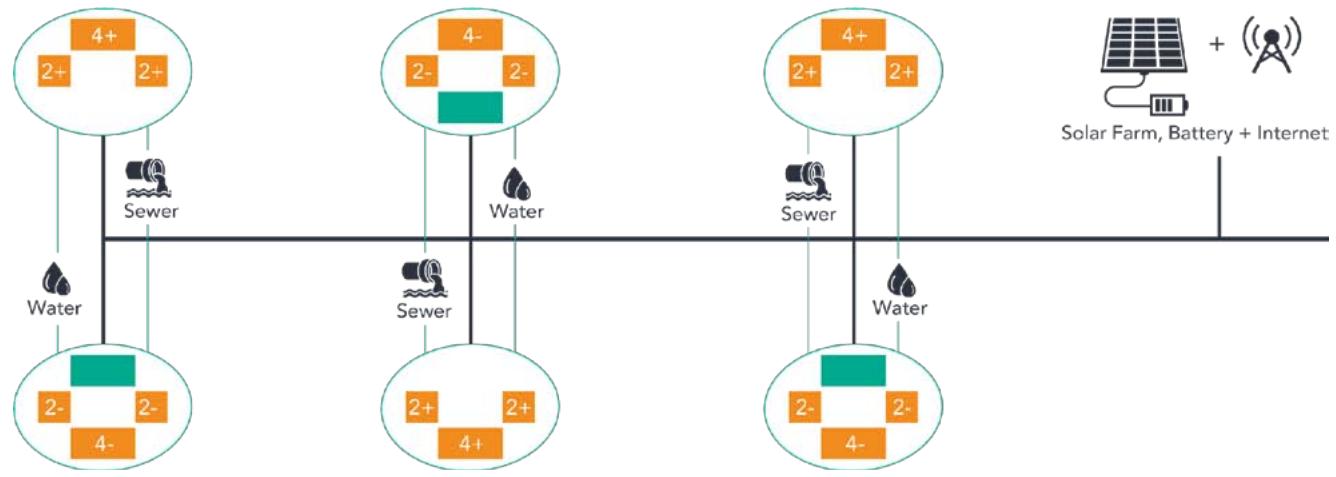 Figure 2: Glamping Property Design for the Sensitivity Analysis
Furthermore, the main access road stretches for $3\mathrm{km}$ alongside a hypothetical river, with pairs of unit clusters branching off at the 1, 2 and $3\mathrm{km}$ marks. There is a single property wide solar farm and battery near to the main entrance, as shown in Figure 2. The financial model estimates that the complete property requires $15\mathrm{kW}$ of generating capacity and $60\mathrm{kWh}$ of electricity storage. Also, there are main water holding tanks at each pair of clusters which draw water from the river, which is paid for according to a water entitlements agreement. The model estimates that each pair of unit clusters needs $5\mathrm{kl}$ of water storage and may draw
1,500l/day from the river, on average. Similarly, there is a small 500l/day sewerage treatment plant to serve each pair of unit clusters. Finally, there is one Starlink ground station at the solar farm with an Internet traffic switch/concentrator at each pair of clusters and Wi-Fi mesh nodes at each site.
The analysis considers the investments, operating income, and expenses over a 10-year period for three development scenarios for this whole property, namely:
- All clusters/units constructed at the beginning,
- Three clusters of three units constructed at the beginning and the remaining three clusters of three units constructed in year 5, and
- One pair of clusters of three units built at the beginning, another pair of clusters of three units built in year 4 and the final pair of clusters of three units built in year 8.
Each of these three development scenarios is modelled with both rapid and slow occupancy growth, where rapid growth is defined as taking 2 years to reach full occupancy and slow growth is taking 4 years to reach full occupancy. Further, full occupancy is defined as an average of $65\%$ of the total number of available units being rented every night, or each unit being rented 3-5 nights/week. In the authors' experience, these growth and occupancy projections are reasonable for this kind of offgrid glamping property. The horizontal axis of the three graphs in figures 3, 4 and 5 are time measured in quarter years, so that the 10-year financial modelling horizon spans forty quarters.
If the property is developed all at once, all of the utilities, infrastructure and guest and other facilities are built at the same time. Alternatively with phased development of the property, smaller central electricity and internet infrastructure facilities are initially built, and then expanded as each pair of unit clusters is added to the property. Similarly, the access road is extended, and the water and sewerage infrastructure are added as each pair of unit clusters is developed.
An Excel® spreadsheet containing all of the property definitions and costs is available from the authors. This spreadsheet can be used to create the graphs in the following Figures 3, 4 and 5. Interested readers can review full details of the financial model and the values of all the variables for the hypothetical property analysed in the spreadsheet. As can be seen, these graphs show timelines of the property development investments along with the optimistic and pessimistic operating revenues and expenses projections for each of the three development scenarios considered. It also shows the net investment position during each year for each of the three different development scenarios.
Based on our general understanding of 2022 Australian construction costs and operating labour costs, the spreadsheet model gives a ballpark total investment of about AU$150,000/per unit on average. About 40% of this money is spent on tents/tented cabins, with a similar amount for other guest facilities (bathrooms, outdoor kitchens, and dining, etc) and the final 20% is needed to pay for the site preparation and utilities infrastructure. The spreadsheet model further estimates the average room revenue at AU$375 per unit, per night, with each unit being occupied for up to 65% of the year as noted above. As expected, the operating costs in the spreadsheet are low, generally being less than 10% of revenues. The reasonableness of all the costs and revenues in this analysis have been confirmed with experienced industry practitioners.
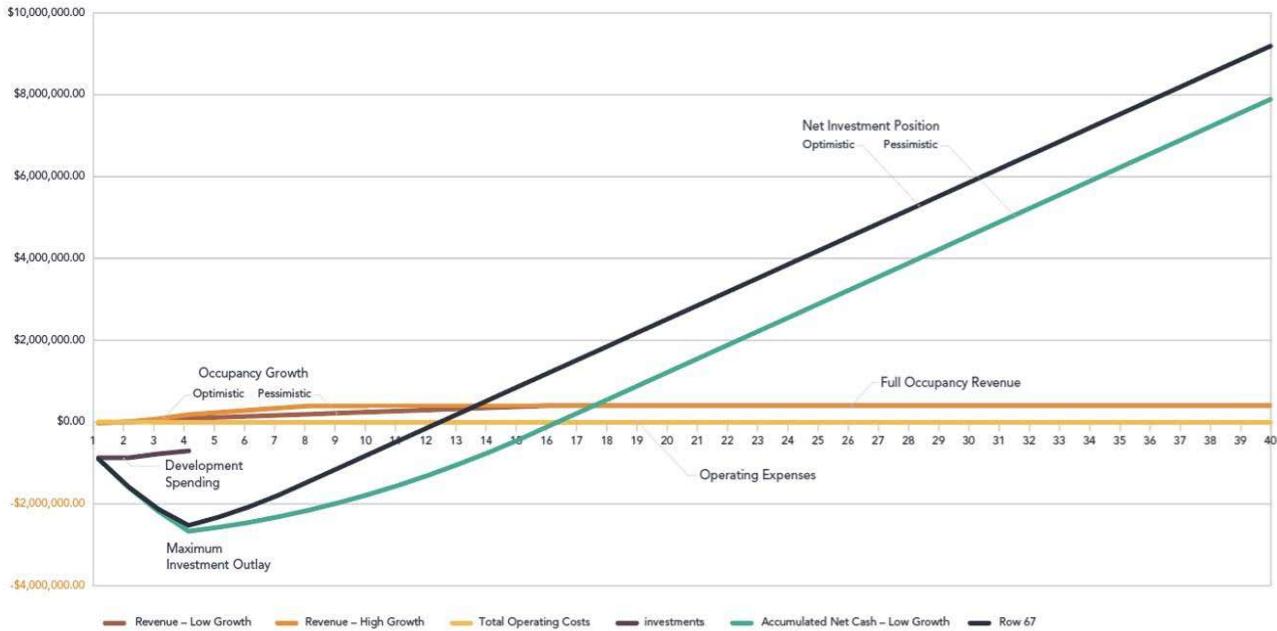 Figure 3: Investments, Revenues and Expenses for Initially Building the Whole Property
As noted in Figure 3, the first scenario is developing the entire property at the beginning. As expected, this scenario has a large initial cash outlay of around $2.66 million to build the whole property. This investment is then gradually repaid from the operating profits, more slowly at first as the property occupancy
increases, and then more rapidly once the property reaches stable "full" occupancy. As can be seen in Figure 3, under the optimistic occupancy growth assumption, the initial investment is entirely repaid after about 3 years (12 quarters), while under the pessimistic occupancy growth assumption this milestone is only achieved after just under 4 years (16 quarters). The IRR for the optimistic occupancy growth assumption is a very healthy $9.01\%$, and it is $5.56\%$ for the low growth assumption. Finally, if a $4\%$ discount rate is used, over the 10-year investment horizon, the NPV (Net Present Value) of the venture is $8.42 million under the low growth assumption but this rises to $26.70 million if the high occupancy growth rate can be achieved.
Careful readers will notice that in the sensitivity analysis the property is open and serving guests before the initial investment is fully completed, which is quite desirable because it significantly reduces the time till first income is generated. This is possible because of the nature of the property and is rarely possible with traditional hotel development. Because most of the construction work is actually done offsite, it is quite feasible to open the pair of clusters nearest to the gate after they and the solar farm have been made and installed. Work on extending the access road and finishing the other pairs of clusters can quite readily be done while the property is already open and serving guests staying in the finished sites. Readers may also recognize that the overall development project duration is very short compared to the time needed to build a comparable traditional hotel. Rapid build-out is a well-known benefit of prefabricated modular construction.
Achieving payback within 3- 4 years is anexcellent outcome compared to a similar traditional
hotel. This is because the initial investment is relatively low, perhaps being less than half that needed for a small, traditionally built hotel. As important, the operating costs are also very low because of the much-reduced services compared to a traditional hotel (which consequently greatly reduces the staffing needed). By contrast, the room rates achieved are comparable to, or even higher than, a similar traditional hotel because of the novelty and attractiveness of the guest experience. In the authors experience, the IRR for the proposed off-grid glamping property is significantly higher than a comparable traditionally designed, constructed and operated hotel.
As noted in Figure 4, the second scenario splits the development of the property into two halves. As shown, there is an initial investment to build the first three clusters of three units and then there is a second investment in year 5 to build the remaining three clusters of three units. The maximum cash outlay for the developer is around \(1,343,000 by the end of the first year (fourth quarter), and again this amount is fully repaid from operating profits in 3-4 years for the high and low occupancy growth assumptions, respectively. Also, as noted in Figure 4, a second cash outlay is needed at the end of year 5 (20 quarters) to build the second half of the property but the accumulated profits from the initial 5 years of operations can be used for most of it. The cost penalty for splitting the construction over two phases is minimal because of the nature of the development. This is very different to the situation for the equivalent traditional hotel construction, where all the accommodation units are typically in a single large building.
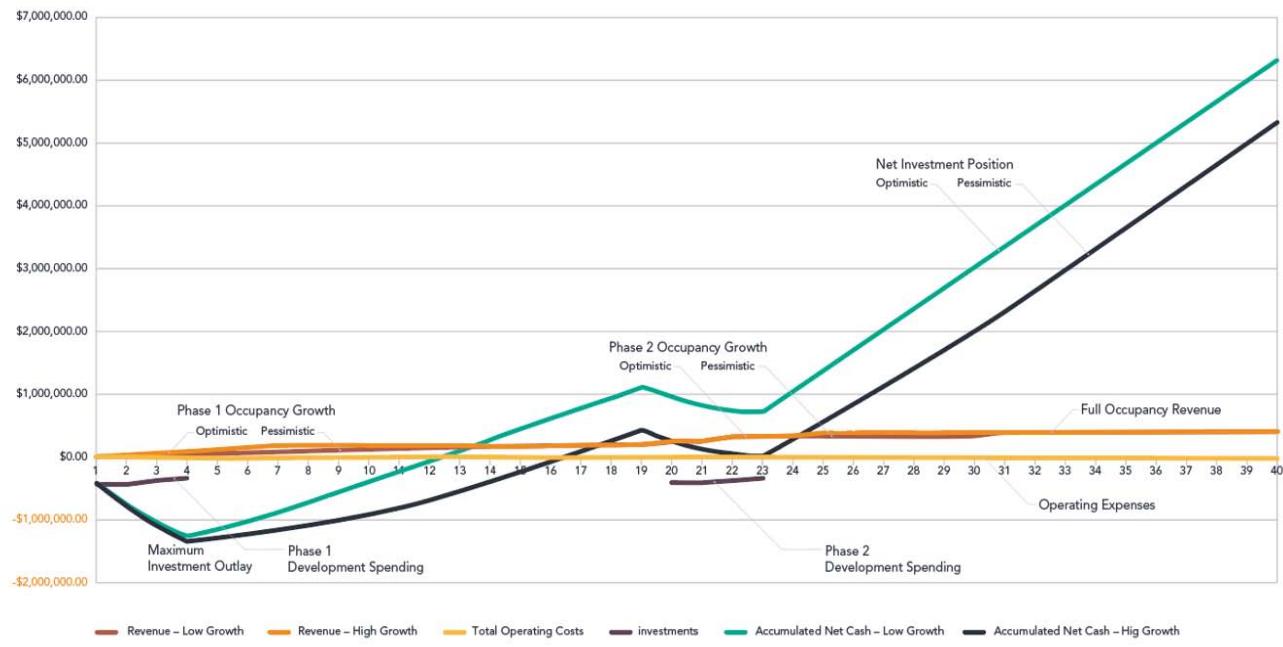
Figure 4: Investments, Revenues and Expenses for Building the Property in Two Equal Phases
This second development scenario follows a similar pattern to the first, where initial investments are made to build the property, and these are gradually recouped from operating profits. However, the maximum investment in the first year is about half that of the first scenario because the major cost, namely the property construction, is split over two equal phases that are carried out 5 years apart.
When the property is built in two halves, the high occupancy growth assumption also gives a very healthy IRR of $8.69\%$ and the low occupancy growth scenario give an IRR of $4.93\%$. These values are relatively little changed from the case where the property is entirely built at the beginning, but the cash that actually needs to be paid out by the developer is approximately halved. Building the property in two stages is very beneficial if the developer has limited resources. The corresponding NPV values building the property in two halves are about $2.57 million and $13.4 million for the low and high occupancy growth assumptions, respectively. These values are significantly lower than building the whole property at the beginning because it operates with fewer units for the first half of its operating life. At the end of the 10-year modelling horizon, half of the units are only 5 years old and so they have significant unused working life. Extending the time
horizon for the financial modelling will increase these NPV estimates.
The third development scenario, shown in Figure 5, involves building one third of the property initially, and the next third after 4 years and completing the final development phase after 8 years. As can be seen, the investment is again fully paid back after 3-5.5 years, for the high and low occupancy growth assumptions, respectively. The IRR for this third development scenario is still a very healthy $8.64\%$ and $4.37\%$ for the high and low occupancy growth assumptions, respectively. And finally, using a $4\%$ discount rate, the NPV for the investment is $9.58 million and $0.72 million for the high and low growth assumptions.
When the property is built in three phases, the initial cash outlay further reduces to $917,000 to build the first part of the property. If the high occupancy growth rate can be achieved, the second investment outlay in the fourth year can be paid entirely from the accumulated profits; otherwise, a cash injection of $3-400,000 will be needed. It should be possible to entirely pay for the construction of the final part of the property in year 8 from the accumulated profits, irrespective of the occupancy growth achieved.
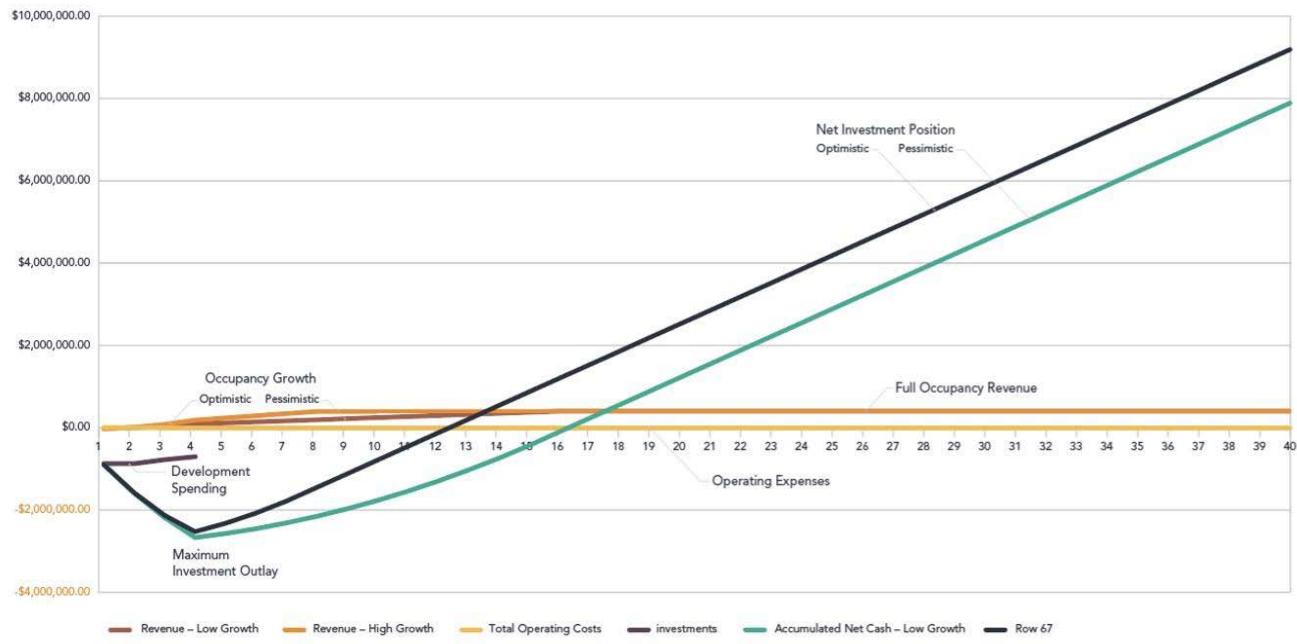
Figure 5: Investments, Revenues and Expenses for Building the Property in Three Equal Phases
Table 5 summarizes the financial results for the three different development scenarios and the low and high occupancy growth assumptions. As expected, building out the property in several phases significantly reduces the maximum cash outlay for the developer. Moreover, initially operating at smaller scale and progressively growing the property in line with demand growth has little impact on the overall payback period. It
also has little impact on the IRR. These are all very healthy investments that pay for themselves quickly.
Table 5: Financial Modelling Results Summary
<table><tr><td rowspan="2">Development Scenario</td><td rowspan="2">Maximum Cash Draw</td><td colspan="2">Payback Period</td><td colspan="2">Internal Rate of Return</td><td colspan="2">Net Present Value</td></tr><tr><td>Low</td><td>High</td><td>Low</td><td>High</td><td>Low</td><td>High</td></tr><tr><td>Build All at Beginning</td><td>$ 2,656,000</td><td>3</td><td>4</td><td>5.56%</td><td>9.01%</td><td>$ 8,417,000</td><td>$ 26,696,000</td></tr><tr><td>Build in Halves</td><td>$ 1,343,000</td><td>3</td><td>4</td><td>4.93%</td><td>8.69%</td><td>$ 2,659,000</td><td>$ 13,396,000</td></tr><tr><td>Build in Thirds</td><td>$ 917,000</td><td>3</td><td>5,5</td><td>4.37%</td><td>8.64%</td><td>$ 717,000</td><td>$ 9,574,000</td></tr></table>
However, building the property in phases does reduce the NPV of the investment. This is to be expected because progressively building the property means that it operates at significantly smaller scale for long periods, which pushes the investment returns further into the future and reduces the NPV. For example, when the property is built in thirds, six of the sites are only 2 years old at the end of the 10-year modelling horizon. Extending the time horizon for the financial model increases the NPV values.
Because of the nature of the property and the way it is designed and constructed there are minimal cost penalties in building it in phases. Moreover, constructing the property in phases has the benefit of greatly de-risking the venture – the entrepreneur can "test the waters" with a small property and then grow its capacity in line with actual customer demand growth. If customer demand is especially strong, it is quite feasible to accelerate construction of the later property phases, or to delay (or even abandon) them if occupancy growth is weak. Thus, prudent off-grid glamping property developers should phase their investments and only expand once guest demand has proven itself.
As important, building the property in phases has the added advantage of enabling the entrepreneur to evaluate the market demand for different accommodation unit and cluster designs. The first development phase can include several varied unit designs. Then actual customer feedback on their relative popularity can be used to adjust the unit mix built in later phases to speed up occupancy growth and thus maximize the overall return on investment.
## V. CONCLUSIONS
In this paper we have noted the rising popularity of off-grid glamping and developed a detailed financial model that clearly shows the substantial benefits of adopting this approach in comparison to a traditional hotel development in these circumstances. These benefits include much reduced development and operating costs while achieving premium nightly rates. As important, the ability to easily and cost-effectively phase the development of the property to significantly de-risk the venture and to adjust the property's room capacity and mix of unit types to match actual customer demand is a key benefit that cannot be ignored. Of course, there are several other important benefits of adopting prefabricated modular construction and using only semi-permanent hotel facilities, including low environmental impact and very quick construction of a relatively high-quality property at a relatively low cost and, often, simplified development and operating licensing procedures. Overall, in the authors' view, entrepreneurs should nearly always choose to build a glamping property instead of a traditional hotel when it is to be located in a remote, off-grid, natural location that has a moderate to warm climate.
The approach proposed here for offgrid glamping properties also maximizes their "ecotourism" credentials. Site disturbances are minimized, use of "environmentally friendly" construction materials is maximized, and sustainable electricity, water, sewerage and Internet infrastructure is maximized. All electrical distribution cabling is also put underground to minimize fire risks.
The financial model also clearly demonstrates that developing an off-grid glamping property is very different to traditional hotel development and considerable changes in how the project is approached, planned and executed are needed. In particular, the engineering and architecture are very different, along with the adoption of prefabricated modular construction, so that the development team needs very different skillsets. The selection of very good site preparation and module manufacturing contractors and closely monitoring their performance is also crucial to the success of the project. Because they are so heavily relied upon, all the construction and other contractors should be very well respected and have strong experience in comparable projects and they should be extensively vetted before they are engaged.
The financial model presented here provides a comprehensive roadmap that entrepreneurs can follow to cost-effectively conceptualize, design, and develop an off-grid glamping project. It can also be used to evaluate the financial viability and potential rewards for developing a proposed property and making the key decision of whether or not to proceed with a given venture. We strongly encourage entrepreneurs to adopt the approach advocated here for their future offgrid glamping ventures.
Generating HTML Viewer...
References
11 Cites in Article
(2022). Protective Coatings Market – Global Industry Growth, Size, Share, Trends, Analysis And Forecast To 2020: Research Report By Grand View Research, Inc..
R Honeywell (2022). NEOs: The Premium Consumer.
S Jones,D Laquidara-Carr (2020). Prefabrication and Modular Construction 2020, Dodge Data & Analytics.
C Lichner (2022). Unknown Title.
C Lloyd (2017). What are mesh Wi-Fi systems, and how do they work? How-To Geek.
G Noordzy,R Whitfield (2021). The New Hotel Development Project Life Cycle -Doing the Right New Hotel Project Holistically and doing it in the Right Way.
Gert Noordzy,Richard Whitfield (2021). Project Management of New Hotel Openings.
T Smitherman (2021). Consumer Research on Glamping in Western Australia.
(2022). Glamping. In Wikipedia, The Free Encyclopedia.
R Whitfield,G Noordzy (2022). A Roadmap for Developing New Holiday Resorts on Remote Tropical Islands.
R Whitfield,L-C Lin,G Noordzy,L Chirumiko (2022). Developing the Meridian Adventure Dive Resort: a modular hotel construction case study.
No ethics committee approval was required for this article type.
Data Availability
Not applicable for this article.
How to Cite This Article
Gert Noordzy. 2026. \u201cOptimizing Returns: A Holistic Financial Model for Off-Grid Glamping Ventures\u201d. Global Journal of Management and Business Research - A: Administration & Management GJMBR-A Volume 24 (GJMBR Volume 24 Issue A1): .
Explore published articles in an immersive Augmented Reality environment. Our platform converts research papers into interactive 3D books, allowing readers to view and interact with content using AR and VR compatible devices.
Your published article is automatically converted into a realistic 3D book. Flip through pages and read research papers in a more engaging and interactive format.
Our website is actively being updated, and changes may occur frequently. Please clear your browser cache if needed. For feedback or error reporting, please email [email protected]
Thank you for connecting with us. We will respond to you shortly.