
I. INTRODUCTION
Only organisation that can overcome ambiguous, volatile, complex and uncertain environment that can enjoy perpetuity in business (Sule & Onuoha, 2020). In the course of overcoming such business environment, many practices come into play among organisations and one such survival solutions practiced by organisations include competitive advantage tactics. Gilaninia, Ganjinia and Karimi (2013) discoursed that "organisations have been forced to constantly seek the best solutions and practices to adapt to their environment and thus gain a competitive advantage".
Competitive advantage is the solitary aim to gain from corporate strategy (Onuoha, 2016). Competitive advantage was described by Porter in Gilaninia, Ganjinia and Karimi (2013) as tactics that are embraced by organisations to overtake other participants in the trade and Onuoha (2016) said that building competitive advantage entails four approaches which are being the industry's low-cost provider (cost leadership); outsmarting competitors using differentiating features (differentiation); creating a niche in the marketplace that the organisation will concentrate on (focus); and growth of a specific resource and/or expertise which might be a strength that competitors might not be easy to imitate and/or overtake. View of Porter as expressed in Gilaninia, et al. (2013) emphasized three types of public strategies (generic strategies) applied to overtake competitors and they were listed as focus differentiation, and cost leadership.
The fourth strategy as given by Onuoha (2016) is similarto organisational learning because of the way it was described by Gilaninia. Ganjunia and Karimi (2013) that "it strengthen the company's ability to identify opportunities and looking for new investments and to achieve continuous alignment with the environment". Efforts of organisational learning, therefore, are not just an option but an essential necessity needed by organisations around the world Makabila, et al. (2017). Organisational learning help in achieving relationship marketing, organisational performance, supply chain process strategy in things like innovation, service quality as well as results and human resources performance Makabila, et al. (2017). Also, in Makabila, et al. (2017), Sanz-Valle, Naranjo-Valencia and Perez-Caballero (2011) see organisational learning as a veritable tool for achieving supportable competitive advantage and the source to increasing the organisation performance.
The theory of resource-based is of essence here because "organisational learning is a unique resource that is critical in today's dynamic and discontinuous environment of change and a crucial determinant of competitive advantage" Makabila, et al. (2017) quoting Garvin, Edmoudson and Gino (2008).
Many scholars had done series of enquiry on organisational learning and competitive advantage and had confirmed existence of relationship between the variables. Even, Farrukh and Waheed (2015) did their own on learning organisation where organisational learning is a fundamental part of and confirm also that there exists relationship. But searching through, none had really considered examining the association of these variables in conjunction to media broadcasting organisation. That now forms the foundation for this study so as to establish if relationship exist between organisational learning and competitive advantage of media broadcasting organisations in Rivers State.
II. AIM AND OBJECTIVES
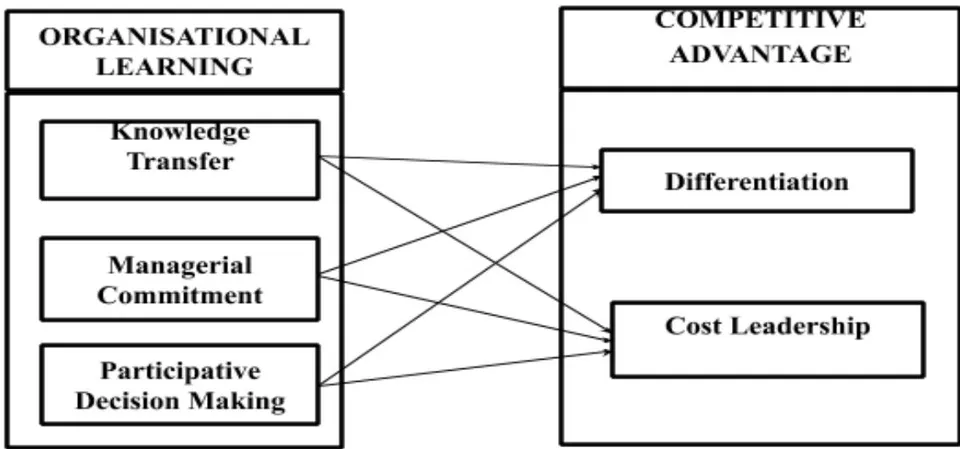
Ascertaining the relationship amongst organisational learning cum competitive advantage as it happened in media broadcasting organisations in Rivers State was this study aim. For easy and strong inference from study, we looked at the listed objectives:
Determining the relationship amongst knowledge transfer and differentiation of media broadcasting organisations in Rivers State.
Examining the relationship amongst knowledge transfer and cost leadership of media broadcasting organisations in Rivers State.
Evaluating the relationship amongst managerial commitment and differentiation of media broadcasting organisations in River State.
Ascertaining the relationship amongst managerial commitment and cost leadership of media broadcasting organisations in Rivers State.
Finding out the relationship amongst participative decision making and differentiation of media broadcasting organisations in Rivers State.
Determining the relationship amongst participative decision making and cost leadership of media broadcasting organisations in Rivers State.
III. RESEARCH QUESTIONS
What is the relationship amongst knowledge transfer and differentiation of media broadcasting organisations in Rivers State?
What is the relationship amongst knowledge transfer and cost leadership of media broadcasting organisations in Rivers State?
What is the relationship amongst managerial commitment and differentiation of media broadcasting organisations in River State?
What is the relationship amongst managerial commitment and cost leadership of media broadcasting organisations in Rivers State?
What is the relationship amongst participative decision making and differentiation of media broadcasting organisations in Rivers State?
What is the relationship amongst participative decision making and cost leadership of media broadcasting organisations in Rivers State?
IV. RESEARCH HYPOTHESES
There is no relationship amongst knowledge transfer and differentiation of media broadcasting organisations in Rivers State.
There is no relationship amongst knowledge transfer and cost leadership of media broadcasting organisations in Rivers State.
There is no relationship amongst managerial commitment and differentiation of media broadcasting organisations in River State.
There is no relationship amongst managerial commitment and cost leadership of media broadcasting organisations in Rivers State.
There is no relationship amongst participative decision making and differentiation of media broadcasting organisations in Rivers State.
There is no relationship amongst participative decision making and cost leadership of media broadcasting organisations in Rivers State.
V. LITERATURE REVIEW
a) Concept of Organisational Learning
Different scholars had described organisational learning differently to cover wide research sphere. Organisational learning was explicitly defined by Guta (2013) as "the development of new knowledge or insights that have the potentials to influence behaviour". A particular concept that keeps re-appearing whenever organisational learning was being discussed is organisational memory. Stain 1995 in Guta (2013) described organisational memory as "the means by which knowledge from the past is brought to bear on present activities, thus resulting in higher or lower levels of organisational effectiveness".
Organisational learning can be a basis of competitive advantage. Appelbaum and Gallagher, 2000; Curado, 2006; Saru, 2007 as quoted in Kamya, Ntayi and Ahiauzu (2011) opined that organisational learning as a vital resource of the firm is understood to be fostering competitive advantage according to scholars.
b) Knowledge Transfer
Knowledge was reflected to be a cherished property to organisations according to Swami ivekanada. Knowledge is one treasured resources with which an organisation can contend with other participants in the trade once the organisation possesses the knowledge or rather have a dominant of it. Sincerely speaking, organisation cannot exist without human beings, that is, human beings makes up the company as such the knowledge resides within each worker and thus, become competitive advantage of the organisation. With labour turnover, employees move with their understanding from one job to another organisation. Organisations can, therefore, benefit from such understanding is via knowledge sharing, knowledge transfer and knowledge integration.
Knowledge transfer could be explicit and tacit knowledge transfer. Tacit knowledge comprises the following experience, thinking competence, commitment and deed. Organisations should, again, have the ability to absorb knowledge and perhaps, their workers with experience must be able to develop and alter their tacit knowledge base such that will later transform into explicit knowledge. Then, organisations should be clever to domicile such understanding and knowledge even when such employee might have left with the organisation.
Tacit knowledge was described by Nonaka, Takeuchi & Umemoto (1996) as the experience knowledge that are physical and. Subjective. Tacit knowledge must be personal, context specific and known by a person. Tacit Knowledge is also highly difficult to write down and communicate and also experiential. Sharing of tacit knowledge requires learning and it could not be codified easily but it could be transmitted through experience sharing and training; and in conclusion, it is all around "know-who""know-why", "know-what" and "know-how".
Explicit knowledge according to Wikipedia was describes as readily articulated, codified, stored and accessed knowledge which can easily be transmitted to others. Many explicit forms of knowledge could be stored in some form of media. Often explicit knowledge complements tacit knowledge. Explicit knowledge is usually forms seen in data/information, documents, records and files. Explicit knowledge of rationality and trends to be metaphysical and objective, often relates to past events and objects 'there and then', oriented towards a context free theory Nonaka, Takeuchi & Umemoto (1996).Characteristics of explicit knowledge include context independent, more formal, easily shared, reproducible and could be codified, documented, transformed and conveyed in systematic way.
c) Managerial Commitment
For every organisation to have effective and efficient organisation learning there is need for adequate managerial commitment. Managerial commitment could be describes as high level of loyalty in all ramifications to organisation by managers/employees. The loyalty arena includes behaviour, action, attitude, thinking and so on. Many scholars had described commitment in different ways as such Mowday, et al. (1982) as cited in Lamsa and Savolalnen (2000) said that there is yet to be any agreement on what exactly commitment is. For instance, Meyer and Allen (1997) as quoted in Lamsa and Savolalnen (2000) said that commitment is the psychological condition of an employee as he/she interacts with the organisation. This psychological state affects the employee's continuous membership decision. Gbemaw (1991) as quoted in Lamsa and Savolalnen (2000) said commitment is simply "the persistence of strategies".
Commitment has three major element – normative, affective and continuance. Commitment is continuance if it has to do with the cost of leaving an organisation and such cost will arise when the cost of leaving an organisation increases, and the employee is in the knowing of incurring such cost. Commitment can also be affective if there is emotional attachment, involvement and identification through an organisation and such commitment is compelling the worker to stay with the organisation by accepting goals and values of the organisation. Finally, commitment may be normative once an employee is adamant in remaining in the engagement of a firm because of such employee's belief that such is right morally. In Lamsa and Savolalnen (2000) commitment was summed up as a "psychological bond" amongst employees and organisation.
d) Participative Decision Making
Participative decision making was described by Probst (2005) as the level employees are permitte dand/or encourage employees' involvement in decision-making in the organisation. Many organisations involve their employees in the process of decision-making. It was emphasized by Abraham Maslow that workers need to have sense of belonging to their organisation as part ofthe needs hierarchy and relying on this, those at top management echelon of many organisations nowadays feel that the only leadership style that can take their organisation to the 'promised land' is participative decision-making which is otherwise known as collective decision-making.
It is said, again, that the simple participative decision-making concept is all about power-sharing arrangements among individuals at workplace which makes hierarchical unequal Locke and Schweiger (1979). Participative decision-making, on the portion of the employers will normally result into quality decision-making and efficiency normally influenced by mixed layers in multiple and differential terms of information access, participation level, dimensions and processes in participative decision-making.
Management experts had, however, criticized participative decision-making that one crucial risk of participative decision-making is the desire by the organization to have inclusive participation which may not be genuine. A distinction was made between going through empty participation ritual as well as the process consequence of the preferred real power Arnstein (1969:216). The insinuation of this, is the participation without redistribution of power amounts to an empty and very frustrating process for the powerless within the organisation. Conceivable destructive results of participative decision-making as pointed out by Debruin, Parker & Fischh off (2007) could involve great costs, incompetence inefficiency, and indecisiveness.
VI. CONCEPT OF COST ADVANTAGE
Organisations in one industry always turn to be rivals among themselves just like women in polygamous relationship that perceive themselves as being in competition. Competition among organisations can be domestic rivalry which is among organisations within the same country and foreign competition which happen between organisations in diverse nations (Onuoha, 2016). Organisations use high quality manpower, raw resources, and technological breakthroughs to contest in the business Onuoha (2016).
For instance, Guinness Nigeria PLC is using raw materials to outsmart their competitors. That is, the taste of Guinness Stout. Till tomorrow, other breweries in Nigeria find it difficult to acquire the actual raw material(s) Guinness Nigeria PLC is using to have the special taste of Guinness stout. Organisations, again, can use high quality manpower to build a niche such that other competitors will not be capable to replicate just as it can be seen in the theory of resource based. No wonder, Onuoha (2016) emphasized that "developing expertise and resource strengths which rival cannot easily imitate, overtake or defeat with their own capabilities." This presupposed that organisational learning could be used in achieving competitive advantage above participants in the business. For organisation to achieve competitive advantage Porter (1980) proposed the using one or two from what was described as generic strategies – focus, differentiation and cost leadership strategies. It has been established in many studies that focus recently on resource-based theory that competitive advantage is as a result of "...firm-specific resources and capabilities with characteristics of value, rareness, inimitability and non-substitutability" (Barner, 2007, 1991 as quoted in Kamya, Ntayi & Ahiauzu, 2011).
Generic strategies were defined by Porter from two perspectives – strategic scope and strategic strength. But this study will focus on the strategic strength perspective, that is, strength or core competency of the firm which in this study is leveraging on organisation learning to achieve efficiency looking at cost and product differentiation.
a) Differentiation
Differentiation strategy denotes uniqueness of product of a specific organisation. That is, there exist a specific feature and distinction in a firm's product that could not be seen and/or felt using competitor's product. In Mahfod, Ismaeel, Al-Haddad and Upadhyaya (2017), Dirisu, Iyiola and Ibidunni (2013) was said to have said that "differentiation strategy is about creating a unique business proposition, that adds value to the organisation and allows it to stand out among its rivals in terms of creating products and services with distinguishing features in response to customer's demands". This distinguishing feature makes the producing cost of such product high which is always shifted to customers but because the customers are enjoying the particular distinguishing feature(s), they do not always care about the high cost. Tanwar (2013) opined that "differentiation is a viable strategy for earning above average returns in a specific business because the resulting brand loyalty lowers customers' sensitivity to price". A very good example is the Rolls Royce manufacturing company; this company produces cars to sell to few that the brand loyalty lowers their price sensitivity and the company is as well the main manufacturer of airplane engine. Subrahmanyam and Azad (2019) said that "differentiation involves distinguishing the service or a product provided by the company, making something that is observed to be unique in the market place".
Organisation adopting differentiation might want to find means of sharing experience and knowledge among its workforce because it is applicable in organisation learning to ensure much research and development exercises. Miller (1987) and Jermias (2008) as quoted in Valipour, Birjandi and Honarbakhah (2012) opined that organisation planning to have product differentiation should be ready to invest heavily in Research and Development (R&D) activities to push up the organisation's innovative capability and checkmate the organisation competitor's innovations. Biggadike (1979) as mentioned in Valipour, Birjandi and Honarbakhah (2012) emphasized that innovation requires the firm to be involved in risky activities and not yet crystallized products which could be easily achieved by experienced and well-informed workforce and, highly committed, too. Spencer a, Joinerb and Salmon (2009) as quoted in Mahfod, Ismaeel, Al-Haddad and Upadhyaya (2017) said that differentiation can be splitted into sub-strategy like differentiation by responsiveness of customer, by innovation of product, or by marketing and public perception management.
b) Cost Leadership
A Porter's generic strategies aimed at achieving efficiency at lower cost rate for larger market share under such organisation control. Tanwar (2013) described strategy of cost leadership as exploitation of every cost advantage sources in becoming the lowest cost manufacturer among the organisation's competitors. Valipour, Birjandi and Honarbakhsh (2012) said that strategy of cost leadership can successfully takes place effectively through workforce experience, production facilities investment and others. Valipour, Birjandi and Honarbakhsh (2012) went further to opined that any organisation pursuing strategy of cost leadership must "... refrain from incurring too many expenses...". Such expenses might include cost of formal training and development for the workforce but once it is the organisation culture to imbibe organisation learning, knowledge and experience transfer could be a better substitute. Tanwar (2013) submitted that cost leadership requires access to labour and other important materials.
The emphasis of strategy of cost leadership is efficiency by standardized products production in high volume, such organisation intends that economies of scale advantage cum experience curve effects like knowledge transfer, commitment and collective decision making will be taken advantage of Tanwar (2013).
The strategy of cost leadership is "the significant strategy to achieve its goals and reached the maximum outcome (Pulaj, et al., 2015 as cited in
c) Operational Framework
Subrahmanyam and Azad, 2019). One of the cardinal objectives of organisation learning is proficiency of the workforce through knowledge and experience transfer and cost leadership strategy was said by Subrahmanyam and Azad (2019) to be encouraging proficiency. "Cost leadership strategy procedures give points of interest by means of scale, proficiency and access to ease inputs" Subrahmanyam and Azad (2019).
VII. METHODOLOGY
Survey research design method was used. Our population encompassed all the 22 media broadcasting organisations (11 radios and 11 televisions and other media broadcasting Organisations) in Rivers State be it private or public owned media broadcasting organisations. To obtain primary data, we selected two private owned radio and television; and one each of public owned radio and television media broadcasting organisation totaling six media broadcasting stations, all with the staff strength of 1405 staff and secondary data include journal articles, textbooks and related publications. The six media broadcasting organisations staff forms the population of the study. Krejcie and Morgan sampling determination table was used to get the sample size of 302 staff. Research instrument was administered on 302 staff of the two firms by using random sampling method. Pearson Product Moment Correlation (PPMC) was used to test the hypotheses.
VIII. HYPOTHESES TESTING
a) Hypothesis One ( ) Testing
: There is no relationship between knowledge transfer and differentiation of media broadcasting organisations in Rivers State.
| Knowledge Transfer | Differentiation | ||
| Knowledge Transfer | Pearson Correlation (r) | 1 | .659** |
| Sig. (2-tailed) | .000 | ||
| N | 302 | 302 | |
| Differentiation | Pearson Correlation(r) | .659** | 1 |
| Sig. (2-tailed) | .000 | ||
| N | 302 | 302 | |
| **. Correlation is significant at the 0.05 level (2-tailed)Coefficient of Correlation Source: SPSS Output, (2020) | |||
Table 1– Knowledge Transfer and Differentiation: The data analysis result shows low relationship. The r = 0.659, showing positive medium correlation among the variables. The findings disclose medium relationship among the variables. The alternate hypothesis is hereby accepted and the null hypothesis rejected.
b) Hypothesis Two ( ) Testing
: There is no relationship between knowledge transfer and cost leadership of media broadcasting organisations in Rivers State.
| Knowledge Transfer | Cost Leadership | ||
| Knowledge Transfer | Pearson Correlation(r) | 1 | .697** |
| Sig. (2-tailed) | .000 | ||
| N | 302 | 302 | |
| Cost Leadership | Pearson Correlation(r) | .697** | 1 |
| Sig. (2-tailed) | .000 | ||
| N | 302 | 302 | |
| **. Correlation is significant at the 0.05 level (2-tailed).Coefficient of Correlation Source: SPSS Output, (2020) | |||
Table 2 –Knowledge Transfer and Cost Leadership: The data analysis result shows medium relationship level. The r = 0.697, showing positive medium correlation between the variables. The findings expose medium relationship among the variables. The null hypothesis is hereby rejected and the alternate hypothesis accepted.
c) Hypothesis Three ( ) Testing
: There is no relationship between managerial commitment and differentiation of media broadcasting organisations in Rivers State.
| Managerial Commitment | Differentiation | ||
| Managerial Commitment | Pearson Correlation(r) | 1 | .689** |
| Sig. (2-tailed) | .000 | ||
| N | 302 | 302 | |
| Differentiation | Pearson Correlation(r) | .689** | 1 |
| Sig. (2-tailed) | .000 | ||
| N | 302 | 302 | |
| **. Correlation is significant at the 0.05 level (2-tailed).Coefficient of Correlation (r2) = 0.48 Source: SPSS Output, (2020) | |||
Table 3 – Managerial Commitment and Differentiation: The result of the data analysis shows medium relationship. The r = 0.689, showing medium relationship among the variables. The findings disclose medium correlation among the variables. The null hypothesis is hereby rejected and the alternate hypothesis accepted.
d) Hypothesis Four ( ) Testing
: There is no relationship between managerial commitment and cost leadership of media broadcasting organisations in Rivers State.
| Managerial Commitment | Cost Leadership | ||
| Managerial Commitment | Pearson Correlation(r) | 1 | .677** |
| Sig. (2-tailed) | .000 | ||
| N | 302 | 302 | |
| Cost Leadership | Pearson Correlation(r) | .677** | 1 |
| Sig. (2-tailed) | .000 | ||
| N | 302 | 302 | |
| **. Correlation is significant at the 0.05 level (2-tailed).Coefficient of Correlation Source: SPSS Output, (2020) | |||
Table 4– Managerial Commitment and Cost Leadership: The result of the data analysis shows medium relationship. The r = 0.677, showing medium correlation among the variables. The findings reveal medium relationship between the variables. The null hypothesis is hereby rejected and the alternate hypothesis accepted.
e) Hypothesis Five ( ) Testing
: There is no relationship between participative decision making and differentiation of media broadcasting organisations in Rivers State.
| Participative Decision Making | Differentiation | ||
| Participative Decision Making | Pearson Correlation(r) | 1 | .693** |
| Sig. (2-tailed) | .000 | ||
| N | 302 | 302 | |
| Differentiation | Pearson Correlation(r) | .693** | 1 |
| Sig. (2-tailed) | .000 | ||
| N | 302 | 302 | |
| **. Correlation is significant at the 0.05 level (2-tailed). | |||
Table 5 – Participative Decision Making and Differentiation: The result of the data analysis shows medium relationship. The r = 0.693, showing positive medium correlation between the variables. The findings reveal medium relationship between the variables. The null hypothesis is hereby rejected and the alternate hypothesis accepted.
f) Hypothesis Six ( ) Testing
: There is no relationship between participative decision making and cost leadership of media broadcasting organisations in Rivers State.
| Participative Decision Making | Cost Leadership | ||
| Participative Decision Making | Pearson Correlation | 1 | .662** |
| Sig. (2-tailed) | .000 | ||
| N | 302 | 302 | |
| Cost Leadership | Pearson Correlation | .662** | 1 |
| Sig. (2-tailed) | .000 | ||
| N | 302 | 302 | |
| **. Correlation is significant at the 0.05 level (2-tailed).Coefficient of Correlation ( ) = 0.44 Source: SPSS Output, (2017) | |||
Table 6 – Participative Decision Making and Cost Leadership: The result of the data analysis shows medium relationship. The r = 0.662, showing positive medium correlation amongst the variables. The findings disclose low relationship amongst the variables. The null hypothesis is hereby rejected and the alternate hypothesis accepted.
IX. FINDINGS
a) Knowledge Transfer and Differentiation
The knowledge transfer and differentiation (Hypothesis One) analysis result shows medium relationship with , indicating that for an element of knowledge transfer, there is 43 percent increase in the differentiation level. This implies medium relationship among knowledge transfer and differentiation of media broadcasting staff. This shows that knowledge transfer accounted for 43 percent of media broadcasting staff differentiation. This finding agrees with that of Biggadike (1979) as cited in Valipour, Birjandi and Honarbakhah (2012) emphasized that innovation (differentiation) requires the organisation to be involved in risky activities and not yet crystallized products which can be easily achieved by workforce that are transferring of knowledge and experience and highly committed, too.
b) Knowledge Transfer and Cost Leadership
The knowledge transfer and cost leadership (Hypothesis Two) analysis result shows existence of medium relationship among knowledge transfer and cost leadership. This is confirmed, given . The result revealed that 49% total disparity in knowledge transferac counted for cost leadership. This imply that for every growth in knowledge transfer, there is 49% corresponding increase in the level of cost leadership of media broadcasting organisations in Rivers State. This shows medium relationship among knowledge transferand cost leadership of media broadcasting organisations. This finding concur with that of Tanwar (2013) that said that the emphasis of cost leadership strategy is efficiency by producing standardized products in high volume, such organisation intends that economies of scale advantage and experience curve effects like knowledge transfer, commitment and collective decision making will be taken advantage of.
c) Managerial Commitment and Differentiation
The managerial commitment and differentiation (Hypothesis Three) analysis result shows significant relationship amongst the variables. This shows medium correlation between the variables. The determination coefficient , however, displays that . The implication is that managerial commitment will account for 48% of differentiation. This findings is in track with that of Biggadike (1979) as cited in Valipour, Birjandi and Honarbakhah (2012) emphasized that innovation (differentiation) requires the organisation involvement in risky activities and not yet crystallized products which could be easily achieved by highly committed workforce.
d) Managerial Commitment and Cost Leadership
From the correlation result among managerial commitment and cost leadership analysis (Hypothesis Four), there is indication of relationship among the variables. The is 46 percent indicating that medium relationship exists. The implication is that medium positive correlation exists amongst the variables. Managerial commitment accounted for cost leadership of media broadcasting organisation at the level of 46 percent. This finding is in agreement with the submission of Tanwar (2013) that the emphasis of cost leadership strategy is efficiency by producing standardized products in high volume, such organisation intends that economies of scale advantage and experience curve effects like knowledge transfer, commitment and collective decision making will be taken advantage of.
e) Participative Decision Making and Differentiation
The analysis of participative decision making and differentiation (Hypothesis Five) exposed that we have 48 percent level of relationship among participative decision making and differentiation of media broadcasting organisation with percent. The result indicated 48 percent rise in the motivating level of media broadcasting organisation accounting for by participative decision making. The analysis of the relationship among participative decision making and differentiation reveals medium relationship. This finding support the words of Biggadike (1979) as quoted in Valipour, Birjandi and Honarbakhah (2012) emphasized that innovation (differentiation) requires the organisation to get involved in risky activities and not yet crystallized products which could be easily achieved by workforce that are allowed to participate in decision making practice.
f) Participative Decision Making and Cost Leadership
The analysis of participative decision making and cost leadership (Hypothesis Six) displays that there exist positive relationship amongst participative decision making and cost leadership. With determination coefficient which display that percent. This analysis is indicating that participative decision making attributed for additional 44 percent growth in the cost leadership of media broadcasting organisations. The assertion of Tanwar (2013) that the emphasis of cost leadership strategy is efficiency by producing standardized products in high volume, such organisation intends that economies of scale advantage and experience curve effects like knowledge transfer, commitment and collective decision making will be taken advantage of.
X. CONCLUSION
With all the hypotheses testing revealing medium relationship, it can be resolved that there exist relationship between organisational learning dimensions (knowledge transfer, managerial commitment and participative decision making) and competitive advantage measures (cost leadership and differentiation) of media broadcasting organisations in Rivers State.
XI. RECOMMENDATIONS
The following are the recommendations, relying on the findings:
The media broadcasting organisations should be resource-based competitor over their opponents using organisational learning.
The management of media broadcasting organisations should encourage knowledge sharing via knowledge transfer, managerial commitment and participative decision making to attract differentiation and cost leadership in the industry.